Last July on bearcam, we witnessed the ascent of 32 Chunk in the hierarchy at Brooks Falls. Chunk was the largest bear to consistently use the falls in July, and most bears didn’t challenge him. We watched Chunk interact with many bears, occasionally with some that I (and many bearcam watchers) didn’t recognize. In mid July, for example, we saw Chunk displace another large adult male.
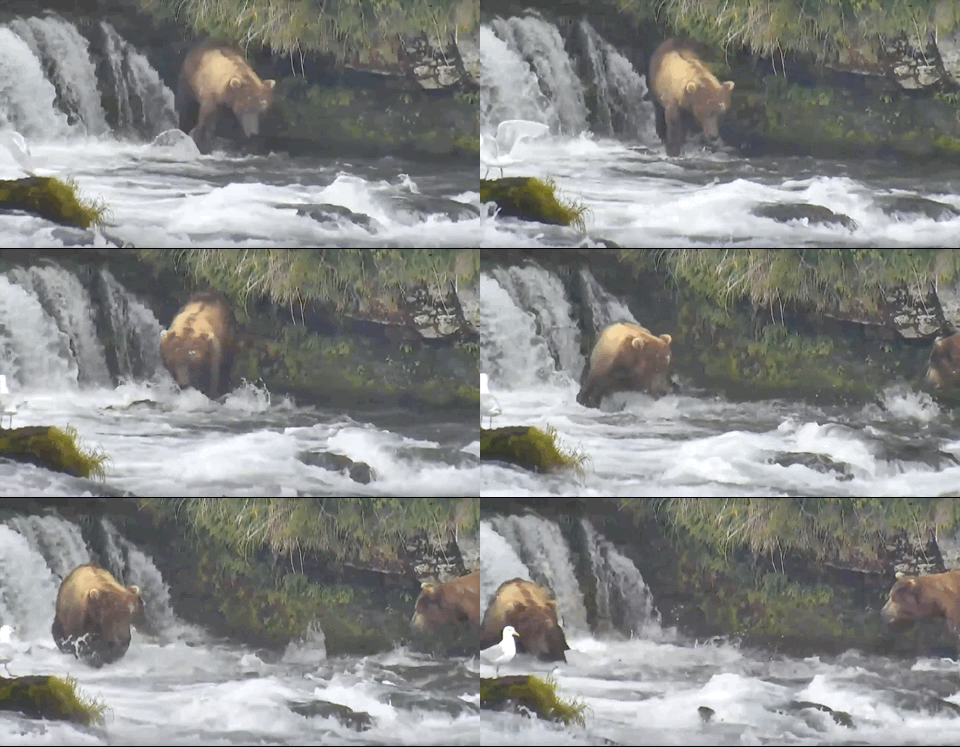
In this GIF from July 2017, a unidentified bear avoids the approach of 32 Chunk.
At the time, a few bearcam watchers speculated the subordinate bear may have been 856, who was the most dominant bear at Brooks River for many years. As I wrote in a previous post, I didn’t think this was 856. So who was it? Was he a previously identified bear or a newcomer to the river?
Before his seasonal position ended this fall, Ranger Dave from Katmai posted photos of several bears who were seen along the river, but were unknown or unrecognized by webcam viewers. Assuming Ranger Dave’s IDs are correct, which they are much more often than not, the unknown bear in the GIF above could be #611.
Bear 611 at Brooks Falls in 2017. Photo courtesy of Dave Kopshever and Katmai National Park.
611 is a bear I don’t know much about. According to my notes, he was first identified in 2015, but only in September and October not in July. Preliminary bear monitoring data from that fall state this bear was an older subadult or young adult at the time.
611 in September 2015, the first year he was identified. NPS photo.
I may be splitting hairs or misunderstanding Dave’s intent, but note that Ranger Dave said, “This is believed to be 611” when he posted the photo. Perhaps there’s still some uncertainty regarding the ID. Filling in the gaps of who’s who at Brooks River can be difficult, and it isn’t possible to identify every bear with certainty. But—based on scars, size, head shape, and ear color—I am fairly convinced the bear in the 2017 photo posted by Ranger Dave is the same bear that Chunk displaced in the GIF above.
At Brooks River, I made the effort to learn to recognize the bears who used the river frequently. Since bear behavior is often complex and can vary from animal to animal, recognizing individual bears leads to a better understanding of their growth, behavior, and strategies for survival. If 611 returns in 2018, we’ll have another opportunity to observe his behavior. Will he challenge other adult males for fishing spots or will he avoid confrontation more often than not? Whatever happens, it will allow us to learn just a little more about the bear world.
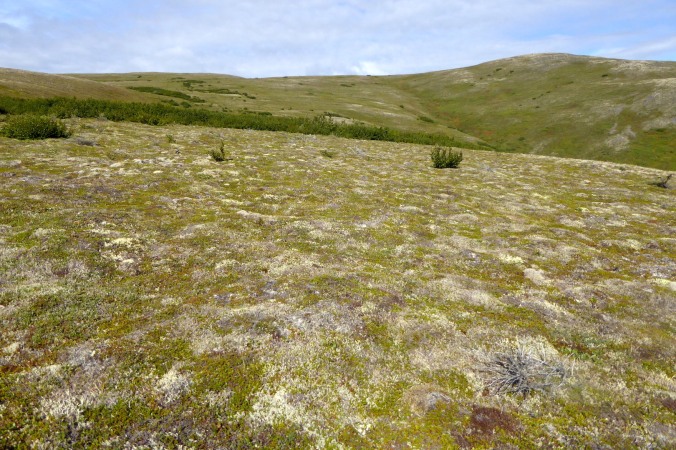
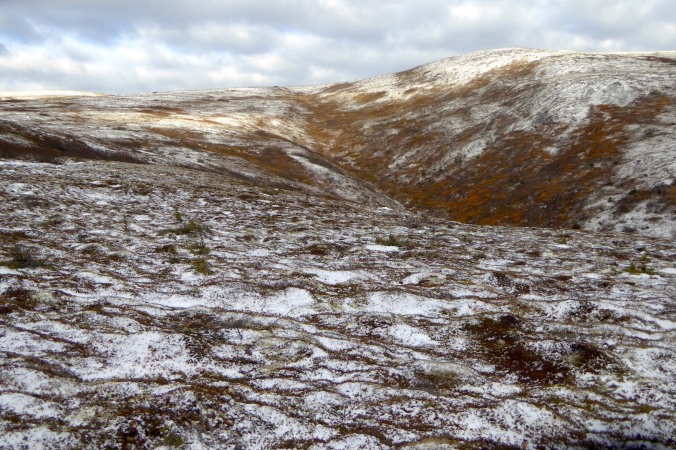
Dumpling Mountain, in west-central Katmai National Park, rises gently between Naknek Lake and Lake Brooks. Overridden repeatedly by glaciers during the last ice age, its slopes contour less abruptly than taller mountains to the east. About half the mountain’s topographical prominence lies above timberline. The upper mountain is a chilly, wind-swept place (especially in mid October) where only hardy, ground-hugging shrubs and forbs grow.
Tundra on upper Dumpling Mountain on August 22, 2015
Tundra on upper Dumpling Mountain on September 30, 2015.
The Dumpling Mountain Cam recently captured footage of a mother bear and three yearling cubs there.
The Dumpling Mountain Cam is located about 2,150 feet above sea level on the mountain’s dry alpine tundra, just under 300 feet below and .75 miles distant from the mountain’s 2,440-foot high summit. I hiked up Dumpling Mountain dozens of times, mostly to escape the relative hustle and noise of Brooks Camp, but I rarely saw bears on the mountain. Tracks, sure. Scat, definitely. But bears? Almost never. They don’t use the mountaintop as frequently as other areas. So why would bears venture nearly to the summit of Dumpling now? Are they migrating to a denning site?
Last fall, in a blog post for explore.org, I discussed what is known about the denning habits of Brooks River’s bears. From limited radio tracking studies done in the 1970s, we know these bears probably den on steep, well-vegetated slopes that collect a lot of snow. The same study determined Katmai’s bears denned, on average, at 1,300 feet in elevation.
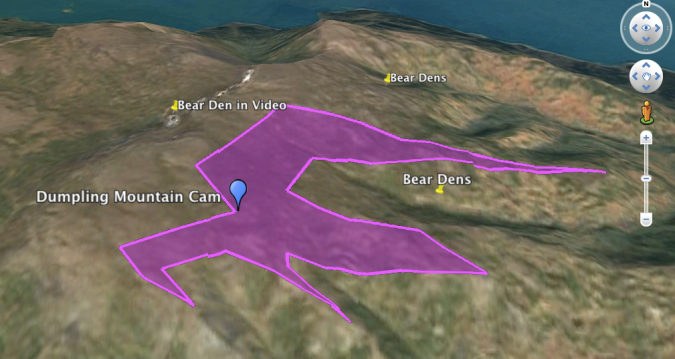
Dumpling Mountain offers much suitable denning habitat. Although none of the bears radio-collared at Brooks River in the 1970s were tracked to it, I found at least three areas with bear dens in my explorations of the mountain. None are visible within the Dumpling Cam’s viewshed, but they aren’t very far away either.
All the dens I found on Dumpling Mountain were around the 2,000 foot elevation line or lower. The purple area represents the Dumpling Mountain Cam viewshed.
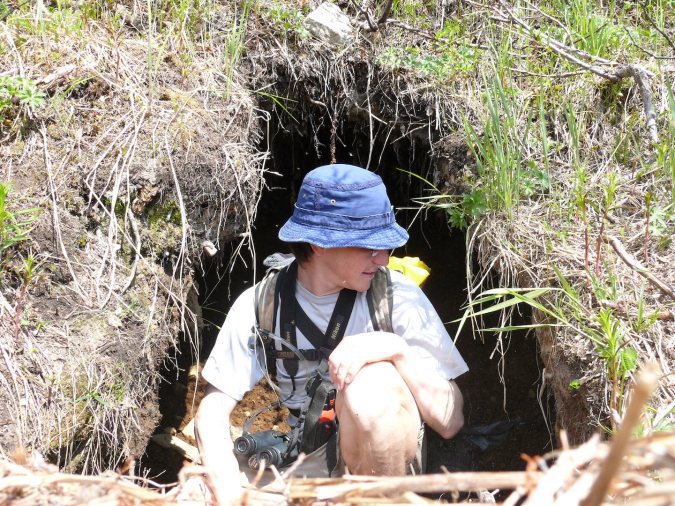
Yours truly sits at the entrance of a bear den on Dumpling Mountain.
Bear dens are cozy places. An entrance tunnel leads to a sleeping chamber, which is usually just large enough for the bear crawl into and turn around. Brown bears have the strength and endurance to dig their dens quickly, but den excavation typically takes place over several days. They may also make several excavations near their denning site, perhaps aborting these first attempts due to poor soil conditions.
Bear abundance at Brooks River peaks in late September and early October then decreases coincident with fewer spawning salmon. The bears’ migration away from the river doesn’t necessarily mean they’ll immediately head to their denning site. Bears can still find opportunities to feed elsewhere, even on Dumpling.
These bears on Dumpling may not have been moving to a denning site. Instead, they could’ve been there to eat. Their time on camera showed them traveling, playing, and grazing. Crowberry (Empetrum nigrum), alpine or bog blueberry (Vaccinium uliginosum), and lingonberry (Vaccinium vitus-vitae) all grown on the mountain’s tundra and can be important, and easily accessible foods for bear. Wild berries in Katmai are a fickle crop though. Some years, berry plants produce bumper crops, while in others I was hard pressed to find many berries at all. When one or all are abundant, however, berry-filled scat reveals the bears’ motivation on the mountain. In October, all three species can linger on the bush, but lingonberries are most likely to remain abundant into fall.
Lingonberry (Vaccinium vitis-idaea)
This dark purple bear scat is filled with black crowberry (Empetrum nigrum).
Bog or alpine blueberry (Vaccinium uliginosum)
Dumpling Mountain offers several things bears need—food in the form of seasonally abundant berries, open space relatively free of human disturbance, and pockets of prime denning habitat. Bears using the mountain, especially in the fall, could be there to locate a denning site, to graze frozen berries, or simply on their way from one place to another.
Addendum:
Some bearcam viewers have speculated the bear family recently seen on Dumpling Mountain was 854 Divot and her three yearlings. While the video evidence is inconclusive I saw Divot on Dumpling Mountain in the spring of 2015, so the mountain is part of her home range.
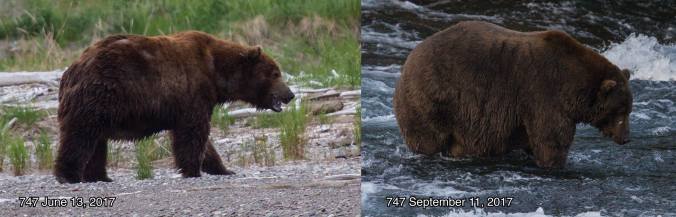
Photos of bear 747 from late spring and late summer illustrate this bear’s substantial weight gain. Photos courtesy of Katmai National Park.
As we’re in the midst of Fat Bear Week, it’s a good time to ponder some of the mechanisms that allow bears to gain enough weight to survive hibernation. Bears get fat to survive and hyperphagia is how they do it. In the bearcam week in review for October 5, I briefly explained hyperphagia. Here it is in case you missed it.
Bears experience hunger in ways humans do not. They need to eat a year’s worth of food in six months or less to survive winter hibernation and the lean months of spring. To do this they eat A LOT, especially at this time of the year.
In bears, hyperphagia is the period of excessive eating which takes place in late summer and fall. During this time black bears will eat 20,000 calories of food per day. Katmai’s brown bears can easily eat even more by catching calorie-rich salmon. Even though their calorie intake is extremely high, hyperphagic bears don’t feel full.
Satiety is the feeling of fullness after a meal. During hyperphagia, a bear’s body temporarily suppresses the normal mechanisms that balance food intake with weight gain. The body says, “You aren’t full. You don’t have enough fat reserves and need to eat more.” In short, hyperphagic bears don’t feel sated. This contrasts with the excessive eating of bears in June and July when they are eating a lot, but their bodies probably still respond to a feeling of fullness (which is sometimes hard to believe when you watch Otis or 747 catch fish after fish after fish). Hyperphagia, therefore, is a physiological state of bears in late summer and fall, as much as it is a behavior we can see. It’s how they prepare to survive the famine ahead.
There are small and fat bears, old and fat bears, young and fat bears, just plain fat bears. But none, NONE I say, are as fat as 747 in 2017. He has earned my official endorsement in the 2017 Fat Bear Week tournament.
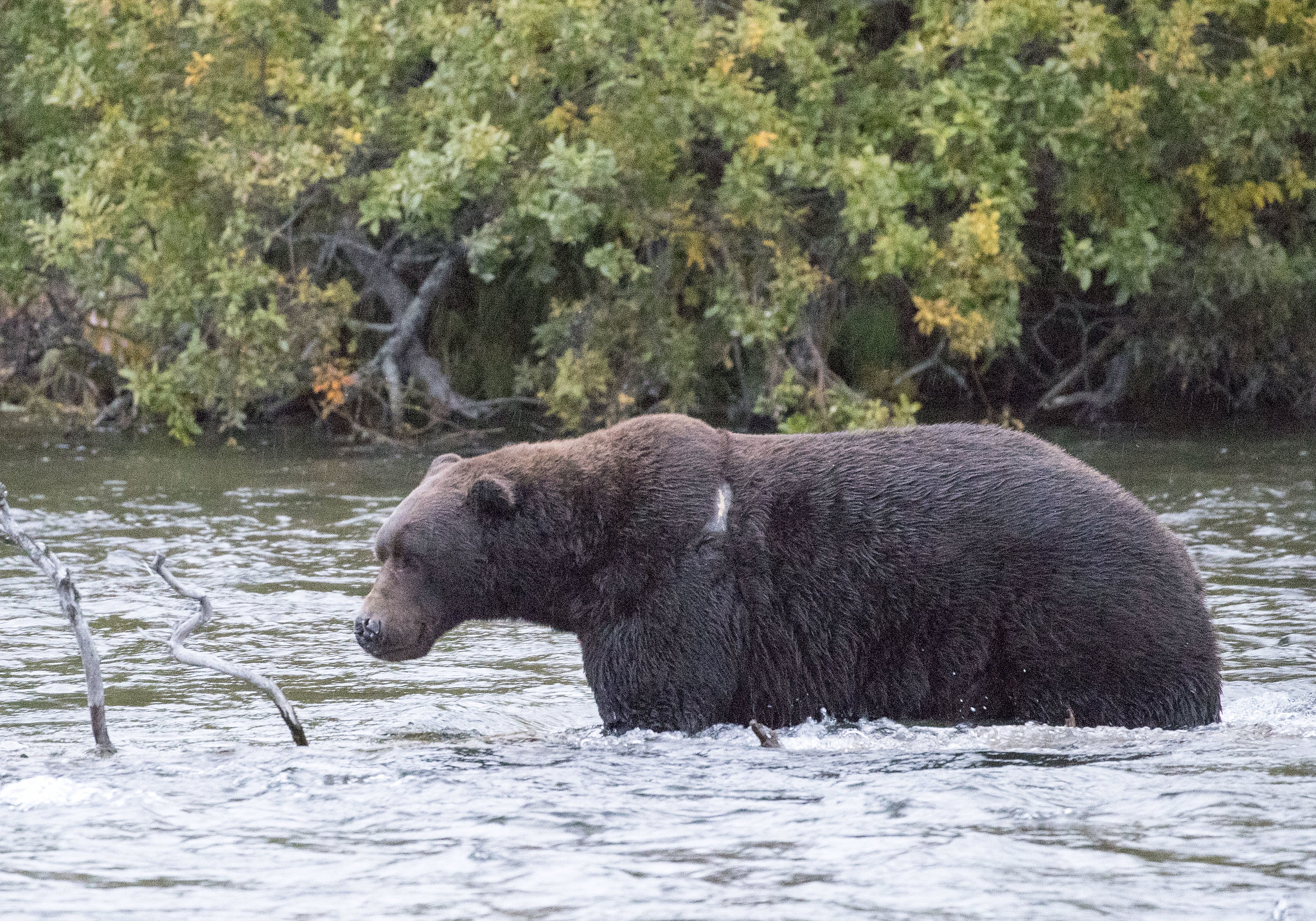
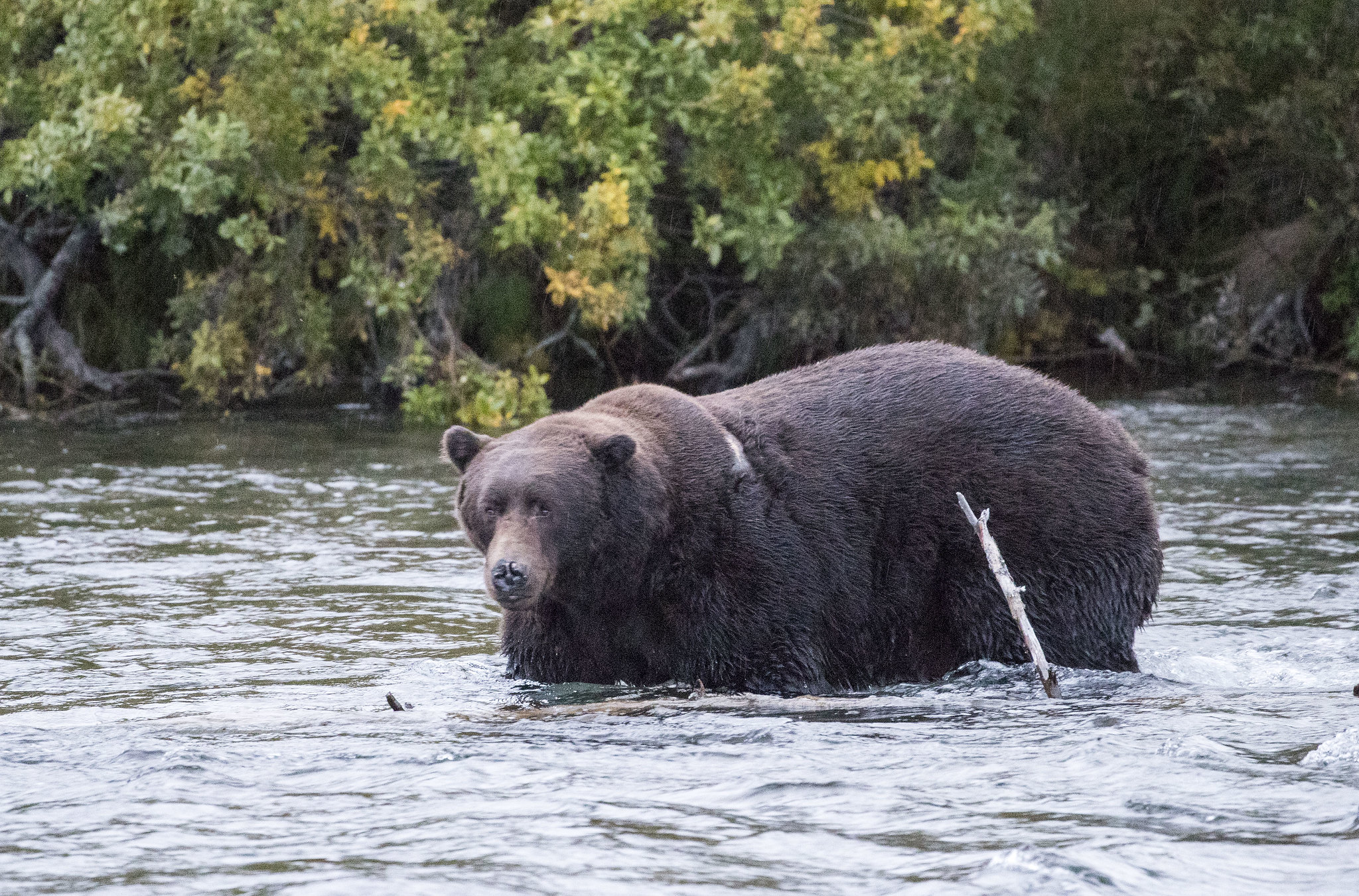
747 displays his massive silhouette near Brooks Falls on September 6, 2017.
747 is a mature adult male in the prime of his life. He has gained at least as much and probably more weight than all others. In my opinion, 747 is the biggest and fattest at Brook River.
Compare 747’s overall size in late spring…
747 in mid June 2017. Photo courtesy of David Kopshever.
…with his fatness in early September.
747 is so fat, his belly almost touches the ground.
Still not convinced? Then watch this video of 747 from September 6, 2017.
Since then, 747 has gained even more weight.
Too much fat is unhealthy for humans, but fat is essential to the survival of brown bears. It is a savings account against famine. Without ample fat, bears do not survive hibernation. In spring, often a season of starvation for bears, females with cubs will metabolize fat into milk to nurse their growing cubs, and adult males will use their fat to fuel their pursuit of mates.
747 won’t be rearing any cubs next spring as male brown bears play no role in raising offspring. During a season when almost no high calorie foods are available to bears, 747 will use his fat to roam the landscape for mates instead.
747 faces some tough competitors in this year’s tournament, but don’t fall for any other fat bear propaganda from the fake news mainstream leftwing socialist progressive liberal media. 747 is larger and fatter than any other bear at Brooks River. He’s huge, tremendous, and will win “bigly.”
This is my 2017 #FatBearWeek bracket. I look forward to seeing your bracket and campaign posters in the bearcam chat on explore.org.
At Brooks Falls, most bears tend to focus their efforts at one or two fishing spots. More rarely, a bear will learn to fish successfully almost anywhere at the falls. 503 has used several different fishing spots at Brooks Falls this year—the far pool, near the downed log, the jacuzzi, and the lip. Is he learning to become a generalist angler or will he eventually specialize in a particular spot? Bears from Brooks River’s past and present can offer us some insights into 503’s potential future. Read more in my latest post on explore.org.
It’s not uncommon to see bears with open wounds and distinctive scars, like bear 83 who seems to repeatedly get injured.
Photo of 83’s wound from 2015. In 2016, his rump was injured again courtesy of bear 747.
Wounds and the subsequent scars are useful when identifying Brooks River’s bears, since each bear carries a unique suite of them. 83 now sports a large scar on his rump.
The lump on 83’s rump marks the scar from his 2015 injury.
Sometimes though, we see bears with scars or injuries that may be more than superficial, perhaps impacting the sense they rely on most.
On September 13, 2017, a bear with a large, distinctive scar on his left shoulder was photographed at Brooks River.
This appears to be an old injury and when I saw these photos I wondered have we seen this bear before?
In 2010 and 2011, a subadult bear with a torn nostril was seen at Brooks River. Bear 253 was a young subadult at the time, but Katmai’s bear monitor was not able to determine its sex. Its nose was most likely injured in 2010 as photos from 2011 show some healing.
Bear 253 on September 6, 2010. NPS photo.
Bear 253 on October 8, 2010. NPS photo.
Bear 253 on September 6, 2010. NPS photo.
Bear 253 on September 17, 2011. NPS Photo.
Bear 253 on September 27, 2011. NPS Photo.
Bear 253 on September 17, 2011. NPS Photo.
253 probably isn’t the unidentified male photographed with the nose injury this past September though. 253’s muzzle is long and somewhat pointed while the male bear’s muzzle is blockier in shape. The nose injury on the male bear also seems more symmetrical than 253’s.
Would injuries like these impair these bears’ sense of smell? Perhaps, especially if it reduced the surface area inside the nose where scent can be detected.
Bears have a legendary sense of smell. The inside of their nose is filled with many turbinals, a complex scaffold of paper-thin bones. Humans have turbinal bones too, just far less than ursids. In black bears, for example, these bones greatly increase the surface area inside the nasal cavity, providing 100 times more nasal mucosa, or mucous membranes, than humans. More tangibly, if the area of muscous membranes inside the human nose equals the area of your typical postage stamp, then the area covered by mucous membranes inside the black bear nose covers an 8.5 x 11” sheet of office paper. On the surface of the membranes are millions and millions of scent detecting cells. In short, bears live in a world of odors we can scarcely imagine.
Like human eyesight, hearing, and smell, the strength of these senses likely varies in bears. Some bears may have worse eyesight than others (although it’s a myth that bears have poor eyesight; they don’t). Others may have worse hearing. In the case of bears with injured noses, they may not be able to smell as well as their cohorts. (It’s important to note that in the case of 253 and the adult male seen this past September, the injury to their nose may not be deep enough to affect the turbinals.)
If bears are anything though, they are tough survivalists. A nose injury could impose a severe disability on them, but that won’t stop them from doing whatever they need to do to survive.
In many ways, we can stereotype bears based on their age, sex, and reproductive status. While watching bears and even interacting with bears, certain stereotypes are useful. They help us begin to understand and explain a wide spectrum of behavior exhibited by a group of intelligent animals.
To stereotype a group of bears, adult males who rank at or near the top of the hierarchy are probably the least likely to act like a kid. They are the least likely to play or show overt curiosity towards new things. For most of bearcam’s history (2012-present) we’ve watched bears like 856, 747, and 814 dominate the falls through their size and assertiveness. These bears showed little interest in other bears except when establishing or reaffirming their dominance, stealing fish (especially 814 Lurch), appropriating preferred fishing spots, or when seeking a mate. Their behavior framed (biased?) our expectations of bears at the top of the hierarchy. They acted like stereotypical dominant males, and in their own ways, average bears.
But this logic can only take us so far, because there are no average bears.
This past July 32 Chunk displaced 856 as the most dominant bear at Brooks River. Chunk is approximately 12-13 years old and is perhaps the largest bear to use the river regularly this summer. Much of his behavior, especially early in Brooks River’s salmon run, is typical of a big dominant male. Not only did he displace other bears, he also wasn’t successfully challenged for food or fishing spots.
Notice how 856 quickly vacates the jacuzzi and doesn’t even attempt to challenge 32 Chunk.
Initially, 32 Chunk fit our expectations of a dominant male, but over the past two weeks or more bearcam has captured Chunk play fighting with another large, and older adult male, 755 Scare D Bear, as well as scavenging fish from him.
Just what is going on? Has Brooks Falls gone topsy-turvy in the wake of this summer’s hierarchy shift? Or this something more akin to the peculiarities of individual bear behavior during a summer when salmon are plentiful?
In July especially, Chunk fit the stereotype of a dominant adult male—challenging and displacing other bears, marking trees and cowboy walking in full view of other large males, and courting females. Since then, he’s behaved in ways that do not fit the dominant male stereotype—waiting patiently downstream of 755 for scraps of fish (a behavior more akin to scavenging than begging) and even initiating prolonged play fights with 755.
Play among adult male bears in their early teens is uncommon, but not unprecedented. I’ve previously wondered if bears outgrow play, and my personal observations suggest the frequency of play decreases as bears age. (I’m more surprised by 755 Scare D Bear’s willingness to play-fight, something I’ve never witnessed from him, than from 32’s).
Chunk’s play behavior separates him from bear 856 who was the most dominant bear seen through the entire history of bearcam until this summer. 856, like 24 BB before him, was hyper-dominant. As far as I know, this term has never been formally described in the scientific literature about bears. Tamara Olson, one of Katmai’s former bear biologists, introduced me to it. As I understand the term, hyper-dominance in bears is a willingness to continuously assert dominance over other competitors, giving them no slack, no chances to gain an edge. 856 became the river’s most dominant animal in 2011, when he was about the same age as Chunk is now. Once 856 became more dominant than 814 Lurch, for example, he repeatedly approached and displaced Lurch, perhaps in an effort to remind his large competitor, “Don’t challenge me or infringe on my space.”
Perhaps a lack of other large males who can challenge Chunk has allowed him to exhibit more playful and less hyper-dominant behavior. The relatively high abundance of salmon at Brooks River this summer also influences how bears interact with each other. To add another stereotype to the mix, bears are generally more playful and more tolerant of each other when they are well fed.
Because of his rank at the top of the hierarchy, we expect Chunk to behave like more like 856 than a youthful subadult. However, no biological edict commands Chunk to fit our expectations. His bimodal behavior is uncommon among adult male bears of his rank. Yet, Chunk can play-fight with other bears and still maintain an exceptionally high rank in the hierarchy.
The average bear is an amalgam of our observations and conclusions, created to help us better understand the lives of bears. No single bear will ever fit this role completely. Chunk can be both playful and dominant. He is no anomaly, because the average bear doesn’t exist.
Alaska is often described as a cold place, and justifiably so. Winters are long. Summer temperatures, especially on the Alaska Peninsula, are often damp and cool. It’s easy to imagine Brooks River’s water as bone-chillingly cold. But, just how cold is the water in Brooks River, the scene of bearcam? Brooks River is never very warm, but its temperature varies more than you might think. These temperature shifts can impact spawning salmon, but salmon are adapted to avoid the risk.
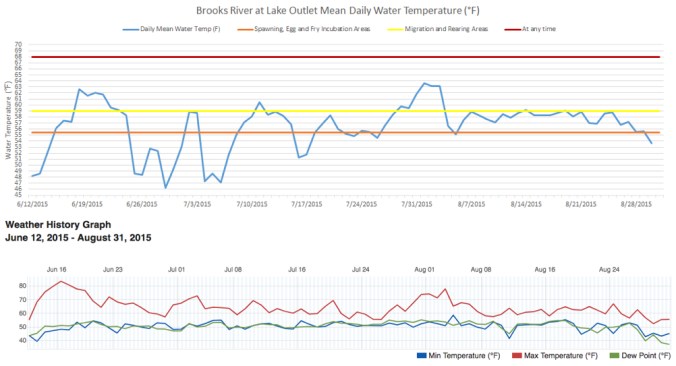
Staff from the National Park Service’s Southwest Alaska Network are tasked with monitoring the long term water quality in Katmai. During the summer, they install a data logger at the outlet of Lake Brooks where it drains into Brooks River to record water temperature. When the water temperature data is compiled into a graph, it displays quite a bit of variability.
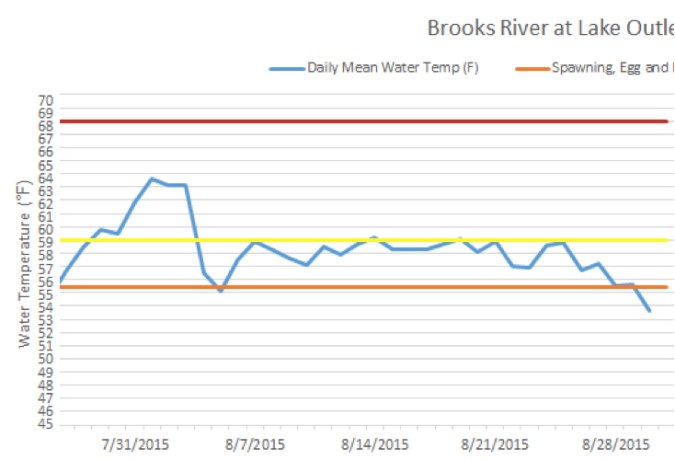
This graph plots water temperatures for the head of Brooks River from mid June to late August 2015. The blue line is a daily average of hourly temperature readings. The horizontal red, yellow, and orange lines represent State of Alaska water temperature threshold standards for fish habitat. Data courtesy of the National Park Service Southwest Alaska Network.
During the height of summer, Brooks River’s temperatures can rise well into the 60˚s F (15-20˚ C). Temperatures also drop rapidly, sometimes as much as ten to fifteen degrees in a few days. The maximum temperature recorded in 2015 was 69 °F (21˚ C) on August 2 at 5 p.m. and the minimum temperature was 44 °F (6.7˚ C) on July 5 at 8 a.m. What explains this variability?
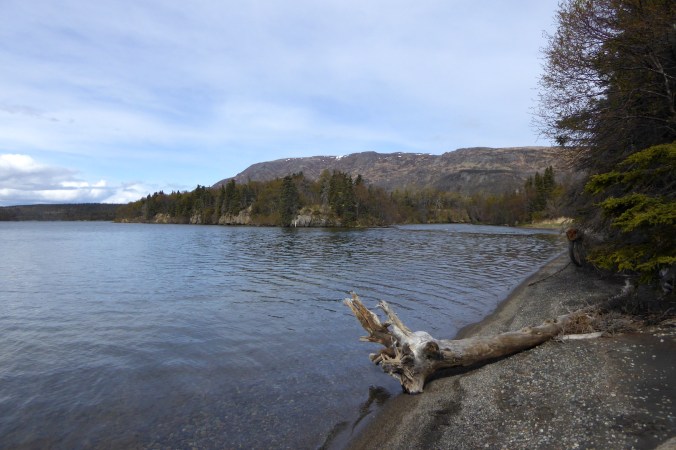
Weather and the underwater topography of Lake Brooks drive the rise and fall of the river’s temperature in summer. Brooks River drains Lake Brooks, a large glacially carved basin. Lake Brooks is filled with crystal clear water, and most of the lake is very cold so we could expect Brooks River to remain cold too if it weren’t for a shallow shelf of sediment extending a few hundred yards offshore from the lake’s northeastern shoreline. Over the shelf, the water is only a few feet deep at most.
Near the head of Brooks River, a shelf of sediment extends far out into Lake Brooks. In this Google Earth image, the shelf is outlined in blue.
Brooks River begins at the northeast corner of Lake Brooks. The beginning of the river can be seen at center right.
When summer’s long days (Katmai experiences almost 19 hours of daylight at the summer solstice) combine with stretches of clear and sunny weather, the water above this shelf is warmed considerably. When cool, cloudy weather covers the region, the water over the shelf drops in temperature. Wind across Lake Brooks can also help stir the lake, perhaps even breaking the thermocline between warm water on the surface and the cold water underneath. Even a rough comparison of weather and the river’s water temperature shows a clear correlation.
On the weather graph (bottom), the red line represents the daily maximum temperature, the blue line represents the daily minimum temperature, and the green line represents the dew point. Peaks in the river’s water temperatures roughly correspond with long stretches of warm weather. Weather data graph courtesy of wunderground.com.
While warmer water temperatures may not affect bears, salmon are sensitive to it. If water temperatures exceed certain limits, then dissolved oxygen levels in the water can drop, increasing mortality rates for adults salmon, fry, and eggs, or altering the timing of migration and spawning. Importantly, water temperature drives incubation time for salmon eggs. Incubation rates for salmon eggs are slower in cold water and faster in warmer water. If the sockeye salmon in Brook River spawned in July, for example, then warmer water would decrease the incubation period for the newly spawned eggs, potentially causing them to hatch too early when no food is available for the fry. These temperatures would also increase egg mortality. Sockeye and coho salmon egg survival plummets when water temperatures reach 14˚C (57˚ F). (See pages 9-15 in ADF&G’s Technical Report 91-1).
This graph displays sockeye and coho egg mortality compared to water temperature. Graph courtesy of the Alaska Department of Fish of Game.
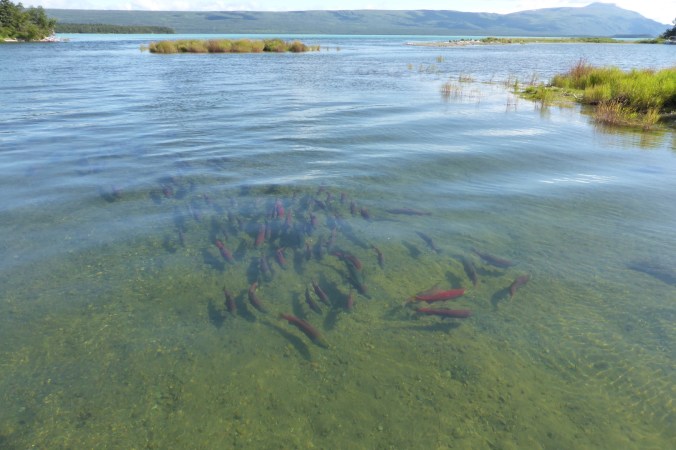
The sockeye salmon that spawn in Brooks River avoid this risk by delaying their spawning until late August and September. Notice how water temperature on the graph plateaus then begins to decrease by the end of August.
By late summer, day length has shortened by many hours. With less sunlight available to warm the water near the outlet of Lake Brooks, temperatures eventually dip well within ideal thresholds for spawning and egg incubation. The river’s salmon take advantage of these conditions by delaying their spawning until late summer and fall when cooler water temperatures, which continue to drop as fall wanes into winter, slow the salmon eggs’ incubation time. They don’t hatch until very late winter, and the fry don’t emerge from the stream gravel until spring when water temperatures begin to rise again and more sunlight supports more plankton, which feed the young salmon.
Brooks River is a dynamic place. No one week, no one year is the same as the last. Salmon, at least genetically, understand this. They “know” spawning in July would be risky business and probably unsuccessful. Their spawning cycle is timed to avoid the warmest and most variable water temperatures. In this way, every year, Brooks River’s salmon demonstrate their adaptation to variable conditions.
A few days ago, bearcam viewers alerted me to an interesting interaction at Brooks Falls where 32 Chunk appeared to displace 856.
I’ve taken some time to review bearcam footage of the subordinate bear in the video above, and I don’t think he is 856. The bear looks like an adult male, based on his size and the presence of scars around his face. I don’t recognize him, but I am willing to say it is not 856. Here’s why…
856 is a large adult male with blond ears and a long neck. This year he returned with a noticeable limp and sports a shed patch on his rump.
856 will fish at several different places in the falls—the jacuzzi, in the far pool, and near the rocks in between. When he sits at the rocks, he does so in a fairly distinctive manner.
When 856 fishes the jacuzzi, he’ll often leave that spot to eat near the island, almost sitting and facing away from the cam.
In contrast to these behaviors, the bear displaced by 32 Chunk doesn’t appear to be limping (and I’ll admit that bears can heal quickly, so the limp may not be very pronounced now). Both 856 and the unidentified bear may have similar wounds or scars on their face, the ears of the bear displaced by 32 Chunk are darker. The contrast between the unidentified male bear’s front quarters and hind quarters is also more apparent than 856. His muzzle appears blockier than 856, and 856 is very unlikely to play with 89 Backpack.
This is a screen shot of the unidentified adult male who displaced by 32 Chunk.
856 walking on the island near Brooks Falls in July 2015.
So was this a changing of the guard at Brooks Falls? Probably not. In my opinion, 32 Chunk displaced a full grown adult male, but the subordinate bear was not 856. However, in the absence of other large males like 856 and 747, 32 Chunk may be the most dominant bear on the river. Chunk clearly asserted his dominance over the unidentified male.
Almost every year, a new and fully mature adult bear shows up at Brooks River. Bears are creatures of habit, but they also remain flexible, changing their behaviors when necessary. The unidentified male may have never visited Brooks Falls before and never encountered 32 Chunk. His life up until now is a mystery, but these events are one reason why the story of Brooks River’s bears is so fascinating. This is a constantly evolving story. It will never become static.
When we ask, “Why did that bear behave like that?” we should ask two additional questions.
Was the bear motivated by food or potential access to food?
Was the bear motivated by sex or reproductive success?
Biology can be distilled simplistically into two categories: food and sex. Adequate nutrition is necessary for survival of the individual, and since bears hibernate throughout much of the year they are particularly motivated by food. Reproduction also drives bears to behave in particular ways. We should also consider how each bear’s disposition influences their behavior.
128 Grazer As a young adult bear, 128 Grazer became very skilled at fishing the lip of the falls. She’d compete for access to that spot with several other adult males and females. As a single bear (i.e. no cubs), she was fairly tolerant of other bears in close proximity. After 128 became a mother in 2016 though, her behavior became increasingly defensive. She didn’t shy away from confronting larger adult males in order to protect her cubs .
Still caring for three yearlings in 2017, she seems to be just as protective and wary as last year.
409 Beadnose In contrast to Grazer, 409 Beadnose is an experienced mother who has weaned three litters (her current batch of yearlings is her fourth known litter). Beadnose can be defensive too, but tends to avoid confrontation more often than 128. While Grazer visited the falls with her spring cubs last summer, 409 did not. This is a clear behavioral change for Beadnose, because she visits the falls frequently when she’s not caring for cubs.
128 Grazer (left) and 409 Beadnose are familiar with each other and often use the same areas to fish.
Now both of these mothers are raising yearlings, both have returned to Brooks Falls, and both tend to fish the same places (the lip or the far pool). Most importantly, both are competing for the same resources in order to successfully raise their cubs—leading to situations like this.
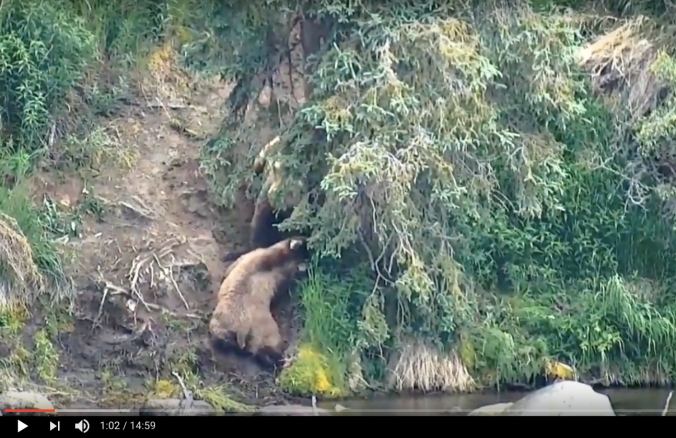
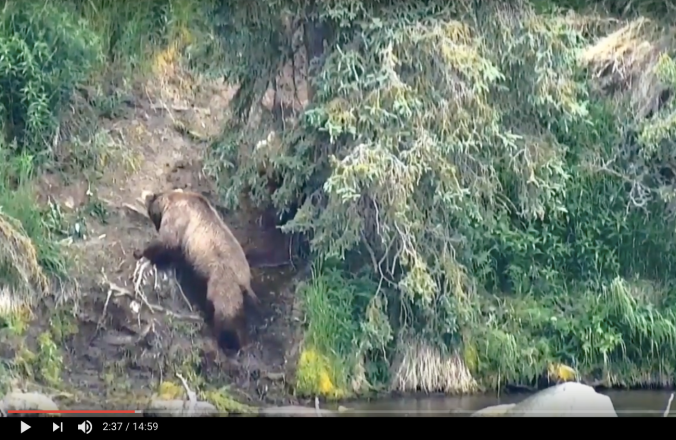
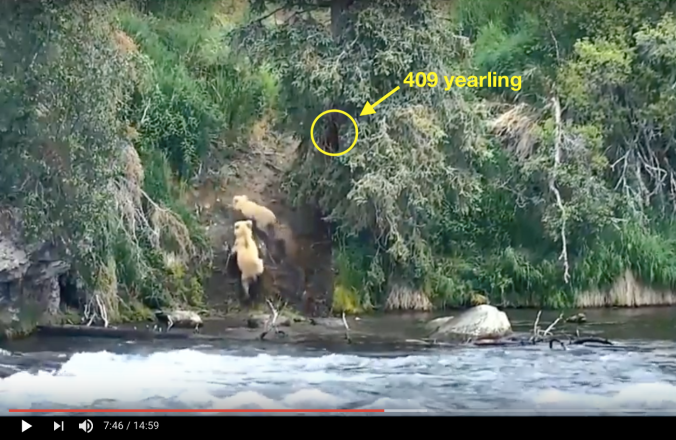
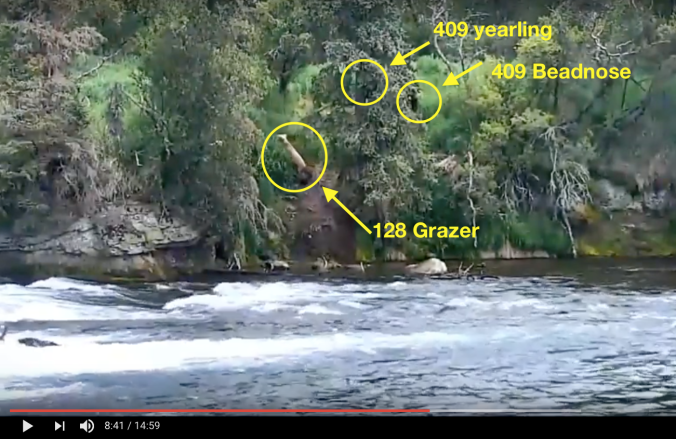
Can this apparent snafu be explained by a motivation for food or reproductive success? When the video begins, 409 Beadnose is ascending the hill. 128 Grazer is the blonder bear standing under the spruce tree. Grazer refuses to yield to Beadnose’s approach. The bears jaw and growl at each other, while 128’s yearlings remain in the spruce tree above their mom.
Beadnose seems compelled to get up the hill and skirts Grazer. There are other routes available, but she sticks with this one.
Grazer’s cubs eventually come down from the tree while Beadnose lingers in the forest nearby. Something keeps Beadnose from moving farther away, but at this point we can’t see her.
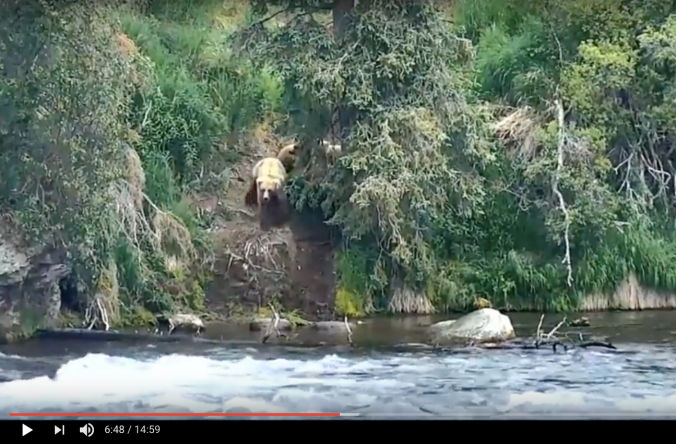
With 409 still on the hill, Grazer and cubs move down to the river. Shortly afterward her yearlings react to something in the same tree they had just climbed down from. Grazer begins to jaw pop, a loud and distinctive warning noise. We can see movement in the spruce tree above.
It’s one of Beadnose’s cubs.
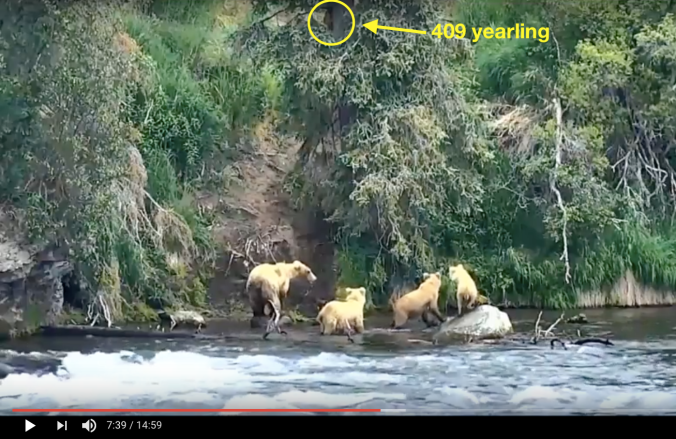
Grazer and her yearlings scramble up the hill just 409’s yearling tries to climb down. Now we understand why Beadnose didn’t give Grazer more space previously and why Beadnose remained in the forest near spruce tree—one of her cubs was in the same tree as Grazer’s cubs! This is something I never witnessed before, cubs from two litters in the same tree at the same time.
409 is mostly out of sight as 128 and cubs run up the hill. 409’s yearling though, is unable to get out of the tree.
A short stand-off ensues. 409’s yearling remains in the tree, 409 stands not far up the hill, and 128 Grazer and yearlings remain close by.
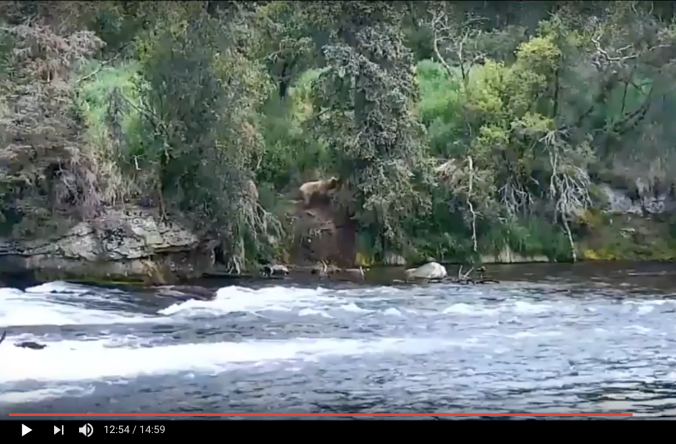
When 409’s cub tries to climb down again, Grazer reacts and charges to the base of the tree.
Grazer then climbs the tree, forcing Beadnose’s yearling back up. About ninety seconds later, 128 has moved farther away, which allows 409’s cub to climb out of the tree and rejoin its mother.
This interaction between Grazer and Beadnose was unique because cubs from two different litters were in the same tree at the same time, greatly complicating a situation where the families could’ve avoided each other. The interaction was ordinary however, because both Beadnose’s and Grazer’s behavior seemed to be motivated by an urge to protect their cubs. Grazer’s defensiveness is easily triggered and she must’ve viewed the 409 yearling as a threat, which in my opinion led her to chase it back up the tree. Beadnose may have realized Grazer was willing to physically fight in this situation. This could’ve deterred Beadnose from standing next to the tree under her cub. At the beginning of the video, Beadnose also couldn’t get her cub out of the tree with Grazer’s cubs still in it. Stuck in a Catch-22, Beadnose seemed to choose a more cautious tactic: move slightly away and wait.
Motivation for food or reproductive success explains quite a lot in biology, but not all bear behavior can be explained so simplistically (why would a bear play with her foot? ). The prolonged interaction between these families however, does fit one of the biological motivators. This interaction probably wasn’t hierarchical; that is, it wasn’t about asserting dominance for access to food and mates. It was about protecting offspring. In other words, it was about reproduction.












 Wandering at Large