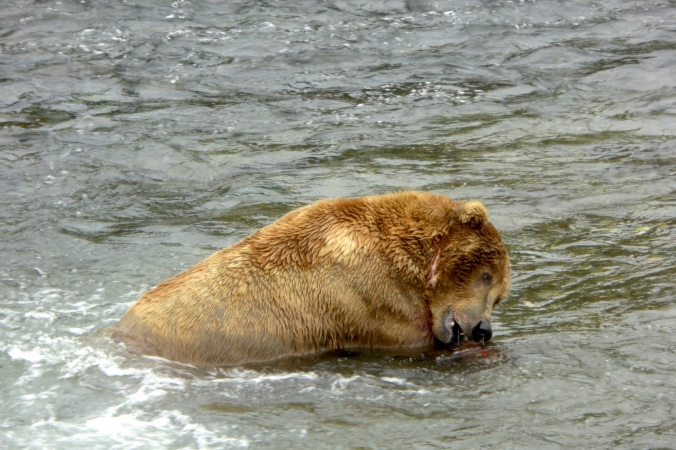
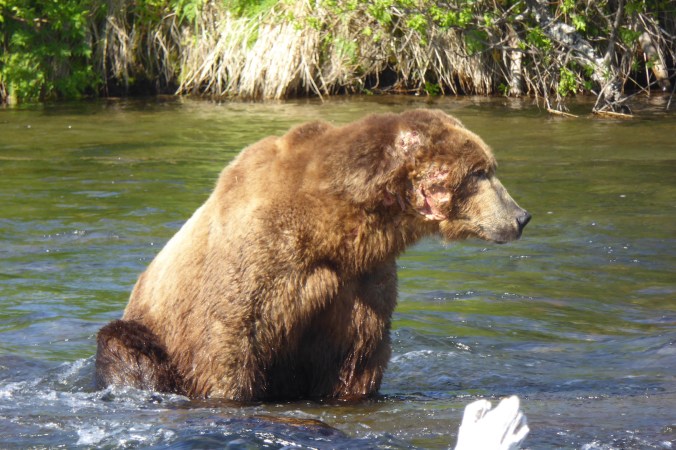
480 Otis is currently the oldest adult male bear known to use Brooks River. First identified in 2001, a conservative age estimate places him in his early twenties. This bear is a skilled and patient angler who often sits for hours in Brooks River. When he catches salmon though, a common ailment of bears his age is noticeable.
480 Otis often bites the tails off of salmon by utilizing his molars, a method that younger bears with all their canine teeth do not use.
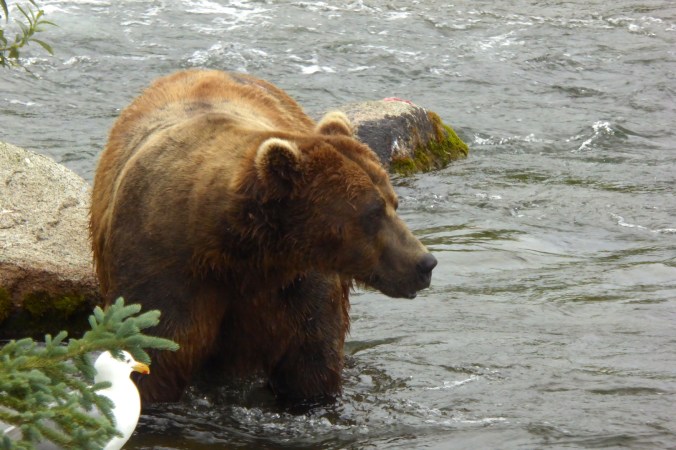
In 2013, I first took note of the peculiar manner in which Otis eats his salmon. Unlike young bears with relatively sharp canine teeth and incisors, Otis sometimes seems to struggle with grasping and biting through the tough skin of sockeye salmon. He seemed to use his molars much more than younger bears to bite into salmon. After watching closely through binoculars, I eventually saw why. Otis is missing canine teeth.
Notice how he seems to have difficultly chewing his food.
Otis’ lower left canine appears to be completely missing. A nub of his upper right canine may still exist, but it is so small to be nearly useless. He may also have missing or worn incisors, premolars, and molars. This affects his ability to grasp and bite into salmon.
Even when salmon are so abundant that most bears high-grade their fish—eating the fattiest parts like the skin, brain, and eggs and discarding the rest of the carcass—Otis eats higher proportions of the whole fish, probably because his worn and missing teeth prevent him from handling the fish as dexterously as his younger competitors.
Throughout their lives, brown bears suffer from broken bones, disease, wounds, and many other ailments. As they age, the rigors of their diet and lifestyle wear on their teeth. Without access to a dentist, bears must tolerate broken and worn teeth as well as deep cavities and even abscessed teeth, conditions which may ultimately reduce their fitness and survival.
480 Otis is one of the most experienced bears at Brooks River. Despite his less than healthy teeth, he continues to fish quite successfully (incredibly, he once caught and ate 44 fish in about six hours!) to gain the calories needed to survive the lean months of winter and spring.
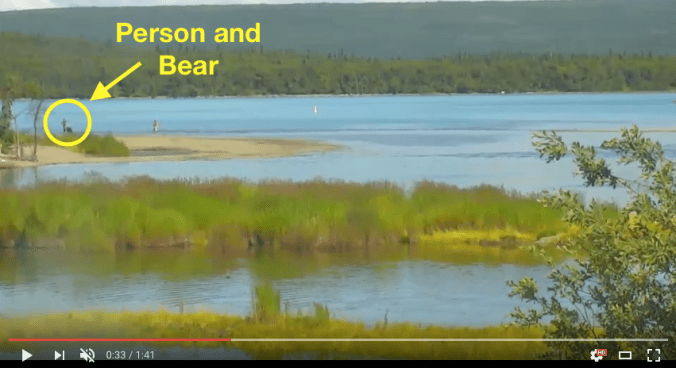
Early today, bearcam captured a very close encounter of the ursine kind.
When the video begins, two people are walking out of the water in the direction of Brooks Lodge. A relatively small brown bear, probably a subadult, then begins to run towards them. Eventually, the bear gets very close to both individuals. Other than wading into very deep water, the couple had few options in this situation. Their only line of retreat was towards Brooks Lodge (the direction they were walking).
The bear could’ve approached the people for a few reasons. If the people were fishing and if they had a fish on their line, then this could have attracted the bear. If the bear had taken fish from anglers before, which happens at Brooks River, then it would be more likely to approach people as it searches for an easy meal. The splashing of their feet could’ve caught the bear’s attention. That’s a sound that mimics the sound of splashing fish, and for bears at Brooks River this is the sound of food. The bear could also have been attempting to play or assert its dominance.
The bear doesn’t look like it was charging the people defensively. Its bounds aren’t direct. In contrast to this bear, a charging bear moves very quickly in a straight line. Defensive bears, from what I’ve observed, do not deviate from their target until they decide to stop the charge.
There was one thing the couple could have done to reduce the chances of a scary encounter—stay together. Instead of walking 5-10 meters apart, they could’ve walked shoulder to shoulder. Size means a lot to a bear and bears are much less likely to approach groups of people compared to single people. Beyond anything else traveling in groups, especially groups of four or more people, is the most important step we can take to increase our level of safety in bear country. Most importantly, the couple could have not gone into that area.
People are permitted to be in that location, and often don’t consult rangers before doing so. However, I don’t necessarily place blame on them. Quite often, visitors are not aware how vulnerable they are in many places at Brooks River.
This is a place where people have a lot of freedom, maybe more so than any other well known bear viewing location in Alaska. The only area closed to people is the immediate area near Brooks Falls from June 15 to August 15. Situations like this don’t happen every day, but bears and people are often in very close proximity. I know many of us who watch the bearcam won’t visit Brooks Camp, but a few of us will. If you choose to visit, please consider ways in which you can minimize this type of encounter. I recommend staying on established trails and bear viewing from specific locations where bears expect to find people, like the wildlife viewing platforms. The river mouth often looks like a great place to be with its open sight lines. Yet, the depth of the water greatly limits where one can go to avoid bears. The river mouth from late June through July and again from late August through early October is wonderful habitat for bears. For this reason, everyone who visits Brooks Camp should consider not going into this area. This provides a higher level of safety for us and greater opportunities for bears to access the resources they need to survive without our interference.
Despite my best intentions over the years, I still got much too close to bears when I wasn’t paying attention to my surroundings, when I traveled into a spot where sight lines were limited, or when I was in an area where bears were likely to feed or rest. Close encounters will happen, but there are ways we can minimize the risk.
Watch bears from trails and the wildlife viewing platforms.
Avoid moving into areas where bears are likely to rest, play, or feed.
Give yourself two avenues of escape to avoid an approaching bear.
The bear hierarchy is fluid. Bears jostle constantly within it, gaining and losing rank as they grow into adults and age into older bears. In 2017 at Brooks River, one bear has asserted his dominance over all others in ways he’s never done before. There appears to be a new dominant male on the river and he’s known as 32 Chunk.
32 Chunk in early June 2017. Photo courtesy of Katmai National Park.
In 2011, I began recording interactions between bears at Brooks Falls, noting who displaced who, who avoided who, and which bears were courting, stealing fish, and playing together. Out of hundreds of interactions I witnessed, one bear was consistently and clearly dominant over all others, 856.
856 stands in Brooks River on June 30, 2016.
From 2011 to 2016, 856 wasn’t displaced once. I only noted him yielding on very rare occasions, like when he faced a particularly defensive mother bear. No other bears even seemed to challenge him. 856 ascended to the top of the hierarchy rather quickly in 2011, outcompeting other large males like 814 Lurch and 747, and for many years remained the river’s most dominant bear.
856 (right) displaces 747, another large adult male bear, from the jacuzzi in 2013.
Life at the top of the hierarchy is difficult, however. Other bears are subordinate, but not subservient, to more dominant animals. If injury, illness, or age weakens a dominant bear then others will not hesitate to usurp their position, gaining greater access to food and potential mates. Other bears, often younger and stronger, are more than willing to take your spot if given the opportunity.
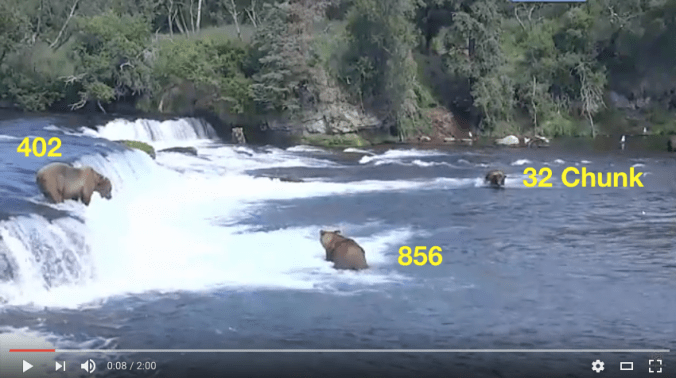
In the video above, 856 is the bear in the jacuzzi (the plunge pool below Brooks Falls) while 402, an adult female, stands on the lip. Notice how 856 turns to face the bear approaching from the far side of the river. This is 32 Chunk.
856 backs out of the jacuzzi to avoid 32 Chunk. He then goes to the lip where 402 stands, but 32 Chunk follows. Above the falls, 856 makes no attempt to challenge Chunk. 856 stands and watches as 32 turns away from his competitor, like dominant bears are apt to do, and walks out of the frame.
32 Chunk in 2014, while he ranked in the middle of the bear hierarchy for adult males.
Nature abhors a vacuum. No niche is left unfilled within the bear hierarchy. 856, perhaps weakened by injury or age, appears to no longer be the most dominant bear at Brooks River. His younger competitor sensed weakness and exploited it. This isn’t a contest of longevity though. During his time as the most dominant bear, 856 had free reign over the best fishing spots and went unchallenged for access to females in estrus. For years, he grew large and strong, probably siring more than one litter of bear cubs along the way. Now 32 Chunk (and possibly other bears like 747) hold those advantages.
856 remains a large bear and his size will continue to allow him great access to fishing spots at Brooks River. Bears grow up quickly, gaining the strength and skills necessary to survive a harsh, competitive world. Eventually though, the competition catches up.
A few days ago, bearcam viewers alerted me to an interesting interaction at Brooks Falls where 32 Chunk appeared to displace 856.
I’ve taken some time to review bearcam footage of the subordinate bear in the video above, and I don’t think he is 856. The bear looks like an adult male, based on his size and the presence of scars around his face. I don’t recognize him, but I am willing to say it is not 856. Here’s why…
856 is a large adult male with blond ears and a long neck. This year he returned with a noticeable limp and sports a shed patch on his rump.
856 will fish at several different places in the falls—the jacuzzi, in the far pool, and near the rocks in between. When he sits at the rocks, he does so in a fairly distinctive manner.
When 856 fishes the jacuzzi, he’ll often leave that spot to eat near the island, almost sitting and facing away from the cam.
In contrast to these behaviors, the bear displaced by 32 Chunk doesn’t appear to be limping (and I’ll admit that bears can heal quickly, so the limp may not be very pronounced now). Both 856 and the unidentified bear may have similar wounds or scars on their face, the ears of the bear displaced by 32 Chunk are darker. The contrast between the unidentified male bear’s front quarters and hind quarters is also more apparent than 856. His muzzle appears blockier than 856, and 856 is very unlikely to play with 89 Backpack.
This is a screen shot of the unidentified adult male who displaced by 32 Chunk.
856 walking on the island near Brooks Falls in July 2015.
So was this a changing of the guard at Brooks Falls? Probably not. In my opinion, 32 Chunk displaced a full grown adult male, but the subordinate bear was not 856. However, in the absence of other large males like 856 and 747, 32 Chunk may be the most dominant bear on the river. Chunk clearly asserted his dominance over the unidentified male.
Almost every year, a new and fully mature adult bear shows up at Brooks River. Bears are creatures of habit, but they also remain flexible, changing their behaviors when necessary. The unidentified male may have never visited Brooks Falls before and never encountered 32 Chunk. His life up until now is a mystery, but these events are one reason why the story of Brooks River’s bears is so fascinating. This is a constantly evolving story. It will never become static.
Brown bears live in a hierarchy, where dominance allows greater access to food and the most productive fishing areas. One recent interaction between bears 32 Chunk and 480 Otis represents a shift in this social order. This is a story of maturation for two bears going in opposite hierarchical directions.
The hierarchy at Brooks River allows bears to quickly assess their competitors, avoiding most physical fights and saving valuable energy. Within the hierarchy large, mature males rank highest followed by other adult males, females with cubs, single females, and finally subadult bears. While this pattern holds as a general rule, bears shift their position in the hierarchy depending on their size, strength, and overall health.
As an adult male in his early teens, 32 Chunk is well positioned to rank near the top of the hierarchy. Chunk was first identified in 2007 as a chunky subadult bear. We don’t know his exact age, but bear monitoring staff noted he appeared to be a young subadult, perhaps 3.5 or 4.5 years old at the time. Since then, he’s grown considerably and is among the largest bears at Brooks River.
32 Chunk as a young subadult in 2007. Ten years later, he has grown to become one of the largest bears at Brooks River. (Photo courtesy of Jeanne Roy.)
In contrast, 480 Otis was a mature adult in his early teens in 2007. He was a big, walrus-shaped bear who, like today, was skilled at fishing in the jacuzzi and far pool. He was not often displaced from his preferred fishing spots.
480 Otis in 2007. (NPS Photo)
In 2007 and 2008, a young subadult bear like Chunk wouldn’t even consider challenging a larger adult like Otis. Since then both bears have matured, but their life histories since then lead in different directions within the hierarchy. Recently, 32 Chunk demonstrated his dominance over the older 480 Otis.
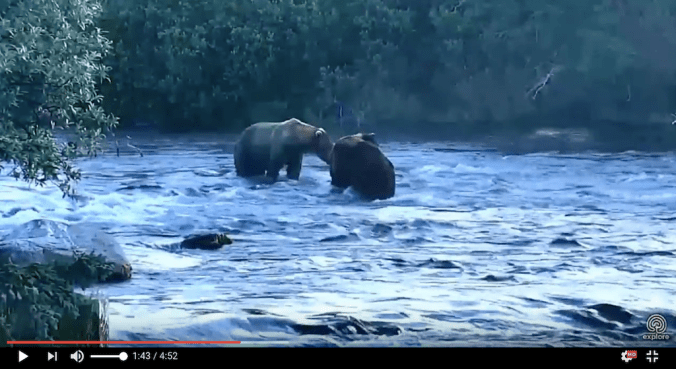
When the video begins, 480 Otis is standing upstream of the falls in the middle of the river. 32 Chunk is the darker colored bear in the jacuzzi below the falls.
After Chunk notices Otis above the falls, he leaves the jacuzzi and begins to approach Otis.
480 Otis starts to move away, possibly to avoid 32 Chunk’s approach. This is one sign Otis could be subordinate to 32. The rest of the interaction leaves no doubt who is dominant, however.
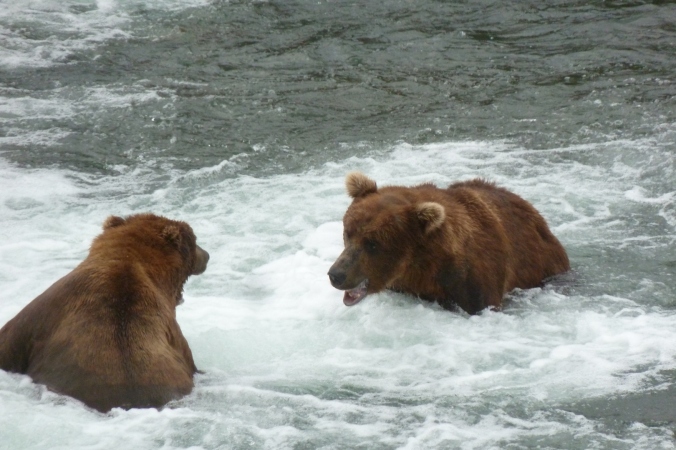
Chunk moves through the river faster than Otis. When Chunk nears the older bear, Otis turns to face the younger competitor. They stand mostly still, yawning and assessing each other’s size.
32 Chunk then swats at 480 Otis.
In the video, the bears’ ear positions aren’t easy to see, but 480’s ears seem to be held back against his head, indicating he’s somewhat defensive. Chunk’s ears, in contrast, are mostly upright and oriented forward, a sign of assertiveness and dominance in this context.
The interaction ends when 32 Chunk walks away with 480 Otis watching.
Several behavioral cues demonstrate 32 Chunk’s dominance and 480 Otis’ subordinate status in this interaction.
32 directly approached 480.
480 attempted to avoid 32.
32 lunged at 480 and 480 did not attempt to engage.
32’s ears were upright and forward, while 480’s ears were held slightly back against his head.
32 ended the encounter, turning his back on 480 and walking away. (Dominant bears decide when an interaction ends unless they have good reason to usurp a resource such as food, a fishing spot, or access to a potential mate.)
Chunk is now entering the prime of his life where he’ll attain his greatest size and rank, and while Otis remains a large bear he’s no longer able to compete with the largest male bears for fishing spots. It seems that Chunk recognizes his size and strength and Otis recognizes the great risks of challenging a younger, larger bear. For the rest of the summer, 32 may displace 480 from fishing spots at Brooks Falls.
Chunk appears to be moving up the hierarchy while Otis continues to slide down it. With these bears, there are two tales of maturation.
When we ask, “Why did that bear behave like that?” we should ask two additional questions.
Was the bear motivated by food or potential access to food?
Was the bear motivated by sex or reproductive success?
Biology can be distilled simplistically into two categories: food and sex. Adequate nutrition is necessary for survival of the individual, and since bears hibernate throughout much of the year they are particularly motivated by food. Reproduction also drives bears to behave in particular ways. We should also consider how each bear’s disposition influences their behavior.
128 Grazer As a young adult bear, 128 Grazer became very skilled at fishing the lip of the falls. She’d compete for access to that spot with several other adult males and females. As a single bear (i.e. no cubs), she was fairly tolerant of other bears in close proximity. After 128 became a mother in 2016 though, her behavior became increasingly defensive. She didn’t shy away from confronting larger adult males in order to protect her cubs .
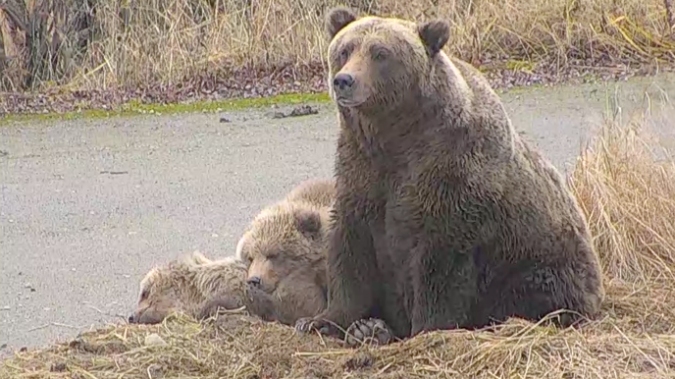
Still caring for three yearlings in 2017, she seems to be just as protective and wary as last year.
409 Beadnose In contrast to Grazer, 409 Beadnose is an experienced mother who has weaned three litters (her current batch of yearlings is her fourth known litter). Beadnose can be defensive too, but tends to avoid confrontation more often than 128. While Grazer visited the falls with her spring cubs last summer, 409 did not. This is a clear behavioral change for Beadnose, because she visits the falls frequently when she’s not caring for cubs.
128 Grazer (left) and 409 Beadnose are familiar with each other and often use the same areas to fish.
Now both of these mothers are raising yearlings, both have returned to Brooks Falls, and both tend to fish the same places (the lip or the far pool). Most importantly, both are competing for the same resources in order to successfully raise their cubs—leading to situations like this.
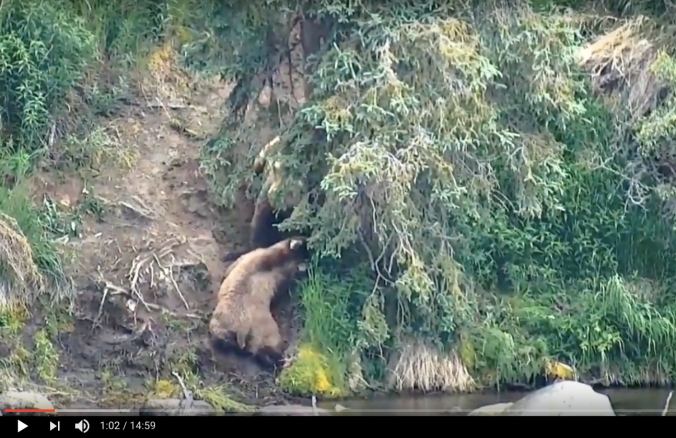
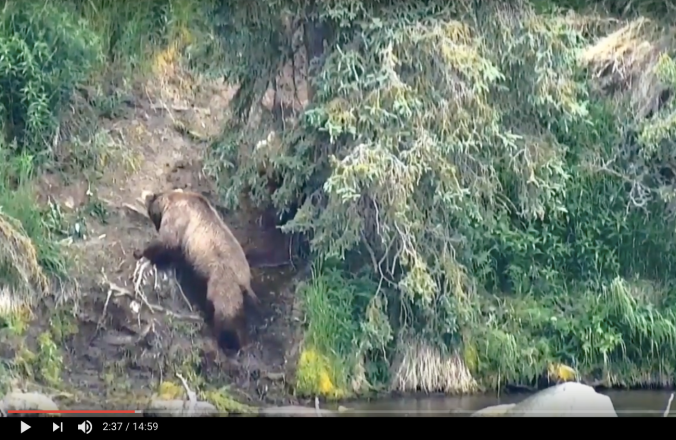
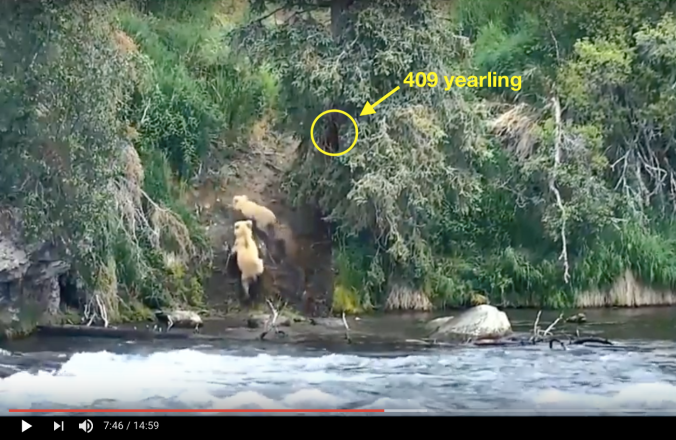
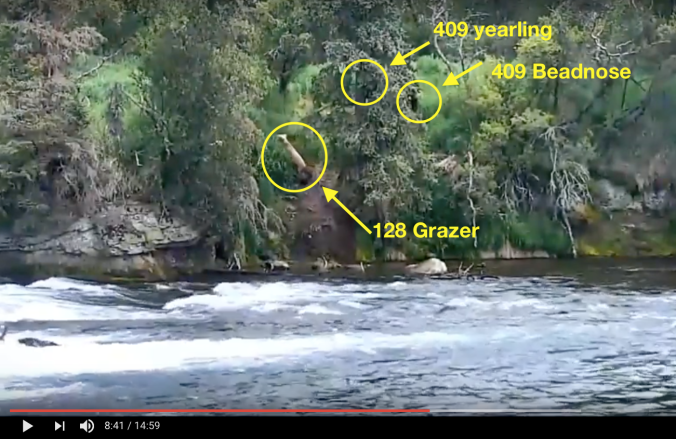
Can this apparent snafu be explained by a motivation for food or reproductive success? When the video begins, 409 Beadnose is ascending the hill. 128 Grazer is the blonder bear standing under the spruce tree. Grazer refuses to yield to Beadnose’s approach. The bears jaw and growl at each other, while 128’s yearlings remain in the spruce tree above their mom.
Beadnose seems compelled to get up the hill and skirts Grazer. There are other routes available, but she sticks with this one.
Grazer’s cubs eventually come down from the tree while Beadnose lingers in the forest nearby. Something keeps Beadnose from moving farther away, but at this point we can’t see her.
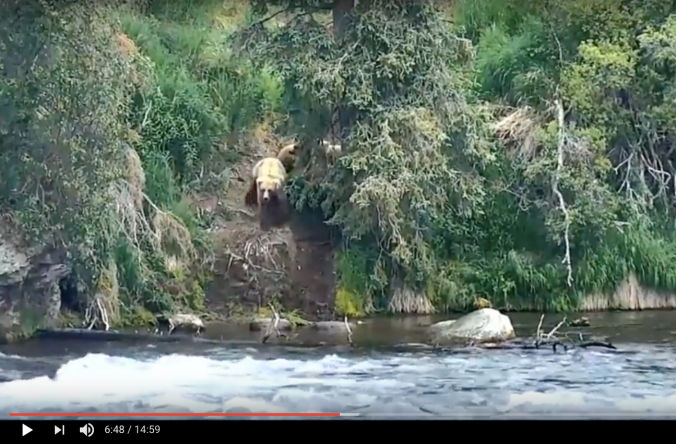
With 409 still on the hill, Grazer and cubs move down to the river. Shortly afterward her yearlings react to something in the same tree they had just climbed down from. Grazer begins to jaw pop, a loud and distinctive warning noise. We can see movement in the spruce tree above.
It’s one of Beadnose’s cubs.
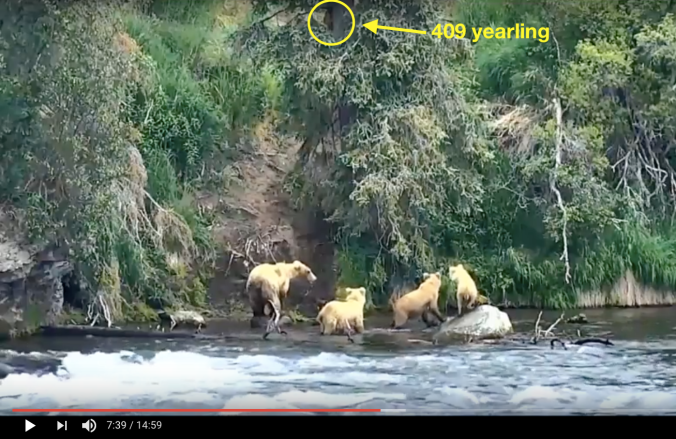
Grazer and her yearlings scramble up the hill just 409’s yearling tries to climb down. Now we understand why Beadnose didn’t give Grazer more space previously and why Beadnose remained in the forest near spruce tree—one of her cubs was in the same tree as Grazer’s cubs! This is something I never witnessed before, cubs from two litters in the same tree at the same time.
409 is mostly out of sight as 128 and cubs run up the hill. 409’s yearling though, is unable to get out of the tree.
A short stand-off ensues. 409’s yearling remains in the tree, 409 stands not far up the hill, and 128 Grazer and yearlings remain close by.
When 409’s cub tries to climb down again, Grazer reacts and charges to the base of the tree.
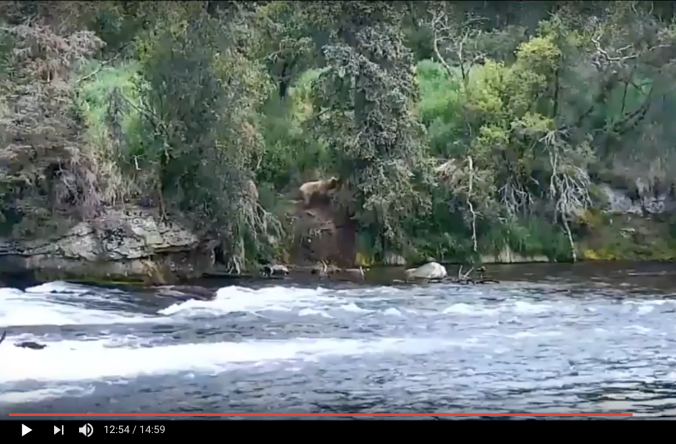
Grazer then climbs the tree, forcing Beadnose’s yearling back up. About ninety seconds later, 128 has moved farther away, which allows 409’s cub to climb out of the tree and rejoin its mother.
This interaction between Grazer and Beadnose was unique because cubs from two different litters were in the same tree at the same time, greatly complicating a situation where the families could’ve avoided each other. The interaction was ordinary however, because both Beadnose’s and Grazer’s behavior seemed to be motivated by an urge to protect their cubs. Grazer’s defensiveness is easily triggered and she must’ve viewed the 409 yearling as a threat, which in my opinion led her to chase it back up the tree. Beadnose may have realized Grazer was willing to physically fight in this situation. This could’ve deterred Beadnose from standing next to the tree under her cub. At the beginning of the video, Beadnose also couldn’t get her cub out of the tree with Grazer’s cubs still in it. Stuck in a Catch-22, Beadnose seemed to choose a more cautious tactic: move slightly away and wait.
Motivation for food or reproductive success explains quite a lot in biology, but not all bear behavior can be explained so simplistically (why would a bear play with her foot? ). The prolonged interaction between these families however, does fit one of the biological motivators. This interaction probably wasn’t hierarchical; that is, it wasn’t about asserting dominance for access to food and mates. It was about protecting offspring. In other words, it was about reproduction.
Bearcam is back! While brown bears fishing at Brooks Falls are the cam’s main attraction, bears also engage in another important event—courtship. Bears make new cubs at this time of year.
Courtship is a conspicuous part of bear life in spring and early summer. Sometimes a male bear encounters a female bear at the right time and they copulate immediately, but more often bear courtship is a prolonged affair. From an ursine perspective, courtship is a process in which a male follows a female in estrus, habituating her to his presence until she is ready to mate.
A large adult male, 856 (right), follows 708 Amelia while she was in estrus in 2013.
Courting pairs are easy to recognize by the male’s conspicuous and persistent behavior. A male bear recognizes an estrous female by her scent. He then walks behind her, shadowing her movements like he has a laser sight affixed to her rump (hormonally, the simile may not be far from the truth). However, bear courtship contains neither romance nor effort from the male to attract the female. He’s simply biding his time.
Copulation takes place only when the female is ready, which may not be for days. (The longest courtship I ever noted at Brooks River was 10 days.) It’s certainly not uncommon to see a male following a female for hours and hours.
Over those hours and days, the male follows her, guarding his access for the opportunity to mate. If another male of equal or greater dominance catches the female’s scent, then the two males may engage in a violent fight. Male testosterone levels peak, not coincidentally, in June as well. In late spring and early summer, fresh wounds on dominant adult males may be battle scars from a fight for access to a female bear. Bigger can be better in the bear world.
In June 2015, 814 Lurch returned to Brooks Falls missing an ear and with a large wound in his right cheek. These wounds could have been received during a fight with another male over access to a female.]
The victor continues his slow pursuit until the female decides the time is right. Outside of the mating season, male bears pose real threats to smaller females (sometimes, albeit very rarely, killing them) so the close, persistent proximity of a large male must be alarming at first. Eventually, hormones and habituation to the male overcome her initial trepidation.
Even then, the female may not be ready.
This slideshow requires JavaScript.
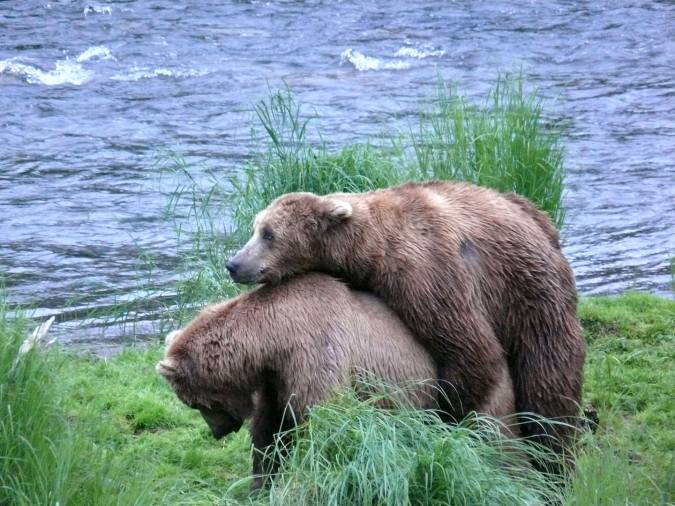
Copulation lasts upwards of twenty minutes. Brown bear females are promiscuous and may mate with more than one male. Her estrus cycle isn’t a single event. She can have several over the mating season, which generally runs May through July. Female black bears may be induced ovulators, so brown bears could be too, and while no evidence of multiple paternities has yet been confirmed at Brooks River, a single litter of cubs could have multiple fathers.
218 Ugly mates with 402 at Brooks Falls in 2010.
If mating is successful, the fertilized egg divides only a few times before entering a state of arrested development in the mother’s uterus. Only after she enters the den in the fall will the blastocyst begin to grow again. Through this delayed implantation, female bears can focus the rest of their summer efforts gaining enough fat reserves to survive hibernation. This allows cubs to be born in mid-winter when they are most protected in their mother’s den.
Over the next few weeks on bearcam, watch for male bears to doggedly follow single females. This is the most conspicuous sign of bear courtship, a season is marked by competition, conflict, persistence, and the promise of another generation of bears at Brooks River.
Explore.org, which hosts the world famous bearcams, asked viewers to share their brown bear stories. On their blog, I explain why the tale of a dying cub is one of the most surprising, interesting, and meaningful events I ever witnessed. You can read the post on explore’s blog or on Facebook.
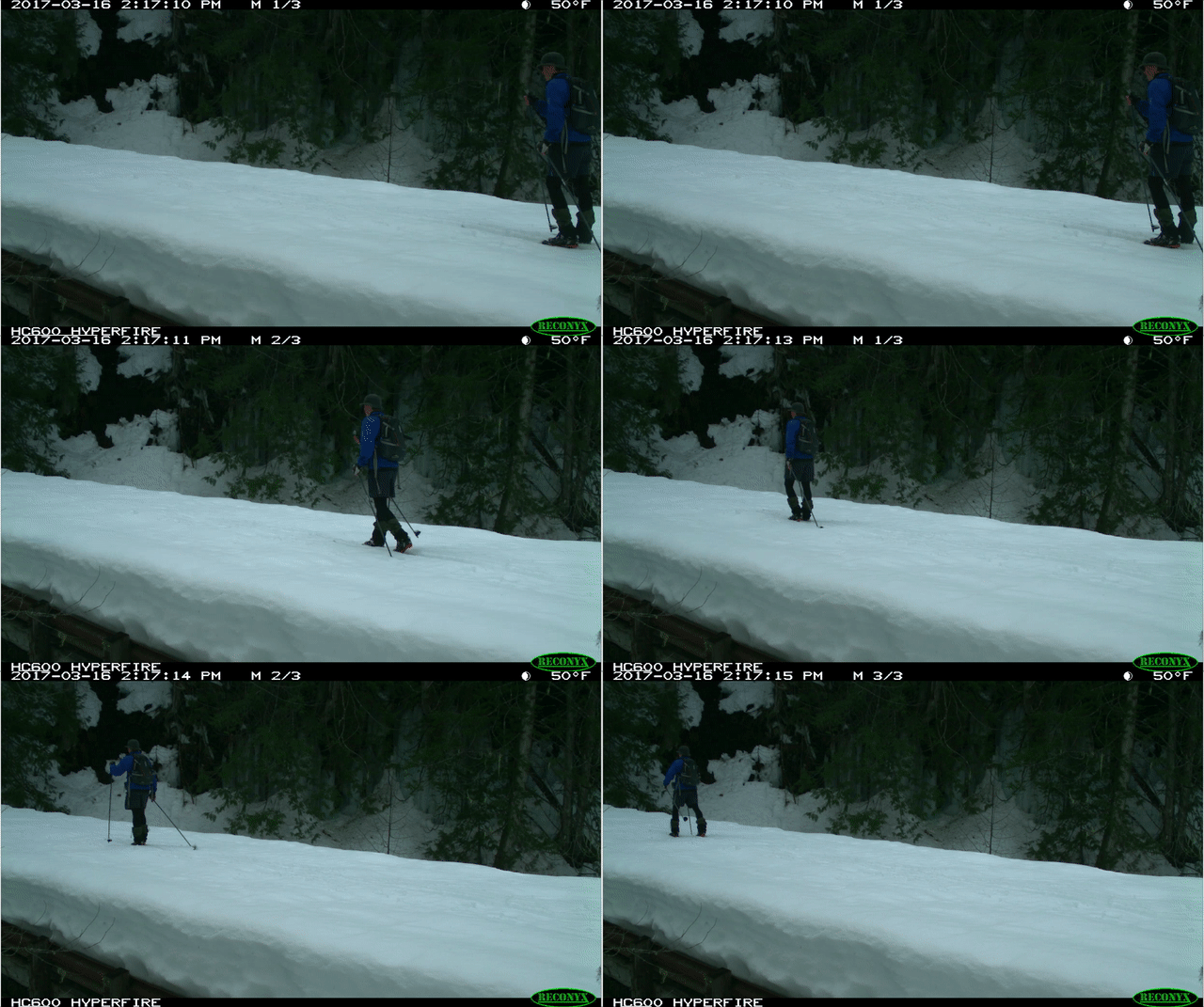
In February, I discovered wolverine tracks in the snow. After mentioning the tracks to a resource management specialist at North Cascades National Park, we decided to set up one of the park’s motion sensor trail cams hoping to capture photos of wolverines or any other animals that might wander by. The cam didn’t capture images of any wolverines, but it did reveal the presence of other large critters. (In this post, all photos from the trail cam are courtesy of North Cascades National Park Service Complex).
On March 20, I mounted the cam on a tree with a clear view of an unplowed, snow covered bridge over Stehekin River, surmising that the relative ease of crossing the bridge would funnel wildlife across it.
After setting up the cam, the first photos capture me skiing away.
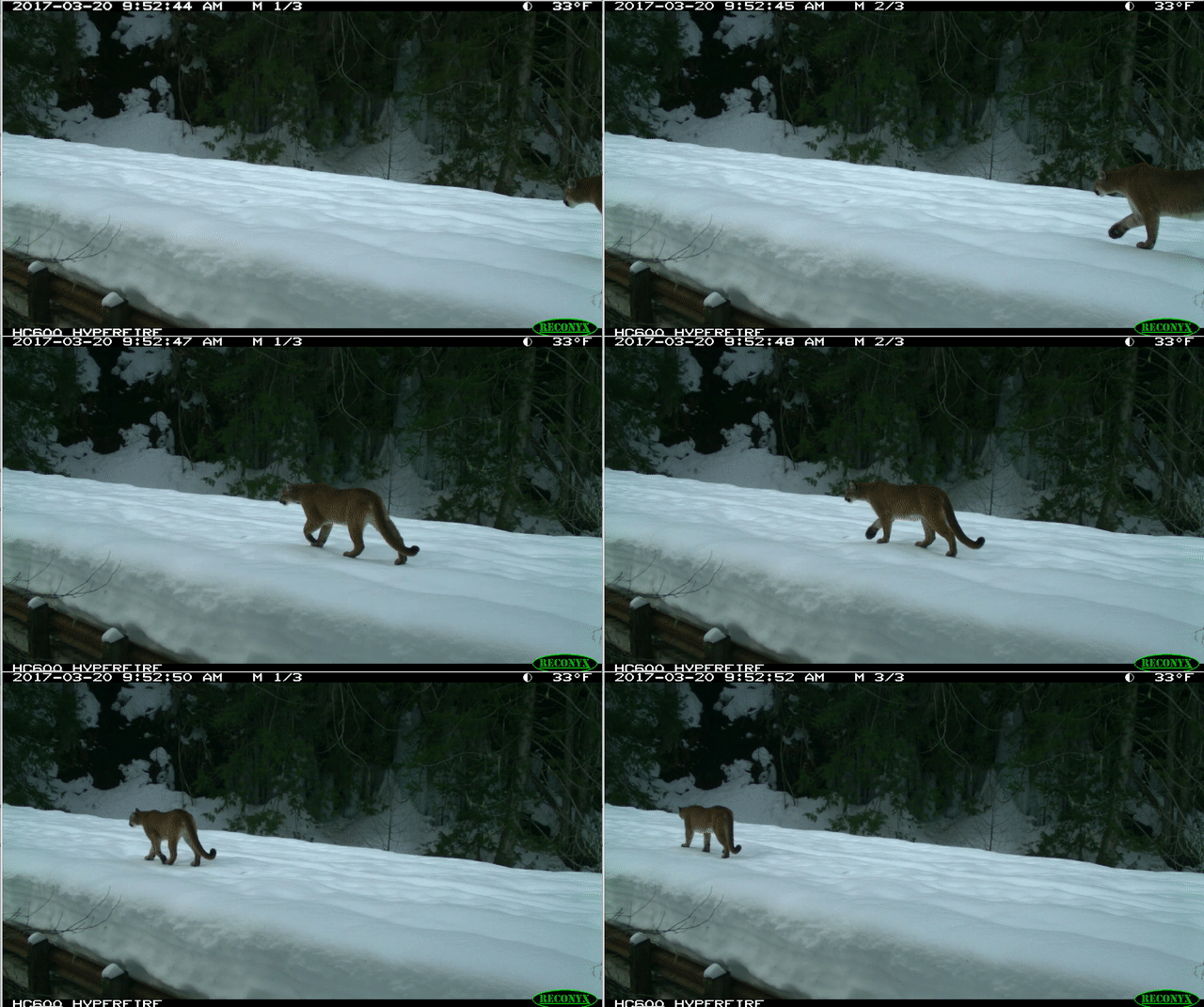
Nothing appears on the cam until March 30 when a mountain lion waltzes by!
I was surprised the mountain lion was in this habitat during late March. Many deer, the primary prey for Washington state’s cougars, inhabit the lower Stehekin River valley, but I had seen no tracks of those animals anywhere within five miles of the bridge. The four feet of snow in this location was still prohibitively deep for deer. Perhaps this was a male seeking females or simply one of the resident lions moving through its territory. I’m not sure, although I found a pair of lion tracks a couple of miles north along the Pacific Crest Trail three days afterward.
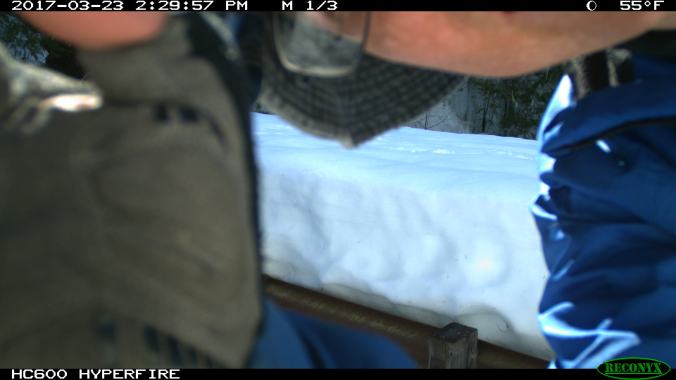
After swapping out the cam’s memory card on March 23…
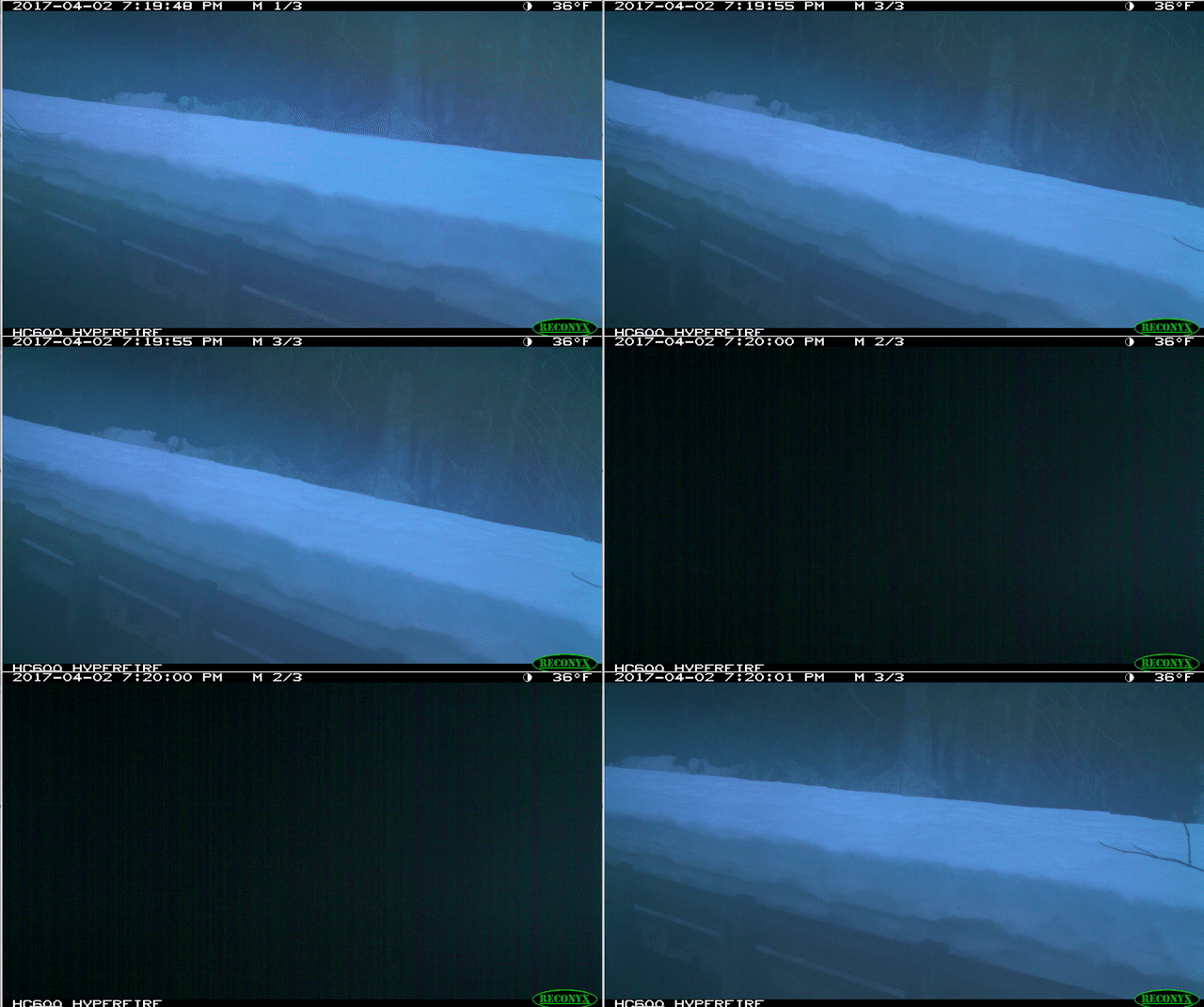
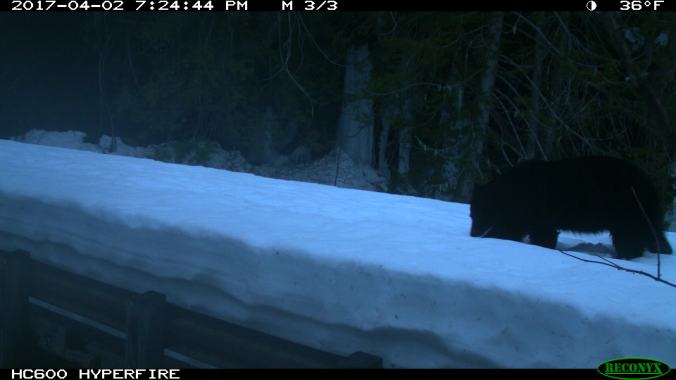
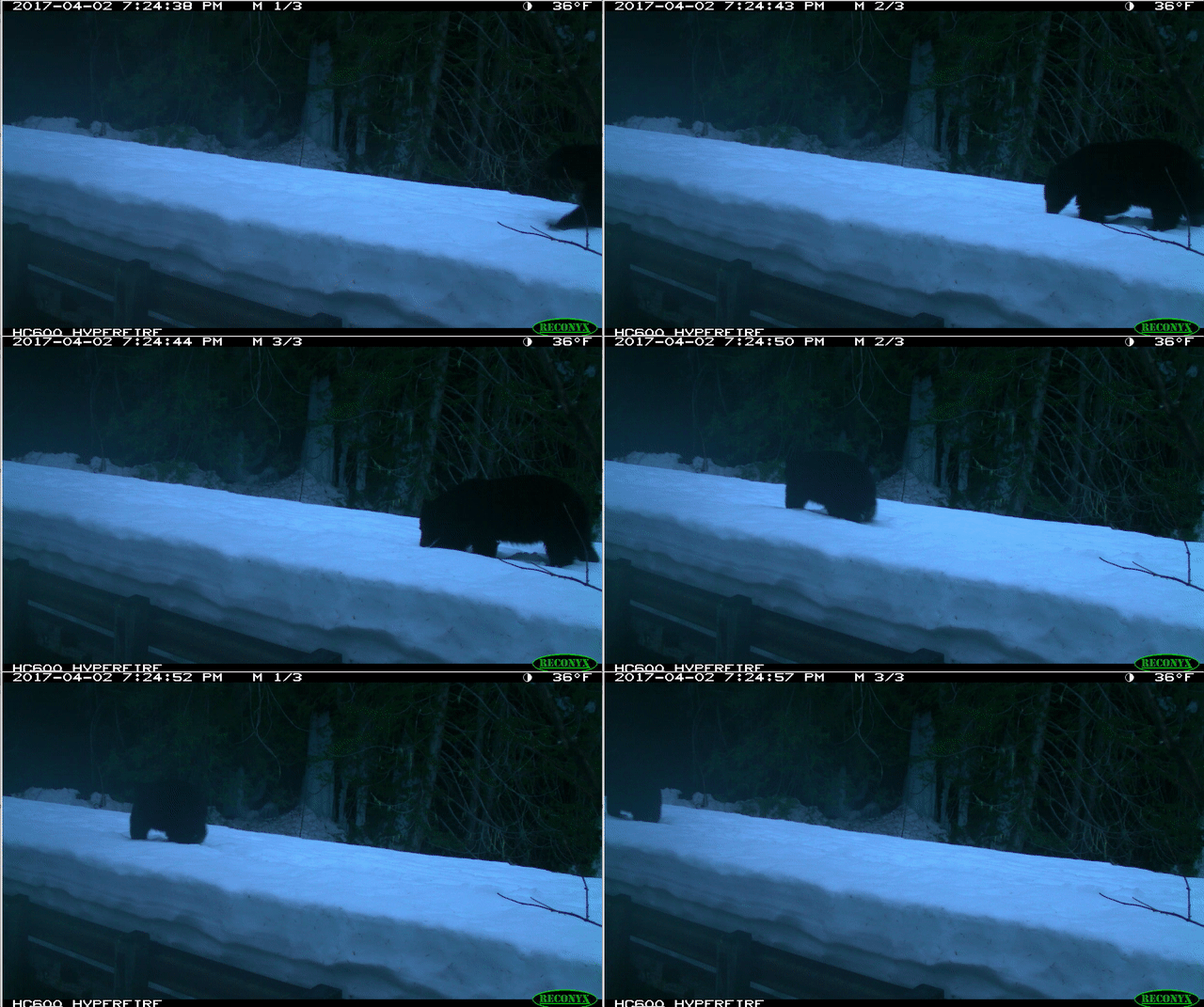
…I left the cam alone until April 3. When I returned I noticed some large, semi-fresh tracks post-holed across the bridge. Backtracking the animal’s movement, I found it walked right under the cam before crossing the bridge. Interestingly, the cam took many photos of an empty bridge the evening before I arrived. Something had nudged the cam, triggering it for 13 seconds according to the photos’ time stamps. One photo in the sequence is completely black as if something briefly covered the lens.
The culprit was revealed a few seconds later.
Bears are extremely curious. This one found the cam and investigated it seconds before walking across the bridge. Since black bears in the northeastern corner of the North Cascades begin to emerge from hibernation in early April, it may have been fresh out of the den. On the other side of the bridge it’s tracks continued straight up the hillside disappearing into the forest.
I know these animals live here with me. I see their tracks and scat somewhat often, but I encounter the living individuals less frequently. For me, the cam provided an enjoyable, albeit brief, glimpse into their lives.
Wilderness Watch, a non-profit advocacy and watchdog group for the National Wilderness Preservation System, opposes active restoration of grizzly bears in the North Cascades ecosystem. While their strict adherence to wilderness values is laudable, in this case it could lead to the extirpation of grizzlies from the ecosystem. Arbitrary wilderness values are not more important than the restoration of grizzlies.
Wilderness, as defined by the 1964 Wilderness Act, is “an area where the earth and its community of life are untrammeled by man, where man himself is a visitor who does not remain.” Importantly, the Wilderness Act states wilderness areas also preserve “wilderness character,” a set of values that link wilderness conditions with legislative intent. Federal land management agencies must manage wilderness so it maintains all aspects of wilderness character. Wilderness must remain untrammeled, natural, undeveloped, provide opportunities for solitude or primitive and unconfined recreation, and protect other features of value.
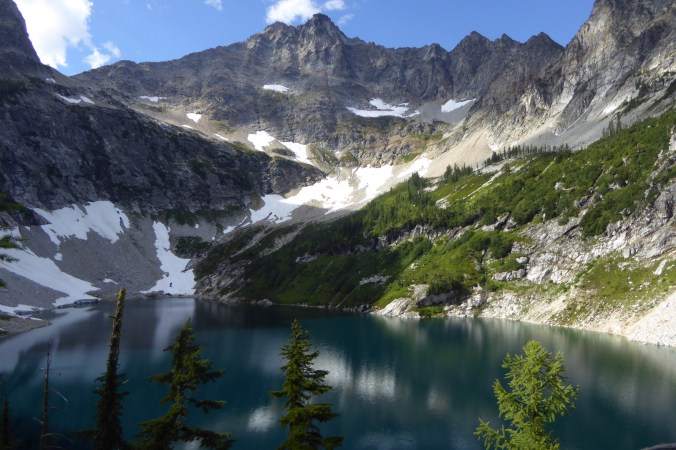
Green view lake sits below Goode Mountain in the Stephen Mather Wilderness, North Cascades National Park.
Any ecosystem manipulation in designated wilderness will affect some of these values, especially during the effort to restore grizzlies. Specifically, the Draft Grizzly Bear Restoration Plan will temporarily trammel the land by manipulating a species’ population. Additionally, helicopters flights can impact opportunities for solitude, and tracking collars on bears will affect the wilderness’s naturalness and undeveloped characteristics. For these reasons, Wilderness Watch advocates for a natural recovery alternative, which would allow bears to return on their own and offer the greatest adherence to wilderness character and values. They state:
Information is lacking on the status of grizzlies on the Canadian side of the border where two moderately sized provincial parks provide some protection for the bears.
For dubious reasons, a natural recovery alternative was rejected for further analysis. Instead, the DEIS considers only heavy-handed management alternatives.
The extensive use of helicopters would continue indefinitely for monitoring bear movement and numbers. This heavy-handed management would be detrimental to Wilderness and bears alike.
None of the current action alternatives, involving translocating bears, are compatible with Wilderness.
However, some of these assertions are incorrect. There is a “natural recovery alternative” in the draft restoration plan. It’s the no action alternative, or Alternative A. This alternative may need further revision to achieve Wilderness Watch’s goals, but it hasn’t been rejected for further analysis or excluded. Perhaps most importantly, if Wilderness Watch’s position is adopted by the National Park Service and U.S. Fish and Wildlife Service, it will likely lead to the extirpation of grizzlies in the ecosystem, where only six bears are thought to remain (Draft Grizzly Bear Restoration Plan, p. 90).
Grizzly bears are not doing well in southwestern British Columbia. Adjacent populations to the north are only slightly more numerous. Fewer than 30 grizzlies are estimated to live within the Stein-Nahatlatch and Garibaldi-Pitt areas (interactive map of grizzly populations in British Columbia). Under current conditions, no grizzly population in Canada or the U.S. is likely to expand and occupy the North Cascades region (Draft Grizzly Bear Restoration Plan, p. 88-89).
This map shows the current status of grizzly bear populations in British Columbia. Many areas of B.C. have healthy populations of grizzlies, but every population in southwest B.C. is either threatened or already extirpated. Red Circle is approximate area of North Cascades ecosystem.
Wilderness Watch is correct when they write, “None of the current action alternatives, involving translocating bears, are compatible with Wilderness.” In this case, helicopters and intensive management of translocated bears would impact the area’s wilderness character. The impacts may be unavoidable, but under certain conditions wilderness character can be manipulated for safety and management needs (i.e. invasive species removal). The NPS and USFWS would need to diligently consider ways to minimize impacts.
Anyone who is willing to share the ecosystem with bears and also wishes to preserve wilderness character should support Alternative B in the draft restoration plan, which proposes to introduce a small number of grizzly bears into the area, monitor them, then reevaluate whether more bears should be introduced. This offers the best compromise, in my opinion, between the no action (natural restoration) alternative and other options (alternatives C and D) that are much more heavy handed.
Wilderness and wilderness character is worth protecting. Groups like Wilderness Watch should continue to be a watchdog for designated wilderness. Yet, the effort to restore a healthy, self-sustaining population of grizzlies in North Cascades transcends arbitrary wilderness values. Bears need wild areas more than people.
I wish we could step back and let grizzly bears restore themselves. Nothing I’ve read indicates that’s a successful solution though. The North Cascades ecosystem was identified as one of six recovery zones for grizzlies in the Lower 48 partly because of its large, natural, and healthy wilderness areas. Bears can survive here, if we give them a push. I believe we can sacrifice a bit of our cultural need for an idealized, untrammeled wilderness to benefit grizzly bears. If we don’t act, if we allow grizzlies to disappear, then that would be one of the greatest trammels of all.






 Explore.org, which hosts the world famous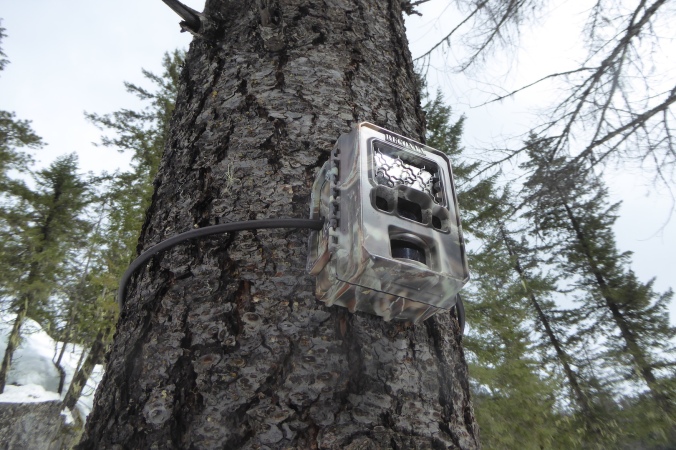


 Wandering at Large