Brown and black bears hibernate to avoid winter famine. For five to seven months, they do not eat, drink, urinate, or defecate, a strategy quite unlike other mammalian hibernators. Chipmunks, for example, cache food to eat in between bouts of torpor. Marmots and arctic ground squirrels don’t eat during winter and survive off of their fat stores like bears, but they activate their metabolism periodically to wake and urinate.
I recently spent about 40 hours reviewing studies related to hibernation and denning in brown bears for a chapter in my book on Brooks River’s bears and salmon, which reminded me just how remarkable this process is. While in the den, bears spend about 98% of their time not moving. Their heart rate declines dramatically from 50-60 beats per minute during summer to 10-20 per minute in hibernation. During this time, they hardly breathe, taking 1.5 breaths per minute on average. Their body temperature drops several degrees entering them into a state of hypothermia. Finally, the metabolic rate of a hibernating bear is 70-75% less than its summer peak. To survive, bears subsist on their body fat, catabolizing it into energy and water.
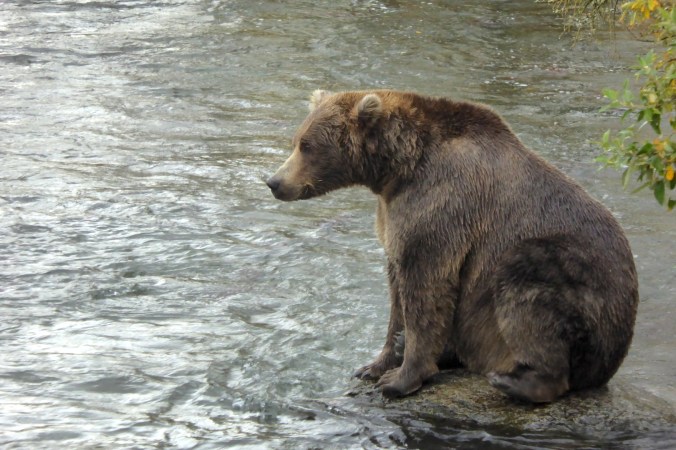
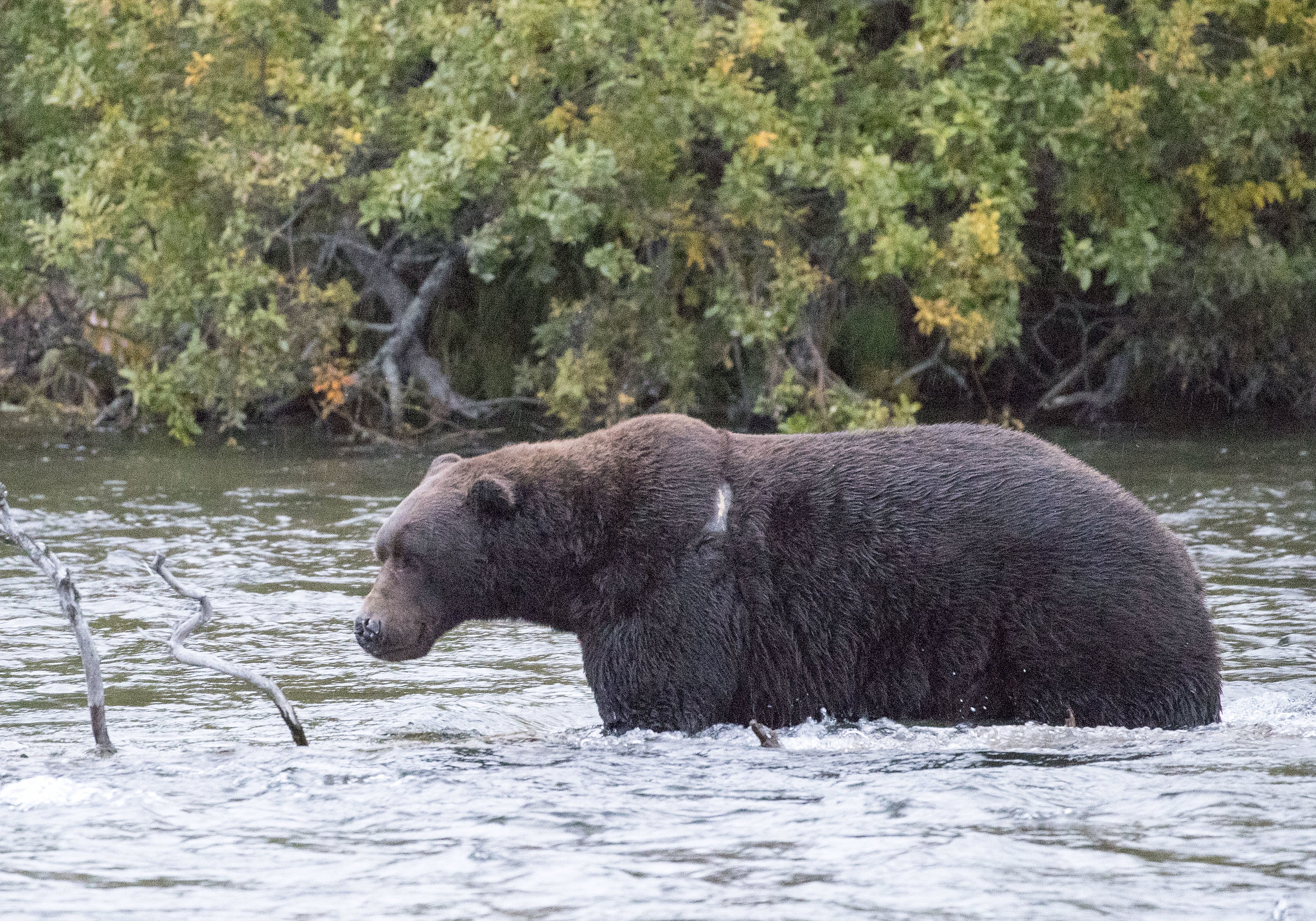
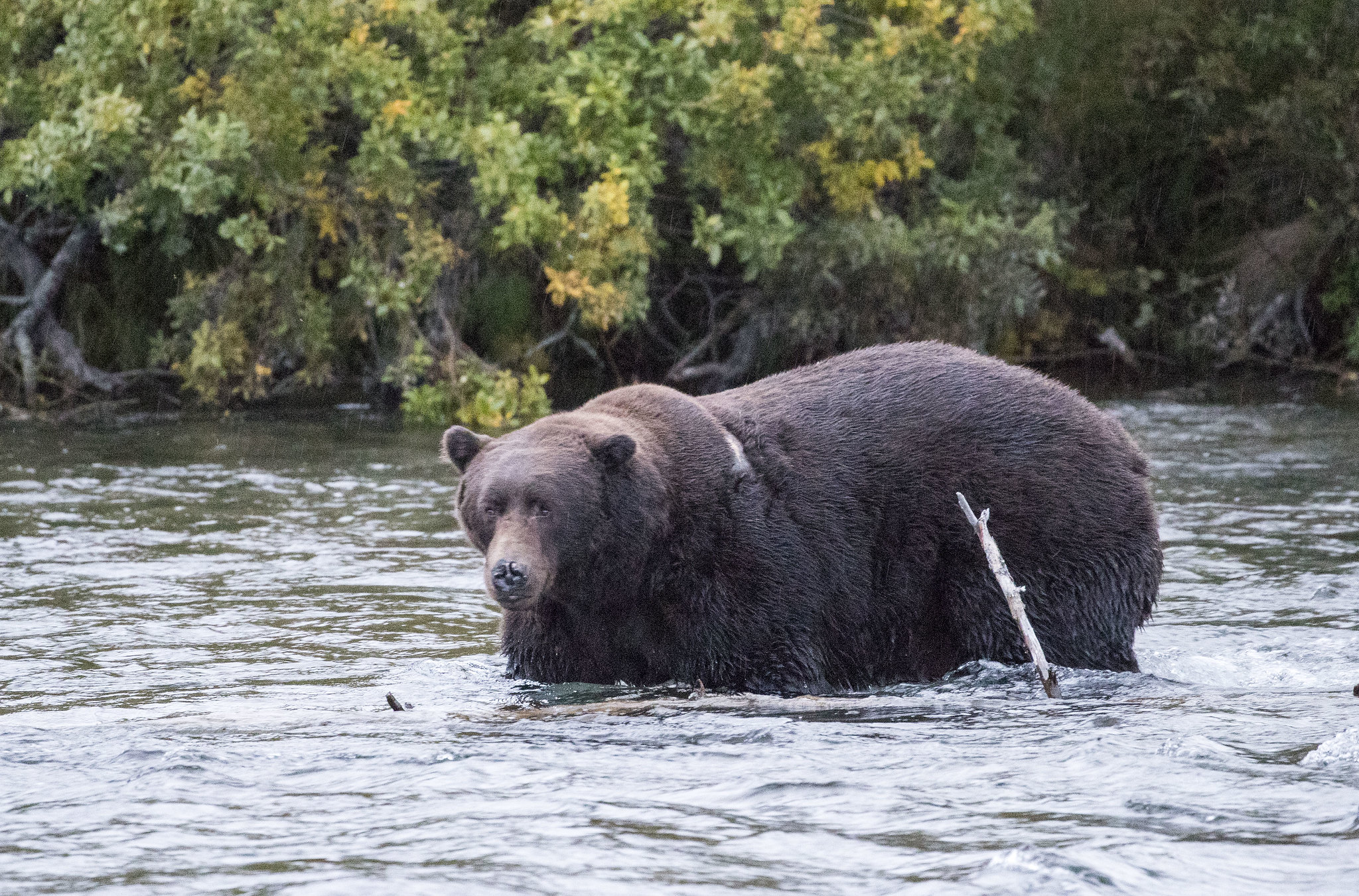
All brown bears, like this adult male known as 89 Backpack, get fat to survive.
Despite their lack of physical activity, hibernating bears maintain muscle strength and bone health. Even if immobilization didn’t cause starvation, osteoporosis, and atrophy in people, we would die of dehydration if placed in an equivalent situation. Hibernating bears, however, are nearly completely self-supporting. The only input they need from the outside world during hibernation is oxygen.
The physiology of bear hibernation is complicated and not fully understood. Scientists are still elucidating basic details about this remarkable process. For example, what causes bears to enter and exit the den? How long do bears need to switch their metabolism from to hibernating mode? As it turns out, the switch is a long process.
Researchers in Sweden used implanted heart rate monitors and GPS-enabled tracking collars on fourteen brown bears. The devices recorded the movement, heart rate, heart rate variability, and body temperature as well as ambient temperature and snow depth. The results, published last year in “Drivers of hibernation in the brown bear,” are insightful because it allowed the researchers to develop correlations between the variables that drive and trigger hibernation.
In fall, well before hibernation begins, body temperature and heart rate of bears began to decrease. Heart rate started to slow, on average, 24 days before den entry, and body temperature began to drop 13 days before den entry. Overall activity lessened 25 days before entry, but metabolic activity declined steeply just as the bears entered their dens. It took an additional 20 days after for heart rate and metabolic activity to bottom out.
The transition back to a more active physiology started long before bears left their dens. Heart and metabolic rate began to rise one month and 20 days, respectively, before den exit. Body temperature began to rise even earlier, a full two months before den exit when winter still locked the landscape in ice and snow. All bears left the den when their body temperature was 36.7˚C (98˚F) ± 0.15 °C, the active-state body temperature for brown bears. As the researchers note, the narrow temperature range at this time suggests bears exit the den when their body temperature reaches a specific point. Body temperature and metabolic rate stabilized 10 and 15 days, respectively, after den exit, but heart rate didn’t stabilize for another month.

These graphs chart the relationship between physiological parameters of brown bears in Sweden. Den entry (left column) and exit (right column) are indicated by time zero (the green vertical line) to determine the sequence of physiological events. SDANN is the standard deviation of heart rate variability over five minute intervals. It was used a proxy measure of metabolic activity. A red line denotes when a variable was decreasing, while a blue line indicates when a variable was increasing, with the number of days from the entry/exit indicated. From Drivers of Hibernation in the Brown Bear and reposted under the Creative Commons Attribution 4.0
International License.
Even though the bears’ physiology initiates the ultimate beginning and end of hibernation, climate plays a role in this process too. Changes to body temperature before den entry were affected by ambient air temperature, but bears largely relied upon a physiologic slowdown to cool themselves. In spring, bears left the den when the weather was right, exiting when air temperature rose to above 3.7˚C ± 1.5 ˚C (38.7˚F ± 2.7˚F). Some biologists have suggested that food availability drives the timing of den entry, but this study did not attempt to test the hypothesis.
As a survival strategy, bear hibernation is remarkably efficient, and no other animal attains the same physiologic feats. Small mammal hibernators wake to pee; bears don’t even need to do that. Changing from an active metabolism to one of hibernation and back again takes a lot of time. If you are fortunate enough to see a bear in the middle of fall or the middle of spring, that bear is likely living in a transitional body equipped to handle two worlds—one with food and one without.















 Wandering at Large