My neck of the woods isn’t like the Chihuahuan Desert, where nearly everything that photosynthesizes seems like it evolved to grab, shred, tear, puncture, and stab you (just try an off trail hike at Carlsbad Caverns National Park if you want the experience and say hello to the lechuguilla while you do). Nor is my habitat like the poison-oak dominated slopes found in coastal California where a careless walk through brush can leave you itchy for weeks. No, not like that. Heck, I don’t even need to worry about ticks.
Along the Skagit River, devil’s club and a couple of species of invasive blackberry will stop you in your tracks with their numerous, stout thorns. Besides those few, the list of plants to avoid drops off fairly quickly, with a notable exception. One of the most ecologically interesting and menacing members of my plant community is a nondescript perennial that’s easy to ignore until it’s too late.
Lots of plants are fuzzy with fine hair. Some plants, like common mullein (Verbascum thapsus), utilize hairs on their leaves and stem like sunscreen and to make grazing just a little uncomfortable for herbivores. Some hair is just there, perhaps not serving a specific adaptive purpose, or not one that we know currently. But one plant in my forest, Urtica dioica or stinging nettle, has turned their hairs up to 11.
Nettle is rather inconspicuous. It has oppositely-arranged, coarsely-toothed, and heart shaped leaves. Its flowers grow in small, string-like clusters from the leaf axils and lack petals, typical for a wind pollinated plant, but what it lacks in showiness it makes up in its ability to inflict pain.
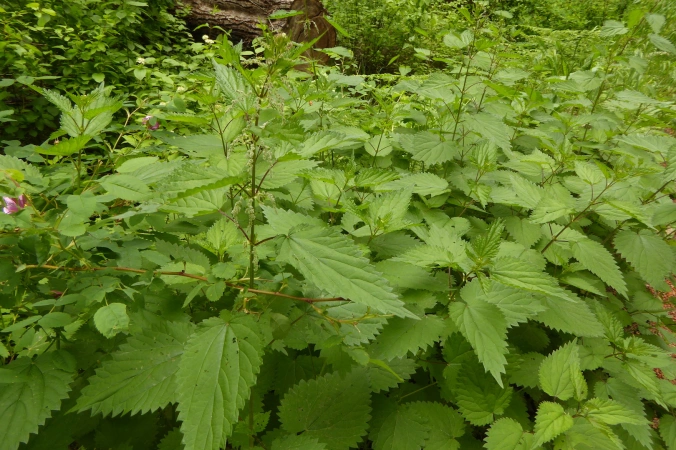
Stinging Nettle (Urtica dioica)
I learned about stinging nettle as a young teenager scrambling up a creek bank in Pennsylvania. The bank was steep and muddy. I needed just a little extra support to prevent me from sliding down. Lacking a tree to hold, I grabbed a group of herbaceous stems and immediately realized I had made a mistake. I made it up the bank, but the palms of my hands burned for the rest of the day. I was just introduced to nettle’s defense against mammalian herbivores.
Stinging nettle is equipped with tiny, but potent, stinging hairs. On the plants in my area, the hairs are particularly concentrated on the stems, flowers, petioles, and leaf undersides. Each hair is tipped with a small, fragile bulb that breaks off when contacted to expose a needle-like tip that, hardened by calcium carbonate and silica, readily injects a cocktail of chemicals into your skin. The stinging sensation is immediate and long lasting.
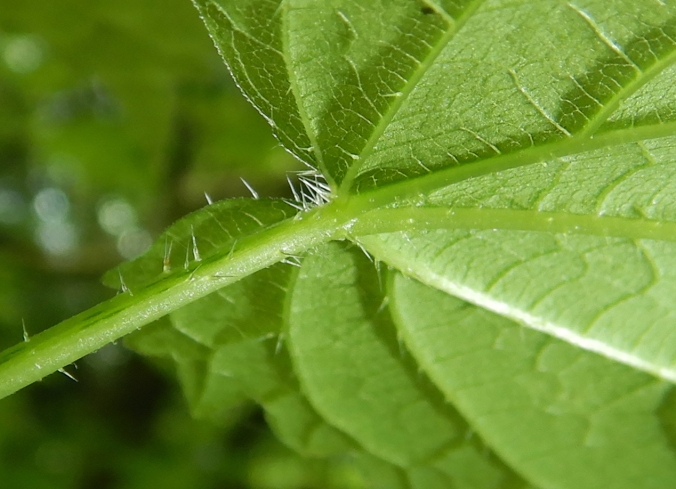

Among other chemicals, the juice inside a hair contains histamine, which is an inflammatory compound (we take antihistamines to inhibit the affects of allergic reactions), and serotonin, which constricts blood vessels and acts as a neurotransmitter. In sum, it is designed to irritate.
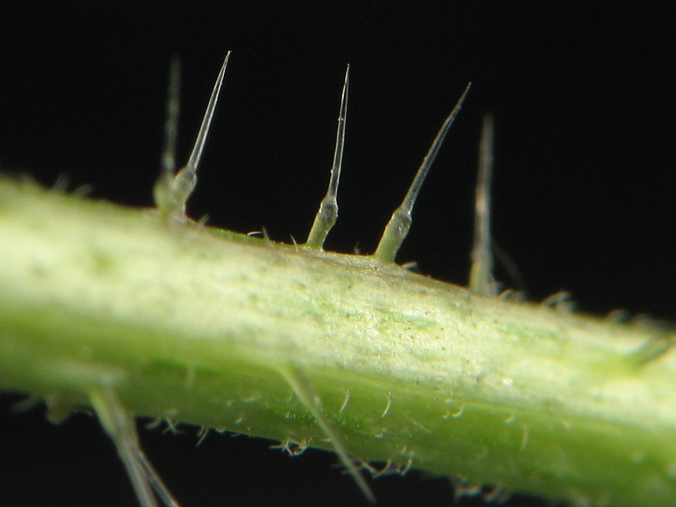
Photo courtesy Jerome Prohaska and Wikipedia.
Why the need for this defense? Nettle leaves are nutritious and high in vitamins A and C as well as protein. They would likely be a sought after commodity by deer and other browsing mammals if it weren’t for their stinging hairs.
We can neutralize the sting by drying or steaming the leaves. Steamed, the leaves taste as mild as spinach and they make a decent pesto.


The rash you get from poison ivy is an accident of evolution. The oily liquid, urushiol, which causes the itchy dermatitis on us doesn’t affect other North American mammals or birds. Your dog won’t get it. Deer eat the leaves. Many bird species relish poison ivy fruits for food. The stinging hairs on nettles tell a different story. They are purposefully indiscriminate against all mammals.
Plants, like all life forms, experience a wide variety of limiting factors. Stinging nettle may have evolved one way to dissuade herbivorous mammals, but the same defense doesn’t deter insects or snails. The stinging hairs don’t work on parasitic fungus or microorganisms either, nor on anything that attacks and eats its perennial rhizome. But, its stinging hairs work, quite well in fact for their evolved purpose—discouraging mammals from eating it.
Despite the pain nettle can inflict, I look forward to seeing it sprout each spring. It gives me an opportunity to reflect upon why it needs to evoke such discomfort in mammals. Stinging nettle is a plant with teeth. It fights back.




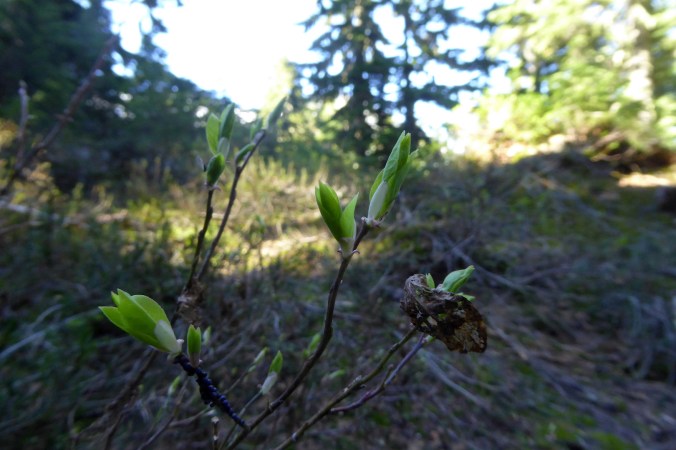
 Salmonberries (Rubus spectabilis) are moderately tall shrubs with compound leaves and bright magenta flowers. The flowers later produce large, raspberry-like fruit in various shades of yellow, orange, or scarlet. According to Cascade-Olympic Natural History, the plant’s common name derives from the fruit’s ability to cut the greasiness or fishiness of salmon, not from their color. Like many sugary, wild fruits, they are relished by more than humans. Recently, other critters have beaten me to the choicest berries.

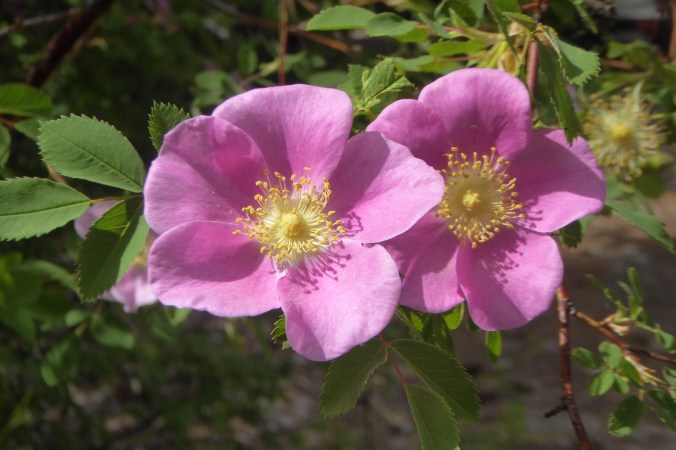

 To increase the skink level another notch, take a whiff of mountain-ash (Sorbus sp.) or yarrow (Achillea millifolium). Mountain-ash and yarrow are in different plant families, Roseaceae and Asteraceae respectively, but they share one trait: their flowers smell like shit.


 The train soon left the Kootenai River and passed through the Salish Mountains to the Flathead River valley. After Whitefish, Montana we began a slow climb toward the continental divide. Along the middle fork of the Flathead River, between Glacier National Park to the north and the Great Bear Wilderness to the south, lies one of the most scenic stretches of rail on the route. Every bend provided new views of the snow-capped mountains bounding the narrow valley.
 While I enjoyed the mountain scenery, for me the real highlight of this section was the stark contrasts in vegetation and climate. The low valleys on the west side Glacier National Park capture enough precipitation to support the growth of species also found within the wet forests Washington’s Cascades. At West Glacier I caught glimpses of the some of the eastern-most stands of western red-cedar (Thuja plicata). This species, you could say, likes it feet wet and it won’t grow where soil moisture is too low. In this part of North America, a lack of suitable habitat squeezes the red-cedars into narrower and narrower confines, and it quickly disappeared as we traveled east.
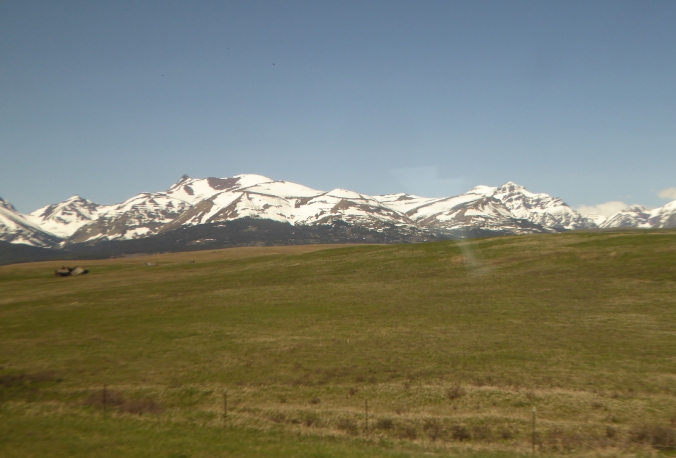 Like the Cascades, the Rocky Mountains create a strong rain shadow across northwestern Montana. Browning, MT, east of the mountains, receives only half the precipitation of West Glacier. For the next thousand miles across Montana and North Dakota prairie dominated where the land was not cultivated or otherwise appropriated by people. The only trees were either planted or grew along creek and river bottoms where their roots could tap into a shallow water table.
 Wildlife became easier to spot on the open prairie. Through Montana the railroad took us just south of the true
  In North Dakota, fracking wells became a prominent sight as the sun set.
 On the morning of my third and final full day on the train I woke up somewhere in Minnesota where the prairie had long since yielded to cornfields. This was, historically, a battleground between prairie and forest. In this area, where precipitation is great enough to support tree growth, fire was the prairie’s greatest ally. Periodic burning kept the forest at bay. After American settlement, the prairie was plowed and fires suppressed. Along this ecosystem margin today, you’re more likely to see farm fields bordered by trees than a patchwork of prairie and forest.
 …and the floodplain forest drowned in water.
 The train crossed the Mississippi one final time at La Crosse, WI. Heading upland into central Wisconsin, jack pine (Pinus banksiana) appeared on sandy soil. This species is essentially the eastern equivalent of lodgepole pine and the two hybridize where their ranges overlap. Like it’s western sibling, jack pine is well adapted to fire, often holding




 Wandering at Large

