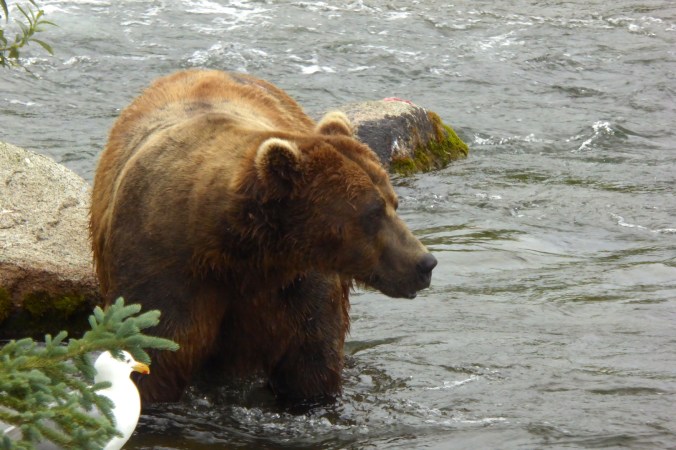
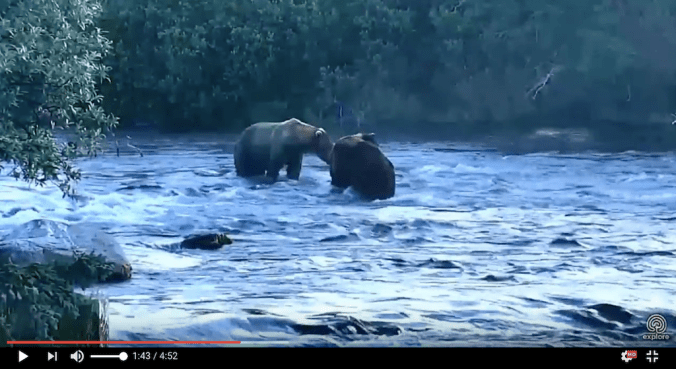
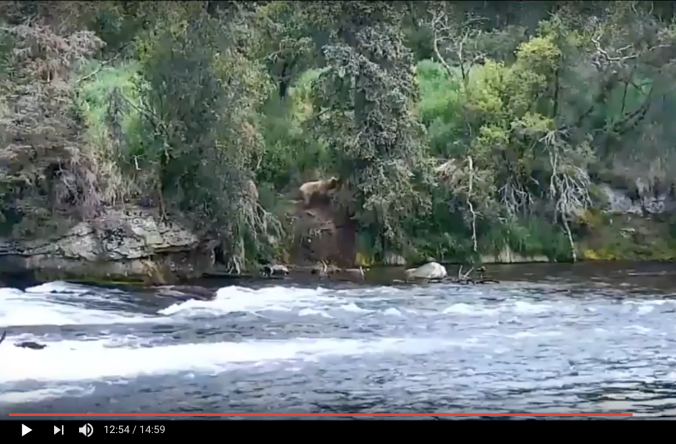
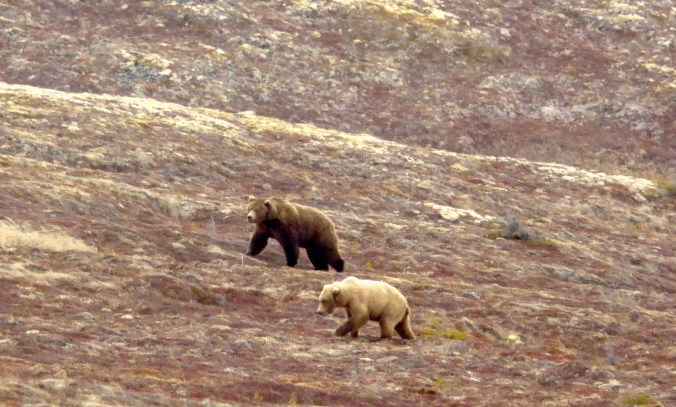
There is no average bear

In many ways, we can stereotype bears based on their age, sex, and reproductive status. While watching bears and even interacting with bears, certain stereotypes are useful. They help us begin to understand and explain a wide spectrum of behavior exhibited by a group of intelligent animals.

To stereotype a group of bears, adult males who rank at or near the top of the hierarchy are probably the least likely to act like a kid. They are the least likely to play or show overt curiosity towards new things. For most of bearcam’s history (2012-present) we’ve watched bears like 856, 747, and 814 dominate the falls through their size and assertiveness. These bears showed little interest in other bears except when establishing or reaffirming their dominance, stealing fish (especially 814 Lurch), appropriating preferred fishing spots, or when seeking a mate. Their behavior framed (biased?) our expectations of bears at the top of the hierarchy. They acted like stereotypical dominant males, and in their own ways, average bears.

But this logic can only take us so far, because there are no average bears.

This past July 32 Chunk displaced 856 as the most dominant bear at Brooks River. Chunk is approximately 12-13 years old and is perhaps the largest bear to use the river regularly this summer. Much of his behavior, especially early in Brooks River’s salmon run, is typical of a big dominant male. Not only did he displace other bears, he also wasn’t successfully challenged for food or fishing spots.

Notice how 856 quickly vacates the jacuzzi and doesn’t even attempt to challenge 32 Chunk.

Initially, 32 Chunk fit our expectations of a dominant male, but over the past two weeks or more bearcam has captured Chunk play fighting with another large, and older adult male, 755 Scare D Bear, as well as scavenging fish from him.

Just what is going on? Has Brooks Falls gone topsy-turvy in the wake of this summer’s hierarchy shift? Or this something more akin to the peculiarities of individual bear behavior during a summer when salmon are plentiful?

In July especially, Chunk fit the stereotype of a dominant adult male—challenging and displacing other bears, marking trees and cowboy walking in full view of other large males, and courting females. Since then, he’s behaved in ways that do not fit the dominant male stereotype—waiting patiently downstream of 755 for scraps of fish (a behavior more akin to scavenging than begging) and even initiating prolonged play fights with 755.

Play among adult male bears in their early teens is uncommon, but not unprecedented. I’ve previously wondered if bears outgrow play, and my personal observations suggest the frequency of play decreases as bears age. (I’m more surprised by 755 Scare D Bear’s willingness to play-fight, something I’ve never witnessed from him, than from 32’s).

Chunk’s play behavior separates him from bear 856 who was the most dominant bear seen through the entire history of bearcam until this summer. 856, like 24 BB before him, was hyper-dominant. As far as I know, this term has never been formally described in the scientific literature about bears. Tamara Olson, one of Katmai’s former bear biologists, introduced me to it. As I understand the term, hyper-dominance in bears is a willingness to continuously assert dominance over other competitors, giving them no slack, no chances to gain an edge. 856 became the river’s most dominant animal in 2011, when he was about the same age as Chunk is now. Once 856 became more dominant than 814 Lurch, for example, he repeatedly approached and displaced Lurch, perhaps in an effort to remind his large competitor, “Don’t challenge me or infringe on my space.”

Perhaps a lack of other large males who can challenge Chunk has allowed him to exhibit more playful and less hyper-dominant behavior. The relatively high abundance of salmon at Brooks River this summer also influences how bears interact with each other. To add another stereotype to the mix, bears are generally more playful and more tolerant of each other when they are well fed.

Because of his rank at the top of the hierarchy, we expect Chunk to behave like more like 856 than a youthful subadult. However, no biological edict commands Chunk to fit our expectations. His bimodal behavior is uncommon among adult male bears of his rank. Yet, Chunk can play-fight with other bears and still maintain an exceptionally high rank in the hierarchy.

The average bear is an amalgam of our observations and conclusions, created to help us better understand the lives of bears. No single bear will ever fit this role completely. Chunk can be both playful and dominant. He is no anomaly, because the average bear doesn’t exist.
Viral Bear Encounter with 435 Holly

Every once and a while a video from Brooks Camp goes viral. The latest involves a mother bear, her two spring cubs, and a person on the trail to the Brooks Camp Campground.

I’m a little late to opine on this video, but most of the responses and explanations (even Katmai’s, which explains what to do fairly well) seem to lack information about the bear’s behavior. Why did the mother bear and her cub approach the person?

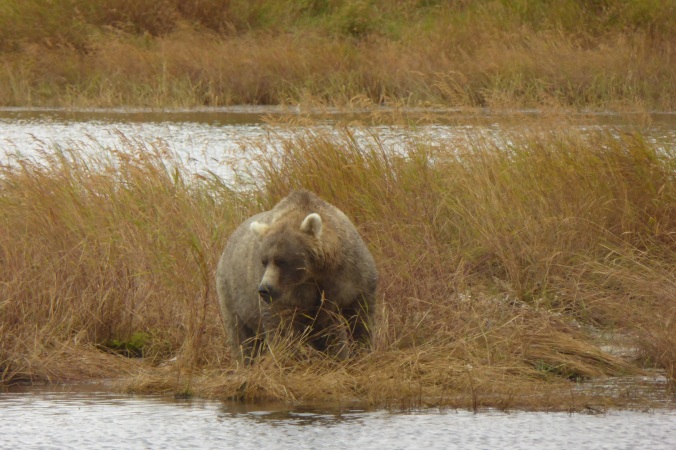
The mother bear in the video is known as 435 Holly, an adult female who was first identified in 2001. This bear has led a storied life so far, successfully caring for her injured yearling in 2007 and adopting an abandoned yearling in 2014.

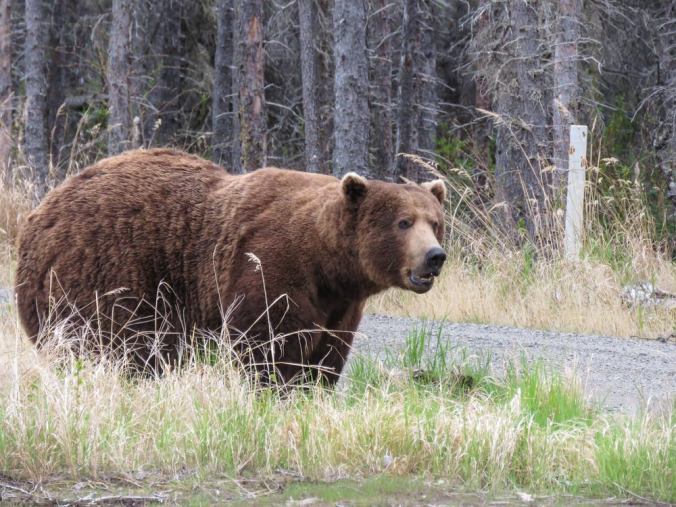
brown bear standing in grass near water

435 Holly in September 2015.

She’s also one of the most human habituated bears known at Brooks River. (Habituation, in this context, is a waning response to a neutral stimulus.) As a result, this bear is not as likely to react as defensively towards people compared to many other bears. Holly frequently uses the developed area from the river mouth to the campground, often traversing the area near Brooks Lodge, the NPS visitor center, and employee housing. She’s even treed herself near the bathrooms at Brooks Lodge and approached large groups of people.

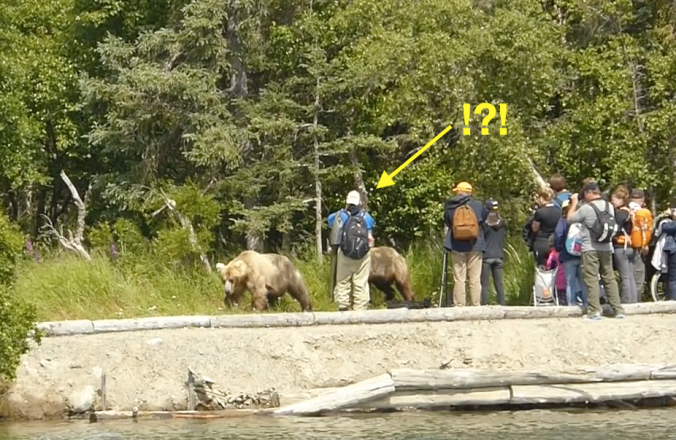
The ranger handled this particular situation well, gathering the group of people together to let the bears pass. Corralling people isn’t easy though. Despite the best efforts of rangers, some people are always willing to push the limit with bears.

Bear near group of people. Arrow pointing towards person who is separate from group.

It’s not a wise move to leave the safety of your group when a mother and cubs is only feet away.

On more than one occasion, I watched Holly walk down “Park Avenue” in front of my cabin, sometimes to avoid other bears and sometimes just because that was the easiest way to get where she was going.

Her behavior demonstrates a relative tolerance for people. She’s not shy about using the same trails as us, which brings me back to the viral video. 435 Holly has encountered many, many people at Brooks River and humans have largely been a neutral stimulus in her life. These factors enable situations like these to happen on a regular basis at Brooks River.

In the viral video, neither Holly nor her cubs show signs of stress or defensiveness. She doesn’t lower her head, her ears remain upright, and she makes no vocalizations. Holly’s cubs reflect their mother’s relaxed state, casually walking with and occasionally in front of mom. They know a human is near and as he backs away, she continues in the same direction. Holly, in this situation, wanted to use the trail. She did not threaten the person or act in a defensive manner.

Of course, there was real risk involved during the encounter and my thoughts should not be misconstrued to downplay the risk. Any encounter with a bear, especially a mother and cubs, needs to be taken seriously, for our own safety and also for the welfare of the animals. If this was different mother bear, with different tolerances and reaction distances around people, then the situation could be different.

This doesn’t mean the person on the trail would be mauled, however. At Brooks River, females with cubs who are not habituated to people are likely to be displaced from the river during periods of high human use, and we shouldn’t approach bears just because they’ve shown tolerance towards us in the past. In areas where bears need more individual space it is even more important to prevent close encounters.

This encounter with 435 Holly and her cubs was the result of a very human habituated bear needing to use the trail at the same time as a person. Her motivation, in this particular case, wasn’t a need to protect her cubs, assert dominance over a person, or even curious approach. It was simply to walk on the trail.

For information about what to do in encounters like this at Brooks Camp, please see Katmai National Park’s video response. That response however, is not usually applicable to bear encounters in other areas of North America.

End of an Era

The bear hierarchy is fluid. Bears jostle constantly within it, gaining and losing rank as they grow into adults and age into older bears. In 2017 at Brooks River, one bear has asserted his dominance over all others in ways he’s never done before. There appears to be a new dominant male on the river and he’s known as 32 Chunk.

bear standing in grass

32 Chunk in early June 2017. Photo courtesy of Katmai National Park.

In 2011, I began recording interactions between bears at Brooks Falls, noting who displaced who, who avoided who, and which bears were courting, stealing fish, and playing together. Out of hundreds of interactions I witnessed, one bear was consistently and clearly dominant over all others, 856.

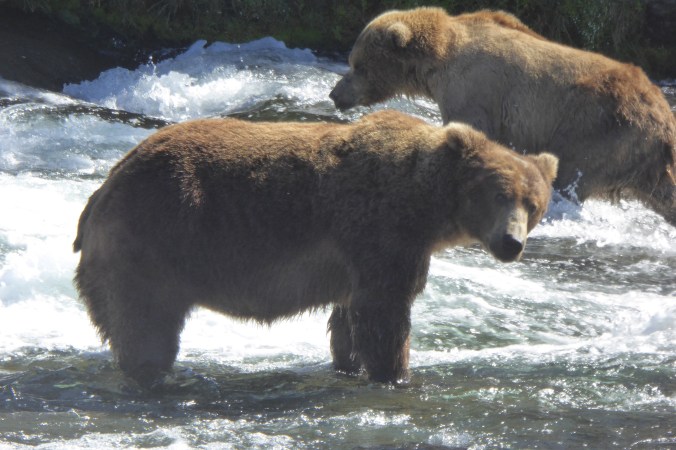
bear standing in water

856 stands in Brooks River on June 30, 2016.

From 2011 to 2016, 856 wasn’t displaced once. I only noted him yielding on very rare occasions, like when he faced a particularly defensive mother bear. No other bears even seemed to challenge him. 856 ascended to the top of the hierarchy rather quickly in 2011, outcompeting other large males like 814 Lurch and 747, and for many years remained the river’s most dominant bear.

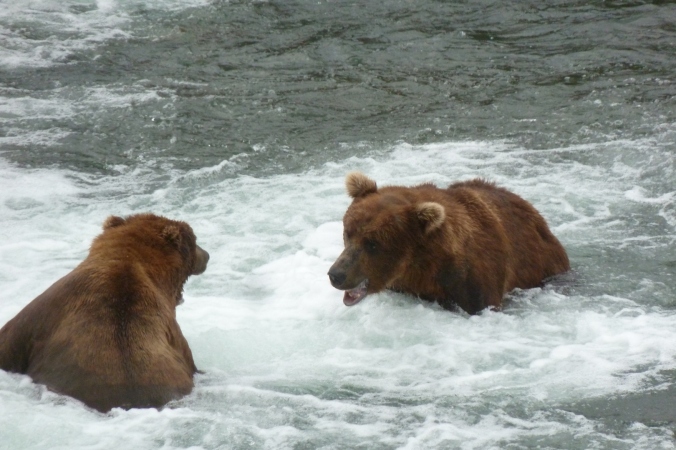
two bears facing each other in water

856 (right) displaces 747, another large adult male bear, from the jacuzzi in 2013.

Life at the top of the hierarchy is difficult, however. Other bears are subordinate, but not subservient, to more dominant animals. If injury, illness, or age weakens a dominant bear then others will not hesitate to usurp their position, gaining greater access to food and potential mates. Other bears, often younger and stronger, are more than willing to take your spot if given the opportunity.

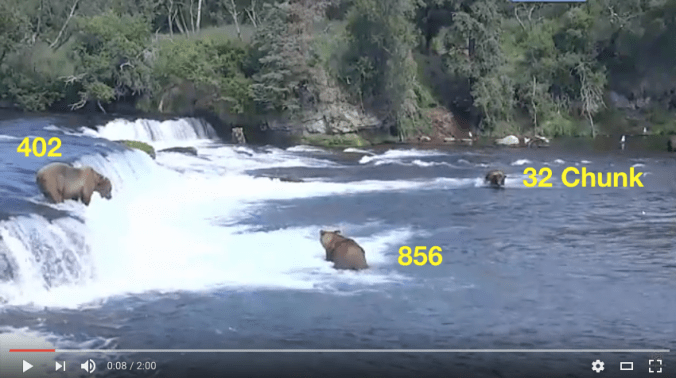
In the video above, 856 is the bear in the jacuzzi (the plunge pool below Brooks Falls) while 402, an adult female, stands on the lip. Notice how 856 turns to face the bear approaching from the far side of the river. This is 32 Chunk.

Screen shot from video. Three bears near a waterfall. Text reads "402," "856," and "32 Chunk."

856 backs out of the jacuzzi to avoid 32 Chunk. He then goes to the lip where 402 stands, but 32 Chunk follows. Above the falls, 856 makes no attempt to challenge Chunk. 856 stands and watches as 32 turns away from his competitor, like dominant bears are apt to do, and walks out of the frame.

Generally, when two bears of approximately the same size and disposition meet for the first time, both bears posture openly as they evaluate each other’s size and the potential to do physical harm. 856 yielded quickly and readily to 32, so they have encountered each other before the video above was recorded. During a previous encounter 32 Chunk may have asserting his dominance even more clearly, hence 856’s willingness to yield. 856 simply saw 32 approach and instantaneously realized he could not challenge the larger 32, so he backed away to avoid picking a fight he probably wouldn’t win. (Many, if not most, interactions between bears are like this. They are defined by avoidance.)

bear standing in water and facing the right side of the photo

32 Chunk in 2014, while he ranked in the middle of the bear hierarchy for adult males.

Nature abhors a vacuum. No niche is left unfilled within the bear hierarchy. 856, perhaps weakened by injury or age, appears to no longer be the most dominant bear at Brooks River. His younger competitor sensed weakness and exploited it. This isn’t a contest of longevity though. During his time as the most dominant bear, 856 had free reign over the best fishing spots and went unchallenged for access to females in estrus. For years, he grew large and strong, probably siring more than one litter of bear cubs along the way. Now 32 Chunk (and possibly other bears like 747) hold those advantages.

856 remains a large bear and his size will continue to allow him great access to fishing spots at Brooks River. Bears grow up quickly, gaining the strength and skills necessary to survive a harsh, competitive world. Eventually though, the competition catches up.

Hierarchy Shift

Brown bears live in a hierarchy, where dominance allows greater access to food and the most productive fishing areas. One recent interaction between bears 32 Chunk and 480 Otis represents a shift in this social order. This is a story of maturation for two bears going in opposite hierarchical directions.

The hierarchy at Brooks River allows bears to quickly assess their competitors, avoiding most physical fights and saving valuable energy. Within the hierarchy large, mature males rank highest followed by other adult males, females with cubs, single females, and finally subadult bears. While this pattern holds as a general rule, bears shift their position in the hierarchy depending on their size, strength, and overall health.

As an adult male in his early teens, 32 Chunk is well positioned to rank near the top of the hierarchy. Chunk was first identified in 2007 as a chunky subadult bear. We don’t know his exact age, but bear monitoring staff noted he appeared to be a young subadult, perhaps 3.5 or 4.5 years old at the time. Since then, he’s grown considerably and is among the largest bears at Brooks River.

small bear standing in grass

32 Chunk as a young subadult in 2007. Ten years later, he has grown to become one of the largest bears at Brooks River. (Photo courtesy of Jeanne Roy.)

In contrast, 480 Otis was a mature adult in his early teens in 2007. He was a big, walrus-shaped bear who, like today, was skilled at fishing in the jacuzzi and far pool. He was not often displaced from his preferred fishing spots.

bear in water

480 Otis in 2007. (NPS Photo)

In 2007 and 2008, a young subadult bear like Chunk wouldn’t even consider challenging a larger adult like Otis. Since then both bears have matured, but their life histories since then lead in different directions within the hierarchy. Recently, 32 Chunk demonstrated his dominance over the older 480 Otis.

When the video begins, 480 Otis is standing upstream of the falls in the middle of the river. 32 Chunk is the darker colored bear in the jacuzzi below the falls.

screen shot from video of waterfall. one bear sits below the falls and another is in the river above the falls

After Chunk notices Otis above the falls, he leaves the jacuzzi and begins to approach Otis.

screen shot from video of waterfall

480 Otis starts to move away, possibly to avoid 32 Chunk’s approach. This is one sign Otis could be subordinate to 32. The rest of the interaction leaves no doubt who is dominant, however.

screen shot from video. Dark bear approaching another bear above the waterfall.

Chunk moves through the river faster than Otis. When Chunk nears the older bear, Otis turns to face the younger competitor. They stand mostly still, yawning and assessing each other’s size.

screen shot from video. two bears standing in river above the falls.

32 Chunk then swats at 480 Otis.

screen shot from video. bear swats at another, splashing water

In the video, the bears’ ear positions aren’t easy to see, but 480’s ears seem to be held back against his head, indicating he’s somewhat defensive. Chunk’s ears, in contrast, are mostly upright and oriented forward, a sign of assertiveness and dominance in this context.

screen shot from video. two bears standing near each other in water

The interaction ends when 32 Chunk walks away with 480 Otis watching.

screen shot from video. Dark bear walking away from lighter bear

Several behavioral cues demonstrate 32 Chunk’s dominance and 480 Otis’ subordinate status in this interaction.

  • 32 directly approached 480.
  • 480 attempted to avoid 32.
  • 32 lunged at 480 and 480 did not attempt to engage.
  • 32’s ears were upright and forward, while 480’s ears were held slightly back against his head.
  • 32 ended the encounter, turning his back on 480 and walking away. (Dominant bears decide when an interaction ends unless they have good reason to usurp a resource such as food, a fishing spot, or access to a potential mate.)

Chunk is now entering the prime of his life where he’ll attain his greatest size and rank, and while Otis remains a large bear he’s no longer able to compete with the largest male bears for fishing spots. It seems that Chunk recognizes his size and strength and Otis recognizes the great risks of challenging a younger, larger bear. For the rest of the summer, 32 may displace 480 from fishing spots at Brooks Falls.

Chunk appears to be moving up the hierarchy while Otis continues to slide down it. With these bears, there are two tales of maturation.

When Mother Bears Collide (Again)

Last summer, 128 Grazer and 409 Beadnose found themselves face to face in defense of their cubs . Recently on bearcam, they had another dustup. This one was unique and included elements I had never observed before.

When we ask, “Why did that bear behave like that?” we should ask two additional questions.

  • Was the bear motivated by food or potential access to food?
  • Was the bear motivated by sex or reproductive success?

Biology can be distilled simplistically into two categories: food and sex. Adequate nutrition is necessary for survival of the individual, and since bears hibernate throughout much of the year they are particularly motivated by food. Reproduction also drives bears to behave in particular ways. We should also consider how each bear’s disposition influences their behavior.

128 Grazer
As a young adult bear, 128 Grazer became very skilled at fishing the lip of the falls. She’d compete for access to that spot with several other adult males and females. As a single bear (i.e. no cubs), she was fairly tolerant of other bears in close proximity. After 128 became a mother in 2016 though, her behavior became increasingly defensive. She didn’t shy away from confronting larger adult males in order to protect her cubs .

Still caring for three yearlings in 2017, she seems to be just as protective and wary as last year.

409 Beadnose
In contrast to Grazer, 409 Beadnose is an experienced mother who has weaned three litters (her current batch of yearlings is her fourth known litter). Beadnose can be defensive too, but tends to avoid confrontation more often than 128. While Grazer visited the falls with her spring cubs last summer, 409 did not. This is a clear behavioral change for Beadnose, because she visits the falls frequently when she’s not caring for cubs.

two bears standing in shallow water

128 Grazer (left) and 409 Beadnose are familiar with each other and often use the same areas to fish.

Now both of these mothers are raising yearlings, both have returned to Brooks Falls, and both tend to fish the same places (the lip or the far pool). Most importantly, both are competing for the same resources in order to successfully raise their cubs—leading to situations like this.

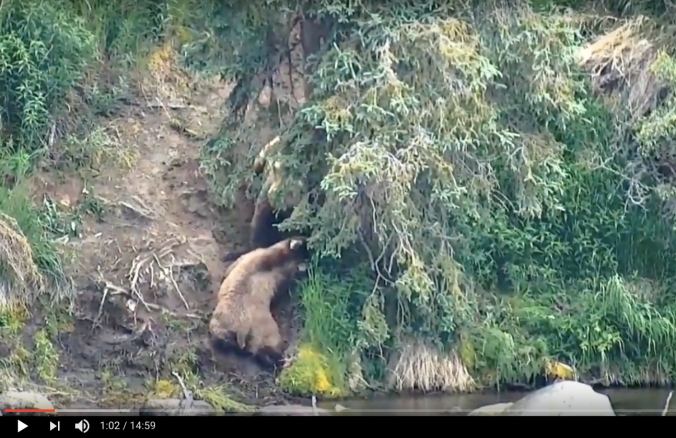
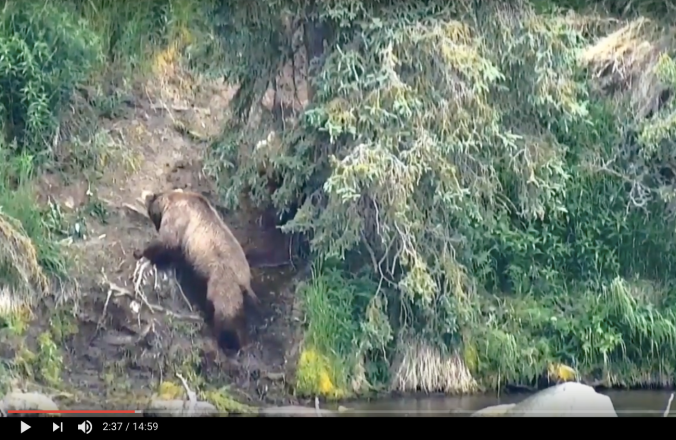
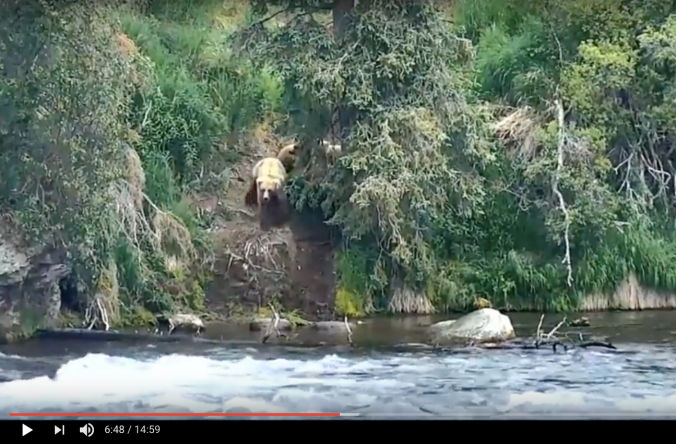
Can this apparent snafu be explained by a motivation for food or reproductive success? When the video begins, 409 Beadnose is ascending the hill. 128 Grazer is the blonder bear standing under the spruce tree. Grazer refuses to yield to Beadnose’s approach. The bears jaw and growl at each other, while 128’s yearlings remain in the spruce tree above their mom.

screen shot of bears beneath spruce tree

Beadnose seems compelled to get up the hill and skirts Grazer. There are other routes available, but she sticks with this one.

screen shot of brown bear on hill near spruce tree

Grazer’s cubs eventually come down from the tree while Beadnose lingers in the forest nearby. Something keeps Beadnose from moving farther away, but at this point we can’t see her.

bears standing on his near river

With 409 still on the hill, Grazer and cubs move down to the river. Shortly afterward her yearlings react to something in the same tree they had just climbed down from. Grazer begins to jaw pop, a loud and distinctive warning noise. We can see movement in the spruce tree above.

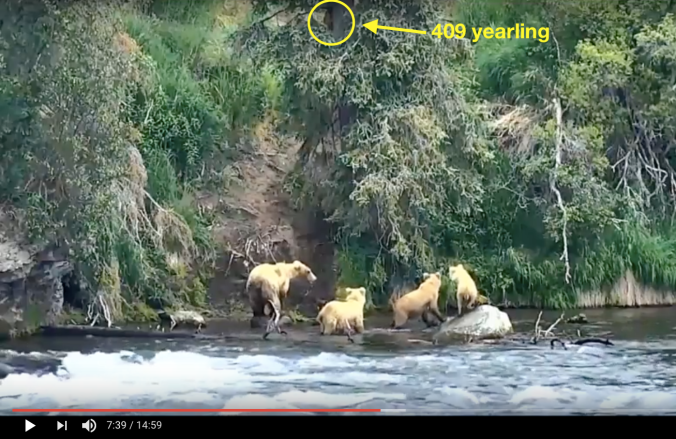
four bears standing in river near a steep embankment

It’s one of Beadnose’s cubs.

four bears standing in river. Yellow circle surrounds bear in tree. Text reads, "409 yearling"

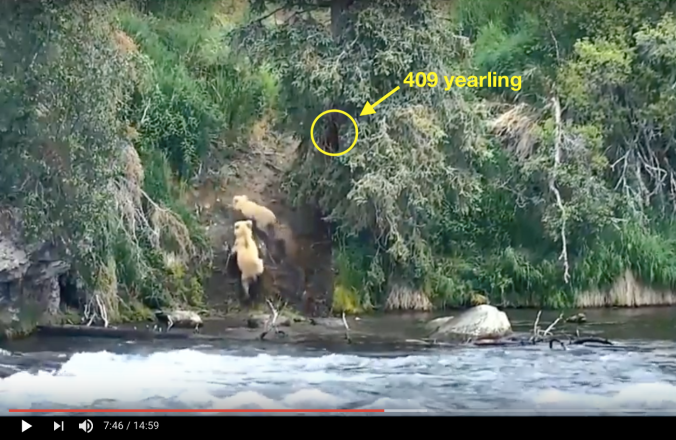
Grazer and her yearlings scramble up the hill just 409’s yearling tries to climb down. Now we understand why Beadnose didn’t give Grazer more space previously and why Beadnose remained in the forest near spruce tree—one of her cubs was in the same tree as Grazer’s cubs! This is something I never witnessed before, cubs from two litters in the same tree at the same time.

409 is mostly out of sight as 128 and cubs run up the hill. 409’s yearling though, is unable to get out of the tree.

Two bears climbing a hill. Yellow circle highlights a bear in a spruce tree. Text reads, "409 Yearling"

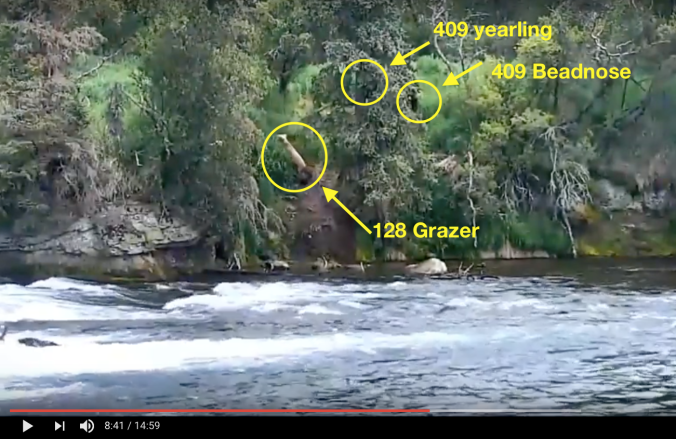
A short stand-off ensues. 409’s yearling remains in the tree, 409 stands not far up the hill, and 128 Grazer and yearlings remain close by.

Screen shot of bears on hill in vegetation. Yellow circles highlight location of bears. Text reads, from top to bottom, "409 yearling" "409 Beadnose" "128 Grazer"

When 409’s cub tries to climb down again, Grazer reacts and charges to the base of the tree.

screen shot of bear standing on hill near river

Grazer then climbs the tree, forcing Beadnose’s yearling back up. About ninety seconds later, 128 has moved farther away, which allows 409’s cub to climb out of the tree and rejoin its mother.

This interaction between Grazer and Beadnose was unique because cubs from two different litters were in the same tree at the same time, greatly complicating a situation where the families could’ve avoided each other. The interaction was ordinary however, because both Beadnose’s and Grazer’s behavior seemed to be motivated by an urge to protect their cubs. Grazer’s defensiveness is easily triggered and she must’ve viewed the 409 yearling as a threat, which in my opinion led her to chase it back up the tree. Beadnose may have realized Grazer was willing to physically fight in this situation. This could’ve deterred Beadnose from standing next to the tree under her cub. At the beginning of the video, Beadnose also couldn’t get her cub out of the tree with Grazer’s cubs still in it. Stuck in a Catch-22, Beadnose seemed to choose a more cautious tactic: move slightly away and wait.

Motivation for food or reproductive success explains quite a lot in biology, but not all bear behavior can be explained so simplistically (why would a bear play with her foot? ). The prolonged interaction between these families however, does fit one of the biological motivators. This interaction probably wasn’t hierarchical; that is, it wasn’t about asserting dominance for access to food and mates. It was about protecting offspring. In other words, it was about reproduction.

Brooks River Bears Need Your Help

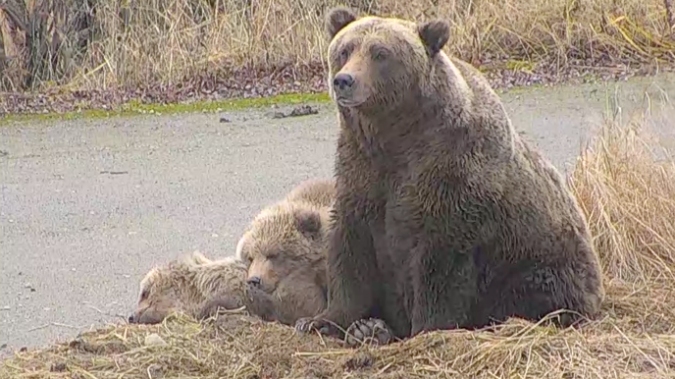
two sleeping bear cubs

402’s spring cubs rest near the Lower River Platform at Brooks River on October 24, 2013.

Addendum: Please read the response to this issue by Katmai’s Superintendent, Mark Sturm.

In 2017, an elevated bridge and boardwalk will be constructed at Brooks River. In this post, you’ll find a letter that asks Katmai National Park to further restrict the timing of staging and construction for the bridge. My reasoning is outlined in the letter. I wrote it because I believe no staging or work on the project should happen from late June to late July or September and October. Brooks River’s bears, especially those who are not habituated to people, need complete access to the lower river area in the fall. That is their last chance to gain weight before hibernation. The current work schedule allows staging and work to begin when bears need Brooks River most. This is not acceptable.

You are welcome to use the letter to contact the park. You can use it as is, or personalize it as you see fit. You can copy the letter’s text below or download the rich text file which can be used with almost all word processing software.

Before you contact Katmai with your thoughts, please consider the following…

  • The construction dates for the bridge project are in a federal contract which has already been awarded. If the dates can be modified it won’t be a simple process since it’s currently a contractual obligation. Don’t expect any change, if it comes, to be quick.
  • Form letters are easy to respond to, because the recipient only needs to write one response. Personalized messages often require more in-depth responses.
  • Phone calls can be more effective than written correspondence.
  • Be polite and respectful when you contact the park. The people who manage Katmai are intelligent and well-meaning. They do not deserve insults or personal attacks.

You can contact the park in several ways.

And now the letter:

Superintendent Sturm,

As you know, an elevated bridge and boardwalk will be constructed at Brooks River in 2017. The summary of work outlined in the project’s construction specifications generally restricts work and staging of equipment and supplies outside of July. Yet, it places minimal restrictions on staging and construction in late summer and fall. This will have serious impacts on bears who need full access to the river in September and October. I urge you to reconsider the construction schedule and modify the current contract to minimize the project’s impact on bears.

The construction schedule allows work in the river corridor to commence as soon as October 1. Work hours outlined in the construction specifications also permits staging on the spit at the mouth of Brooks River anytime after August 1. These activities can potentially displace many bears from the lower river, especially those who are not human-habituated.

Dozens of brown bears gather at Brooks River throughout September and October. The fall feeding period is especially critical, since bears are hyperphagic and need access to Brooks River’s abundant salmon. The river mouth provides salmon catch rates far higher than other areas of the river. Additionally, many bears who use the river in the fall are not habituated to people or vehicles. Habitat use by these bears is already restricted by the presence of people. Staging and construction in the fall will further displace these animals. Impacts to wildlife and the visitor experience from staging and construction of the bridge is of short duration, but can potentially be serious for individual bears who need to utilize the river. Bears that feed at Brooks River may do so because they know of no other or better place. For them, salmon in Brooks River ensures their yearly survival.

I understand that water levels in Naknek Lake provide a narrow window to transport materials and supplies to Brooks River, and often this can only occur in mid to late summer. However, this does not justify displacing bears from the food resources they need to survive, even for one season. Brooks River is a world famous bear viewing area. In FY16, the bearcams received 40 million hits. Brooks River’s wildlife deserves the highest level of protection possible. To do this, I urge you to place further restrictions on the construction schedule for the elevated bridge at Brooks River. Staging should only occur outside of July and September-October. Construction and clearing work in the river corridor should begin no sooner than November 1.

I look forward to your response and thank you for your time.


Addendum: Please read the response to this issue by Katmai’s Superintendent, Mark Sturm.

Bears Have Long Memories

Mother bear standing on rock. Her cub sits on the rock between her legs.Bear cubs are apt to reflect mom’s mood. When she’s relaxed, they are relaxed. When mom is alert and stressed, her cubs are on edge. Cubs also take a keen interest in anything that their mother investigates. In this way, they learn much about what to eat, where to find food, and many other survival skills. In this way, mother bears are teachers. However, mother bears may teach their cubs behaviors that lead to conflict with humans.

In a study recently published in the journal PLOS One, researchers from the University of Alberta found that behavior that leads to conflict with humans is not genetic. It is learned. Bears who were raised by mothers with a documented pattern of conflict with humans were more likely to be involved in conflict with humans as adult bears. The study identified 213 bears (118 males and 95 females) through DNA extracted from hair samples, then examined behavioral patterns in both father-offspring and mother-offspring relationships. The researchers concluded over 60% of offspring from “problem mothers” were likely to be “problem bears.”* In contrast, only 29% of bears from “problem fathers” were identified in bear-human conflicts. This was very similar to the percent of bears (30%) involved in bear-human conflict raised by mothers with no history of conflict with people. Since male bears have no role in raising cubs, the evidence in the study suggests that behavior leading to conflict with people is learned, not inherited through genes.

If you watch Katmai’s bearcams, you may be familiar with the escapades of 273 and her cub. These bears are famous for their curious and playful nature. Over the past two summers, they were prone to investigate almost anything that caught their attention. In 2015, they damaged buildings at Brooks Camp which prompted rangers to escalate their hazing techniques to deter them.

Tar paper shack surrounded by portable electric fence.

This building was damaged by 273 and cub in August 2015. I helped to erect the electric fence as a temporary deterrent to further damage.

They repeatedly damaged a sign near the bridge over Brooks River.

They caused wildlife technicians to photo-bomb a live chat on archeology.

They even played with unattended construction equipment.

I took the video of 273 and her cub with the construction equipment from inside a cabin last summer. Clearly, this family has demonstrated an interest in human objects and equipment. They are also relatively habituated to the presence of people. Since 273 has exposed her cub to people and buildings, does this increase the likelihood that the cub will repeat those behaviors when he becomes an independent bear? All signs point to yes.

I’ve long suspected that bears raised by highly human-habituated mothers are more likely to demonstrate high levels of habituation toward humans when they are adults. I’ve also suspected the same with bear-human conflict. If mom teaches her cubs to investigate human equipment or seek out human food, then the cubs are going to remember those experiences when they become independent bears. The study from Alberta provides some evidence to support my suspicions.

Does this mean that 273’s cub is destined to damage property at Brooks Camp? Not necessarily as long as rangers, lodge staff, and visitors at Brooks Camp are vigilant and actively work to eliminate conflict between bears and people. (Access to lots of natural food is extremely important too.)

Mother bears are teachers and cubs are students, but not everything cubs learn from mothers is advantageous in a world where habitat is increasingly crowded with people. Mother bears teach their cubs many survival skills, some of which can lead to conflict with humans. We can’t change the way bears live, nor should we. The onus is on us to act in ways that allow bears space to live and survive without learning behaviors that lead to conflict.

——-

*I discourage the use of “problem bears” as a term to describe bears involved in bear-human conflict. The term was used in the study, but this label stigmatizes bears in negative, anthropomorphic ways. These bears are only exploiting opportunities presented to them. The problem isn’t the bear. The problem is the temptations for conflict provided or caused by people.