Bearcam is back! While brown bears fishing at Brooks Falls are the cam’s main attraction, bears also engage in another important event—courtship. Bears make new cubs at this time of year.
Courtship is a conspicuous part of bear life in spring and early summer. Sometimes a male bear encounters a female bear at the right time and they copulate immediately, but more often bear courtship is a prolonged affair. From an ursine perspective, courtship is a process in which a male follows a female in estrus, habituating her to his presence until she is ready to mate.
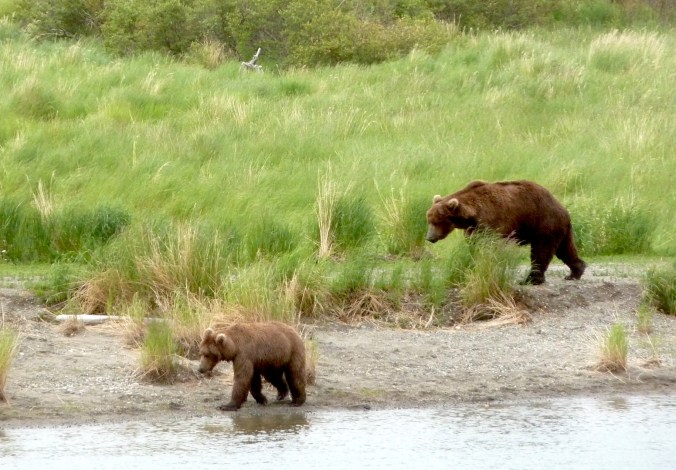
A large adult male, 856 (right), follows 708 Amelia while she was in estrus in 2013.
Courting pairs are easy to recognize by the male’s conspicuous and persistent behavior. A male bear recognizes an estrous female by her scent. He then walks behind her, shadowing her movements like he has a laser sight affixed to her rump (hormonally, the simile may not be far from the truth). However, bear courtship contains neither romance nor effort from the male to attract the female. He’s simply biding his time.
Copulation takes place only when the female is ready, which may not be for days. (The longest courtship I ever noted at Brooks River was 10 days.) It’s certainly not uncommon to see a male following a female for hours and hours.
Over those hours and days, the male follows her, guarding his access for the opportunity to mate. If another male of equal or greater dominance catches the female’s scent, then the two males may engage in a violent fight. Male testosterone levels peak, not coincidentally, in June as well. In late spring and early summer, fresh wounds on dominant adult males may be battle scars from a fight for access to a female bear. Bigger can be better in the bear world.
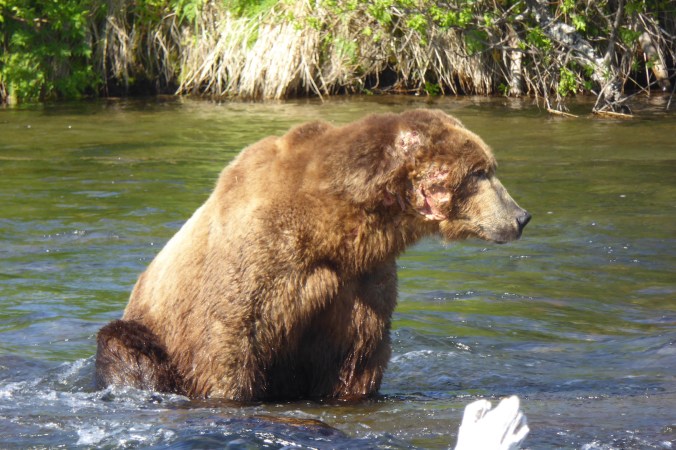
In June 2015, 814 Lurch returned to Brooks Falls missing an ear and with a large wound in his right cheek. These wounds could have been received during a fight with another male over access to a female.]
The victor continues his slow pursuit until the female decides the time is right. Outside of the mating season, male bears pose real threats to smaller females (sometimes, albeit very rarely, killing them) so the close, persistent proximity of a large male must be alarming at first. Eventually, hormones and habituation to the male overcome her initial trepidation.
Even then, the female may not be ready.
Copulation lasts upwards of twenty minutes. Brown bear females are promiscuous and may mate with more than one male. Her estrus cycle isn’t a single event. She can have several over the mating season, which generally runs May through July. Female black bears may be induced ovulators, so brown bears could be too, and while no evidence of multiple paternities has yet been confirmed at Brooks River, a single litter of cubs could have multiple fathers.
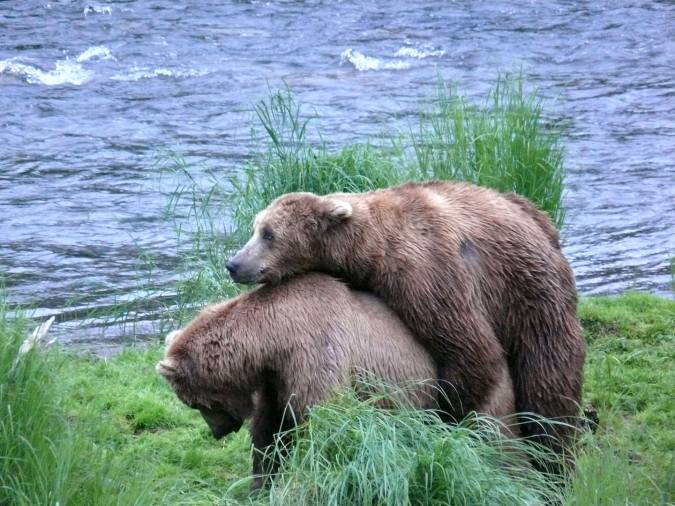
218 Ugly mates with 402 at Brooks Falls in 2010.
If mating is successful, the fertilized egg divides only a few times before entering a state of arrested development in the mother’s uterus. Only after she enters the den in the fall will the blastocyst begin to grow again. Through this delayed implantation, female bears can focus the rest of their summer efforts gaining enough fat reserves to survive hibernation. This allows cubs to be born in mid-winter when they are most protected in their mother’s den.
Over the next few weeks on bearcam, watch for male bears to doggedly follow single females. This is the most conspicuous sign of bear courtship, a season is marked by competition, conflict, persistence, and the promise of another generation of bears at Brooks River.
 Salmonberries (Rubus spectabilis) are moderately tall shrubs with compound leaves and bright magenta flowers. The flowers later produce large, raspberry-like fruit in various shades of yellow, orange, or scarlet. According to Cascade-Olympic Natural History, the plant’s common name derives from the fruit’s ability to cut the greasiness or fishiness of salmon, not from their color. Like many sugary, wild fruits, they are relished by more than humans. Recently, other critters have beaten me to the choicest berries.

 Explore.org, which hosts the world famous
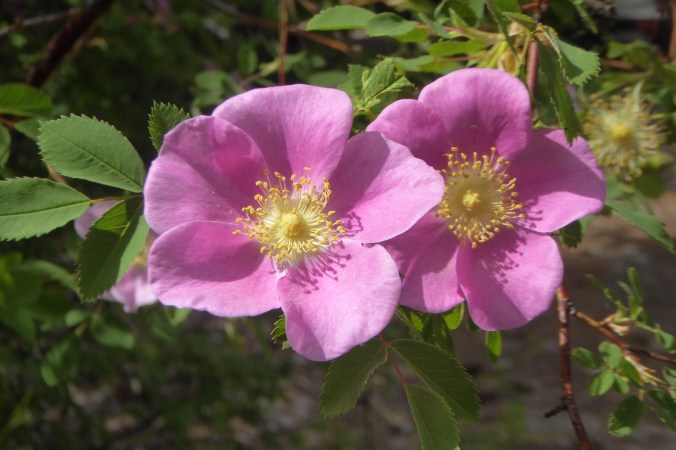

 To increase the skink level another notch, take a whiff of mountain-ash (Sorbus sp.) or yarrow (Achillea millifolium). Mountain-ash and yarrow are in different plant families, Roseaceae and Asteraceae respectively, but they share one trait: their flowers smell like shit.


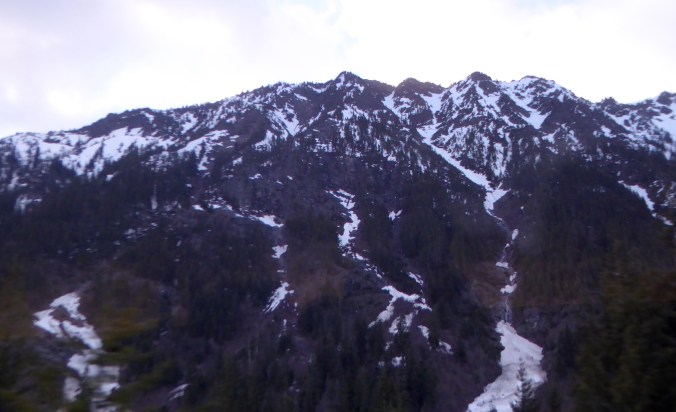
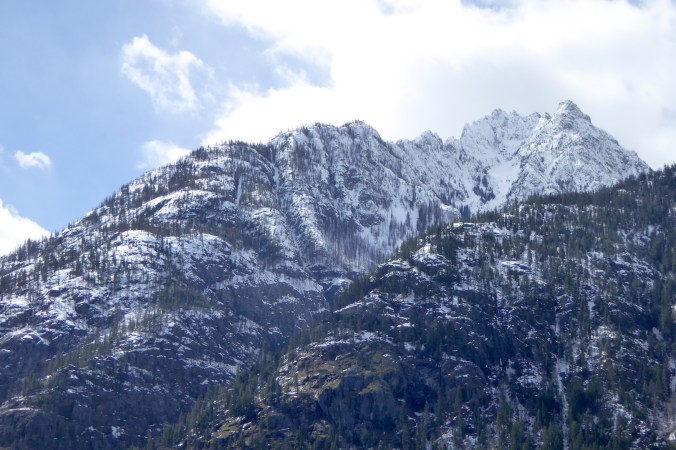
 The train soon left the Kootenai River and passed through the Salish Mountains to the Flathead River valley. After Whitefish, Montana we began a slow climb toward the continental divide. Along the middle fork of the Flathead River, between Glacier National Park to the north and the Great Bear Wilderness to the south, lies one of the most scenic stretches of rail on the route. Every bend provided new views of the snow-capped mountains bounding the narrow valley.
 While I enjoyed the mountain scenery, for me the real highlight of this section was the stark contrasts in vegetation and climate. The low valleys on the west side Glacier National Park capture enough precipitation to support the growth of species also found within the wet forests Washington’s Cascades. At West Glacier I caught glimpses of the some of the eastern-most stands of western red-cedar (Thuja plicata). This species, you could say, likes it feet wet and it won’t grow where soil moisture is too low. In this part of North America, a lack of suitable habitat squeezes the red-cedars into narrower and narrower confines, and it quickly disappeared as we traveled east.
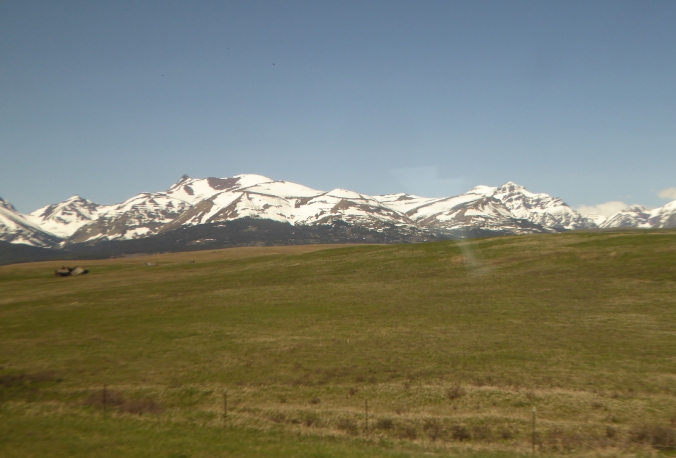 Like the Cascades, the Rocky Mountains create a strong rain shadow across northwestern Montana. Browning, MT, east of the mountains, receives only half the precipitation of West Glacier. For the next thousand miles across Montana and North Dakota prairie dominated where the land was not cultivated or otherwise appropriated by people. The only trees were either planted or grew along creek and river bottoms where their roots could tap into a shallow water table.
 Wildlife became easier to spot on the open prairie. Through Montana the railroad took us just south of the true
  In North Dakota, fracking wells became a prominent sight as the sun set.
 On the morning of my third and final full day on the train I woke up somewhere in Minnesota where the prairie had long since yielded to cornfields. This was, historically, a battleground between prairie and forest. In this area, where precipitation is great enough to support tree growth, fire was the prairie’s greatest ally. Periodic burning kept the forest at bay. After American settlement, the prairie was plowed and fires suppressed. Along this ecosystem margin today, you’re more likely to see farm fields bordered by trees than a patchwork of prairie and forest.
 …and the floodplain forest drowned in water.
 The train crossed the Mississippi one final time at La Crosse, WI. Heading upland into central Wisconsin, jack pine (Pinus banksiana) appeared on sandy soil. This species is essentially the eastern equivalent of lodgepole pine and the two hybridize where their ranges overlap. Like it’s western sibling, jack pine is well adapted to fire, often holding


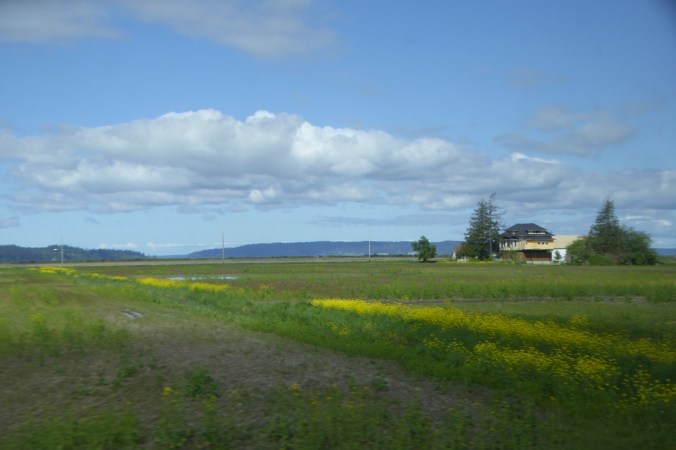 After transferring to the
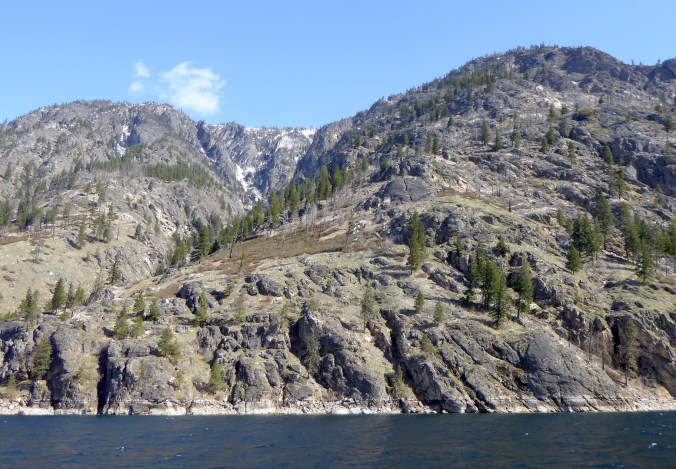
  This section of rail, besides letting me enjoy scenes of lush forest, provided a conspicuous example of habitat changes due to climate, particularly the Cascades’ rain shadow effect. When moisture-laden storms from the Pacific reach the Cascades, the rising air cools and drops a considerable amount of its moisture on the west side of the mountains. Far less remains to wet the mountains’ eastern slopes.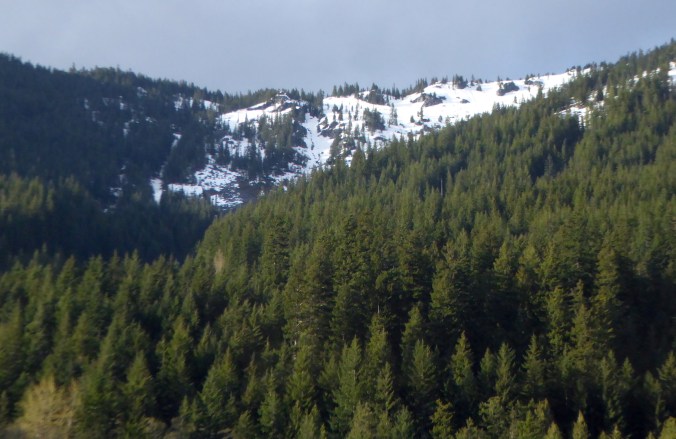
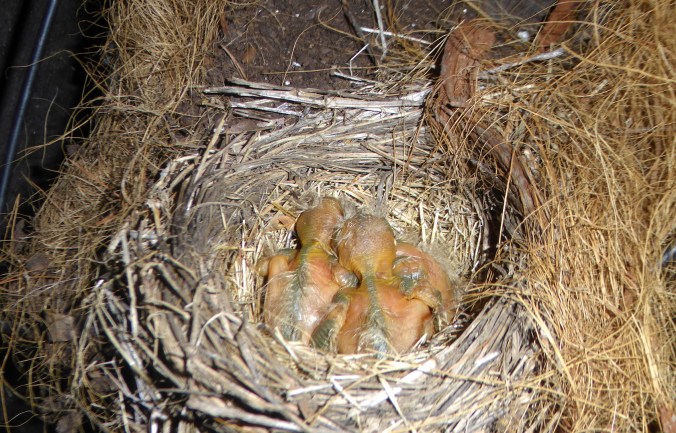 American robins, due to their tolerance of humans and our habitations, are fantastic birds to seek out in the spring, especially if you want to watch the nesting process. Last year, a robin built a nest under the roof eave of my house. It was a perfect location for the bird—secluded, hidden, and difficult for predators to access—and for me since the nest was only two feet outside of my bathroom window. It was a great opportunity to witness the growth and behavior the chicks in the nest, and I could watch it with minimal disturbance to the birds. Several times a day I watched the nest, the highlights of which I compiled into a video.




 Wandering at Large