A Close Encounter at Brooks River


Early today, bearcam captured a very close encounter of the ursine kind.

When the video begins, two people are walking out of the water in the direction of Brooks Lodge. A relatively small brown bear, probably a subadult, then begins to run towards them. Eventually, the bear gets very close to both individuals. Other than wading into very deep water, the couple had few options in this situation. Their only line of retreat was towards Brooks Lodge (the direction they were walking).
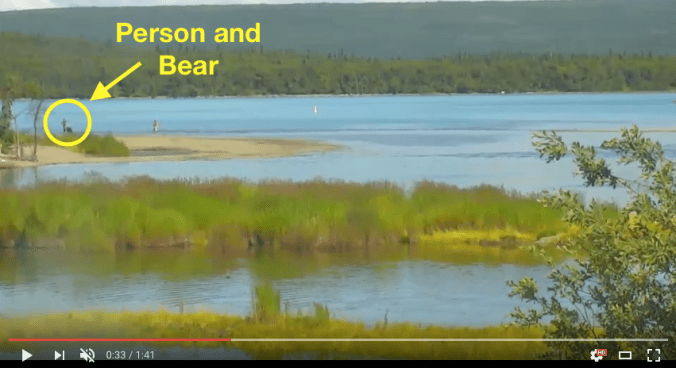
Screen shot of bear and person near each other. Text reads "Person and bear." The person and bear are in the yellow circle.

The bear could’ve approached the people for a few reasons. If the people were fishing and if they had a fish on their line, then this could have attracted the bear. If the bear had taken fish from anglers before, which happens at Brooks River, then it would be more likely to approach people as it searches for an easy meal. The splashing of their feet could’ve caught the bear’s attention. That’s a sound that mimics the sound of splashing fish, and for bears at Brooks River this is the sound of food. The bear could also have been attempting to play or assert its dominance.

The bear doesn’t look like it was charging the people defensively. Its bounds aren’t direct. In contrast to this bear, a charging bear moves very quickly in a straight line. Defensive bears, from what I’ve observed, do not deviate from their target until they decide to stop the charge.

There was one thing the couple could have done to reduce the chances of a scary encounter—stay together. Instead of walking 5-10 meters apart, they could’ve walked shoulder to shoulder. Size means a lot to a bear and bears are much less likely to approach groups of people compared to single people. Beyond anything else traveling in groups, especially groups of four or more people, is the most important step we can take to increase our level of safety in bear country. Most importantly, the couple could have not gone into that area.

People are permitted to be in that location, and often don’t consult rangers before doing so. However, I don’t necessarily place blame on them. Quite often, visitors are not aware how vulnerable they are in many places at Brooks River.

This is a place where people have a lot of freedom, maybe more so than any other well known bear viewing location in Alaska. The only area closed to people is the immediate area near Brooks Falls from June 15 to August 15. Situations like this don’t happen every day, but bears and people are often in very close proximity. I know many of us who watch the bearcam won’t visit Brooks Camp, but a few of us will. If you choose to visit, please consider ways in which you can minimize this type of encounter. I recommend staying on established trails and bear viewing from specific locations where bears expect to find people, like the wildlife viewing platforms. The river mouth often looks like a great place to be with its open sight lines. Yet, the depth of the water greatly limits where one can go to avoid bears. The river mouth from late June through July and again from late August through early October is wonderful habitat for bears. For this reason, everyone who visits Brooks Camp should consider not going into this area. This provides a higher level of safety for us and greater opportunities for bears to access the resources they need to survive without our interference.

Despite my best intentions over the years, I still got much too close to bears when I wasn’t paying attention to my surroundings, when I traveled into a spot where sight lines were limited, or when I was in an area where bears were likely to feed or rest. Close encounters will happen, but there are ways we can minimize the risk.

  • Watch bears from trails and the wildlife viewing platforms.
  • Avoid moving into areas where bears are likely to rest, play, or feed.
  • Give yourself two avenues of escape to avoid an approaching bear.

Related Posts:
Giving Bears Space
The Challenges of Managing Bears and People at Brooks Camp

Brooks River Water Temperature

Alaska is often described as a cold place, and justifiably so. Winters are long. Summer temperatures, especially on the Alaska Peninsula, are often damp and cool. It’s easy to imagine Brooks River’s water as bone-chillingly cold. But, just how cold is the water in Brooks River, the scene of bearcam? Brooks River is never very warm, but its temperature varies more than you might think. These temperature shifts can impact spawning salmon, but salmon are adapted to avoid the risk.

Staff from the National Park Service’s Southwest Alaska Network are tasked with monitoring the long term water quality in Katmai. During the summer, they install a data logger at the outlet of Lake Brooks where it drains into Brooks River to record water temperature. When the water temperature data is compiled into a graph, it displays quite a bit of variability.

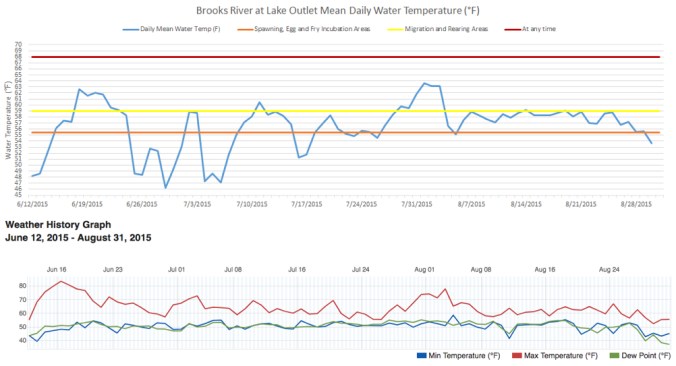
Graph of water temperatures at the head of Brooks River. Verticle axis is degees in fahrenheit. Horizontal axis is time.

This graph plots water temperatures for the head of Brooks River from mid June to late August 2015. The blue line is a daily average of hourly temperature readings. The horizontal red, yellow, and orange lines represent State of Alaska water temperature threshold standards for fish habitat. Data courtesy of the National Park Service Southwest Alaska Network.

During the height of summer, Brooks River’s temperatures can rise well into the 60˚s F (15-20˚ C). Temperatures also drop rapidly, sometimes as much as ten to fifteen degrees in a few days. The maximum temperature recorded in 2015 was 69 °F (21˚ C) on August 2 at 5 p.m. and the minimum temperature was 44 °F (6.7˚ C) on July 5 at 8 a.m. What explains this variability?

Weather and the underwater topography of Lake Brooks drive the rise and fall of the river’s temperature in summer. Brooks River drains Lake Brooks, a large glacially carved basin. Lake Brooks is filled with crystal clear water, and most of the lake is very cold so we could expect Brooks River to remain cold too if it weren’t for a shallow shelf of sediment extending a few hundred yards offshore from the lake’s northeastern shoreline. Over the shelf, the water is only a few feet deep at most.

Screen shot from Google Earth. Text on page reads "Lake Brooks" and "Beginning of Brooks River." Eye altitude is 4623 feet.

Near the head of Brooks River, a shelf of sediment extends far out into Lake Brooks. In this Google Earth image, the shelf is outlined in blue.

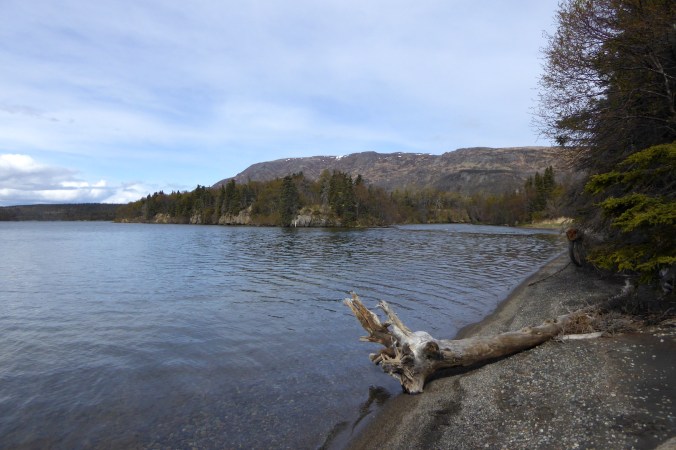
view of lake and mountain

Brooks River begins at the northeast corner of Lake Brooks. The beginning of the river can be seen at center right.

When summer’s long days (Katmai experiences almost 19 hours of daylight at the summer solstice) combine with stretches of clear and sunny weather, the water above this shelf is warmed considerably. When cool, cloudy weather covers the region, the water over the shelf drops in temperature. Wind across Lake Brooks can also help stir the lake, perhaps even breaking the thermocline between warm water on the surface and the cold water underneath. Even a rough comparison of weather and the river’s water temperature shows a clear correlation.

Water temperature graph (top) and weather data graph (bottom).

On the weather graph (bottom), the red line represents the daily maximum temperature, the blue line represents the daily minimum temperature, and the green line represents the dew point. Peaks in the river’s water temperatures roughly correspond with long stretches of warm weather. Weather data graph courtesy of wunderground.com.

While warmer water temperatures may not affect bears, salmon are sensitive to it. If water temperatures exceed certain limits, then dissolved oxygen levels in the water can drop, increasing mortality rates for adults salmon, fry, and eggs, or altering the timing of migration and spawning. Importantly, water temperature drives incubation time for salmon eggs. Incubation rates for salmon eggs are slower in cold water and faster in warmer water. If the sockeye salmon in Brook River spawned in July, for example, then warmer water would decrease the incubation period for the newly spawned eggs, potentially causing them to hatch too early when no food is available for the fry. These temperatures would also increase egg mortality. Sockeye and coho salmon egg survival plummets when water temperatures reach 14˚C (57˚ F). (See pages 9-15 in ADF&G’s Technical Report 91-1).

Vertical axis represents survival % from 0-100. Horizontal axis represents temperture in degrees Celcius from 0-15. Caption on figure reads "Figure 8. Survival of coho and sockeye salmon eggs from Fertilizations to hatching at different temperatures. Data from Murray and McPhail (1988).

This graph displays sockeye and coho egg mortality compared to water temperature. Graph courtesy of the Alaska Department of Fish of Game.

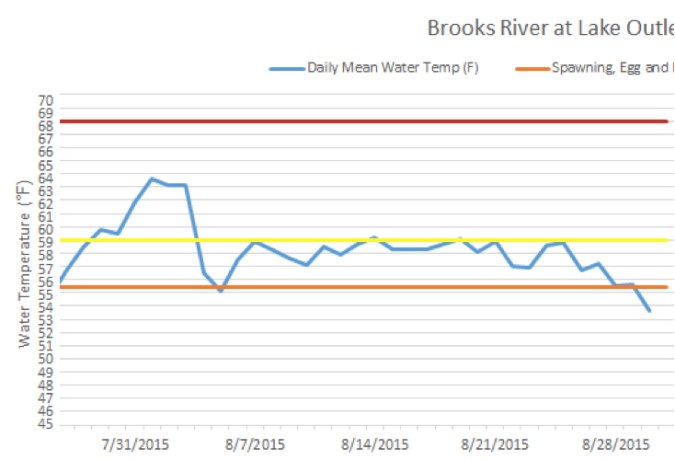
The sockeye salmon that spawn in Brooks River avoid this risk by delaying their spawning until late August and September. Notice how water temperature on the graph plateaus then begins to decrease by the end of August.

Graph of water temperatures for Brooks River in August 2015. Verticle axis is degees in fahrenheit. Horizontal axis is time.

By late summer, day length has shortened by many hours. With less sunlight available to warm the water near the outlet of Lake Brooks, temperatures eventually dip well within ideal thresholds for spawning and egg incubation. The river’s salmon take advantage of these conditions by delaying their spawning until late summer and fall when cooler water temperatures, which continue to drop as fall wanes into winter, slow the salmon eggs’ incubation time. They don’t hatch until very late winter, and the fry don’t emerge from the stream gravel until spring when water temperatures begin to rise again and more sunlight supports more plankton, which feed the young salmon.

Brooks River is a dynamic place. No one week, no one year is the same as the last. Salmon, at least genetically, understand this. They “know” spawning in July would be risky business and probably unsuccessful. Their spawning cycle is timed to avoid the warmest and most variable water temperatures. In this way, every year, Brooks River’s salmon demonstrate their adaptation to variable conditions.

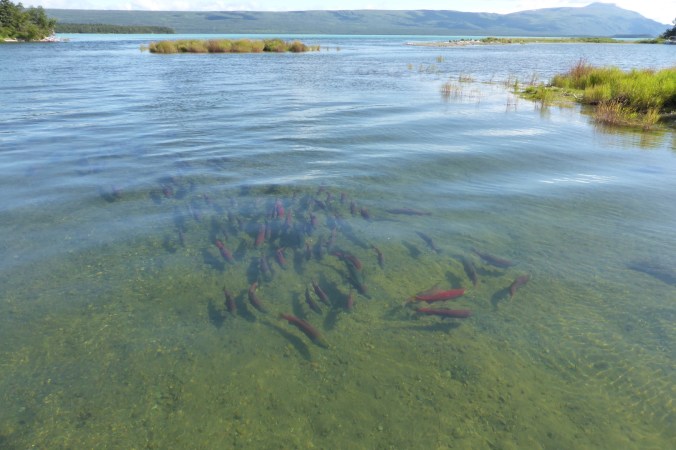
school of salmon in water with lake and mountains in background

Chunk Didn’t Displace 856

A few days ago, bearcam viewers alerted me to an interesting interaction at Brooks Falls where 32 Chunk appeared to displace 856.

I’ve taken some time to review bearcam footage of the subordinate bear in the video above, and I don’t think he is 856. The bear looks like an adult male, based on his size and the presence of scars around his face. I don’t recognize him, but I am willing to say it is not 856. Here’s why…

856 is a large adult male with blond ears and a long neck. This year he returned with a noticeable limp and sports a shed patch on his rump.

856 will fish at several different places in the falls—the jacuzzi, in the far pool, and near the rocks in between. When he sits at the rocks, he does so in a fairly distinctive manner.

When 856 fishes the jacuzzi, he’ll often leave that spot to eat near the island, almost sitting and facing away from the cam.

In contrast to these behaviors, the bear displaced by 32 Chunk doesn’t appear to be limping (and I’ll admit that bears can heal quickly, so the limp may not be very pronounced now). Both 856 and the unidentified bear may have similar wounds or scars on their face, the ears of the bear displaced by 32 Chunk are darker. The contrast between the unidentified male bear’s front quarters and hind quarters is also more apparent than 856. His muzzle appears blockier than 856, and 856 is very unlikely to play with 89 Backpack.

bear standing in water near waterfall

This is a screen shot of the unidentified adult male who displaced by 32 Chunk.

bear standing on grass near water

856 walking on the island near Brooks Falls in July 2015.

So was this a changing of the guard at Brooks Falls? Probably not. In my opinion, 32 Chunk displaced a full grown adult male, but the subordinate bear was not 856. However, in the absence of other large males like 856 and 747, 32 Chunk may be the most dominant bear on the river. Chunk clearly asserted his dominance over the unidentified male.

Almost every year, a new and fully mature adult bear shows up at Brooks River. Bears are creatures of habit, but they also remain flexible, changing their behaviors when necessary. The unidentified male may have never visited Brooks Falls before and never encountered 32 Chunk. His life up until now is a mystery, but these events are one reason why the story of Brooks River’s bears is so fascinating. This is a constantly evolving story. It will never become static.

View more photos of 856 from 2015 and 2016.
(Thanks to bearcam fan stmango for compiling many videos for me to review.)

Hierarchy Shift

Brown bears live in a hierarchy, where dominance allows greater access to food and the most productive fishing areas. One recent interaction between bears 32 Chunk and 480 Otis represents a shift in this social order. This is a story of maturation for two bears going in opposite hierarchical directions.

The hierarchy at Brooks River allows bears to quickly assess their competitors, avoiding most physical fights and saving valuable energy. Within the hierarchy large, mature males rank highest followed by other adult males, females with cubs, single females, and finally subadult bears. While this pattern holds as a general rule, bears shift their position in the hierarchy depending on their size, strength, and overall health.

As an adult male in his early teens, 32 Chunk is well positioned to rank near the top of the hierarchy. Chunk was first identified in 2007 as a chunky subadult bear. We don’t know his exact age, but bear monitoring staff noted he appeared to be a young subadult, perhaps 3.5 or 4.5 years old at the time. Since then, he’s grown considerably and is among the largest bears at Brooks River.

small bear standing in grass

32 Chunk as a young subadult in 2007. Ten years later, he has grown to become one of the largest bears at Brooks River. (Photo courtesy of Jeanne Roy.)

In contrast, 480 Otis was a mature adult in his early teens in 2007. He was a big, walrus-shaped bear who, like today, was skilled at fishing in the jacuzzi and far pool. He was not often displaced from his preferred fishing spots.

bear in water

480 Otis in 2007. (NPS Photo)

In 2007 and 2008, a young subadult bear like Chunk wouldn’t even consider challenging a larger adult like Otis. Since then both bears have matured, but their life histories since then lead in different directions within the hierarchy. Recently, 32 Chunk demonstrated his dominance over the older 480 Otis.

When the video begins, 480 Otis is standing upstream of the falls in the middle of the river. 32 Chunk is the darker colored bear in the jacuzzi below the falls.

screen shot from video of waterfall. one bear sits below the falls and another is in the river above the falls

After Chunk notices Otis above the falls, he leaves the jacuzzi and begins to approach Otis.

screen shot from video of waterfall

480 Otis starts to move away, possibly to avoid 32 Chunk’s approach. This is one sign Otis could be subordinate to 32. The rest of the interaction leaves no doubt who is dominant, however.

screen shot from video. Dark bear approaching another bear above the waterfall.

Chunk moves through the river faster than Otis. When Chunk nears the older bear, Otis turns to face the younger competitor. They stand mostly still, yawning and assessing each other’s size.

screen shot from video. two bears standing in river above the falls.

32 Chunk then swats at 480 Otis.

screen shot from video. bear swats at another, splashing water

In the video, the bears’ ear positions aren’t easy to see, but 480’s ears seem to be held back against his head, indicating he’s somewhat defensive. Chunk’s ears, in contrast, are mostly upright and oriented forward, a sign of assertiveness and dominance in this context.

screen shot from video. two bears standing near each other in water

The interaction ends when 32 Chunk walks away with 480 Otis watching.

screen shot from video. Dark bear walking away from lighter bear

Several behavioral cues demonstrate 32 Chunk’s dominance and 480 Otis’ subordinate status in this interaction.

  • 32 directly approached 480.
  • 480 attempted to avoid 32.
  • 32 lunged at 480 and 480 did not attempt to engage.
  • 32’s ears were upright and forward, while 480’s ears were held slightly back against his head.
  • 32 ended the encounter, turning his back on 480 and walking away. (Dominant bears decide when an interaction ends unless they have good reason to usurp a resource such as food, a fishing spot, or access to a potential mate.)

Chunk is now entering the prime of his life where he’ll attain his greatest size and rank, and while Otis remains a large bear he’s no longer able to compete with the largest male bears for fishing spots. It seems that Chunk recognizes his size and strength and Otis recognizes the great risks of challenging a younger, larger bear. For the rest of the summer, 32 may displace 480 from fishing spots at Brooks Falls.

Chunk appears to be moving up the hierarchy while Otis continues to slide down it. With these bears, there are two tales of maturation.