Where do Brooks River’s brown bears go to hibernate? Find out what we know in my latest on explore.org’s blog: http://blog.explore.org/brown-bear-where-have-you-gone/.
Author: Mike Fitz
On Election Day, Vote to #ActOnClimate
When I think about how climate change may impact my home and the people and places I care about one example resonates strongly with me.

Sockeye salmon jump at Brooks Falls.
When I lived in southwest Alaska, I marveled at the return of sockeye salmon each summer. These extraordinary fish endure weeks, even months without food after they reenter freshwater. Instincts and memory drive them upstream to conditions they cannot know until they get there. Finally, they sacrifice their lives to reproduce. Salmon are Katmai’s keystone, yet climate change may threaten these fish that sustain so much of the region’s ecology and economy.
Ocean acidification is a by-product of climate change. Not all the CO2 we pump into the atmosphere stays there. Plants use it during photosynthesis and the oceans absorb it. At first glance, the ocean’s capacity to absorb CO2 seems like a good thing, because less CO2 will be in the atmosphere to trap heat.
In the ocean however, high concentrations of CO2 impact the base of the food web through a process of ocean acidification. H2O plus CO2 forms a weak acid, H2CO3, also known as carbonic acid. In ocean water, carbonic acid makes the water more acidic by releasing a hydrogen ion, which combines with carbonate ions, CO32 to form bicarbonate molecules (read more about the chemistry involved).
Ocean water is normally supersaturated in carbonate, which many species of plankton need to build and maintain their shells. When ocean water becomes more acidic, less carbonate is available for certain algae and animals grow and maintain calcified shells. Calcium minerals used in shell building dissolve in acid, even weak acids like carbonic acid (that’s how most limestone caves are formed), so if you’re a tiny bit of plankton then a small dip in pH can have dramatic affects on your shell.
Plankton are the foundation of marine food webs in many parts of the worlds, including the North Pacific. In one experiment pteropod shells dissolved when placed in sea water with pH and carbonate levels projected for year 2100. Pteropods are eaten by everything from krill to salmon to whales. If we continue to pump CO2 into the atmosphere at current rates, not only will the climate warm, but the oceans will acidify further. (More info on ocean acidification including a great series of photos demonstrating the effects of carbonic acid on pteropods can be found on NOAA’s ocean acidification page.)
How would a decline in marine plankton affect Katmai’s terrestrial world? Follow the food chain. Ocean acidification impacts the base of the food chain. More acidic oceans can mean less food for salmon. Sockeye salmon primarily eat aquatic invertebrates while they travel the open ocean. When they return to fresh water, salmon feed Katmai’s wolves, bears, trout, char, even plants. Katmai’s world famous bears are adaptable enough to survive dramatic climate shifts, but only if they have adequate habitat to adjust. Adequate habitat means food. Without large runs of salmon, bear densities in Katmai would plummet. The gathering of bears at Brooks Falls will become a memory and Bristol Bay’s economy, based on the salmon fishery and salmon based tourism (sport fishing and wildlife viewing) would collapse.

Salmon are the most important food source for Katmai’s bears.
In a few more years, maybe it’ll be easier to grow tomatoes in Anchorage, but climate change’s worldwide consequences outweigh any potential benefits. Climate change is one of the greatest issues humanity faces, and if left unmitigated it may exacerbate every other environmental issue. Climate change is real and humans are forcing Earth’s climate to warm. That’s not political, it’s scientific fact.
Politics though drives efforts to mitigate climate change. Voters can make an impact this fall. For example, I got Washington’s Voter’s Pamphlet in the mail recently, and discovered Initiative 732 on the ballot.
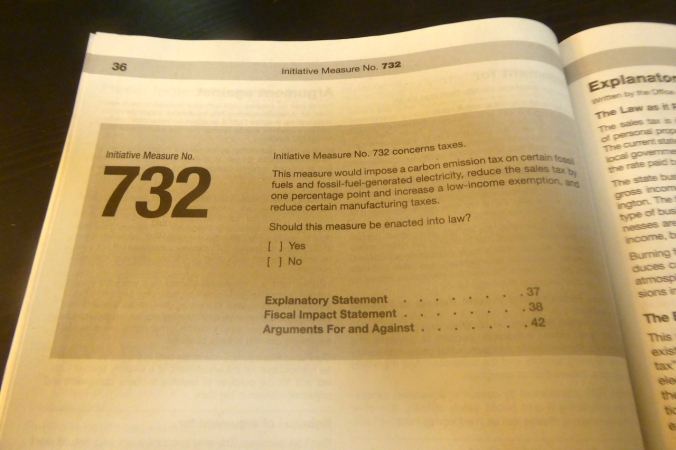
“This measure would impose a carbon emission tax on certain fossil fuels and fossil-fuel-generated electricity, reduce the sales tax one percentage point and increase a low-income exemption, and reduce certain manufacturing taxes.”
This initiative is modeled after British Columbia’s similar carbon tax. Turns out, that the tax was effective without slowing economic growth. However, some environmental groups oppose the initiative. While they may have legitimate concerns, we no longer have time to wait for something better. We’ve waited far too long to address climate change. This situation reminds me of the debate over the 1980 Alaska National Interest Lands Conservation Act (ANILCA), which permanently protect millions of acres of land in Alaska. The final version of ANILCA didn’t give environmental groups everything they wanted, but it gave Americans a whole hell of a lot.
We didn’t have time to waste with ANILCA and we don’t have time to waste on climate change. It’s time for all of us to step up and sacrifice a bit for the future. I’m glad to see to that Washington voters are considering taking action to help mitigate climate change. I voted early and I voted yes on Initiative 732. If you live in Washington, I think you should as well. Wherever you live, vote for candidates who will take action on climate. I vote #ActOnClimate. I do it for salmon, bears, and people everywhere.
For more information on climate change science: You can read the climate change chapter I wrote for Katmai’s Interpretation Training Manual, available for free from Earth To Sky’s website. Also check out Skeptical Science, one of the best climate science website I’ve found.
Brown Bear Fatness Index
Brown bears get fat, often really fat. They also lose a lot of weight and sometimes become really skinny. They are often fat and skinny in the same year. When you watch brown bears, either in person or via bearcam, you can sometimes make a fairly accurate determination of a bear’s body fat and relative health by looking at its shape.
Fatness can be used as an indicator of health in brown bears. Brown bears need to eat a year’s worth of food in six months or less to survive, and body fat is the key their survival. They can lose 30% or more of their body weight during hibernation and can continue to lose weight throughout the spring when few high calorie foods are available. In the Brooks River area, only after green plants begin to grow and salmon have arrived do most bears begin to regain lost weight and start to accumulate body fat.
While fat is important to bears, a thin bear isn’t necessarily an unhealthy bear. Young subadult bears and yearling cubs, for example, often appear thin in spring and early summer before many high calorie food sources are available. These bears usually regain lost body mass in summer and early fall.
Polar Bear International developed a handy scorecard to measure the relative fatness of polar bears. I’ve adapted it for brown bears. My brown bear fat index uses the same categories as the polar bear index, which ranges from skinny/emaciated to very fat/obese. I also included additional information for each category such as the age/sex class most likely to be in a category and the time of year bears are most likely to be in a category.
Please note, my brown bear index is subjective and based on my observations at Brooks River, Katmai National Park, Alaska. The polar bear fatness index is also subjective, but less so than mine because researchers who handle immobilized bears can palpate the animal to estimate its body fat content. (Katmai’s Changing Tides project also tracks body fat content in female brown bears, but uses bioelectric impedence analysis.)
Brown Bear Fatness Index
Emaciated: bear appears skinny with ribs, vertebrae, and hip bones usually clearly visible unless covered by fur.
- Time of year most likely to happen: late winter through early summer, but can happen in all seasons.
- Age/sex Class: Older bears, especially older mothers with newborn cubs and injured bears
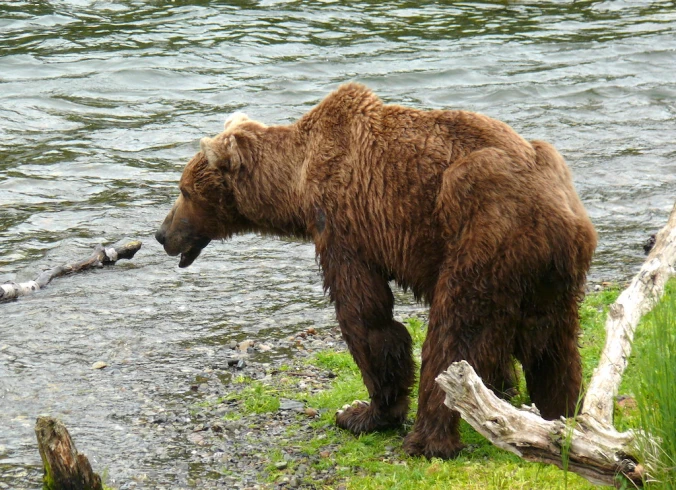
16 Cinnamon shows an emaciated figure in July 2010. Notice his prominent hip bones and shoulder blades. If he had less fur, his ribs would also be noticeable.
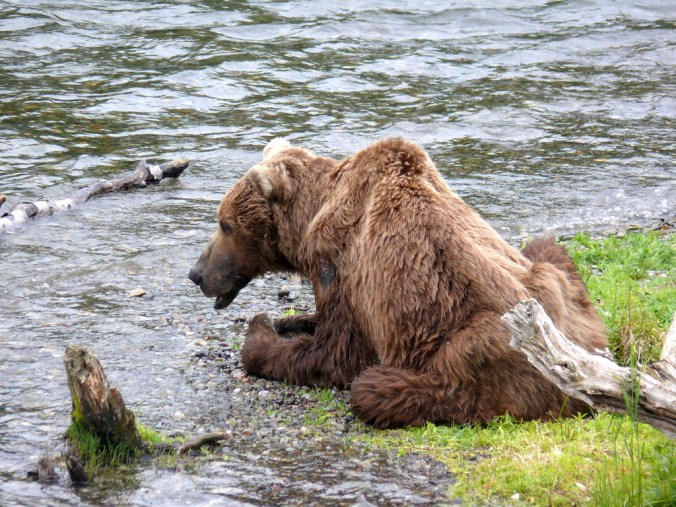
In this photo, also from July 2010, Cinnamon’s vertebrae seem visible through his fur. Despite his lack of body fat in July, he survived winter and returned to Brooks in 2011. At the time, he was estimated to be at least in his late 20s, but could’ve been older.
Thin: vertebrae and hip bones partly visible; narrow body
- Time of year most likely to happen: late winter through early summer, but can happen in all seasons.
- Age/sex class: subadults, yearling cubs, 2.5 year-old cubs, older bears, and mothers with newborn cubs
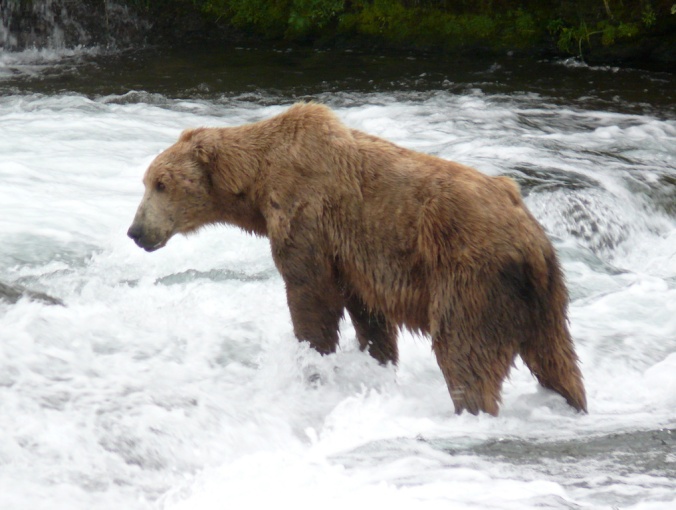
234 Evander in July 2010 displays a thin body with noticeable hip bones. Evander was an older bear (probably older than 20 years) in 2010.
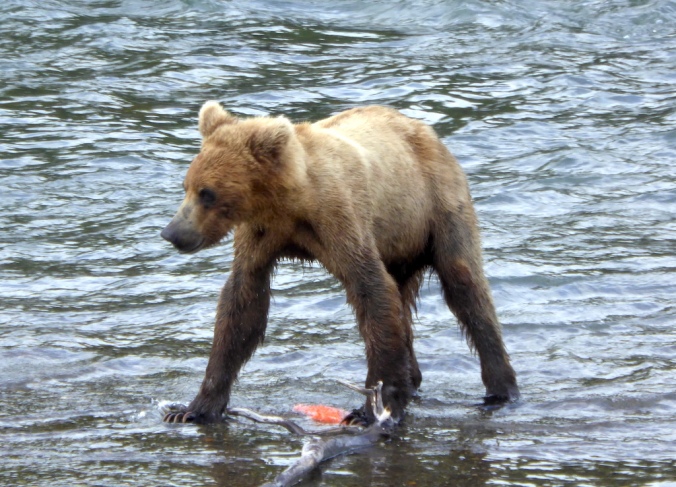
In this photo from early July 2016, 503 Cubadult appears thin with slightly visible hip bones. His narrow body shape is not uncommon for young subadult bears (he was 3.5 years old in July 2016), and does not necessarily indicate poor health. Rather it reflects the time of year and his low rank in the bear hierarchy.
Average: hip bones and ribs not visible; the bear’s body, neck, and head are evenly proportioned
- Time of year most likely to happen: all year, but most often summer
- Age/sex class: all ages
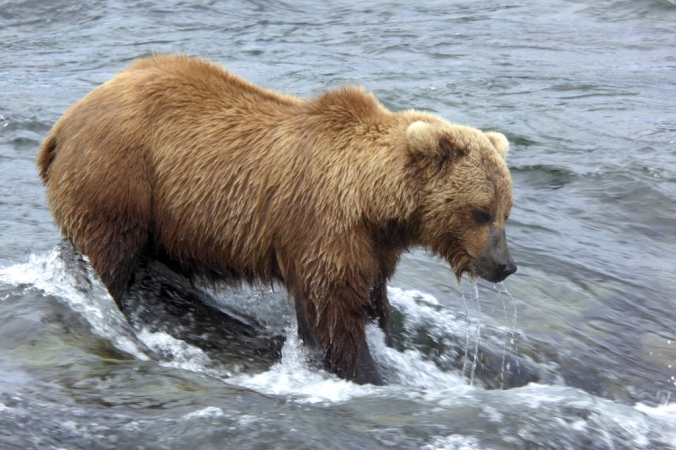
This adult female, 505, is well proportioned and a good representative of average fatness for an early to mid summer bear. Photo taken on July 8, 2016.
Fat: fat over rump, stomach hangs low; bear’s neck is semi-fat but doesn’t distort the size of the head
- Time of year most likely to happen: late summer and fall
- Age/sex class: adult males in prime of life in mid summer, all bears late summer and fall
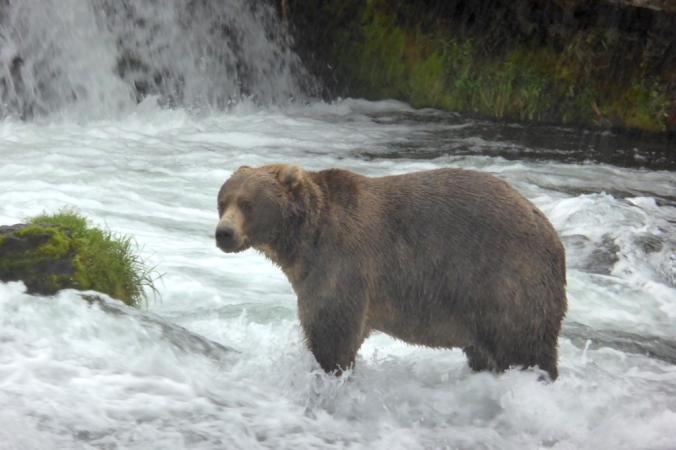
Katmai’s brown bears most often reach the fat class in late summer and fall when salmon are readily accessible and have been so for two months or more. In this photo from September 2015, 89 Backpack displays the typical body shape of a fat bear. Most bears attain this body shape before they hibernate.
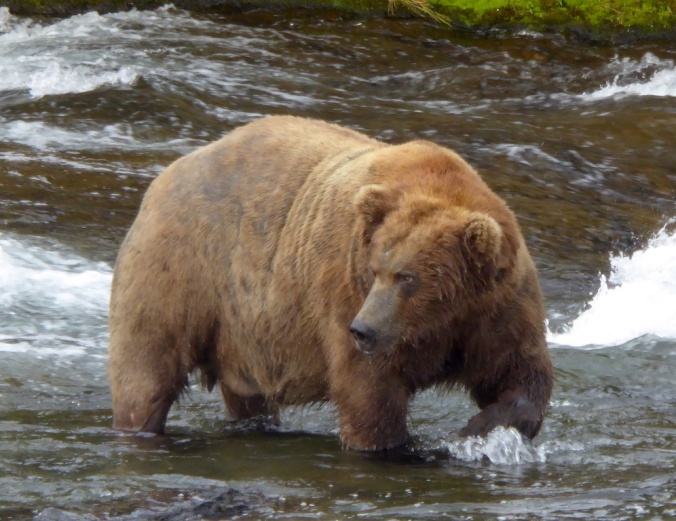
Sometimes large adult males, like 747, can reach the fat category by the end of July. Some bears aren’t this fat when the go into the den, yet 747 reached this size months before hibernation. This photo was taken in late July 2015.
Obese: stomach hangs very low; bear’s neck is very fat and makes head appear smaller in proportion to its body
- Time of year most likely to happen: very late summer and fall
- Age/sex class: adult males in prime of life and adult females without cubs
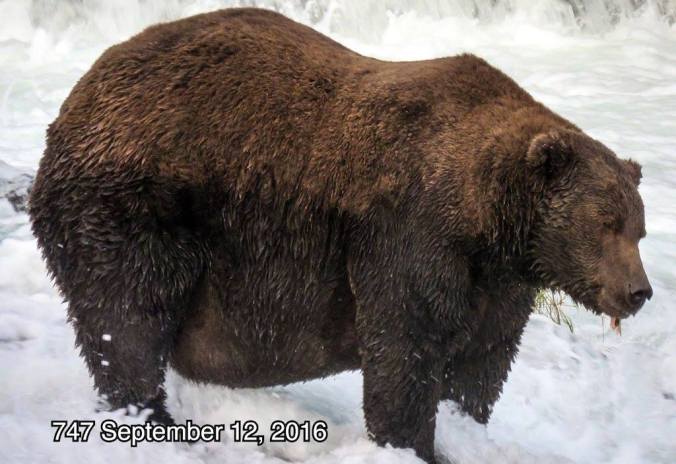
This NPS photo of 747 epitomizes an obese bear. (He should’ve won #FatBearWeek. Election was rigged!) Seriously, this is an extremely obese bear. I don’t think I’ve ever seen a bear this fat before. His belly hangs nearly to the ground (the water is not very deep where he stands in the photo). 747 is a very dominant adult male at Brooks Falls. As such, he has access to his choice of fishing spots. His well-endowed figure is proof of his dominance, health, and fishing skills.
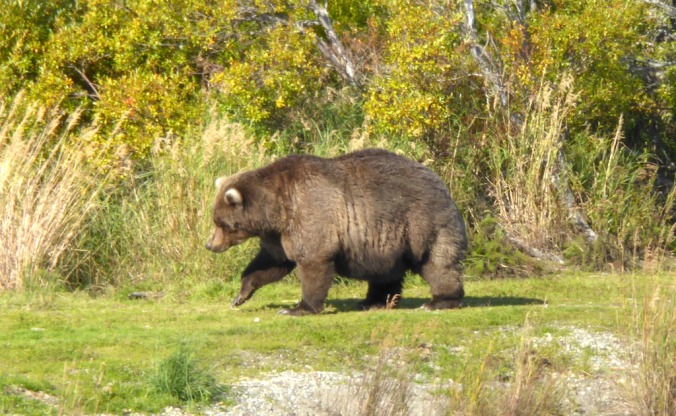
409 Beadnose shows the ample proportions of an obese female in September 2015. Females with cubs do not usually attain this level of fatness because of the energetic costs associated with raising cubs. Beadnose did not have cubs in 2015.
The Best Thing You’ll Read About Bark Today (If You Don’t Read Anything Else about Bark)

This post is about bark.
I know what you’re thinking. “Bark—an enthralling topic!” I couldn’t agree more, but bark is often overlooked and ignored by most people. Yet bark records many events in a tree’s history.
Thin and smooth barked trees like quaking aspen (Populus tremuloides) are especially good at recording animal sign. Aspen is the most widely distributed native tree in North America. Its bark becomes thick and furrowed only on old trees, and usually only near the ground. Most of the time aspen bark is smooth, colored white to gray (even greenish on young trees) with dark chevrons where self-pruned branches fell to the ground.
Since aspen bark is thin-skinned, it’s easily scarred. Along hiking trails, you’ll commonly find names and initials carved into it. (Don’t do this. No one cares if you were there with your “true love,” who you probably dumped the week after, and it opens the tree to possible infection.) Aspen bark records more than human impulses though. In bear country, you can often find evidence of bears climbing the trees.
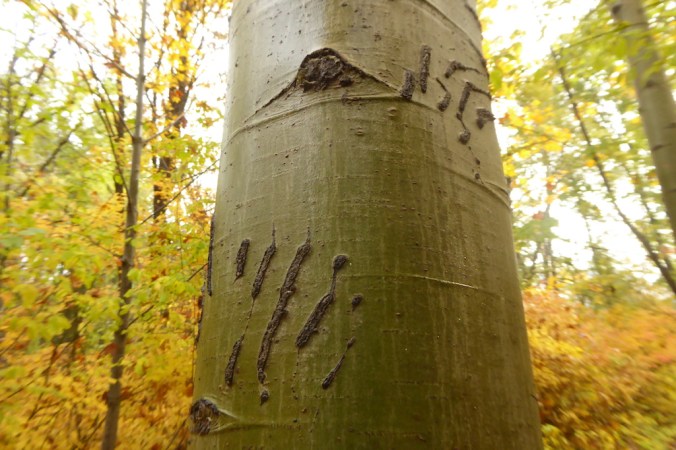
Black bears have five toes each equipped with claws superbly designed for climbing. Scars on trees from climbing bears usually come in sets of five.
Black bears are particularly adept at climbing trees. Their strength and relatively short, sharply curved claws help them gain purchase even on smooth barked trees like aspen. If I’m in an area where black bears live, I almost always look for bear claw marks on aspen. In the Stehekin Valley, bear claw marks are easily seen on aspen along the Stehekin River Trail and Agnes Gorge Trail.
The claw marks represent a moment in time. Under what circumstances were they made? Was a bear startled by a person? Another bear? Was it simply playing or exploring? Black bears are omnivorous, but I have read no records or seen any signs of them eating any part of aspen trees, so they probably weren’t climbing the tree for food. In the eastern U.S. though, black bears often climb another smooth barked tree, American beech (Fagus grandifolia), to feast on beechnuts.
The next time you find an aspen, take a closer look at its bark. Bark isn’t as static as its outward appearance suggests. You might find a story there.

Short Ride Up Stehekin Valley
October has been a wet month here in Stehekin. So far, seven inches of rain have been recorded. Today brought a break in the weather though. When I saw clear skies this morning, I ate a quick breakfast and hopped on my bike for a ride up the Stehekin Valley Road through Lake Chelan National Recreation Area. I wanted to casually revisit different habitats along the way while enjoying bold fall colors.
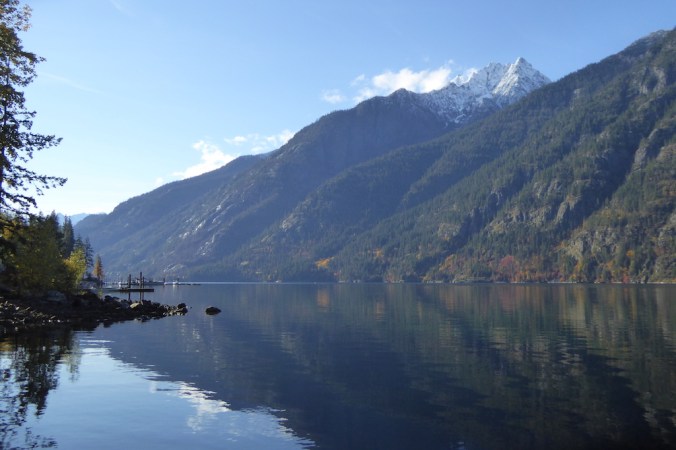
Snow-capped mountains over Lake Chelan
For the first mile the road hugs Lake Chelan’s rocky shoreline. The shallow areas near the head of the lake are popular with waterfowl right now. With the birds and the view of the mountains, I could’ve spent the whole morning near the dock at the Purple Point Campground. But, I probably would’ve chosen a different spot to linger, since I don’t necessarily enjoy the smell of rotting kokanee (land-locked sockeye salmon).

Many dead and dying kokanee salmon are flushed from Stehekin River into Lake Chelan. This one, and many others, accumulated at the dock for Purple Point Campground.
The road quickly leaves the lake and roughly parallels Stehekin River for the next 12 miles.

Stehekin River rises and falls considerably from peak runoff in late spring to its low point in late summer. It’s come up at least a foot since rain returned to the area, but is still several feet below its seasonal high.

Stehekin River
The river is fed by several tributaries. Rainbow Creek is probably the most well known. From a hanging valley, it pours over 300 foot high Rainbow Falls onto an alluvial fan.

Many small tributaries of Stehekin River form alluvial fans where they encounter the valley bottom. Rainbow Falls is tucked back behind the trees at upper center.
Alluvial fans on the side of the valley are typically dry, fire prone habitats. Around Rainbow Falls, fire is managed through controlled burns, which keeps the understory clear and trees well spaced. Usually, only plants with very high tolerances for hot, dry soils live here. The soils on the alluvial fans aren’t particularly rich either, which is one reason my garden, located on the toe of one these fans, sucked this year.
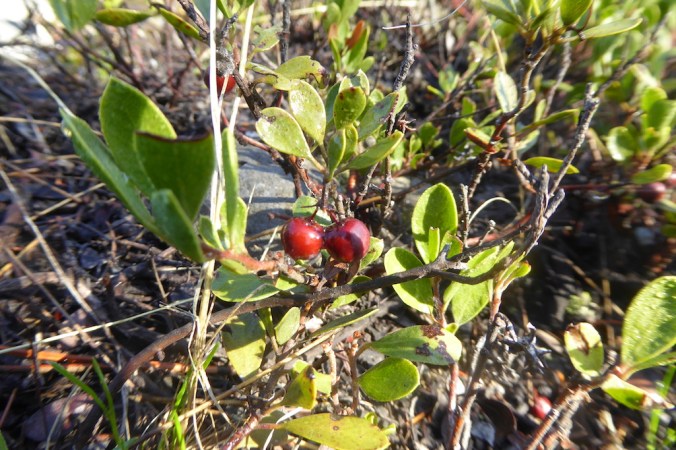
Several species of manzanita (Arctostaphylos sp.), also called kinnikinnik or bearberry, inhabit the area, especially in dry sites. Black bears feed on the berries, but I find them mealy and almost flavorless.
Shortly after Rainbow Falls, the pavement ends next to a talus slope….
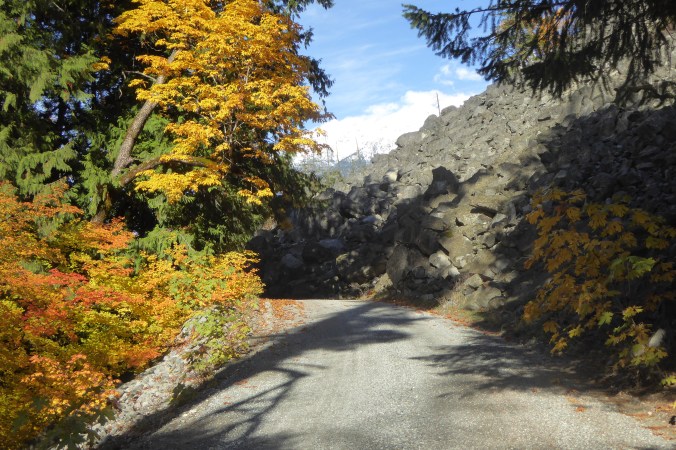
…and the road weaves its way on top of more alluvial fans and down to the floodplain.
Areas that are prone to flooding or have wet soils have a far higher proportion of deciduous trees, like black cottonwood and red alder, than the adjacent uplands.
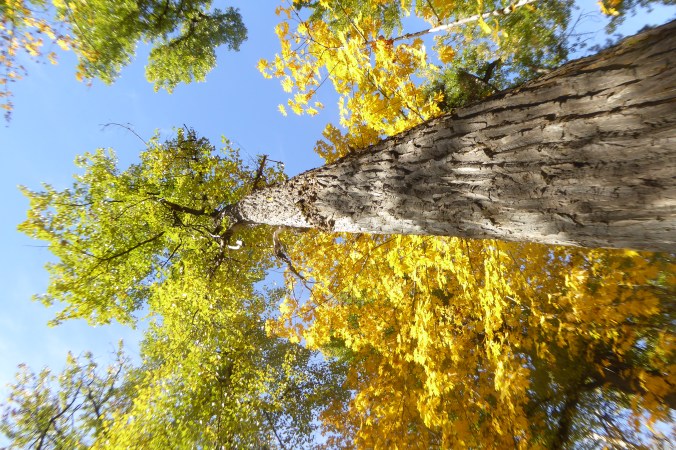
Along the whole route, I stopped frequently just to enjoy the scenery.

At the boundary between Lake Chelan National Recreation Area and North Cascade National Park, the river flows through a narrow valley where wet and dry microhabitats can exist within feet of one another. Plant life here is fairly diverse. Most of North Cascades tree species are found growing in the upper Stehekin watershed, and it’s a good place for animals too. Often I find fresh bear scat and tracks on the roads and trails.

Tracks from a black bear that had walked on the road not long before I passed through.
Near the end of the road, I was forced to cross the river on this rickety down tree.

Just kidding. I crossed on a sturdy bridge.
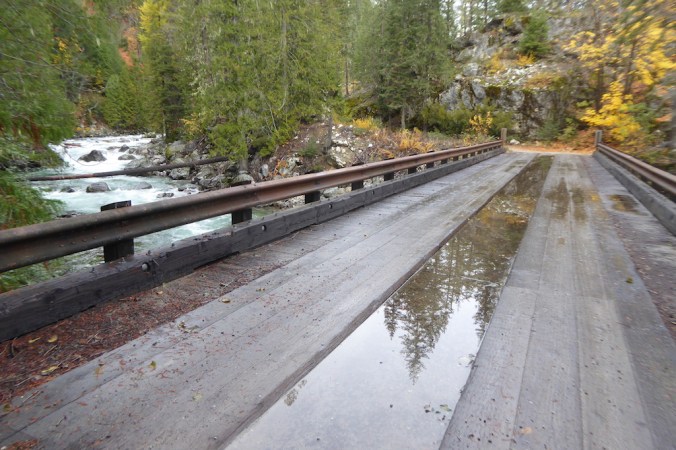
But, within a few more minutes was met with an ominous sign.
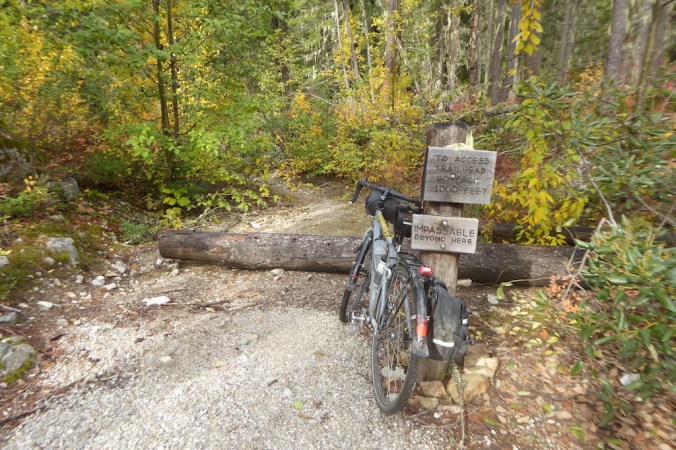
Impassible Beyond Here
Habitats along Stehekin River are subject to change, especially when the river floods. Just beyond the sign, the road is washed away.

Road’s End: A 500 year flood washed away large sections of the Stehekin Road in 2003.
Here, I turned back to enjoy the mostly downhill ride home. Of course, fall colors and scenery kept distracting me, so I didn’t ride too fast, just enough to remain comfortably warm.
Strut Your Stuff
In my last post, I broke down an interaction between two mother bears, one of whom was particularly defensive. Bears though don’t always charge and threaten violence to make their point. As this video illustrates, bears communicate through body language to establish dominance and avoid conflict. (Warning: Long Video.)
In the video, 747 is the heftier, darker bear. 68 is the tall, lanky bear. Both are mature adult males, likely in the prime of their lives. As I see it, bear 747 comes out of this on top as he asserts his dominance over the newcomer, 68. This took some time, however. 68 didn’t exactly yield like most would upon the approach of 747.
As the video starts, 747 (left) immediately approaches the newcomer on the island. 68 subtly skirts 747, but continues his approach toward the falls. You can see that 747 is much bulkier than the newcomer, but the new bear is just as tall, if not taller.
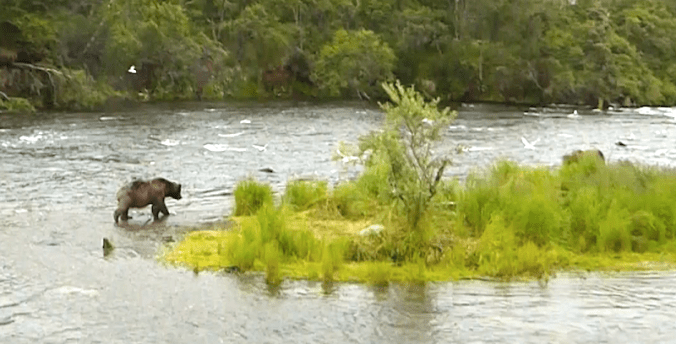
747 (left) approaches 68 on the island downstream of Brooks Falls.
When 747 turns his back on the new bear, 68 takes the opportunity to mark some grass (0:50). 68 is not acting submissive or yielding.
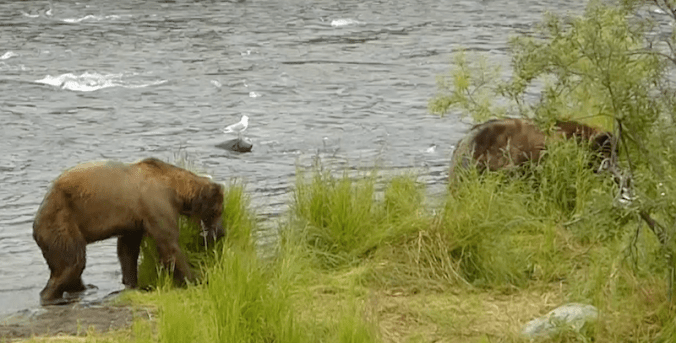
After a brief do-si-do, 68 (left) marks grass while 747 does the same.
The new bear approaches 747. 747 stands and watches. At this point, the outcome is very much undecided (1:12).

68 (left) approaches 747.
After a little more posturing, 747 turns to mark the willow on the island. This is a bold display of dominance in front of 68. The newcomer though continues to cowboy walk away from 747, still not submissive but very focused on 747’s movements (2:00).

747 marks a willow tree while 68 postures nearby.
747 follows the exact same route on the island as 68, probably following the newcomer’s scent and leaving his own on the way (2:20). 68 postures more in the grass. 747 again marks the tree. This time for almost 30 seconds (3:18).
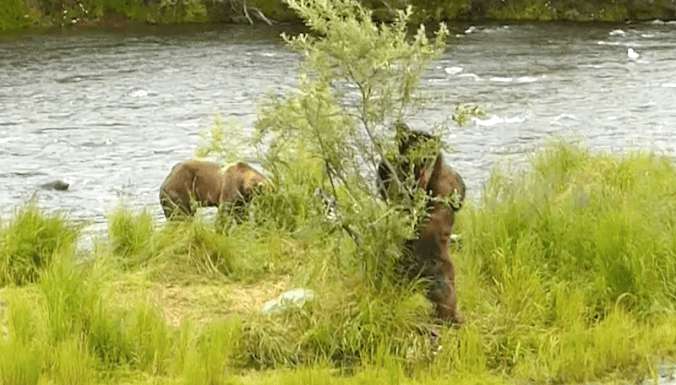
747 says, “This is my turf.”
747 then goes to the grass where 68 just was and rubs it on his body. He seems to want to leave a scent trail everywhere his competitor has (4:05).
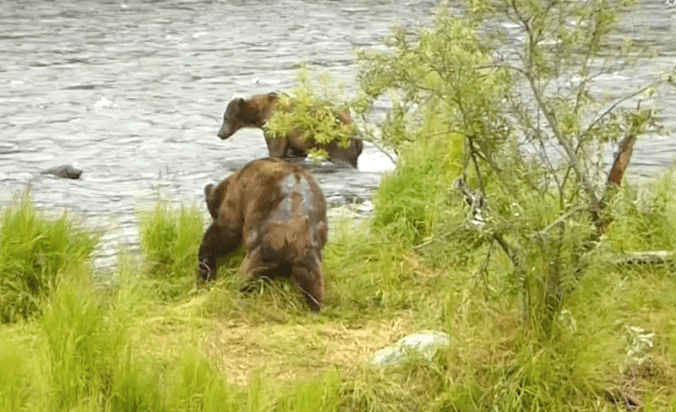
747 (center) marks the grass where 68 had just walked.
68 walks downriver. 747 follows. In the riffles, 747 catches up to him. Instead of fighting, the bears posture more. Here’s where 747 seems to assert his dominance more clearly. 68, instead of posturing further, stands in the riffles and watches 747 approach then walk away (5:00).
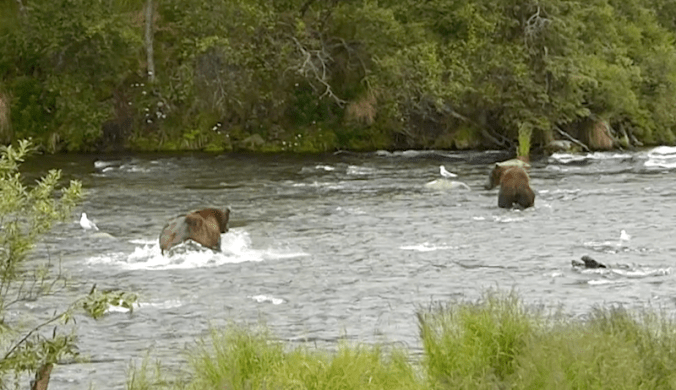
747 pursues 68 downstream.
The video cuts to a moment a few minutes later when 68 makes his way back to the island. This draws 747’s attention and he approaches 68 again. 747’s ears remain upright and forward, a sign of dominance in this context. The new bear’s ears are oriented back against his head, a sign of defensiveness (6:40).
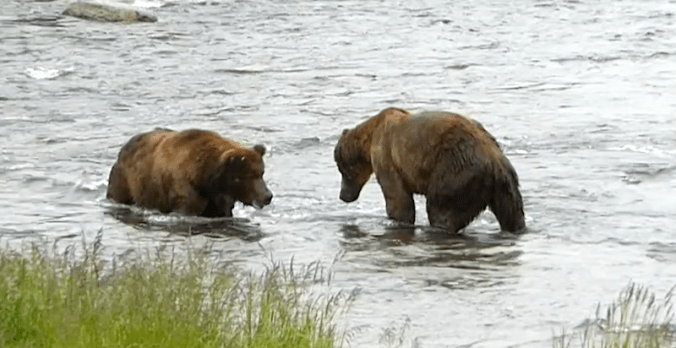
747 (left) directly approaches 68 one last time. Note the bears’ ears. 747’s are pitched forward like he is not intimidated by 68.
747 circles 68. 747 walks away and the newcomer stands and watches, indicating that 747 successfully asserted his dominance in the interaction. 747 then goes back to the island and marks the vegetation again (7:05). 68 continues to stand and watch. Winner: 747.
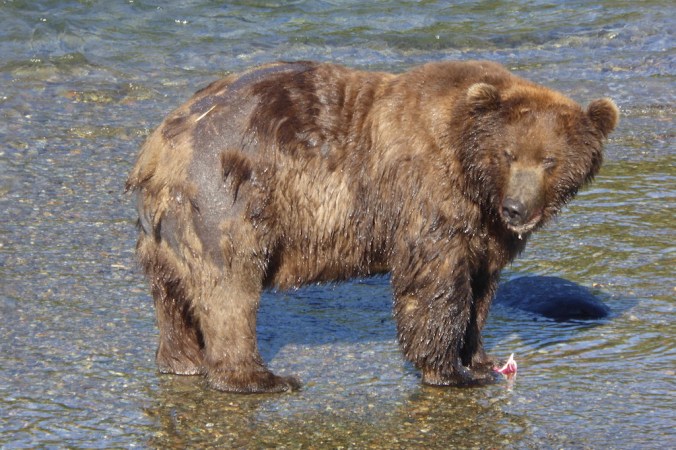
747 is one of the largest and most dominant bears at Brooks River.
During encounters between adult male bears, the “winner” is the bear who ends the interaction, usually by walking away. This is exactly what 747 did. (Exceptions are when bears compete over a resource they want like food, a fishing spot, or access to a female. In those cases, the dominant bear stays where he wants, displacing the subordinate bear who usually moves away.)
Any time a new bear arrives at Brooks Falls, my interest piques. Newcomers are often wildcards. They may or may not know how to fish the falls and must weave their way into the river’s hierarchy. 68 was never identified at Brooks Falls in July. I didn’t recognize him when he arrived. He seemed to show some familiarity with the falls area and wasn’t particularly wary of other bears. When 747 saw the newcomer I thought, “This could get interesting.” It did, just in a non-violent way.
68 and 747 communicated their intentions clearly through posturing and marking vegetation. Throughout the entire video, these bears get very close to each other, but never make physical contact. Both want to hold high places in the hierarchy, because dominance confers many advantages. Through a continued, confident approach and more exaggerated posturing, 747 asserts his dominance over the newcomer. This is a classic, albeit lengthy, example of bears using body language to communicate their intentions, avoid physical conflict, and establish dominance.
For more information on Katmai’s bears, download the latest edition of Bears of Brooks River: A Guide to Their Identification, Lives, Identification, and Habits.
When Mother Bears Collide
What happens when two mother bears, both with spring cubs, meet?
Defensiveness is a trait of all mother bears. In the video, 128 Grazer is the blonde bear with three spring cubs, and her defensiveness is immediately evident. She jaw pops and salivates as 409 approaches.
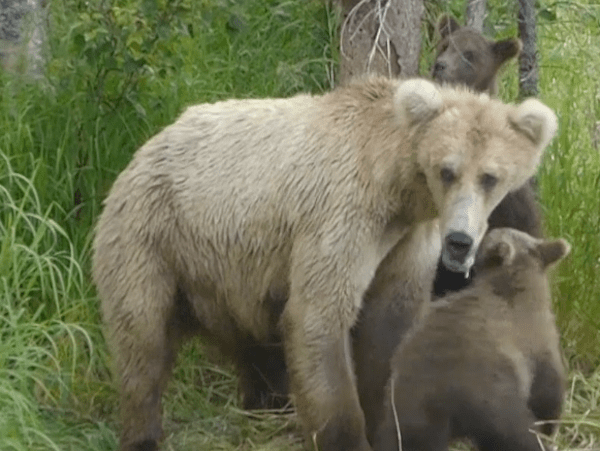
128 Grazer stands next to her cubs. Her excessive salivation is a sign of stress.
Meanwhile, 409 shows no signs of aggression. She probably just wants to get to the river and fish. Her two cubs are behind her.
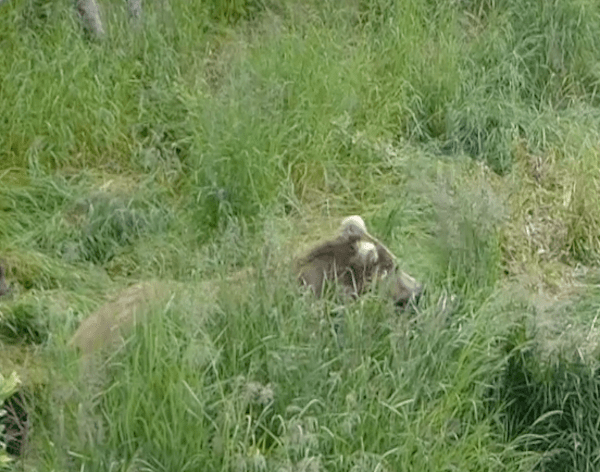
409 Beadnose stands the in grass right before Grazer charges.
128 charges 409. If you listen carefully, you can hear one or both bears utter a low bellow.
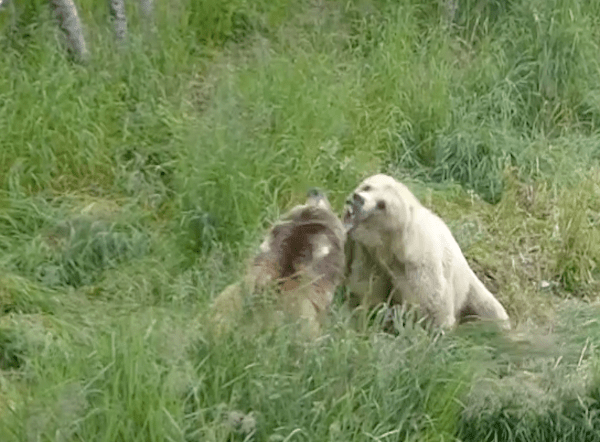
Beadnose (left) and Grazer (right) face off as Grazer stops her charge just short of contact.
409 stands her ground (unlike an adult male who encountered a charging 128) likely because she’s protecting her cubs too. 409’s cubs climb separate birch trees. Now both sets of cubs are up trees. The mother bears can’t go far in this situation.
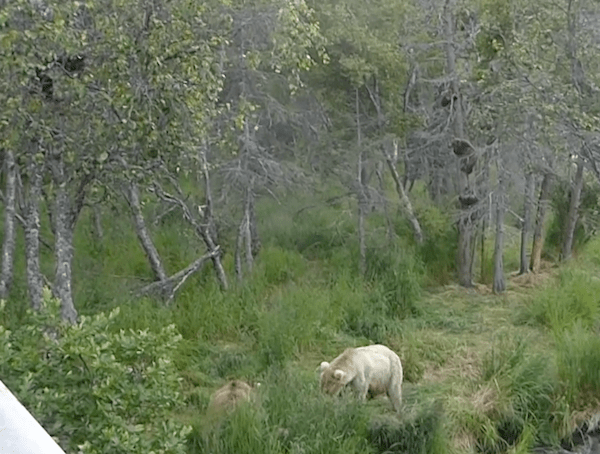
Beadnose and Grazer face one another while their cubs remain in nearby trees.
The situation de-escalates quickly, which is not uncommon in encounters between bears. 128 then moves back to the tree holding her cubs. Beadnose slowly approaches the river then turns toward her cubs, almost like nothing happened. Both mothers keep watchful eyes on the other.
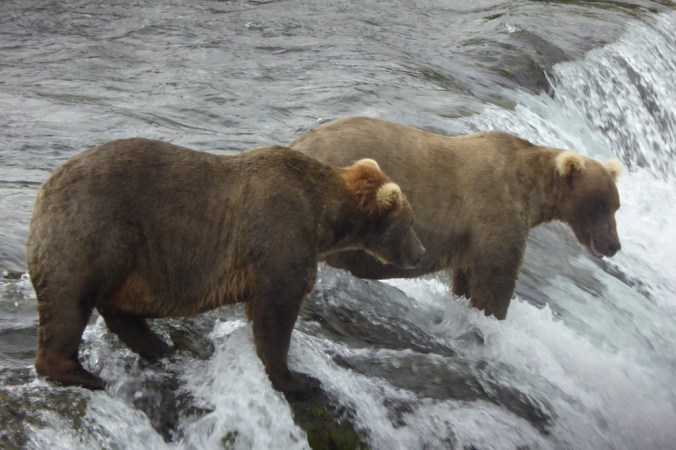
409 Beadnose (left) stands near 128 Grazer on the lip of Brooks Falls in 2015.
Last year, these bears were extremely tolerant of each other. Cubs change the dynamic though. As a new mother, 128 behaved particularly defensive around bears and people in late June and early July. Beadnose’s relatively calm disposition may reflect her greater experience raising cubs (this is her fourth litter) and her high tolerance for certain bears like Grazer. Perhaps Grazer’s aggression is a product of her inexperience. This is her first known litter.
The bears’ experience and disposition factored into the interaction. Each encounter between bears (and bears and people, for that matter) is unique. Defensiveness is one possible reaction when mother bears collide.
 Wandering at Large