The Best Thing You’ll Read About Bark Today (If You Don’t Read Anything Else about Bark)

Black bear claw marks on quaking aspen, Beaver Ponds Trail.JPG

This post is about bark.

I know what you’re thinking. “Bark—an enthralling topic!” I couldn’t agree more, but bark is often overlooked and ignored by most people. Yet bark records many events in a tree’s history.

Thin and smooth barked trees like quaking aspen (Populus tremuloides) are especially good at recording animal sign. Aspen is the most widely distributed native tree in North America. Its bark becomes thick and furrowed only on old trees, and usually only near the ground. Most of the time aspen bark is smooth, colored white to gray (even greenish on young trees) with dark chevrons where self-pruned branches fell to the ground.

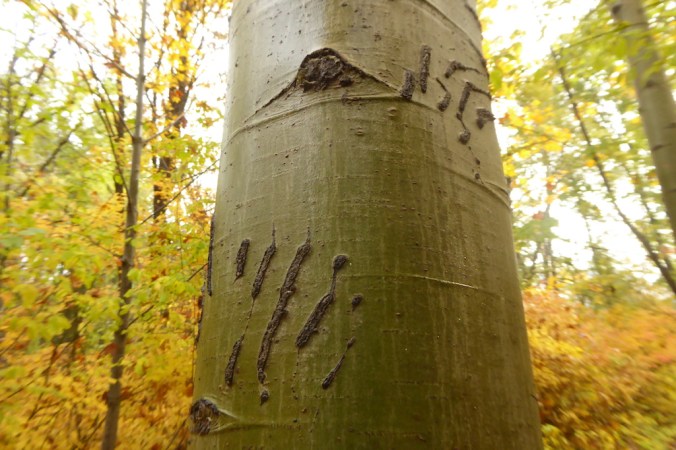
Since aspen bark is thin-skinned, it’s easily scarred. Along hiking trails, you’ll commonly find names and initials carved into it. (Don’t do this. No one cares if you were there with your “true love,” who you probably dumped the week after, and it opens the tree to possible infection.) Aspen bark records more than human impulses though. In bear country, you can often find evidence of bears climbing the trees.
p1230573

Black bears have five toes each equipped with claws superbly designed for climbing. Scars on trees from climbing bears usually come in sets of five.

Black bears are particularly adept at climbing trees. Their strength and relatively short, sharply curved claws help them gain purchase even on smooth barked trees like aspen. If I’m in an area where black bears live, I almost always look for bear claw marks on aspen. In the Stehekin Valley, bear claw marks are easily seen on aspen along the Stehekin River Trail and Agnes Gorge Trail.

The claw marks represent a moment in time. Under what circumstances were they made? Was a bear startled by a person? Another bear? Was it simply playing or exploring? Black bears are omnivorous, but I have read no records or seen any signs of them eating any part of aspen trees, so they probably weren’t climbing the tree for food. In the eastern U.S. though, black bears often climb another smooth barked tree, American beech (Fagus grandifolia), to feast on beechnuts.

The next time you find an aspen, take a closer look at its bark. Bark isn’t as static as its outward appearance suggests. You might find a story there.

p1230575

Strut Your Stuff

In my last post, I broke down an interaction between two mother bears, one of whom was particularly defensive. Bears though don’t always charge and threaten violence to make their point. As this video illustrates, bears communicate through body language to establish dominance and avoid conflict. (Warning: Long Video.)

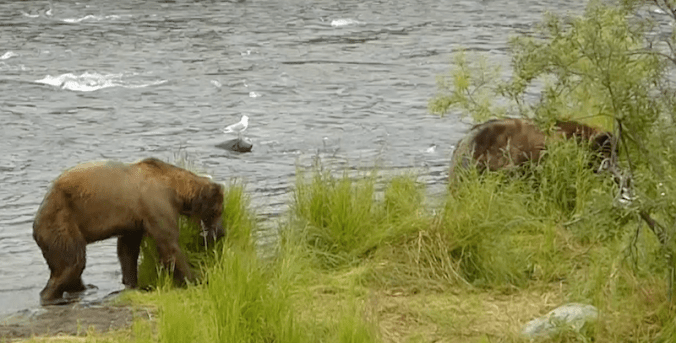
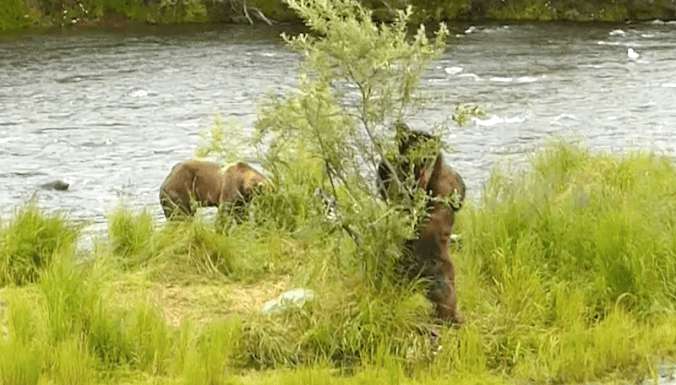
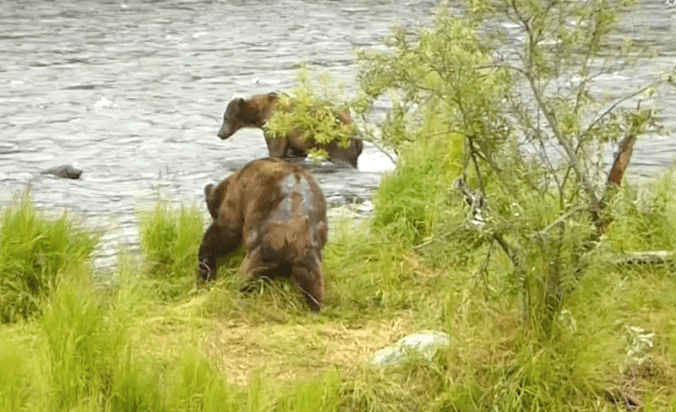
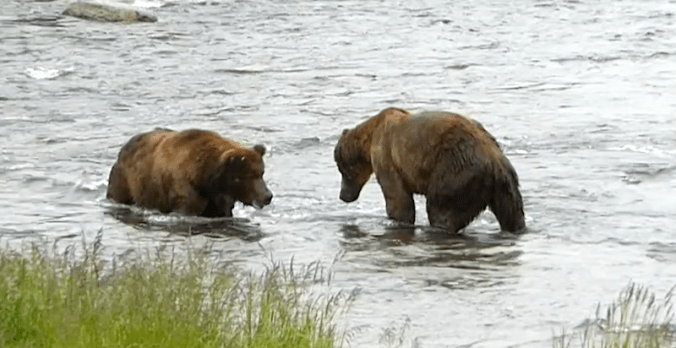
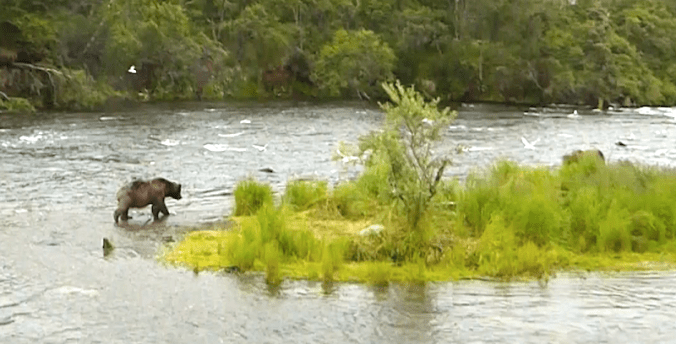
In the video, 747 is the heftier, darker bear. 68 is the tall, lanky bear. Both are mature adult males, likely in the prime of their lives. As I see it, bear 747 comes out of this on top as he asserts his dominance over the newcomer, 68. This took some time, however. 68 didn’t exactly yield like most would upon the approach of 747.

As the video starts, 747 (left) immediately approaches the newcomer on the island. 68 subtly skirts 747, but continues his approach toward the falls. You can see that 747 is much bulkier than the newcomer, but the new bear is just as tall, if not taller.

Screen Shot 2016-10-14 at 10.49.25 AM.png

747 (left) approaches 68 on the island downstream of Brooks Falls.

When 747 turns his back on the new bear, 68 takes the opportunity to mark some grass (0:50). 68 is not acting submissive or yielding.

Screen Shot 2016-10-14 at 10.50.10 AM.png

After a brief do-si-do, 68 (left) marks grass while 747 does the same.

The new bear approaches 747. 747 stands and watches. At this point, the outcome is very much undecided (1:12).

Screen Shot 2016-10-14 at 10.51.34 AM.png

68 (left) approaches 747.

After a little more posturing, 747 turns to mark the willow on the island. This is a bold display of dominance in front of 68. The newcomer though continues to cowboy walk away from 747, still not submissive but very focused on 747’s movements (2:00).

Screen Shot 2016-10-14 at 10.52.50 AM.png

747 marks a willow tree while 68 postures nearby.

747 follows the exact same route on the island as 68, probably following the newcomer’s scent and leaving his own on the way (2:20). 68 postures more in the grass. 747 again marks the tree. This time for almost 30 seconds (3:18).

Screen Shot 2016-10-14 at 10.53.28 AM.png

747 says, “This is my turf.”

747 then goes to the grass where 68 just was and rubs it on his body. He seems to want to leave a scent trail everywhere his competitor has (4:05).

Screen Shot 2016-10-14 at 10.53.59 AM.png

747 (center) marks the grass where 68 had just walked.

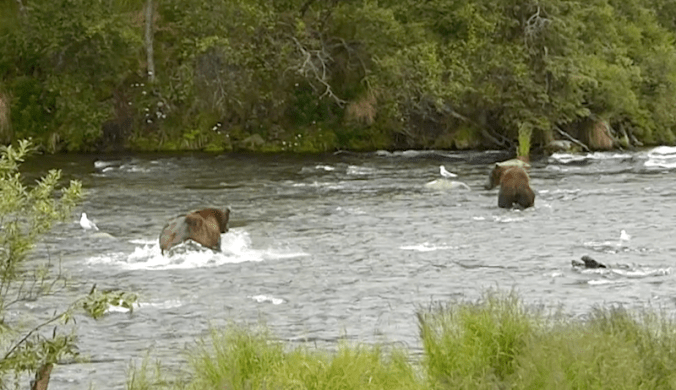
68 walks downriver. 747 follows. In the riffles, 747 catches up to him. Instead of fighting, the bears posture more. Here’s where 747 seems to assert his dominance more clearly. 68, instead of posturing further, stands in the riffles and watches 747 approach then walk away (5:00).

Screen Shot 2016-10-14 at 10.54.21 AM.png

747 pursues 68 downstream.

The video cuts to a moment a few minutes later when 68 makes his way back to the island. This draws 747’s attention and he approaches 68 again. 747’s ears remain upright and forward, a sign of dominance in this context. The new bear’s ears are oriented back against his head, a sign of defensiveness (6:40).

Screen Shot 2016-10-14 at 10.55.34 AM.png

747 (left) directly approaches 68 one last time. Note the bears’ ears. 747’s are pitched forward like he is not intimidated by 68.

747 circles 68. 747 walks away and the newcomer stands and watches, indicating that 747 successfully asserted his dominance in the interaction. 747 then goes back to the island and marks the vegetation again (7:05). 68 continues to stand and watch. Winner: 747.

747_06272016.JPG

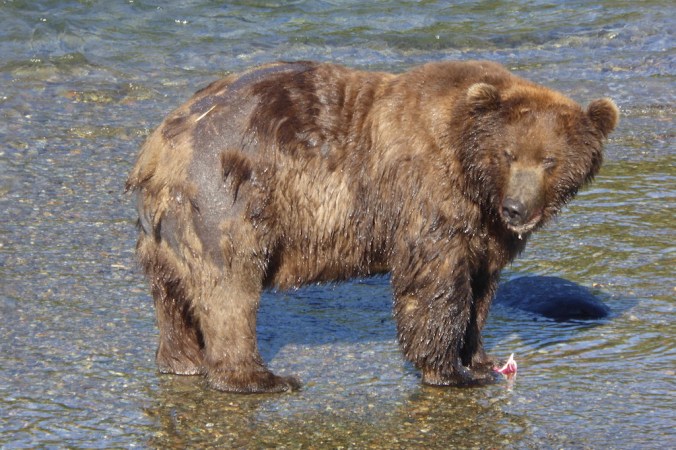
747 is one of the largest and most dominant bears at Brooks River.

During encounters between adult male bears, the “winner” is the bear who ends the interaction, usually by walking away. This is exactly what 747 did. (Exceptions are when bears compete over a resource they want like food, a fishing spot, or access to a female. In those cases, the dominant bear stays where he wants, displacing the subordinate bear who usually moves away.)

Any time a new bear arrives at Brooks Falls, my interest piques. Newcomers are often wildcards. They may or may not know how to fish the falls and must weave their way into the river’s hierarchy. 68 was never identified at Brooks Falls in July. I didn’t recognize him when he arrived. He seemed to show some familiarity with the falls area and wasn’t particularly wary of other bears. When 747 saw the newcomer I thought, “This could get interesting.” It did, just in a non-violent way.

68 and 747 communicated their intentions clearly through posturing and marking vegetation. Throughout the entire video, these bears get very close to each other, but never make physical contact. Both want to hold high places in the hierarchy, because dominance confers many advantages. Through a continued, confident approach and more exaggerated posturing, 747 asserts his dominance over the newcomer. This is a classic, albeit lengthy, example of bears using body language to communicate their intentions, avoid physical conflict, and establish dominance.

For more information on Katmai’s bears, download the latest edition of Bears of Brooks River: A Guide to Their Identification, Lives, Identification, and Habits.

When Mother Bears Collide

What happens when two mother bears, both with spring cubs, meet?

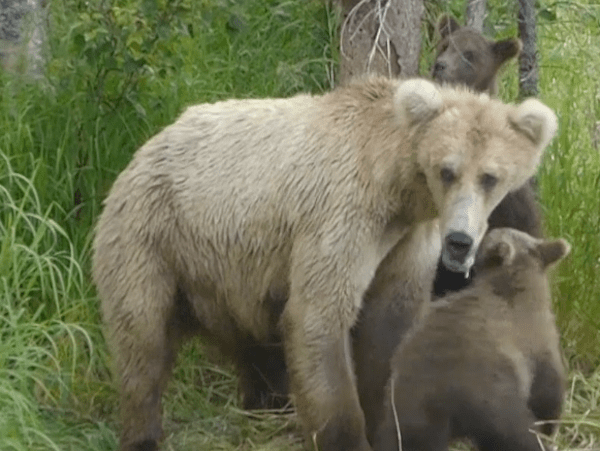
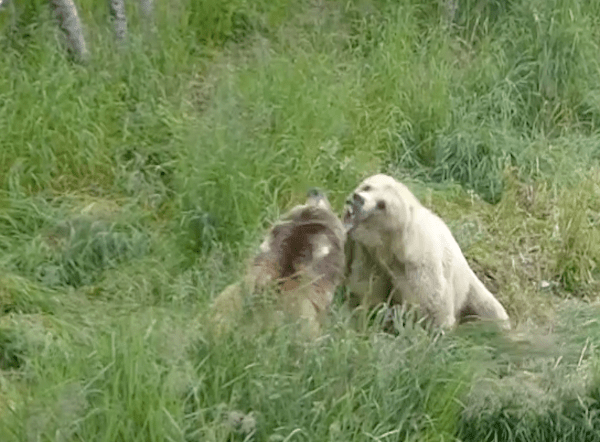
Defensiveness is a trait of all mother bears. In the video, 128 Grazer is the blonde bear with three spring cubs, and her defensiveness is immediately evident. She jaw pops and salivates as 409 approaches.

Mother bear standing near cubs at base of a tree.

128 Grazer stands next to her cubs. Her excessive salivation is a sign of stress.

Meanwhile, 409 shows no signs of aggression. She probably just wants to get to the river and fish. Her two cubs are behind her.

Bear standing in grass.

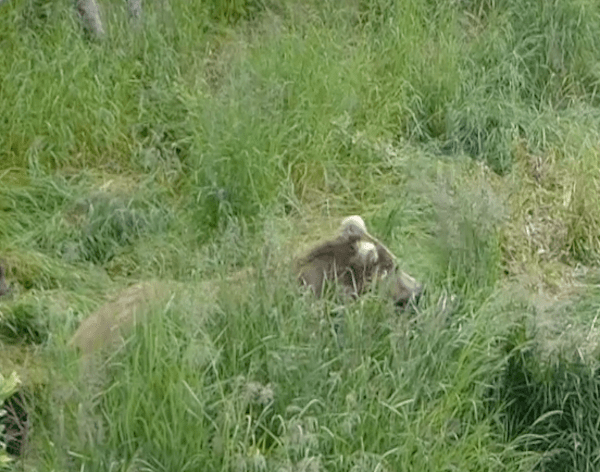
409 Beadnose stands the in grass right before Grazer charges.

128 charges 409. If you listen carefully, you can hear one or both bears utter a low bellow.

Two bears with open mouths in grass.

Beadnose (left) and Grazer (right) face off as Grazer stops her charge just short of contact.

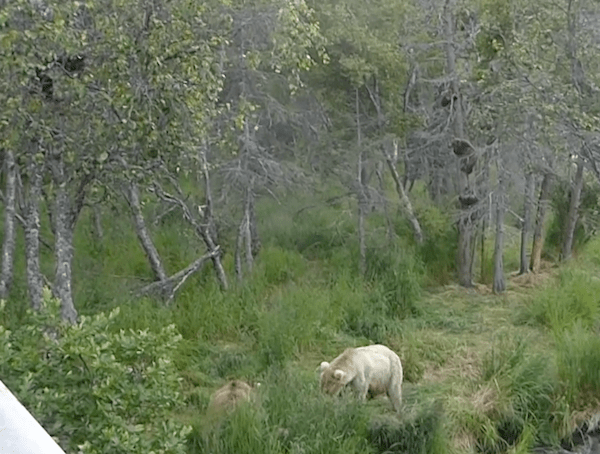
409 stands her ground (unlike an adult male who encountered a charging 128) likely because she’s protecting her cubs too. 409’s cubs climb separate birch trees. Now both sets of cubs are up trees. The mother bears can’t go far in this situation.

Bears in grass with cubs in trees.

Beadnose and Grazer face one another while their cubs remain in nearby trees.

The situation de-escalates quickly, which is not uncommon in encounters between bears. 128 then moves back to the tree holding her cubs. Beadnose slowly approaches the river then turns toward her cubs, almost like nothing happened. Both mothers keep watchful eyes on the other.

bears standing at the edge of a waterfall

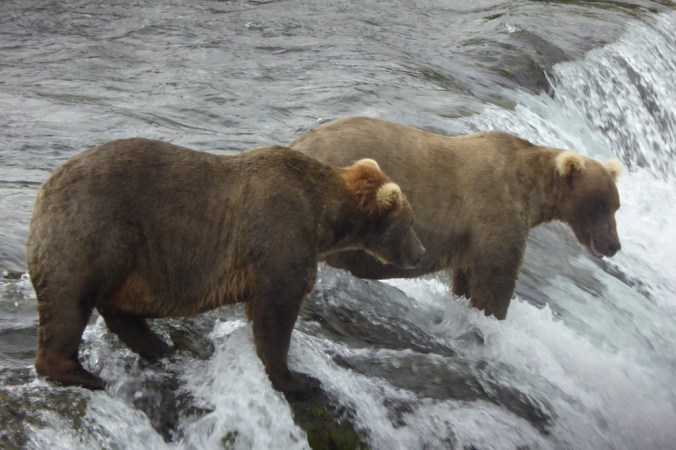
409 Beadnose (left) stands near 128 Grazer on the lip of Brooks Falls in 2015.

Last year, these bears were extremely tolerant of each other. Cubs change the dynamic though. As a new mother, 128 behaved particularly defensive around bears and people in late June and early July. Beadnose’s relatively calm disposition may reflect her greater experience raising cubs (this is her fourth litter) and her high tolerance for certain bears like Grazer. Perhaps Grazer’s aggression is a product of her inexperience. This is her first known litter.

The bears’ experience and disposition factored into the interaction. Each encounter between bears (and bears and people, for that matter) is unique. Defensiveness is one possible reaction when mother bears collide.