North America was once home to the world’s most abundant wild bird. Although passenger pigeons could be found anywhere east of the Rocky Mountains, they concentrated their abundance between the Atlantic Ocean and the Mississippi River, especially from the Great Lakes to the Mid Atlantic and east to Massachusetts. No one knows how many passenger pigeons roamed North America a mere two hundred years ago, but credible estimates suggest three to five billion—a population size that may have exceeded that of any population for any other bird species on Earth. Flocks of pigeons could be so numerous and so dense as to block the light of the sun “as by an eclipse” as John James Audubon experienced in 1813.
Passenger pigeons were also intensely social. Their roosts were communal. So many birds could alight on a tree that branches and sometimes whole trees broke under their collective weight. Their guano collected on the ground like snow. Successful reproduction hinged on a critical mass of birds finding suitable food. They were omnivores, yet fruits and seeds formed the bulk of their diet even when nesting. Masting species such as beech and oaks were preferred. A year with a good acorn crop could sustain breeding flocks that included tens of millions of individuals.
When men arrived with firearms, the pigeon’s sociability and flocking behavior proved to be their Achilles heel. Passenger pigeons lived a nomadic lifestyle—moving between areas with enough food to support their prodigious numbers—but when they settled in an area to breed, people flocked to them like the birds flocked to acorns. Hunters shot into flying flocks and as they roosted in trees, often killing and maiming dozens at a time. Nets and traps were designed to capture hundreds of birds at once. Nestlings, known as squabs, were knocked out of their nests with poles before they could fly or the trees with squabs were cut down or burned. Barrels of dead birds were shipped away and sold in city markets. They were often captured and used for target practice and shooting competitions. “Clay” pigeons in modern shooting sports are replacements for shooting live pigeons, including passenger pigeons.
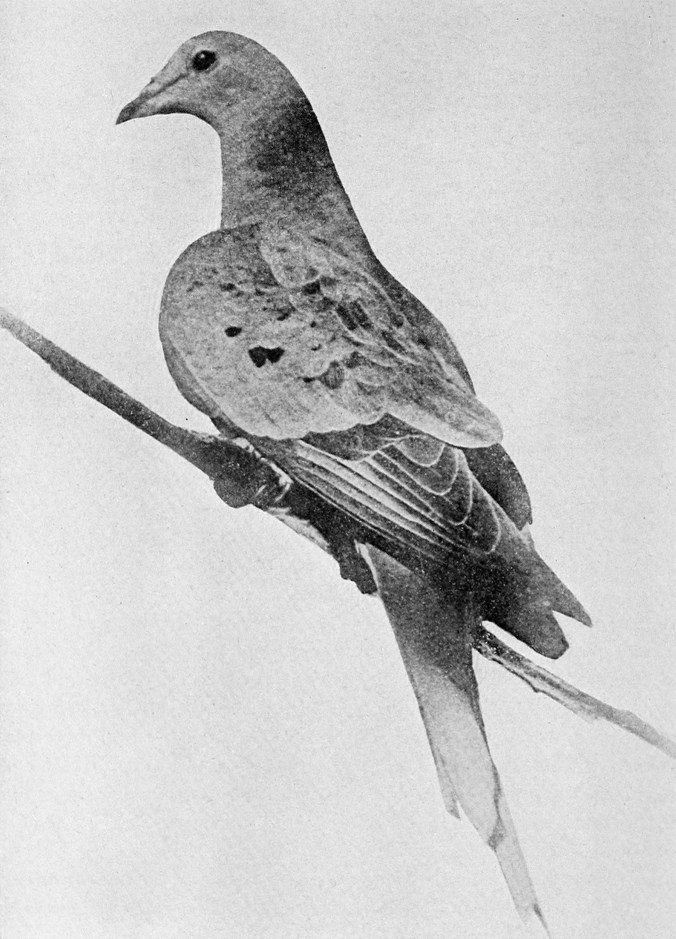
The human toll was so intense that passenger pigeons went from the planet’s most numerous bird to extinct within one human lifetime.1 We’ll never experience them again. Martha, the last remaining passenger pigeon, died on September 1, 1914 at the Cincinnati Zoo.
Martha, that last surviving passenger pigeon, photographed in 1912. Few photographic subjects are as sad as a photo of the last surviving member of its species.
Uncontrolled, unregulated hunting was the ultimate cause of the passenger pigeon’s extinction, although their demise coincided with intense deforestation across the majority of their range. By the late 1800s, all but shreds of forest were removed from the pigeon’s range. They faced unrelenting human pressure on two fronts: direct killing and habitat loss. I wonder if passenger pigeons could have survived the slaughter if enough undisturbed forest remained for them to find refuge and raise their young until market hunting was outlawed in the U.S. and the Migratory Bird Treaty Act of 1918 provided formal protection.
All this makes a proposed regulatory change to the Endangered Species Act2 (ESA) all the more asinine. Segments of our society and culture have yet to understand the necessity of habitat in preventing extinction or realize the immorality of extinction.
Since its passage, the ESA has been the most powerful and impactful regulatory tool in preventing extinction in the United States. The ESA is not perfect, but it has helped prevent the extinction of more than 99 precent of threatened and endangered species under the act’s protection. It works well largely because the ESA includes habitat loss alongside hurting/killing of threatened or endangered individual organisms in its definition of “harm.” If, for example, an endangered plant lives in a wetland then you couldn’t excavate a ditch to drain the wetland. That would prevent the plant from surviving and reproducing. Draining the wetland alters the plant’s habitat negatively when the plant needs the wetland’s hydrology intact to survive. Current federal ESA regulations would consider such a scenario as “take” because draining the wetland would caused clear harm to the endangered plants. The ESA would prohibit altering the wetland even if no person went into the wetland to kill or damage the plants.
For wildlife and plants, habitat is equivalent to home. Protecting habitat is a logical and necessary step to prevent extinction. Often, it is the first step.
Yet the federal government proposes to redefine “harm” as it relates to the ESA so that habitat loss and destruction are not sources of harm for threatened or endangered species. The summary for the rule change states, “The existing regulatory definition of ‘harm,’ which includes habitat modification, runs contrary to the best meaning of the statutory term ‘take.’” In other words, harm to an organism’s home is not equivalent to harm to individuals. (The background and summary info then attempt to justify this point by arguing the ESA was never really meant to protect habitat, and “harm” should be limited to killing, capturing, or injuring. It cites Supreme Court cases and dissents about what “take” means. I’m not a lawyer or legal scholar so I won’t attempt to weigh an opinion on whether the cases are applicable to the ESA but, frankly, if there is any ambiguity then Congress should amend the ESA so that habitat destruction is “take” and “harm.” That’s an unrealistic dream in today’s political climate, I know.)
Limiting the ESA’s definition of harm to only killing and hurting individual organisms is a vastly unscientific and illogical decision. The consequences of the proposed change could be catastrophic for endangered species. It would allow the federal government to ignore the importance of habitat when evaluating development and other activities on threatened and endangered species. Building a dam that blocks endangered salmon from migrating would not be “harm” because the dam didn’t outright kill salmon returning to spawn; they just couldn’t spawn. Cutting down a condor’s nesting tree wouldn’t be “harm” as long the condors weren’t injured when the tree fell. Draining an endemic salamander’s stream wouldn’t be “harm” because you didn’t kill or capture any salamanders; they simply lost their home and food. Building an oil rig in a polar bear maternal denning area wouldn’t be “harm” if the mother polar bears aren’t in the dens; it wouldn’t matter if they couldn’t find denning habitat elsewhere. Building a parking lot on a sage grouse lek wouldn’t be “harm” because the grouse didn’t die during construction; they simply couldn’t court and reproduce. Polluting a river so that sea grass beds die wouldn’t be “harm;” it didn’t directly poison any manatees to death, just led to their slow starvation.
Perhaps with adequate habitat protections in place, passenger pigeons could still be part of our shared landscape. We’ll never know.
Since Martha’s death, extinction rates have accelerated due to human pressure. Market hunting may be a thing of the past in the United States at least, but habitat loss is not. A 2022 study found that habitat destruction was the main threat of extinction for 71 percent of endangered species worldwide. (Overexploitation, which is another way of stating human hunting/harvest was the main factor for 7.4 percent of endangered species.) The International Union for Conservation of Nature (IUCN) lists 28 percent of all assessed species as threatened with extinction. Humans and our livestock and pets outweigh wild vertebrates globally. Vertebrate animals populations have declined more than 70 percent worldwide since the 1970s. In North America alone, bird populations are reduced 3 billion compared to the 1970s—a stat that doesn’t include the loss of passenger pigeons. Most fish populations are overexploited and many are near collapse. We’re poised to mine the deep sea even though we have seen almost none of the life that exists there. All this has happened within my lifetime, and while people in our government argue with a straight face that habitat considerations should not be included in ESA’s regulations. The ultimate legacy of my generation and my parents’ generation may be to leave behind an ecologically impoverished planet. It is a moral failing.
I recently read Apocalypse Never, a book that, through a great deal of cherry-picked data, contends (unsuccessfully IMO) that climate change and biodiversity loss aren’t big deals. At the end of the book, the author Michael Shellenberger writes, “Scientists have long named self-interest as the reason for why humans should care about endangered species like the mountain gorilla. But if the mountain gorillas were ever to go extinct, humankind would become spiritually, not materially, poorer.”
In our short time on Earth, segments of humanity have been insulated from the material costs of extinction, largely because the nature supporting different groups of people wasn’t directly tied to the survival of any one species. When the last mammoth died, were people in Australia or Africa affected? When Steller’s sea cow vanished, did the farmer watching pigeons in Pennsylvania notice? When the last passenger pigeon died, did people in Japan or Bangladesh or Sweden mourn?
Yet extinction is an impoverishing event. We don’t know, and can’t know, how we’d value passenger pigeons today. We know that we are materially poorer because we’ve been denied the opportunity to integrate passenger pigeons into a possible sustainable economy—which, yes, could include hunting. Culturally and spiritually, we’ll never experience the joy and awe that some people must have felt as they watched pigeons blot out the sun like an eclipse. We don’t know what else they might have offered. We cannot truly understand or evaluate the possible effects that billions of pigeons had on temperate forests in eastern North America. We were denied the opportunity to know. Likewise, the extinction of mountain gorillas would affect communities in parts of Central Africa. What’s the value—materially, culturally, spiritually—of a gorilla? It is not our place to decide. It is our place to give future generations the opportunity to discover.
When sitting in a comfortable chair surrounded by material wealth it is easy to shrug your shoulders when a species winks out of existence, but allowing extinction is an immoral act. We should know better. Leopold in Sand County Almanac and Kimmerer in The Serviceberry have envisioned better futures. I’m not sure that we are wise enough to heed their advice.
It is immoral to deny future generations the wealth—however you define it—that non-human organisms provide. Moreover, humanity doesn’t own Earth or the organisms we share the planet with. Governments and corporations don’t either. Our non-human neighbors belong to themselves and the future. Morality compels that we don’t arbitrate whether a species is worthy of existence.3 We can continue to be complicit in extinction by allowing governments and corporations to sacrifice species for material wealth or we can build a sustainable future.
Nature is life. Earth is the Ark. We can be its caretakers or simply its takers.
The public comment period for the proposed regulatory change closed on May 19, before I published this post. ↩︎
This isn’t an absolute. We can defend ourselves from organisms that cause us harm such as the Guinea worm or the protozoan that causes malaria. It is ethical to remedy the suffering certain organisms cause us. These are decisions to make on a case-by-case basis. ↩︎
In Maine, Atlantic salmon are highly endangered. Prior to European colonization and, later, industrialization of the landscape’s rivers, hundreds of thousands of salmon returned to spawn in Maine every spring. Now, however, a so-called good year includes the return of 1,500 fish to the Penobscot River, which is Maine’s most productive salmon river, and maybe 2,000 fish total statewide. Maine is also the only state with runs of wild Atlantic salmon.
Kennebec River used to be one of Maine’s great salmon rivers, but its Atlantic salmon are nearly extinct. The recent 10-year average (from 2014-2023) of annual returning adult salmon at the Lockwood fish lift in Waterville, Maine is a mere 51 fish. Salmon fare so poorly in the Kennebec because they encounter four impassible dams between Waterville and Skowhegan. Even so, there’s an opportunity to save the Kennebec’s salmon run if we act now.
The Federal Energy Regulatory Commission (FERC) is considering relicensing operations on four hydropower dams on the Kennebec River. For decades, these dams have lacked any effective fish passage for salmon and have prevented salmon from reaching upstream spawning areas. If the dams are kept in place, even with improved fish passage efforts, we can expect the dams to continue to harm salmon and heighten their risk of extinction.
Unfortunately, FERC’s draft environmental impact statement (DEIS) for the dams calls for relicensing the facilities at the expense of salmon. At the end of this post, you’ll find the comments that I submitted to FERC about its DEIS. I found reason for extraordinary concern in FERC’s conclusions.
We know that dam removal works to restore fish runs. One of the first and best examples was on the Kennebec in Augusta. The 1999 removal of the Edwards Dam led to a great resurgence of shad, sturgeon, striped bass, river herring, and alewives to the lower Kennebec. Elsewhere in Maine, many people and organizations have worked diligently over the last few decades to restore Atlantic salmon with the largest success occurring on the Penobscot River. (This short podcast explores current efforts to restore sea-run fish in the Penobscot.) On the West Coast, the removal of dams on Washington State’s Elwah River allowed salmon to return in numbers not seen there in 100 years. In California right now, efforts are underway to remove large dams on the Klamath River to open hundreds of miles of river to Chinook and other salmon. In Washington and Idaho there is a growing chorus of support to remove impassible dams on the Snake River for the benefit of salmon and the species (including people) who depend on them.
The upper Kennebec River, though, remains imperiled because four dams block passage of sea-run fish. The few salmon that attempt to return to the upper Kennebec must be captured and transported by truck around the dams to reach any spawning habitat.
In its DEIS, FERC proposes to relicense the dams of the Shawmet Project on the Kennebec. This seems to be another example of conservation minimalism, which was defined in a 2023 paper as “Any minimal standard [that] inevitably excludes some worthwhile conservation targets—values, obligations, and principles that ought to be upheld, or specific ecosystems and species that ought to be protected—by factoring them out as irrelevant to the specified minimum.” That is, humans taking everything but the bare minimum. We allow a species to persist only in greatly restricted ranges or low overall numbers or both. Regarding salmon, the cost-benefit analysis of dams are too often viewed through a lens that obscures the ecological and cultural benefits of fully restored salmon runs. That viewpoint does not allow for the restoration and maintenance of salmon at their fully realized ecologic potential.
Too often, “balancing” the wants of people and needs of wildlife, including fish such as salmon, has meant a cumulative degradation and loss of wildlife habitat. Therefore, the so-called balance is not a compromise with wildlife but harm forced on wildlife and their habitats. These decisions eat away at our natural heritage, piece by piece, leaving each successive human generation with a more impoverished environment than the last. FERC is on the cusp of repeating that mistake on the Kennebec unless the FERC requires stronger, more effective fish passage structures for the Shawmut Project beyond what is already proposed in the DEIS or the dams are removed. These dams are not worth more than salmon. Extinction cannot be an option.
Please comment on the DEIS (docket 2322) if you can (which is not a simple process so see these instructions). But I realize this is a last minute request since the comment period closes today (June 4), and most people don’t have time to wade into a 400-page environmental impact statement. So if you can’t comment this time, then I ask you to keep salmon and other sea-run fish in mind when you make your daily decisions. Vote for people who support wild, sustainable populations of fish and will work to improve protections for salmon, which includes tackling climate change ASAP. Don’t eat farmed salmon, as farmed salmon are one of the greatest threats to the viability of Atlantic salmon in North America, especially in Maritime Canada. Finally, please share the amazing journeys of salmon with people you know. The more people who appreciate the remarkable lives of salmon the better.
Thanks for reading and for your support of wild salmon. Below are my comments on the Shawmut Hydroelectric Project. (FERC restricts comments to 6000 characters, which is quite limiting considering that the documents about relicensing dams often run for hundreds of pages. Nevertheless, I tried my best with the character limit.)
I’m writing to urge FERC to recommend the decommissioning of the Shawmut Hydroelectric Project No. 2322 (Shawmut Project) on the Kennebec river. The fish passage measures outlined in the draft environmental impact statement (DEIS) are inadequate and will likely prevent the restoration of self-sustaining runs of sea-run fish, especially Atlantic salmon. FERC should recommend the Shawmut Project’s dams be removed on the Kennebec River.
We lack the necessary skill and knowledge to engineer fish passage that allows all migratory fish species to overcome the challenges created by dams. On the Kennebec River, it is particularly difficult to provide adequate fish passage around dams because the river is home to at least ten diadromous species that migrate at different times of day, different times of the year, and under different hydrologic conditions.
Of utmost concern is the Kennebec’s run of Atlantic salmon, a distinct population that is highly endangered. Their recovery is doubtful as long as dams exist on the Kennebec. The DEIS contains no substantive evidence that adding additional fish passage to the four dams on the lower Kennebec will favor Atlantic salmon and enhance their recovery to a point where the population is no longer endangered.
I’m greatly concerned that Brookfield’s proposed fish passage measures will not provide salmon with the opportunity to migrate rapidly upstream or downstream. For example, page xx of the draft EIS states,
“Brookfield also intends to achieve an adult salmon upstream passage effectiveness standard of 96% within 48 hours of a fish approaching each project, in order to achieve a cumulative upstream effectiveness standard of 84.9% through all four projects within 192 hours.”
“Resident time” is double speak for substantial, harmful migration delays imposed on salmon. A 192-hour delay is an 8-day delay for a salmon to travel about 18 river miles between the lowermost and uppermost dam of the Shawmut Project. Since Atlantic salmon are reliant on stored body fat and protein to fuel upstream migration, this will cost adult salmon vital energy reserves as they attempt to find a way past the dams with negative consequences on their reproductive survival.
Dams make river water warmer and slow its flow. Under future climate conditions, the Kennebec may become warmer during salmon migration periods. Warmer water holds less dissolved oxygen and increases the metabolism of salmon. Therefore, the effects of an 8-day delay will decrease salmon survival and reproduction upstream, regardless of the modeled 84.9% effectiveness.
Pages 55-57 of the DEIS explore the risks of such a delay on salmon, yet somehow the significant, cumulative, and negative consequences of delays due to the dams are deemed acceptable by FERC. Pg 57 of the DEIS states, “Brookfield’s proposal to test the fishway effectiveness and implement additional adaptive management measures … is a reasonable approach.”
However, FERC’s conclusions on page 57 are not consistent with the science cited in the DEIS. For example, page 56 of the DEIS includes the remarkable statistic that under a four dam scenario on the Kennebec 37.4% of the run would die before spawning. As the Kennebec Atlantic salmon population is close to extinction–the recent 10-year average (from 2014-2023) of annual adults returns at the Lockwood fish lift is a mere 51 fish (DEIS page 44)–then a nearly 40% mortality due to dam-caused migration delays is completely unacceptable.
Additionally, on page 52 of the DEIS notes that Brookfield “would modify or construct additional fishways only if needed after its proposed fishways are complete and have been tested for effectiveness.” This position also risks further harm to salmon. If new fish passage structures are ineffective, then the Kennebec’s salmon may already be faring worse than now. The most parsimonious and beneficial strategy for Atlantic salmon would be to require, beyond doubt, reasonable and effective fish passage as part of the relicensing process or decommission the dams. Based on the best scientific evidence, FERC’s position is neither reasonable or scientifically justifiable.
Additionally, the reasons why certain species of fish do not take to artificial fish passageways is sometimes unknown. Rivers are complex systems and artificial fish passageways only grossly approximate the conditions the fish would experience in the absence of dams.
A free-flowing Kennebec River and naturally self sustaining runs of diadromous fish are worth more—economically, ecologically, and culturally—than anything the Shawmut Hydroelectric Project can provide.
Maine’s rivers likely never supported tens of millions of salmon, but they could and should support hundreds of thousands of salmon and tens of millions of sea-run fish collectively. Instead, status quo industrialization threatens to keep our watersheds impoverished. It is difficult to imagine the richness of a river full of salmon in Maine because that phenomenon hasn’t been experienced here in many generations. We suffer from a multi-generational amnesia that has us collectively accepting the near or complete absence of salmon and other sea-run in our rivers when their absence is not at all normal. The DEIS somehow tries, and fails, to justify that the current status quo is okay when it is not.
The electricity generated by the dams can be replaced easily by wind and solar installations. Energy conservation measures across the state could also be implemented to mitigate the loss of the hydropower. As long as these dams exist, the Kennebec’s Atlantic salmon are likely to remain endangered or, at best, exist only as a remnant population, while people and the ecosystem will never experience the full benefits of healthy runs of Atlantic salmon and other diadromous fish. Do not relicense the dams. It is the wrong decision and guarantees, with near certainty, that Atlantic salmon will remain endangered for the foreseeable future.
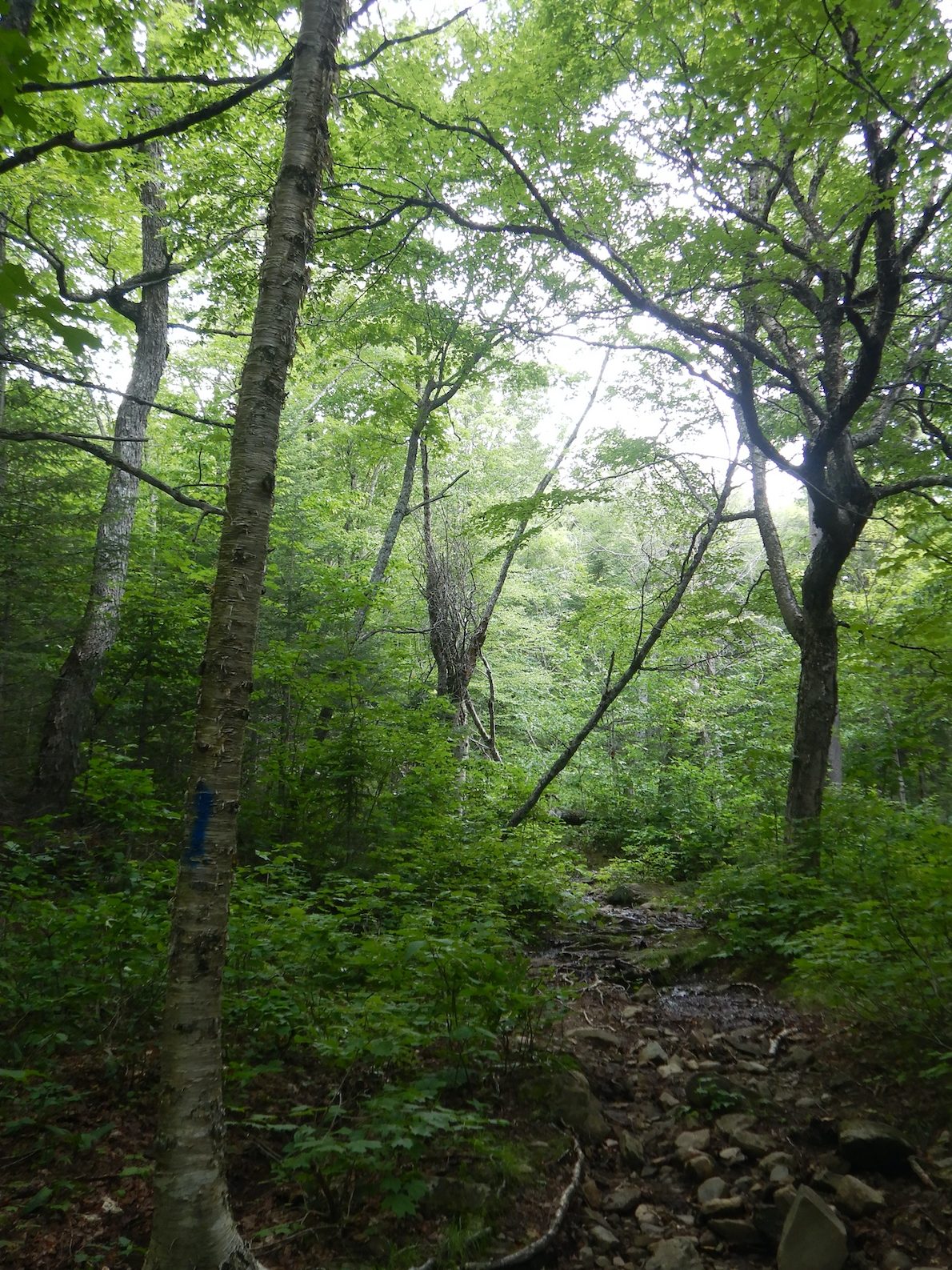
Truly knowing a place might be a capacity only of the omniscient or for earthly beings, perhaps, something gained through multi-generational experience. Lacking omniscience, living in an area far from where I was raised, and having lived in my home only for a few years, I’m forced to make do as best I can. I’ll never know a place in its totality, but I’ve come to realize that I can get closer if I experience it in every season, which is how I found myself trekking to the top of Mount Chase, Maine during every month of the year.
December 11, 2022 The first trip in the journey and the most treacherous. Snow has yet to establish itself for the winter and ice covers many sections of trail. The summit is frosty. The hike down is much slower than the hike up.
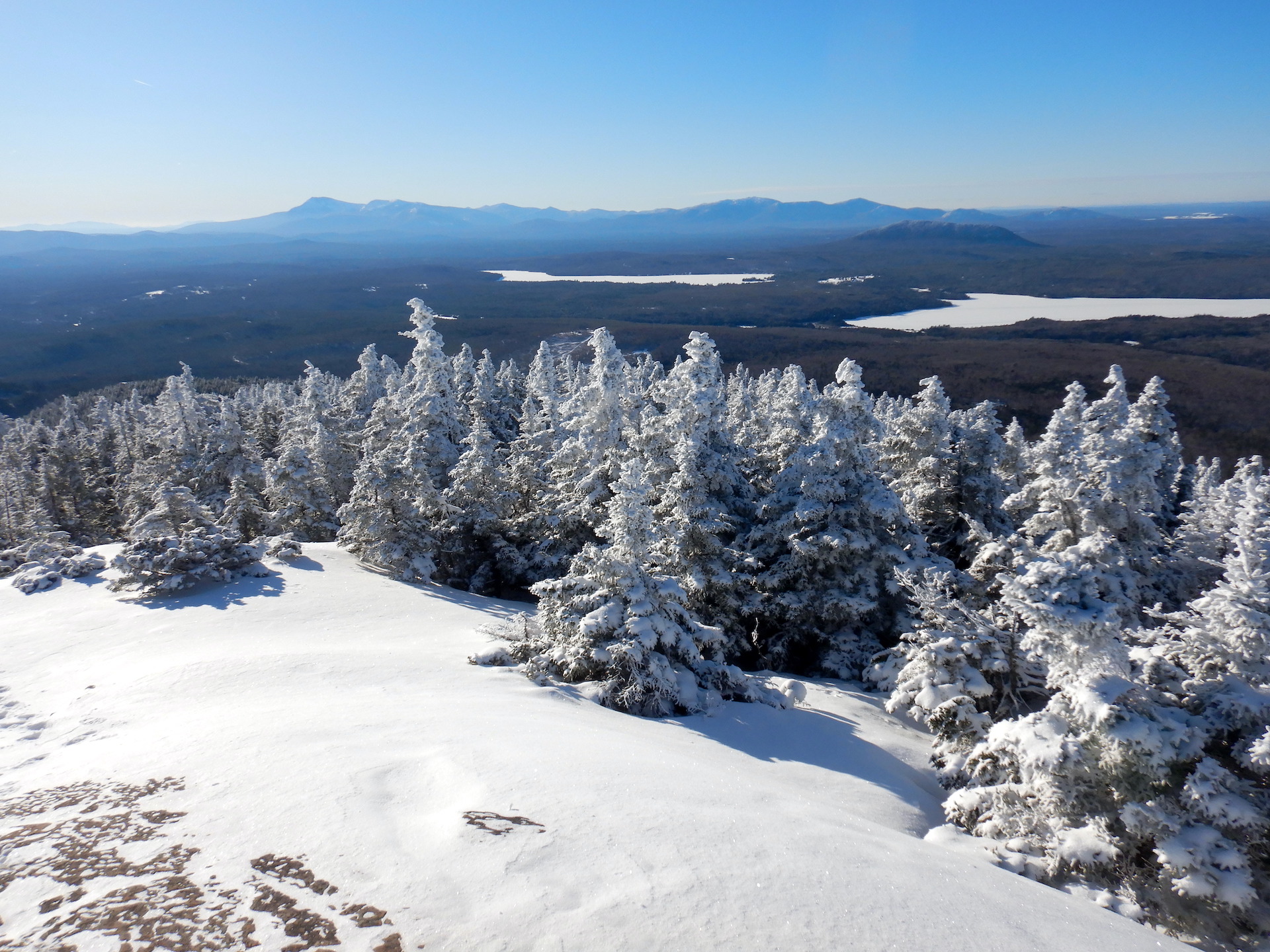
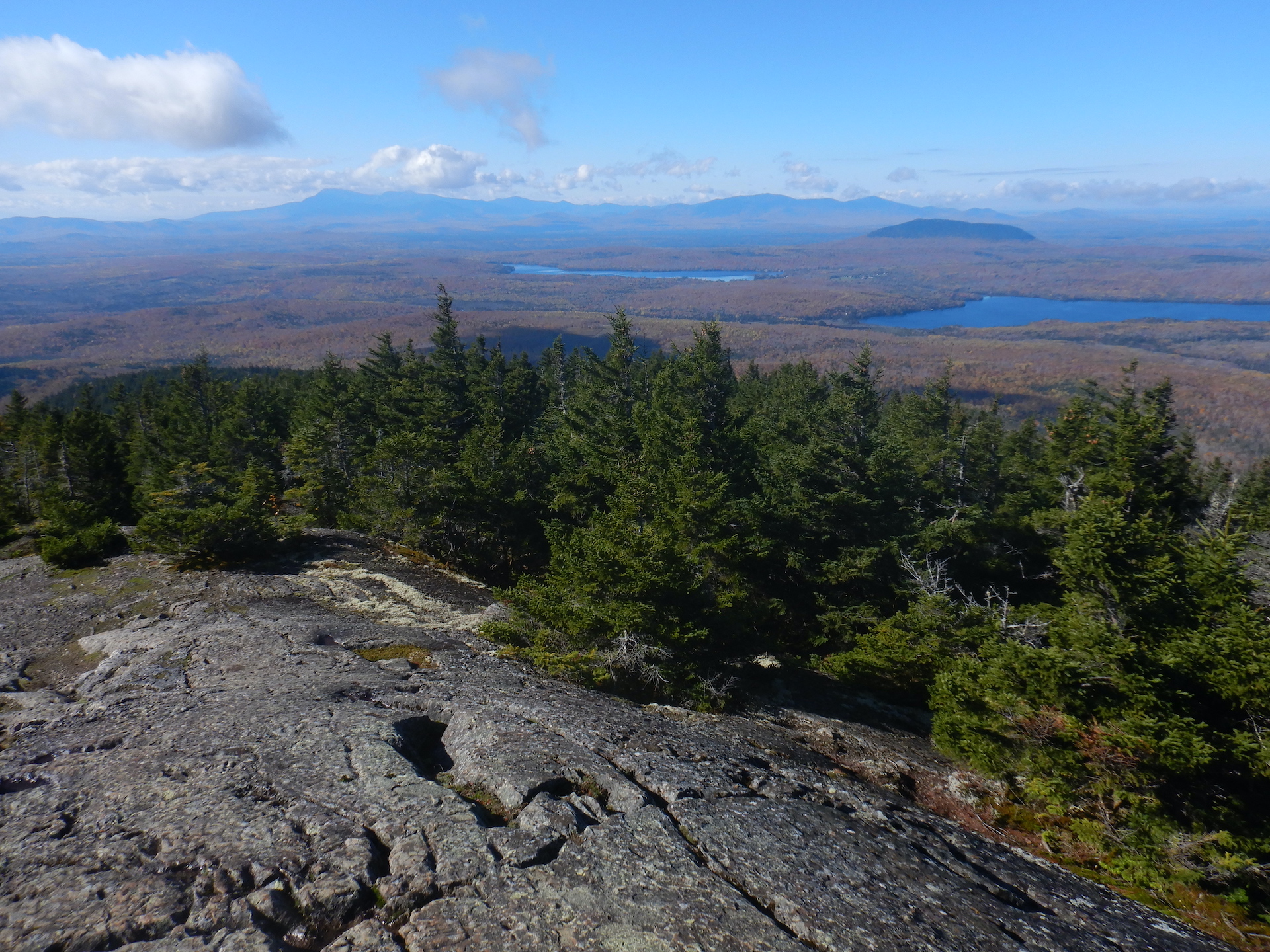
Ice covers the Mount Chase Trail on Dec. 11, 2022.Looking west from the Mount Chase summit toward Upper Shin Pond, Sugarloaf Mountain, and Traveler Mountain.
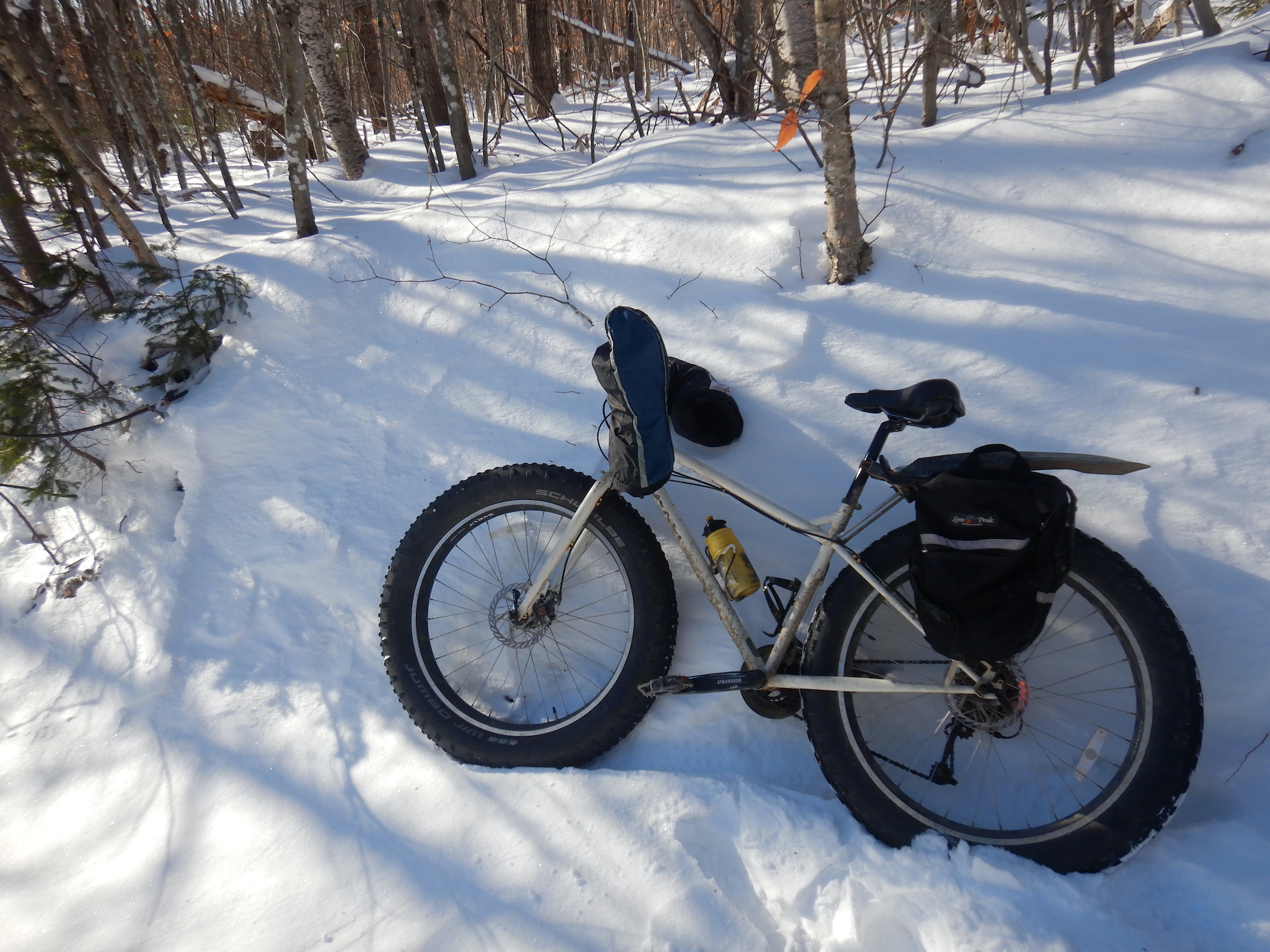
January 8, 2023 With snow now covering the ice, the trip is far easier than last month and the snow is not yet thick enough that I have to ski to the trailhead. My trusty fat tire bike, Large Marge, gets me there. At the summit, visibility is exceptional and perhaps only limited on this day by the curvature of the Earth. On the way down, I hear a raspy-sounding chickadee. A boreal? Yes. I see it fluttering from branch to branch in the spruce-fir forest maybe 200 – 300 feet in elevation below the summit.
The view to the west-southwest from the Mount Chase summit on Jan. 8, 2023. The mountains of Baxter State Park including Katahdin form the horizon.A boreal chickadee perches in a dead spruce.
February 12 Peak winter. Minus 60˚ F wind chills during the week prior and low air temps approaching -30˚ F at home. I know arctic peoples cope with those temperatures routinely, but I’m too poorly prepared to survive those conditions. Thankfully, this day is warmer, so much so that snow fleas are active on the snow surface. I ski as far as I can up the trail. Eventually, I abandon my skis and walk the rest of the way when the trail steepness beyond my comfort level. The trail is also too narrow to ski down safely and I don’t own the the right style of skis or the skills to do that anyway. On the way up, though, I miss their floatation. The snow pack on the upper mountain must be at least 36 inches. I post-hole to my waist on two occasions.
The destination: Mount Chase on Feb. 12, 2023.The view looking south from the Mount Chase summit on Feb. 12, 2023.
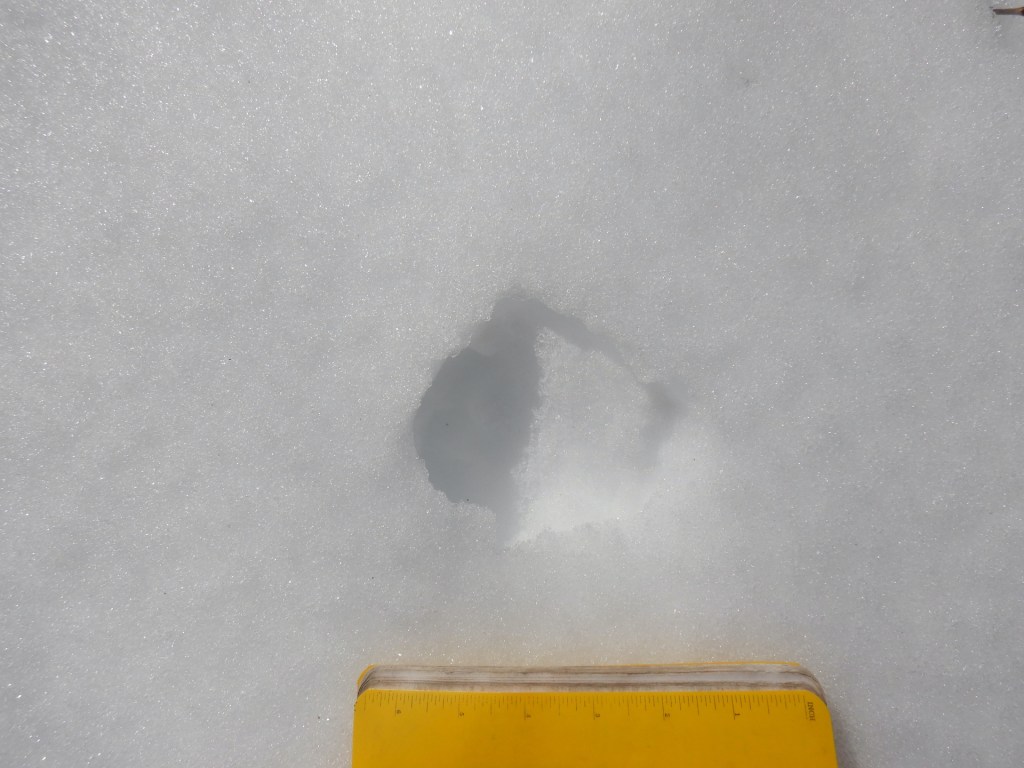
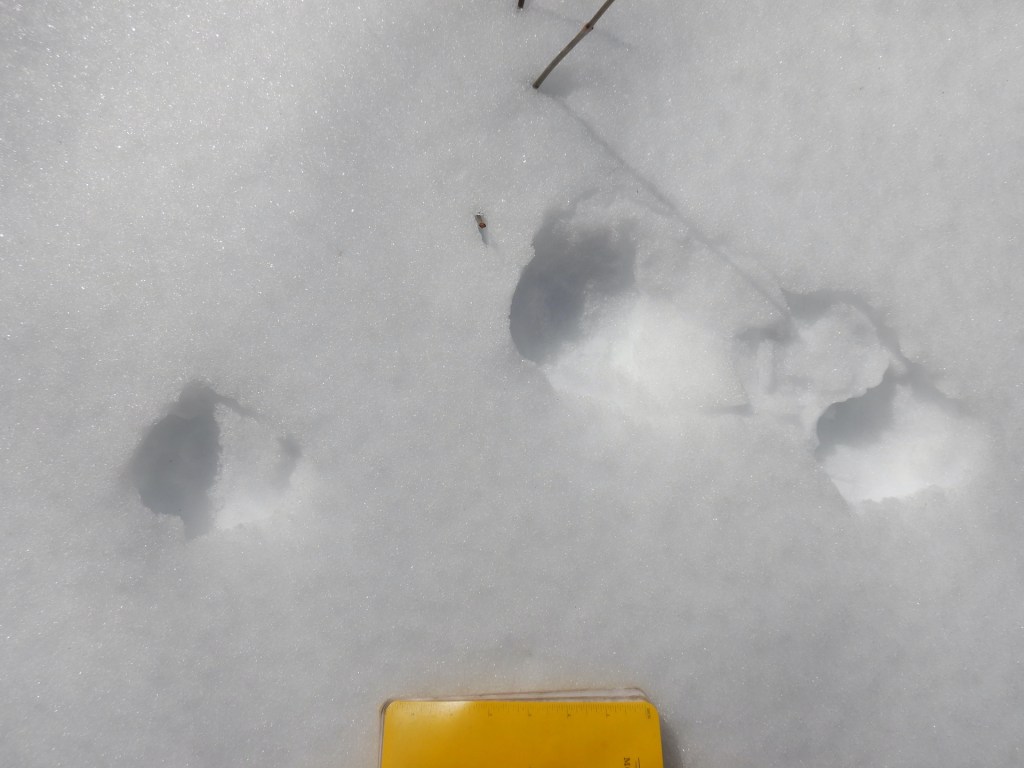
March 11 The snow seems deeper than February, but maybe this will be the last deep snow trip of the year? Along an alternative route I like to take to the main trail, I find a set of lynx prints in the snow. Farther up the mountain I ditch my skis again at a point above the abandoned fire warden’s cabin where the slope gets too steep. A few snowmobiles have made the trip, though, and I continue with relative ease in their trackways.
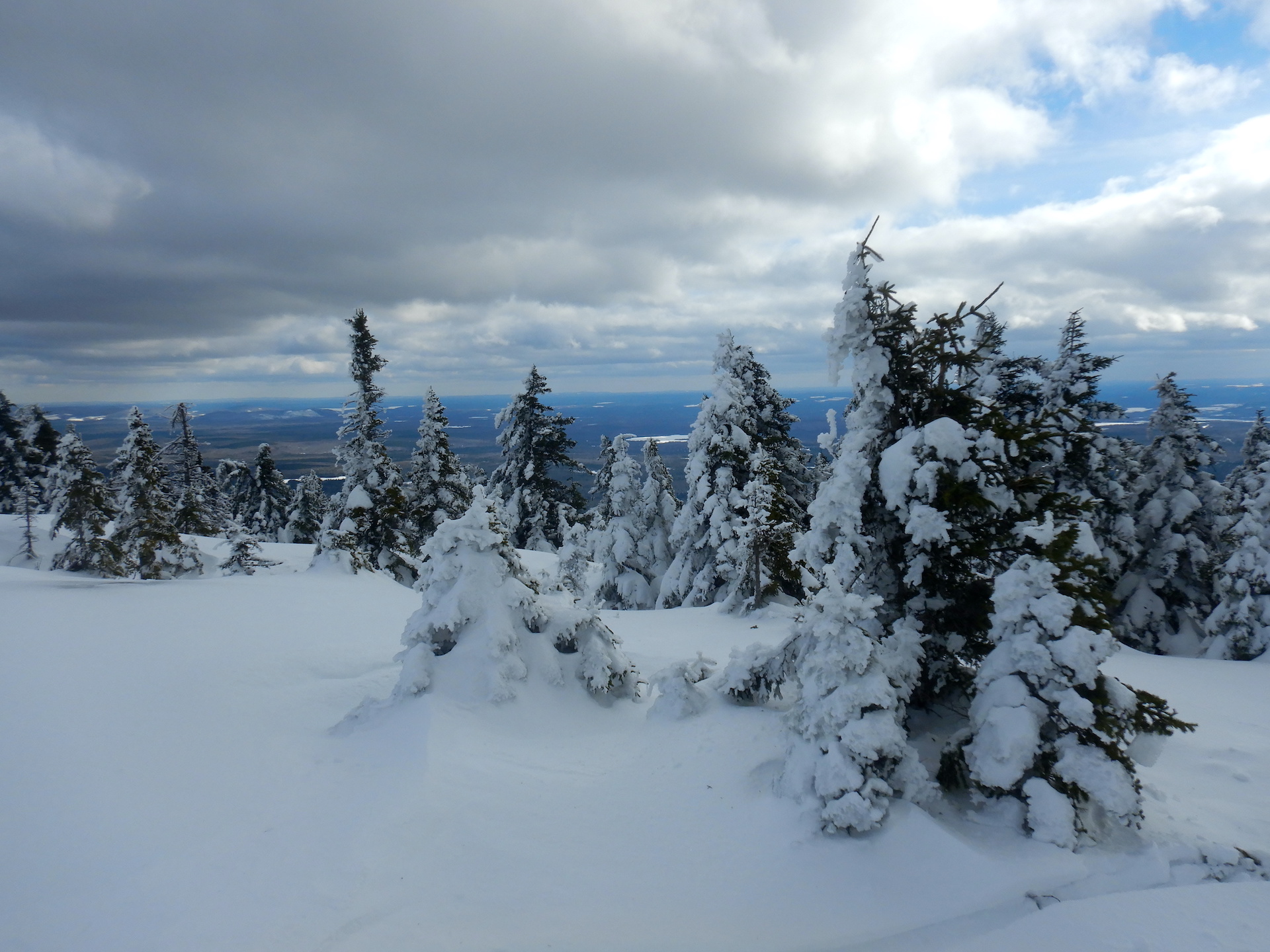
A single lynx track. The feline was traveling from right to left.Although these lynx tracks aren’t well defined, the size and shape are distinctive. I find one set of these tracks per winter on average. Lynx are rare in Maine and have large territories.The coniferous forest on the upper slopes of Mount Chase.
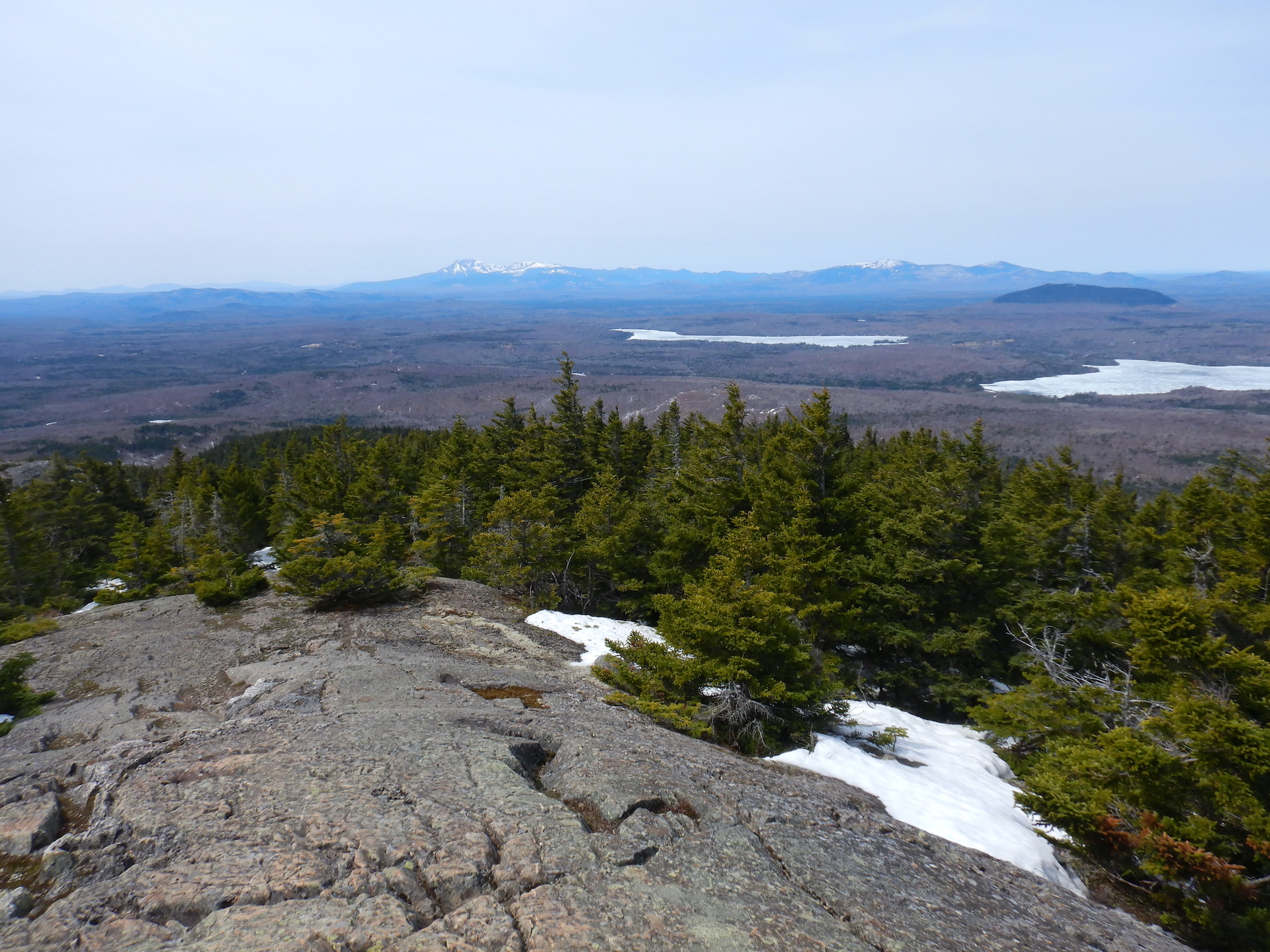
April 22 A difficult trip to the top and back (the hardest of them all, in hindsight). Mud season has fully enveloped the region. The dirt roads that approach the trailhead are slop. Large Marge gets me to the trailhead but not without extra effort from my legs. The trail remains almost wholly snow-covered above the abandoned fire warden’s cabin and the remaining snow is soft. Still, I’m thankful winter’s dormancy is broken. Near the trailhead, I hear wood frogs looking for love in a nearby a vernal pool. The calls of juncos, robins, and sapsuckers—birds that do not overwinter here—fill the deciduous forest nearby.
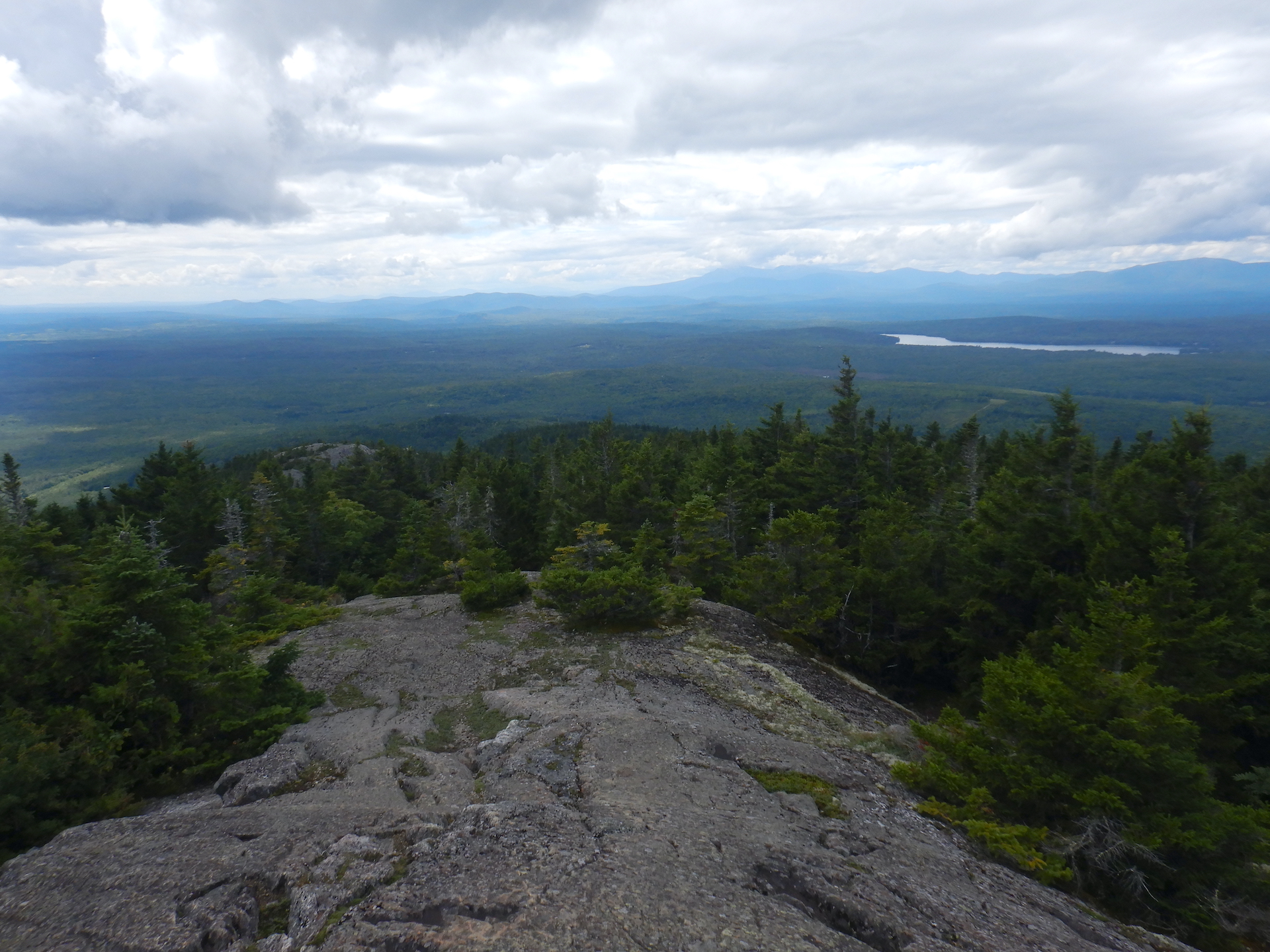
The official Mount Chase trailhead.The abandoned fire warden’s cabin on Mount Chase.Looking west-southwest toward Katahdin and Baxter State Park from the Mount Chase summit on April 22, 2023.
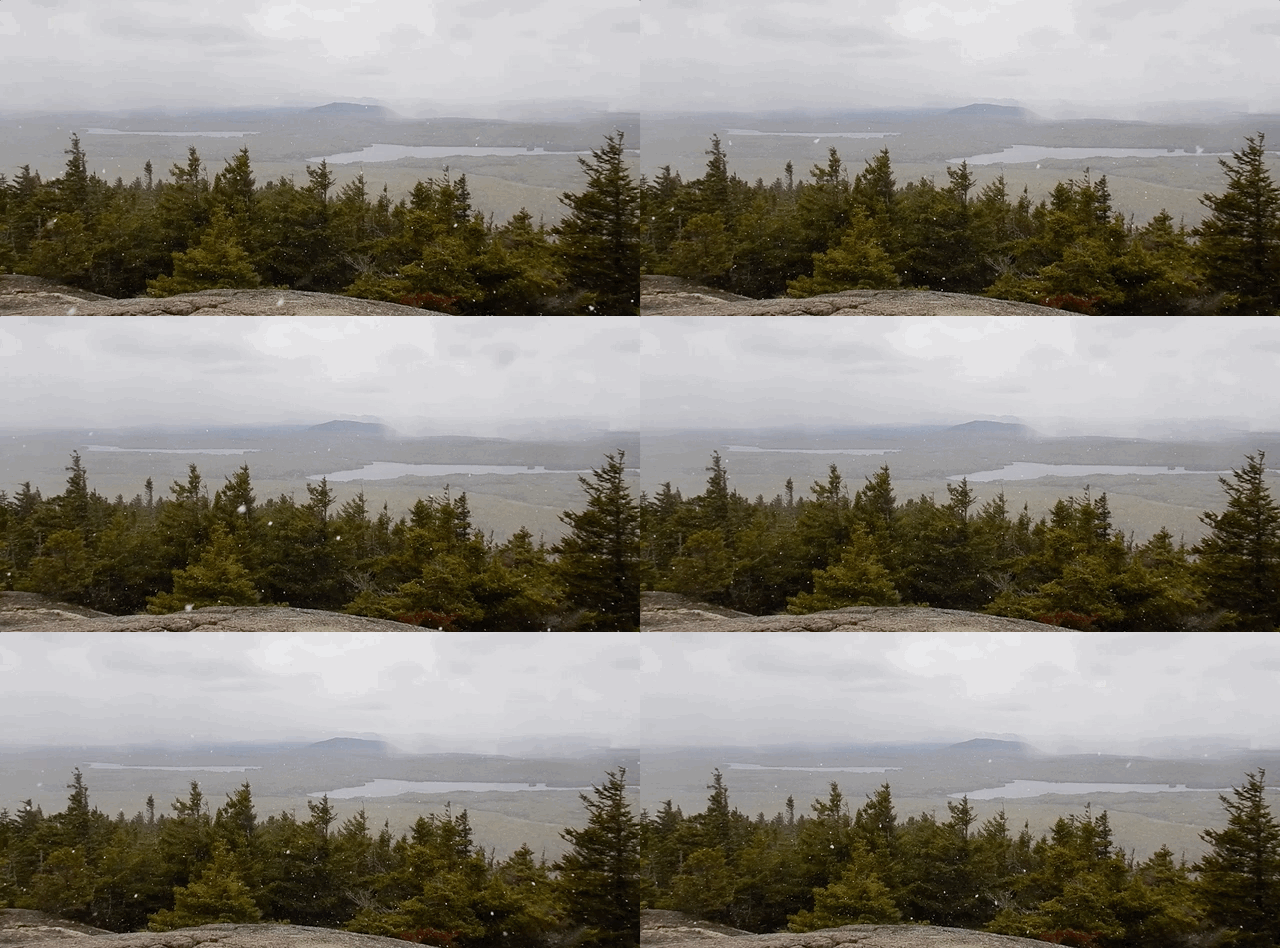
May 17 I thought I’d be done with snow on the mountain by now. I was wrong. It falls on the way up and on the summit. Some small patches linger in the shadiest areas among the spruce and fir. Bud break might be advancing fast at lower elevations, but the plant phenology seems at least a week delayed on the mountain’s mid elevations and maybe two weeks behind in the summit area.
Trillium erectum on the lower slopes of Mount Chase.
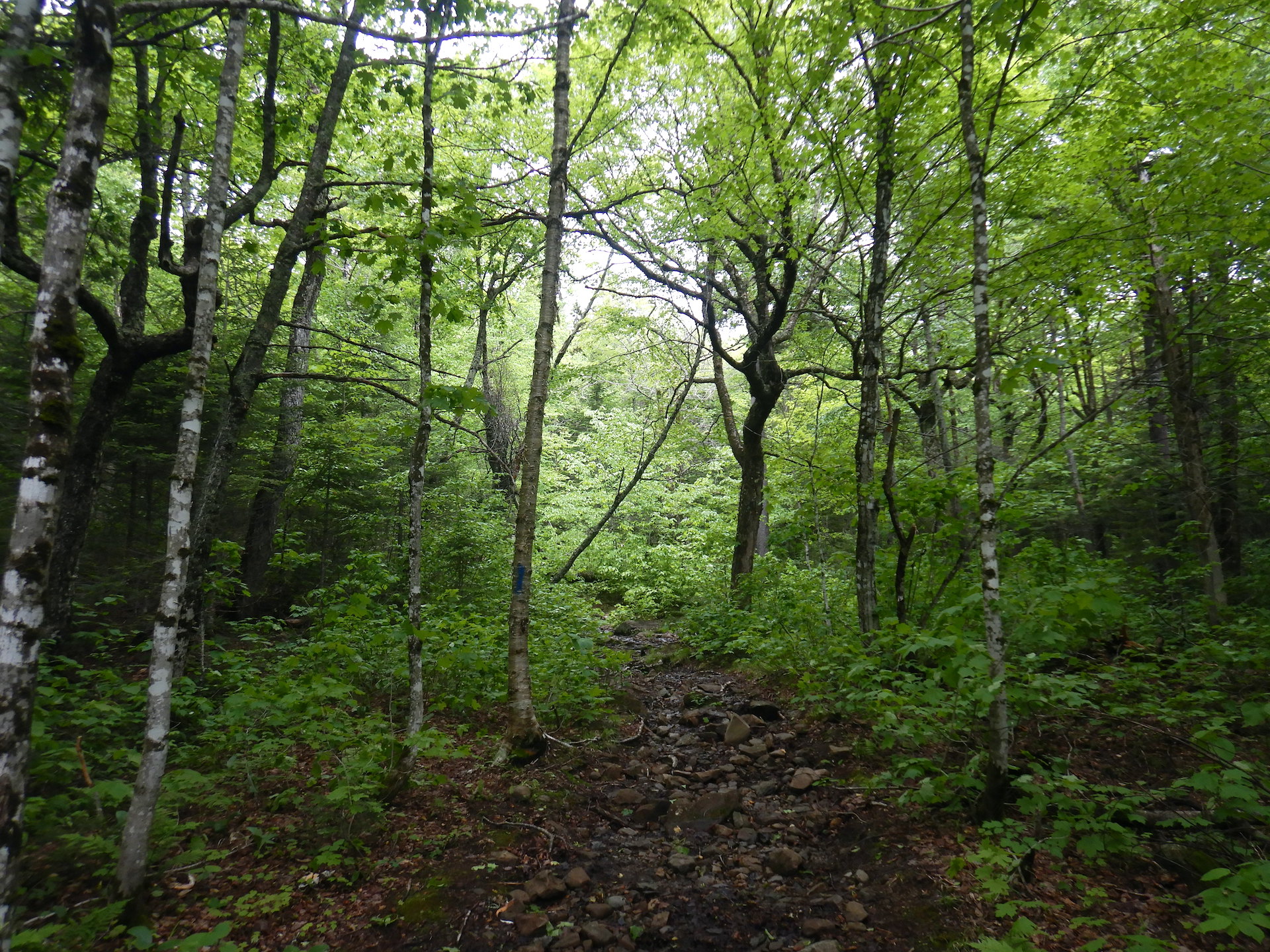
June 19 A busy day on the trail with a whopping three cars at the trailhead! Large Marge, as usual, doesn’t have any other bicycles to keep her company. The forest has come to life. I note more than 20 plant species blooming. Biting insects are surprisingly few in contrast to home where the abundance of mosquitoes and black flies force me to don long sleeves, long pants, and a headnet almost anytime I intend to spend more than a few minutes outside. In the spruce-fir forest, I enjoy listening to the songs of blackpoll warbler. Sadly, they are categorized as a threatened species in the state.
Late spring on the Mount Chase Trail.This is the song of a blackpoll warbler recorded in the spruce-fir forest of Mount Chase. The song is a rapid series of high-pitched notes near the beginning of the track. The audio also captures part of the songs of Swainson’s thrush and winter wren.
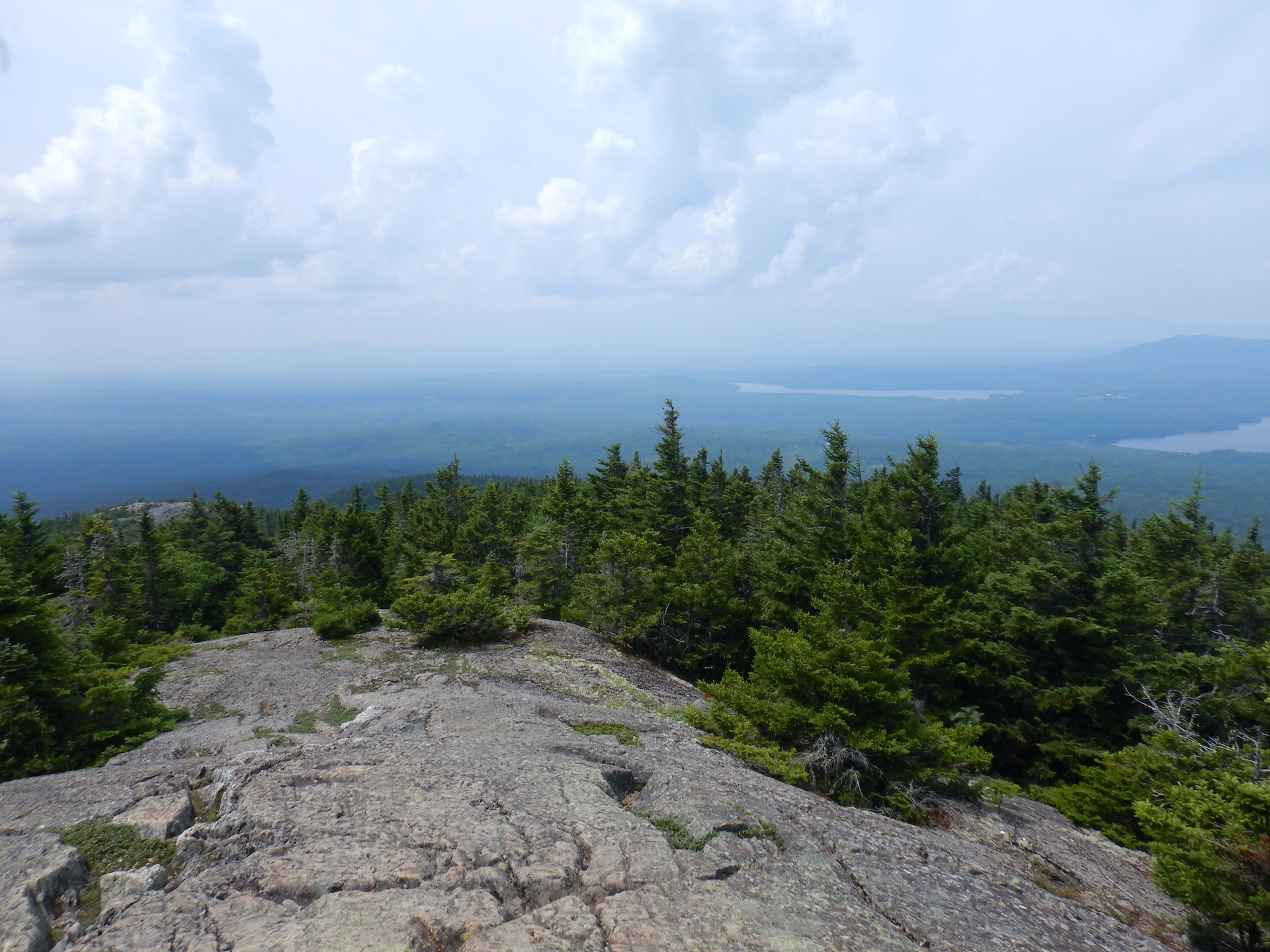
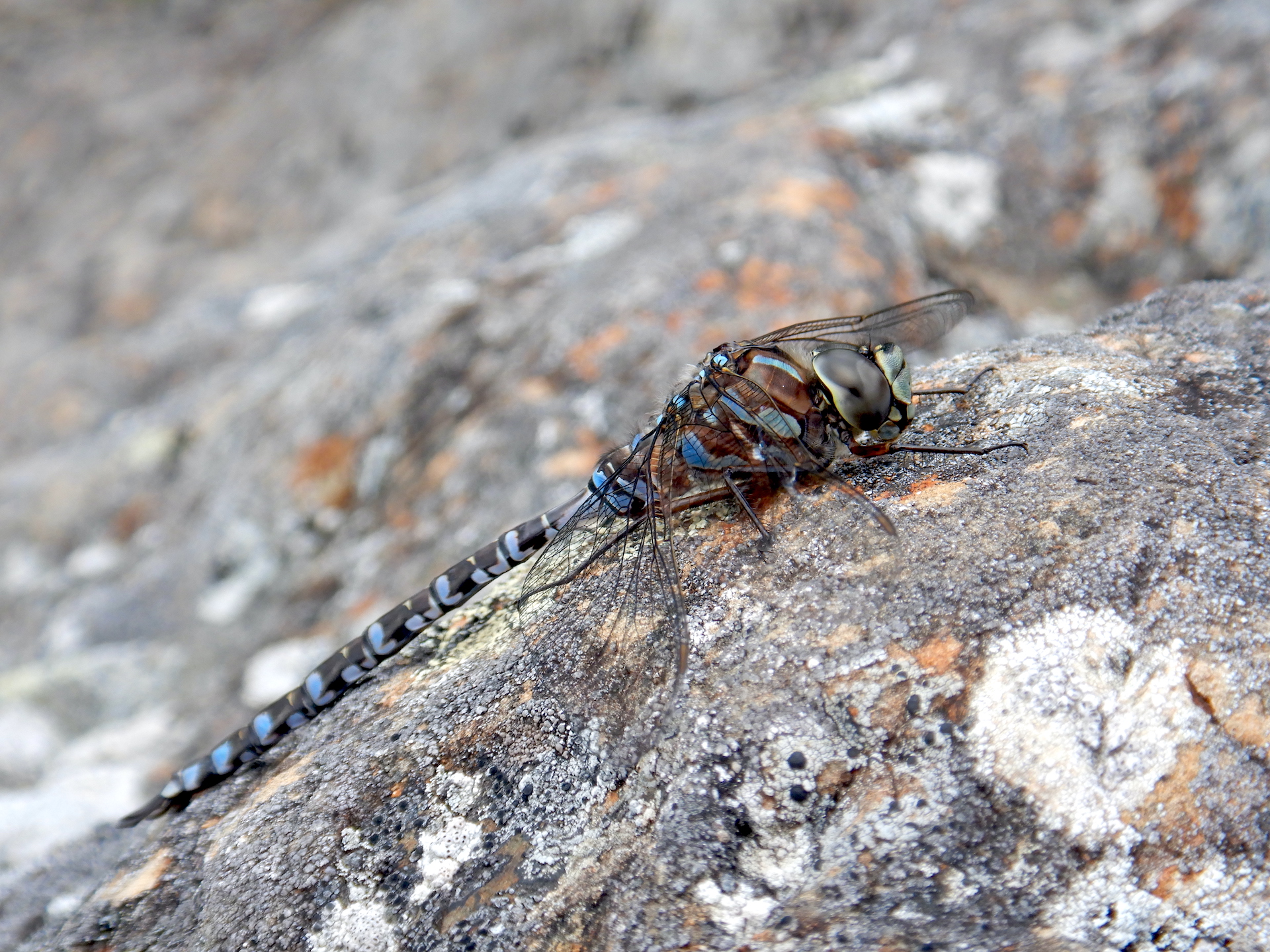
July 21 The air feels and looks heavy due to high humidity and hazy, smoke-filled skies. This isn’t the first day of the summer with these conditions, and the past two summers had days like this too. Is the presence of smoke becoming the new normal for summertime Maine? I concentrate on observing the trees, which are in “peak green,” a phase in summer when the foliage has reached its max yet still retains some of the freshness of spring. Fledgling birds are the latest addition to the animal community. Golden-crowned kinglets and red-eyed vireos feed noisy babies. On the summit, hundreds of dragonflies zip between the stunted trees.
Peak green on Mount Chase trail. July 21, 2023.Looking west-southwest through smoky haze toward Katahdin and Baxter State Park from the Mount Chase summit on July 21, 2023.A darner dragonfly of genus Aeshna rests on at the summit of Mount Chase. If you know what species it is, please identify it on iNaturalist.
August 20 A quiet hike now that songbird nesting season is done. Only white-crowned sparrows sing in the summit area. The summer foliage has reached “tired green.” The work of photosynthesis as well as insect attacks have rendered the previously vibrant leaves a darker, less vibrant hue. I experienced a stressful week. Yet, I’m fortunate to have an escape for some brief solace.
A section of old growth forest on upper Mount Chase.Looking west-southwest toward Katahdin and Baxter State Park from the Mount Chase summit on August 20, 2023.
September 24 I discover (for myself) the remnants of a long abandoned cabin maybe 20 yards off the trail. It’s collapsed to its foundation. Still, I’m surprised by its presence. I walked by it many times previously without seeing it. The forest tends to make things disappear. Hazy conditions have returned to the area. A thick band of wildfire smoke clouds the north horizon and the mountains of Baxter State Park are mostly obscured. A few red-tailed hawks ride the thermals on the mountainside on their migration south. A raven family doesn’t tolerate their presence. They move to chase one of the soaring hawks. We’re approaching peak fall colors, although the colors are quite muted compared to normal.
The forest and weather will soon consume this collapsed cabin.The Mount Chase Trail on Sept. 24, 2023.Looking west-northwest from the Mount Chase summit on Sept. 24, 2023.
October 18 The forest trends brown. A solid layer of newly fallen leaves cloaks the forest floor. I somehow sleepwalk most of the way to the summit, a habit I’ve been trying to break for years with greater mindfulness. I find myself stopping to focus on my breath and immediate surroundings. Something distracted me, probably precipitated by a media culture that profits from distraction and rage-inducing social networks. It is possible to walk through a forest and not see it at all.
The Mount Chase Trail on October 18, 2023.Looking west-southwest toward Katahdin and Baxter State Park from the Mount Chase summit on October 18, 2023.
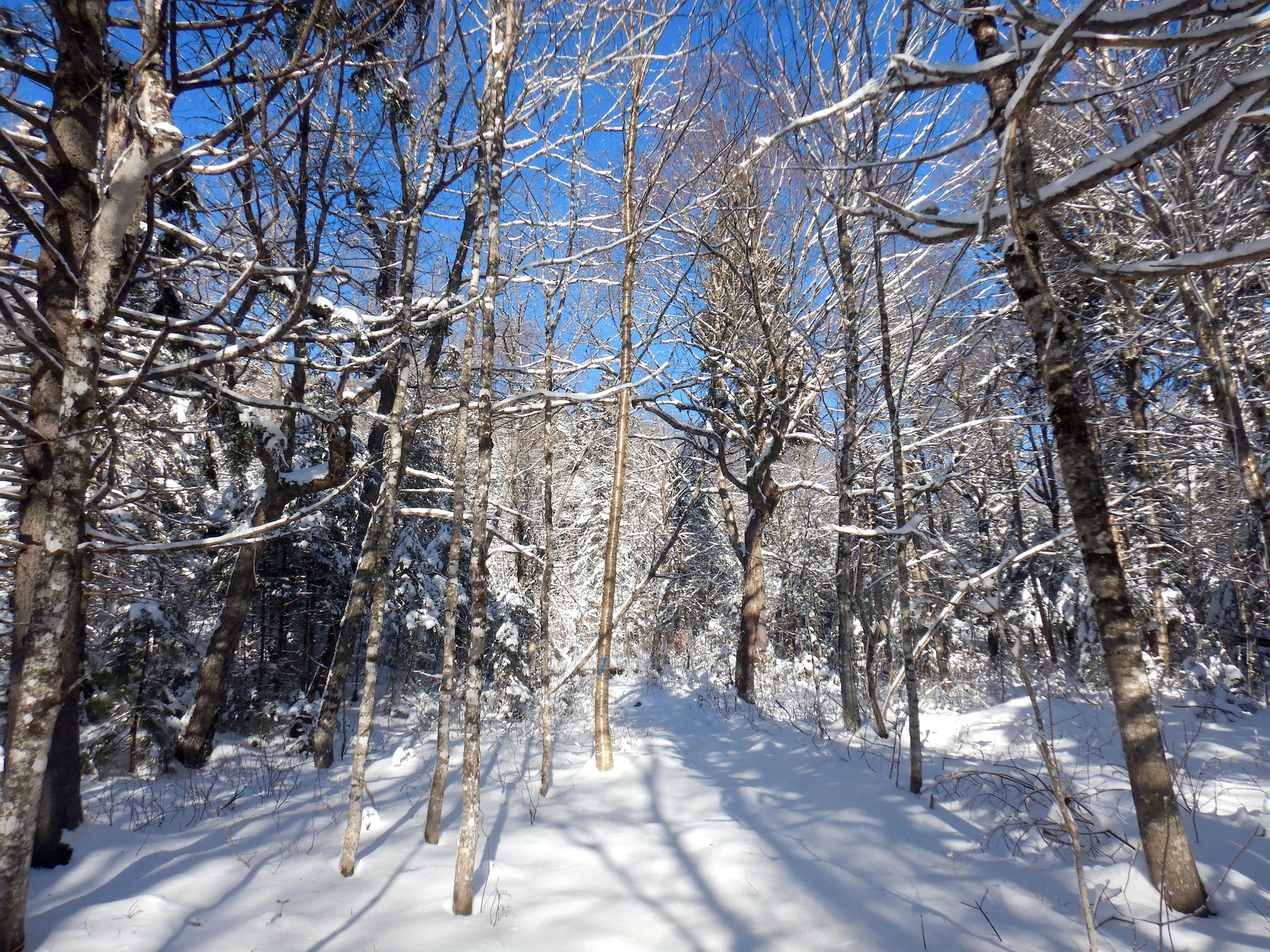
November 16 I begin at an alternative trailhead that I’ve used a few times this year. The route isn’t maintained. It’s nothing more than a decades-old skidder trail, but it is a quicker and more secluded course than the main trailhead. The year has been wetter than average, so water has consistently flowed over parts of the trail. Mid fall brought a prolonged stretch of dry weather though, and the trail is drier than it has been over the entire year. Winter will soon be here. The canopy is bare. Patchy snow sits in the shady areas of the mountain’s spruce-fir forest.
The old growth forest on upper Mount Chase on November 16, 2023.Looking west-southwest toward Katahdin and Baxter State Park from the Mount Chase summit on November 16, 2023.
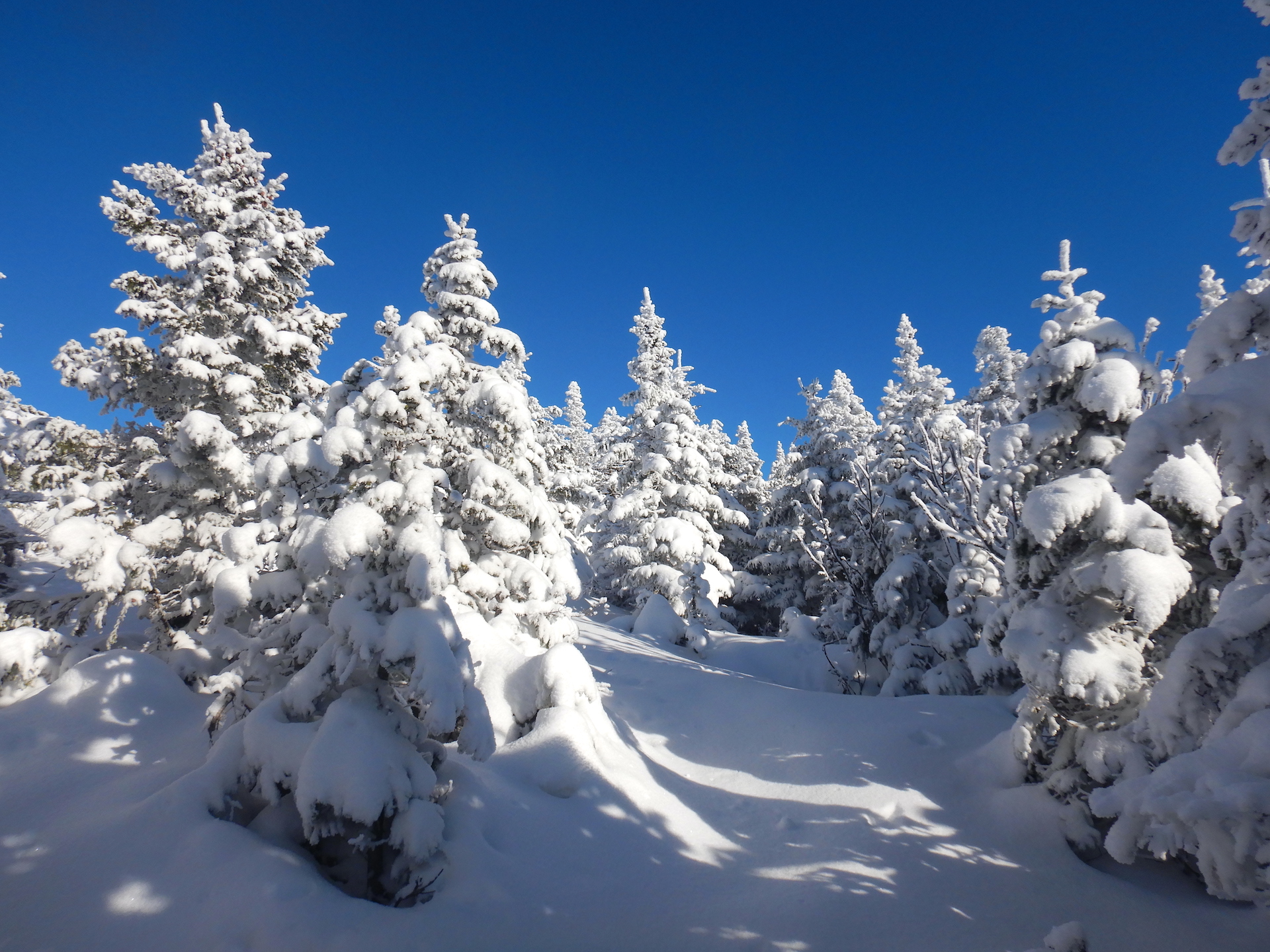
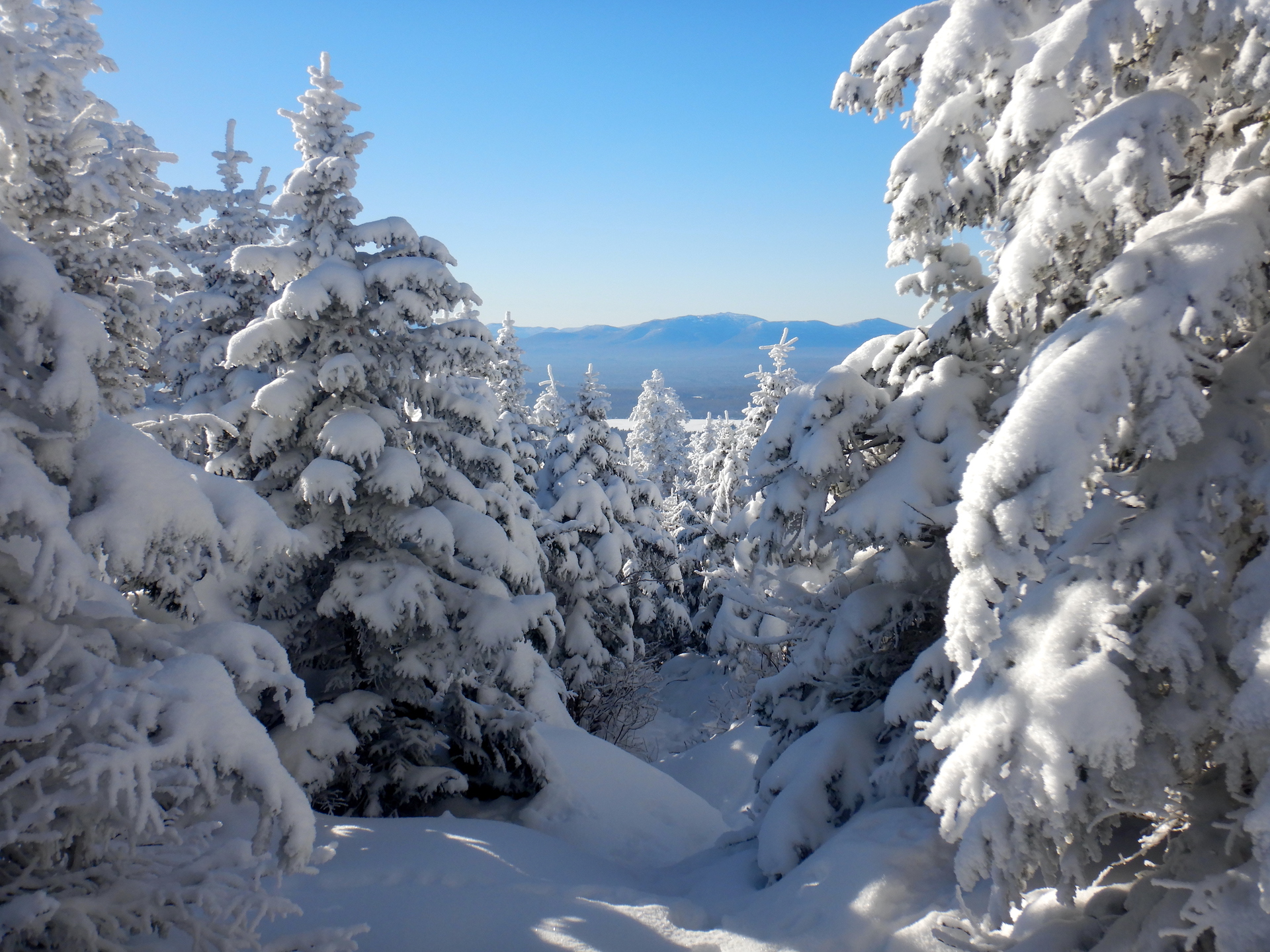
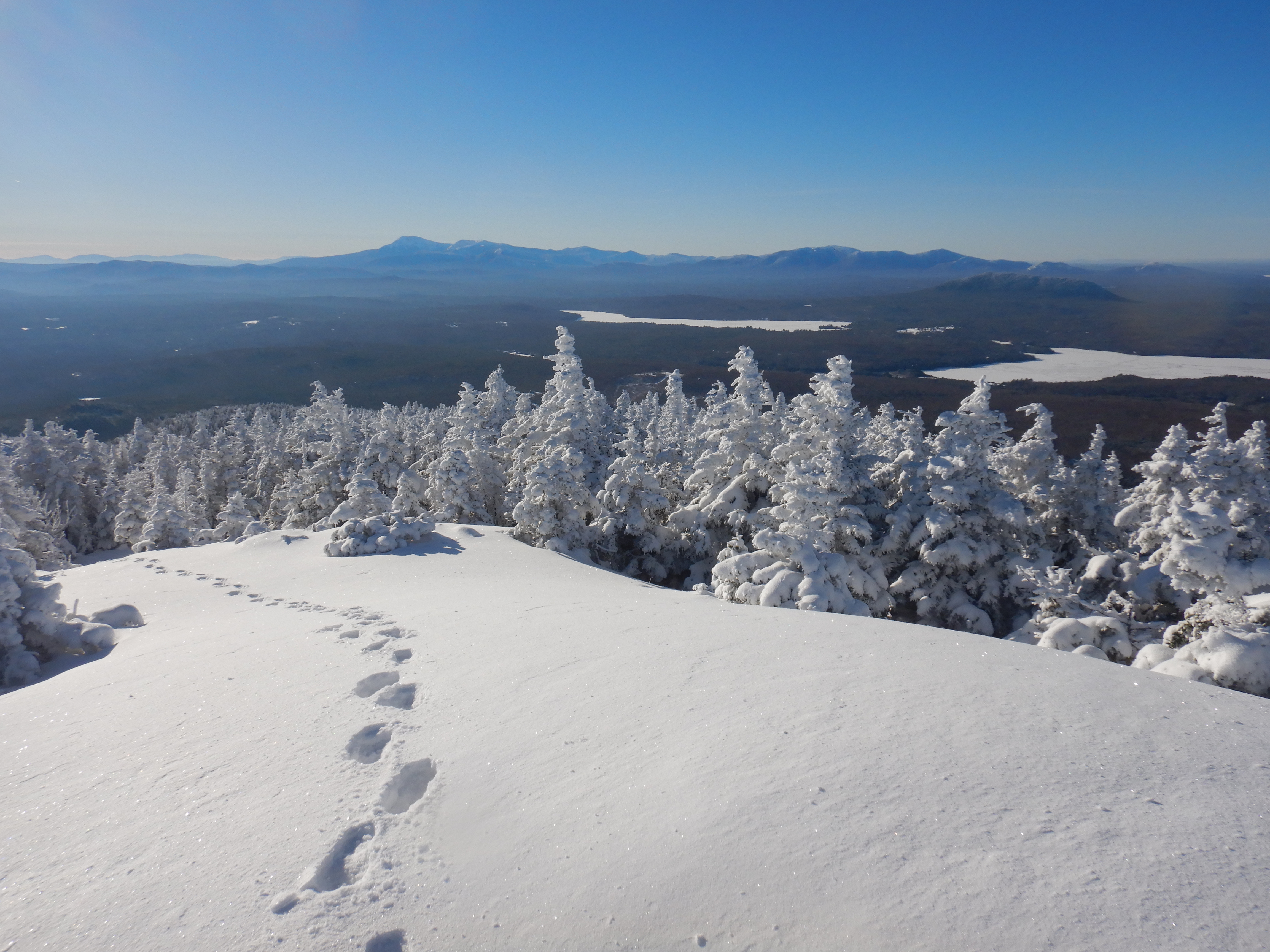
December 8, 2023 Winter is a time of dormancy for many life forms, although it brings vibrancy in other ways. None of the previous trips were as beautiful or as quiet. Several inches of snow coat the ground at low elevations and about 12 inches linger higher on the mountain. No human footprints are discernible on the trail. Snow and hoarfrost cover the conifers like cake icing. The landscape appears clean in a way that I don’t find in spring, summer, and fall.
Large MargeThe Mount Chase Trail on December 8, 2023.The final approach to the Mount Chase summit on December 8, 2023.Looking down the Mount Chase Trail near the summit on December 8, 2023.Looking west-southwest toward Katahdin and Baxter State Park from the Mount Chase summit on December 8, 2023.
Time spent in the forest is never wasted and every moment offers the potential to discover new perspectives. I’m no closer to profound insights after thirteen trips to the summit of Mount Chase, although I’ve walked away with a greater appreciation for the mountain’s rhythms. The experience is both the same and vastly different every time.
Think of a mama bear. What does that idea conjure in your mind? Perhaps it is fierceness, since mother bears are ornery and defensive when necessary. Maybe it is commitment, because mother bears dedicate years to raise a single litter. Perhaps it is sacrifice, since mother bears provide cubs with time and energy that could otherwise serve to promote her own physical health.
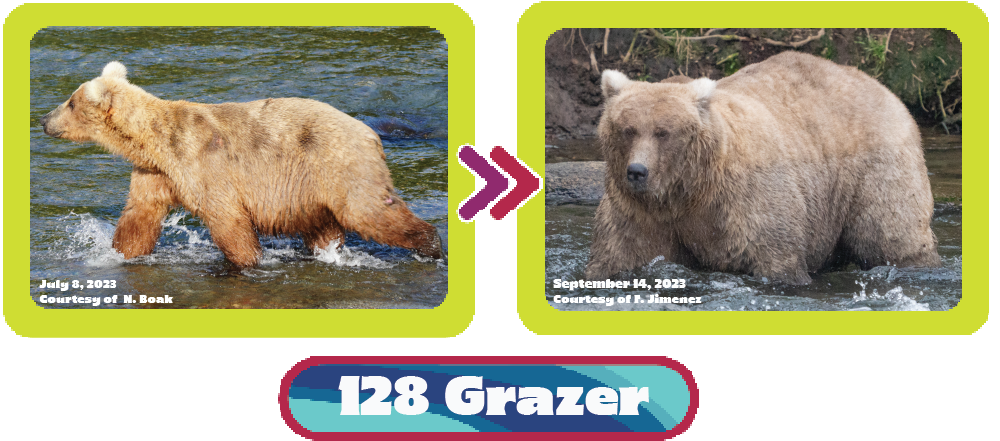
We’re fortunate to watch many different female bears at Brooks River in Katmai National Park. Yet there is one whose maternal efforts are legend. One who can fish successfully almost anywhere. One whose fearsome reputation is long-lived among other brown bears, including large adult males. Don’t get in her way. Don’t lurk near her fishing spot. Don’t look at her cubs. Do give 128 Grazer your 2023 Fat Bear Week vote.
Grazer | ɡrāzər |
(2005 – Present) A female brown bear documented to use Brooks River in Katmai National Park, Alaska. Also known as bear 128.
verb. [with object] The effort of a mother bear to maul or attack another bear with little provocation, especially in defense of her cubs: She grazered him.
Origin: Bear cam slang. Circa late 2010s and early 2020s.
Grazer is famous among people and (maybe) infamous among brown bears for her extraordinary defensiveness. When she arrived at Brooks River in 2016 with three cubs representing her first known litter, she would confront and attack other bears with little or no provocation. Sometimes it appeared that another bear only had to look in her family’s direction to draw her ire, as bear 83 knows well.
Her behavior didn’t mellow when those first cubs grew into yearlings the following summer. Nor did she rethink her aggressiveness toward other bears when raising her second litter. While mother bears can change their parenting strategy as they gain skill and experience, Grazer continued on the path forged with her first litter—the best defense is a good offense.
Grazer separated from her most recent litter at the beginning of summer 2023. Since then, she’s lived a brown bear bachelorette’s life. Her pheromones attracted the attention of male bears during the mating season. They chased her tail, with varying degrees of success, right bear 164? After the mating season, and also during it, she focused on eating. A lot. Her waistline carries the weight of her success.
Grazer’s formidable reputation carried into this summer. She ranked high in the hierarchy among bears and was perhaps the river’s most dominant female. Notably, 151 Walker deferred to her frequently in early summer. Walker is a big dude and he’s not shy about displacing bears from preferred fishing spots. Bears have good memories, though. Maybe he had too many bad experiences with her in the past and didn’t want to risk more dangerous confrontations.
In this video, Walker is in full dominance mode as he works to displace another adult male at Brooks Falls. But watch his behavior when Grazer shows up on the boulders above.
And in case you need more examples of Grazer bulldozing bears, here you go. (Watch with sound on for the full effect.)
During my brief time at Brooks River early last summer, I watched bears fish largely without success because the expected salmon run was slow to arrive. Some of the big guys caught some fish. 747, for example, sat at Brooks Falls like he always does and let the fish come to him, but even he wasn’t catching many. Most other bears fared worse. They roamed from one place at the river to another, searching for the few early arriving salmon.
Grazer, though, has practiced—no, perfected—her fishing tactics in many different places. If fish are jumping Brooks Falls, she’ll catch them there. If there’s space in the waterfall’s far pool, she’ll catch them there. She’ll work the jacuzzi below the falls. She’ll fish in the middle of the night. She’ll use her strength and agility to chase down salmon.
One evening last summer, I stood on the riffles platform watching her work the river in front of me. While the riffles provides brown bears with fishing opportunities, it is often a more challenging place for bears to catch salmon than the falls. The riffles doesn’t provide the same pinch points in topography as the falls and salmon have many escape routes. There aren’t many bears who can make the best of that situation consistently, especially when few salmon are in the water and bears are forced to run through the water to get them.
Grazer parks herself on the near bank upstream of me. She moves into the water after several minutes and spots a lone salmon. She lunges and misses. She chases. Another lunge, another miss. She continues running at full speed through the water while somehow keeping an eye on the salmon. With a final lunge, she fully submerges into a two to three-foot-deep pool and surfaces with the salmon in her jaws. I can see the fish gasping in the air as blood runs from deep puncture wounds in its body. Grazer eats all of it—tail to head—even the gill plates and mandibles.
In early summer when few bears were catching salmon, Grazer found success. She is perhaps the best angler at Brooks River.
Bear 128 Grazer with a catch in the riffles on July 6, 2023.
Let’s not lose sight of Grazer’s goals either. She’s working to build the fat reserves necessary to sustain her survival during winter hibernation. She’s also building fat in case she gives birth in the den. Bear cubs are born mid winter while mother hibernates. Abundant fat reserves are necessary for mother bears to reproduce, so getting fat is vital to a bear’s reproductive success.
In a way, my 2023 Fat Bear Week endorsement is a recognition of Grazer’s full-bodied and fat-addled collection of work since 2016. When she is raising cubs Grazer is the archetypal mama bear. She’s formidable, strong, brave, skilled, and successful. She deserves your vote in Fat Bear Week 2023.
My Fat Bear Week bracket predictions for 2023. Yes, yes, I know. I don’t predict that Grazer will win. There’s a difference between who I think should win and who I think will actually win, after all. Which bear’s corner are you in? Download your bracket from FatBearWeek.org.
While every season has much to admire, I find springtime especially enthralling. Something new appears nearly every day. At first, maple sap runs heavy during March’s warm days and sub-freezing nights. Around then, a trickle of meltwater in a ditch and a bare patch of matted leaves on the edge of a snow bank promise room for other plants to break dormancy. Soon after, the first golden catkins appear on the hazelnut and gray alder. Rainy evenings bring amphibians out of hibernation. In a short time, the soon-to-flower ephemeral herbs emerge from the crust of leaves. By late April and early May, the forest canopy bursts to life again with bird song, the blossoms of red maple and quaking aspen, and finally the unfurling of leaves that will soon thoroughly shade the ground where I trod.
Each of these are little events that promise a lot more. I’m unsure if non-human animals contemplate these changes like I do. Yet, I’m certain they pay attention to them. Black bears, recently emerged from their dens, know the pattern and are eager to exploit the change of the season to their advantage. If I’m lucky, their efforts to find their first substantial meals of the year might allow me to investigate what they are up to.
A section of Katahdin Woods and Waters National Monument sits to the east of Sebois River. It’s a quiet area of the park since there are no campsites, less than a mile of developed hiking trails, and only a few maintained roads. Bicycling through it is fun and is made even more enjoyable when I afford myself the time to go slow and pay attention. It’s one of the best places in park that I’ve yet found to look for bear sign in the spring.
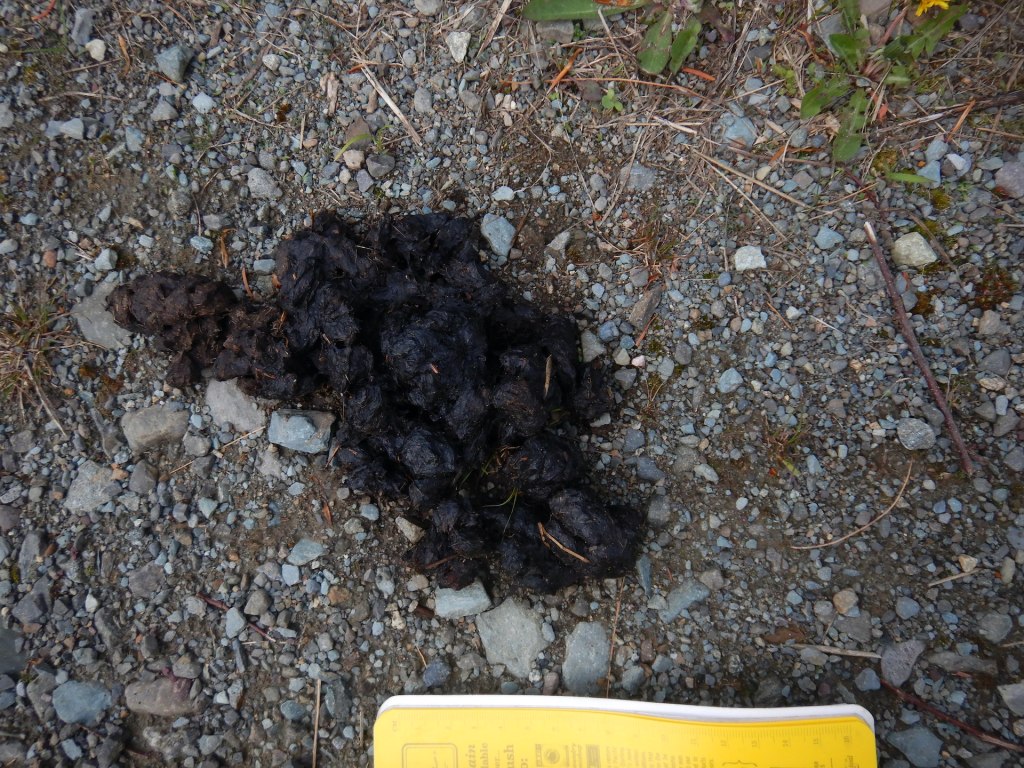
Riding the single lane spur that loops off and back to American Thread Road last weekend I came across many piles of bear scat, which I was hoping to see. Not because I particularly admire turds, but because bears are cryptic here. They are frequently hunted throughout northern Maine and consequently have a substantial fear of people. The thick forest also limits my ability to watch a bear if I happen to see one. The signs that bears leave behind—such as marking trees and scat—are like pages in a book. A single page may not reveal much but look at enough pages and you’ll get a good story.
In particular, scat can reveal how recently a bear was in the vicinity and what it was eating. Black bears are omnivores that are well adapted to survive on plants, and the vast majority of their annual calories come from plant foods. In north-central Maine, though, there are no calorie-rich berries to eat in the spring. Perhaps there are some leftover acorns, but oak trees are not common in the forests as this area is near the northern end of their range in the northeastern U.S. So other plant foods are a bear’s best springtime bet.
While a black bear’s digestive track remains essentially one of a carnivore, it utilizes adaptations such as an elongated gut and slightly flattened molars to extract nutrition from tough to digest plant foods. A bear also consumes plants when they are most nutritious and digestible. Newly emerged green vegetation like grass, sedge, and clover contains relatively high amounts of protein, for example. As those plants mature, protein content declines while indigestible fiber increases. Fiber helps keep the bear on a so-called regular schedule, but the bear is really after the protein. Even though hibernating bears maintain their muscle health without eating or exercise, if they’ve exhausted their fat reserves by springtime then their body is forced to tap into their lean tissue reserves. Young, tender veg helps bears stave off muscle loss and even build muscle before sugary, fat-building foods become available in mid to late summer.
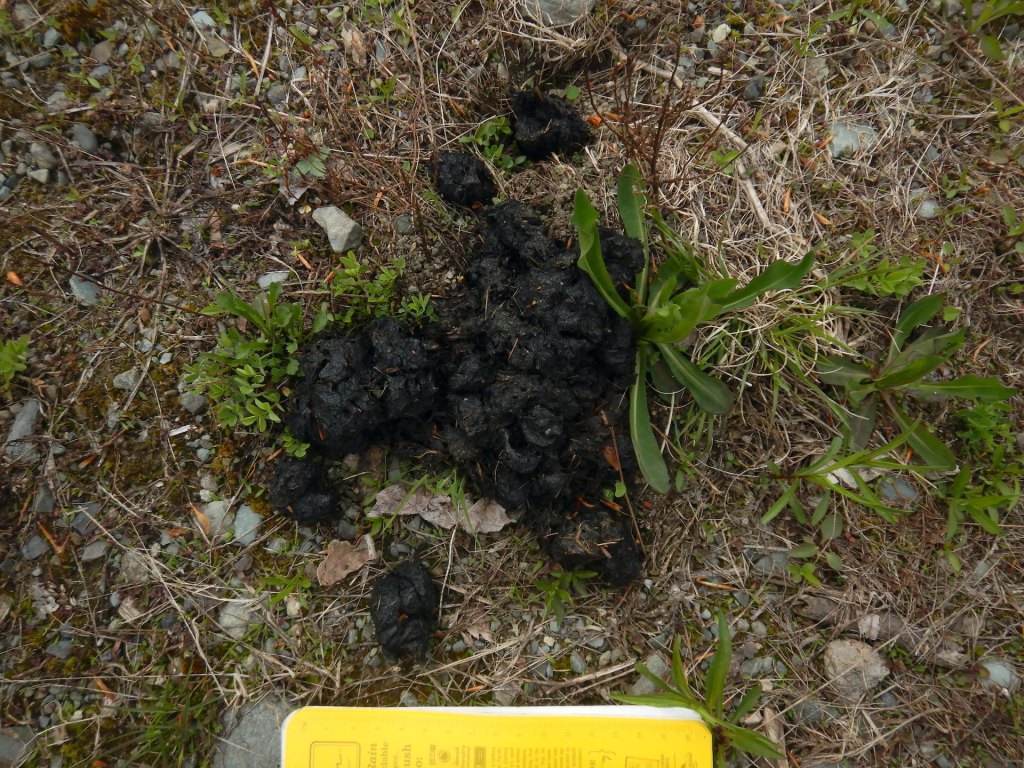
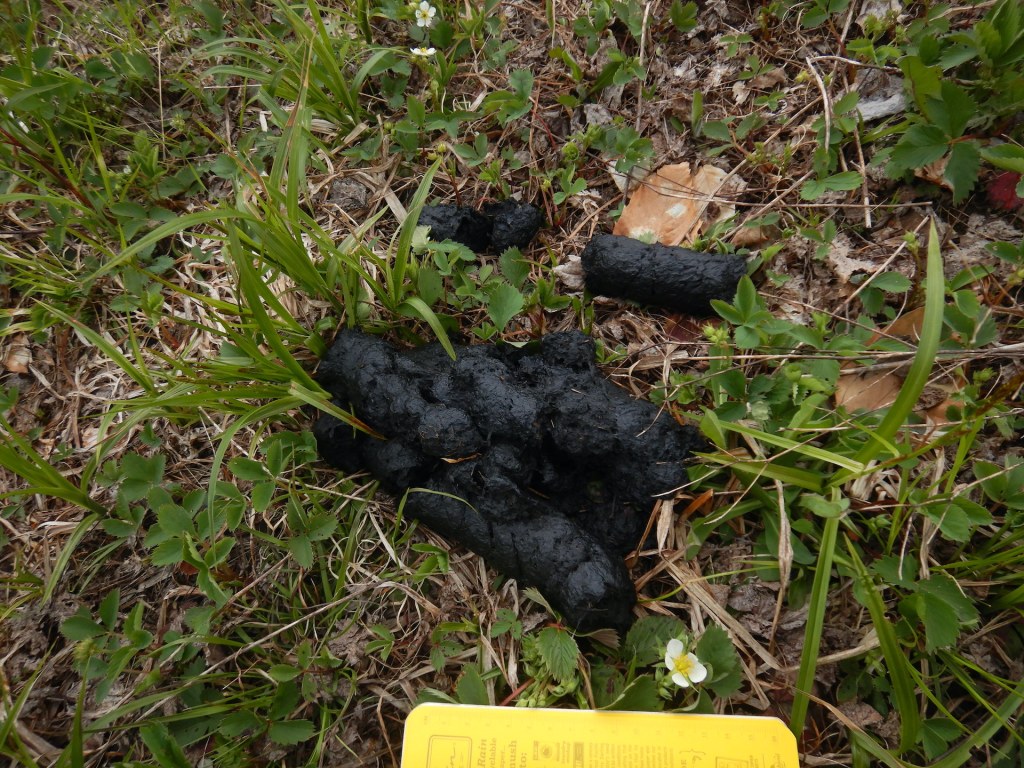
All but one of the scat piles I found were filled with herbaceous plants. Although most looked older than a day–when bears eat green veg, the resulting scat quickly oxidizes when exposed to air to form a black surface crust–this was a promising sign. I knew that the lightly used roads are good travel corridors for bears and the sunlight reaching the road edges allows vegetation to green-up more quickly than the forest interior, which attracts bears to the roadsides. Perhaps I might see a bear if I pedaled slowly and remained observant.
The effort paid off near the crest of a hill when I spotted a dark mass of animal on the edge of the road. I stopped to watch.
The wind was at my back, which is a welcome push when cycling uphill but also carried my scent to the bear. Once it caught my scent, the bear only needed a couple of seconds to decide to run into the forest. Had the wind been blowing the other way, I probably could’ve watched it much longer with less chance of disturbing it unintentionally. Still, I was grateful for the moment and the small insights into its world.
Before widespread logging and, later, roadbuilding encroached on the area’s forests, grassy areas in northern Maine were likely much less common than today. Black bears always sought the first spring greens, but they had to look in other places—riverbanks, stream sides, and beaver meadows for example. They continue to go to those areas, of course, even as roadsides have opened another foraging opportunity. Roads are risky places that expose bears to people though. Bears weigh the risk along with the potential reward of a good meal.
I knew the bear I saw was eating well even as it still had a long way to go until it was fat enough to enter its winter den next fall. Its effort is a journey recorded in its scat—pages, if you will, in the Book of Turds.
Brooks River in Katmai National Park, Alaska is historically, culturally, and ecologically unique. The river corridor has harbored Alaska Native peoples for thousands of years, is one of the densest archeological sites in Alaska, and remains a place of profound significance for Alutiiq descendants of former Katmai residents. The underlying geology records stories of great volcanic and glacial change. Hundreds of thousands of sockeye salmon annually use the river for migration and spawning. And, during the last 40 years it has become especially famous for its brown bears and wildlife viewing opportunities. There’s no other place like it.
Bear 482 Brett searches for salmon in Brooks River while her two cubs hang on for the ride. July 14, 2021.
Brooks Camp is also experiencing more people than ever before.
In the midst of skyrocketing visitation last year, Katmai National Park implemented a pilot permit program for Brooks River. The permit system didn’t change wildlife distance regulations at Brooks River or limit the overall number of people who could visit. Instead, it applied only to those who wish to physically enter the river or its banks outside of the designated trails, roadways, bridge, and platforms. No one needed to reserve a permit unless they planned to enter the river or walk off trail along the riverbanks (two activities that I suggest should be avoided to give bears the space they need).
The pilot program appeared to be successful. It provided National Park Service (NPS) staff with an additional opportunity to communicate the special circumstances, rules, and responsibilities that apply to Brooks River. The NPS could revoke the permit in instances where permit holders did not adhere to wildlife distance or fishing regulations, which effectively prohibited the person(s) from reentering the river. It allowed approved Brooks River Guides to continue to give their clients the mandatory bear-safety orientations. And finally, it did not restrict or interfere with subsistence fishing associated with the traditional redfish harvest.
Now, the NPS is looking for public comments about the permit system. If you have the time and care about the bears who make the river their summer home, then please support the plan with a comment on or before April 28. As the Katmai Conservancy suggests, say yes to the permit and ask the NPS to limit the number of permits on a daily or weekly basis.
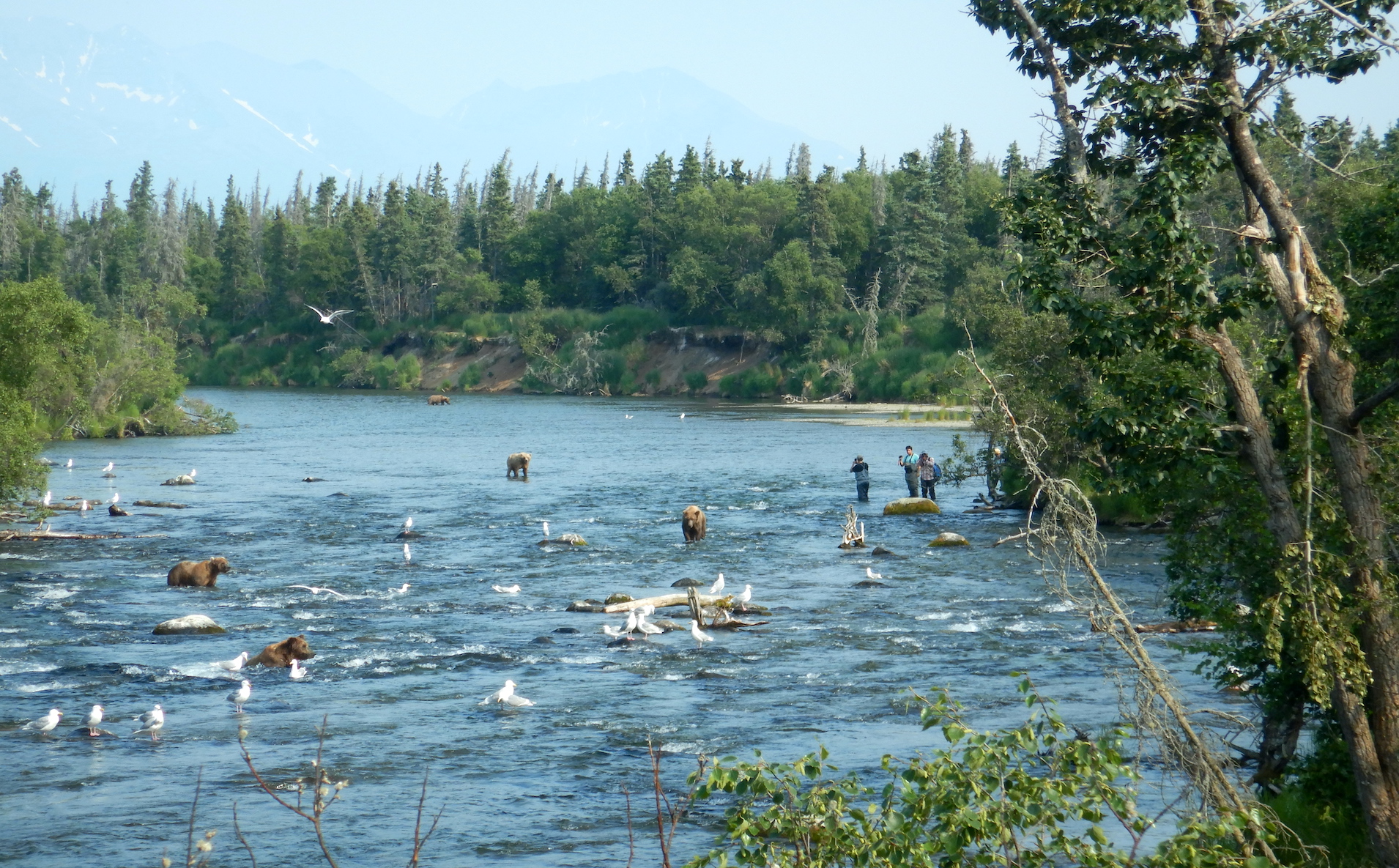
Why are permits necessary? The relative ease and accessibility of the bear-viewing experience at Brooks Camp has attracted increasing numbers of people. More than 16,000 people visited in 2022—an all time record high—and almost double the visitation of 2008. Brooks River is a mere 1.5 miles (2.6 km) long, yet dozens of brown bears use it during the salmon migration and spawning seasons of summer and early fall.
People who enter in the river directly occupy the habitat that bears need to fish for salmon. Numerous scientific studies (reviewed here) have documented that human recreation can displace bears in time and space. The presence of people can cause bears to switch from diurnal to crepuscular activities in response to bear-viewing, angling, hiking, and camping. Bears decrease in number and are present for shorter time spans when exposed to people, angling, and bear-viewing. Bears also spend less time fishing and have less fishing success when anglers and bear-viewers are present.
Bears gather at Brooks River to fish for salmon. People in Brooks River risk displacing bears from important foraging areas in the river. This is especially true for bears who do not habituate to our presence. In these situations, we unwittingly become a competitor in the bear’s mind for space, and most of the time that bear won’t challenge us for it.
Studies specific to Katmai National Park have found that the presence of people can affect when bears fish (Olson et al. 1998) and cause bears to avoid or alter their use of foraging areas (Rode et al. 2007; Smith 2002; Turner and Hamon 2016). Therefore, even a small number of well-behaved and well-intentioned people in the wrong place (like in the river) can have a disproportionately negative effect on brown bears. Disturbance of wildlife can also result in decreased visitor satisfaction (Skibins et al. 2012) and create user conflicts between visitors who are recreating in different ways (bear watching from the platforms or online via webcams vs fishing or photographing bears in the river).
Importantly, and tucked away in the park’s newsletter about the permits, is this: “There is no limit established to the number of permits issued during the permit-required time frame currently, but this will be considered if public feedback to the plan supports a limitation or if conditions change within the Brooks River Corridor to warrant a limitation.” Therefore, I recommend that comments ask the NPS to go beyond merely requiring permits. Comments about the permits should encourage the NPS to establish limits to permits on a daily or weekly basis and perhaps even greater seasonal closures to Brooks River to adequately protect habitat for bears.
I didn’t visit Brooks River in person last year, but rangers and some people I know who had traveled there reported to me that the pilot permit system worked well. While it does not address over-crowding and congestion issues at Brooks Camp caused by record-high levels of visitation, it is certainly a big step in the right direction to ensure the river’s bears have access to the habitat they need to survive. None of the existing regulations would change at Brooks Camp. The permits only make it easier for the NPS to enforce them. But permits alone are not enough. Existing protections for bears can be made more effective if permits were limited in availability. Our national parks, and indeed Brooks Camp, cannot support unlimited numbers of people. The Brooks River corridor is a small area overall. It has limited space for bears and a limited carrying capacity for a high-quality bear-viewing or fishing experiences. Please let the NPS know you support their efforts to protect habitat for bears in the river through the permit system and that the number of permits should be limited on a daily or weekly basis when bears are actively fishing in the river.
This may seem non-controversial. After all, wild animal populations are made of individuals just like human families and communities are composed of individual people. But this idea hasn’t been accepted widely among scientists and managers of national parks.
Thankfully that tide seems to be turning, and I’m pleased to be able to contribute to this scientific effort. Results from a survey of bear cam viewers on explore.org show that people who care about Otis and other individual bears are more likely support conservation efforts for brown bears compared to viewers who do said they could not identify individual bears. Please head over to my post on explore.org to learn more.
Bear 480 Otis sits in his office at Brooks Falls in Katmai National Park, Alaska.
I’d like to thank the researchers who made this study possible—Jeff Skibins (who drafted this paper and did the data analysis) and Lynne Lewis and Leslie Richardson (who were instrumental in the survey design and implementation). I’d also like to thank the Katmai Conservancy for covering the expense to make the paper available to everyone through open access.
Last summer, explore.org celebrated the 10th anniversary of the bear cams at Brooks River in Katmai National Park. These webcams offer an in-depth look at the behavior and ecology of a population of brown bears, allow us to observe the same individual bears over many years–giving us the chance to learn about their personalities and habits–and provide a platform for rangers and other experts to host live programs and commentary about the bears and their stories. It’s a wildlife watching experience like no other.
As part of the celebration, I chose to highlight some the moments that I thought were most memorable from the last ten years of bear cam. Some explore point-in-time events. Others celebrate the behavior of individual bears who have left their mark on Brooks River in ways we can’t forget or ignore. Each was unforgettable from my perspective. I hope you enjoy them.
Most Defensive Mother: 128 Grazer
Grazer is an archetypal mother bear. Don’t get in her way and don’t approach her cubs.
Lefty Learns to Fish at Brooks Falls
Old bears can definitely learn new tricks. In July 2015, we watched a fully mature adult male brown bear figure out how to fish where he’d never fished before.
Otis Eats 42 Salmon in a Sitting
Be awed by the capacity of his stomach.
Death of 451’s Spring Cub
When a bear cub falls ill the world will watch.
503’s Saga
A lone yearling finds a new family.
Reign of 856
Few bears will ever experience the prolonged dominance and advantage earned by 856.
2020 Salmon Smorgasbord
What happens when bears have access to unlimited salmon? The 2020 salmon run gave us the answer.
History of Fat Bear Week
A goofy idea becomes a world famous internet sensation.
We are Family: 909, 910, and Cubs
Sister bears reunite while raising cubs to create an extended family.
If that’s not enough, the bear cam community complied links to all of our bear cam live events from 2022. Two stand out in my mind: 1. The impromptu Q&A about a fight between and mother bear and a dominant male, and 2. The bear cam 10th anniversary live chat.
We’ve seen a lot of special moments on the cams during the last ten summers–perhaps too many to recall–so these are only a small snippet of the larger story. What are your most memorable moments from the bear cams?
Brooks Falls is, without question, the most famous place in Katmai National Park and one of the most famous wildlife-watching destinations in North America. Even if you can’t place it on a map, you’ve likely seen it in a wildlife film, in a photograph, or on TV. Search “bear catching salmon,” for example, and nearly all of the first 50 photos are of a bear standing on the lip of Brooks Falls.
On a sunny, warm morning in mid July 2021, I arrive at the boardwalk leading to the falls after hiking the short trail through the surrounding spruce forest. It’s a promising time to visit. The early summer sockeye salmon migration is in full swing and hungry bears are eager to catch them. But about halfway along the boardwalk, I realize the chances of reaching the falls in a timely manner are slim. At a covered platform nicknamed the Treehouse, where the boardwalk forks and leads to different viewpoints of the river, there’s a wall of people.
Under the Treehouse roof, about 25 people surround a frazzled park ranger who clutches a metal clipboard. The clipboard and the scribble of names he places on it are the ranger’s only lifeline to a semblance of order—it’s the waitlist for the groups wanting to gain access to the platform overlooking the falls. Like a restaurant maître d’, the ranger greets new arrivals, take their names, and asks others to wait their turn when people fill the Falls platform to its 40-person capacity. He also imposes a one-hour time limit for people at the Falls so that those who are waiting have a chance to go there.
Few people normally hang out at the Treehouse voluntarily, since if offers no lines of sight to the river and its bears. Therefore, the crowd at the Treehouse this morning indicates that the wait time to access the falls is substantial. Having staffed the platforms as a ranger in the past, I don’t wish to add to this ranger’s workload or anyone’s wait time this morning. Instead, I look for space at the adjacent Riffles Platform where rangers don’t manage a specific capacity.
I don’t find much space there either. About 20 people occupy it already. Even more fill in gaps within a few minutes of my arrival as the queue for the Falls platform grows larger. With 40 people at the falls, 25 in the treehouse, 30 or more at the nearby Riffles platform, and surely more to come, I leave for a a less crowded space.
The lower fourth of Brooks River meanders through seasonally flooded marshes and gravel bars before spilling into the glacially-fed and turquoise-colored Naknek Lake, the largest lake wholly contained within any U.S. national park. The lower river offers space and safety for mother bears and their cubs who choose to avoid the risks posed by the larger males fishing at the falls. Young, recently weaned bears also use the area as a place to socialize and graze on tender grass with less risk of encountering a larger, more dominant competitor. It’s also the most ecologically diverse place along the river so even if there are no bears in sight, there’s usually something to catch your eye.
About 20 minutes after leaving the falls boardwalk I arrive at the lower river and station myself on a platform adjacent to the long footbridge that leads to Brooks Lodge and the park visitor center. The perch allows me to see most of the river mouth as well as the meandering reverse S-curve upstream. Few bears use the lower river as I sit, although the vicinity remains filled with activity. A near continuous high-decibel, high-pitched whine fills the air as float planes arrive and taxi to the lakeshore. They disgorge their passengers out of my line of sight, but each plane must’ve been filled to capacity. Over the next hour, I count more than 200 people crossing the bridge toward the falls. Almost none walk in the opposite direction. I sympathize mentally with the Treehouse ranger who is likely clutching his clipboard even more tightly.
Later in the day, another ranger reports to me that the wait to reach the Falls platform exceeded two hours at its peak. In total more than 350 people arrived at Brooks Camp this day, which doesn’t seem like much, but that’s on top of the pilots and guides who brought people here, the 30 people who stayed in the campground, the 50-60 people who stayed in the lodge, the 30 concession employees, and the 20 park staff. Even with my conservative math, about 500 people occupied Brooks Camp, all attempting to share a 1.5 mile-long river corridor with two to three dozen brown bears.
By the end of summer 2021 more than 15,000 people visited Brooks Camp—most of whom arrived in July and all of whom used infrastructure largely designed in the 1980s and 1990s to accommodate about half to two-thirds as much at most. It’s double the visitation of 2007, the first year I worked as a ranger at Brooks Camp.
The popularity of national parks is a welcome sign that these spaces are important and meaningful to broad swaths of the public. It wasn’t that long ago, that a National Park Service director wondered aloud whether parks were losing their relevancy. However, at the same time that our national parks experience record high visitation many more people encounter significant barriers that inhibit them from experiencing these places. I might’ve been sharing Brooks River with 500 people that day last July, but millions more are denied the opportunity. In an era of great crowding in our national parks, I wonder, do we have the determination to make parks accessible to everyone?
⚠️Wednesday, Mar. 23 9:20am: The park is currently full, and we are temporarily delaying entries into the park. Vehicles attempting to enter the park should return in 3-5 hours.
Consider visiting nearby attractions. Check this account for updates before returning.
The first national parks in the United States were protected for their scenic splendor, unique features, and wildlife. Nothing compares to Yellowstone’s geyser basins, Yosemite’s towering granitic cliffs, or Sequoia’s majestic trees. However, broad public support for these areas in the late 1800s was lacking. Yellowstone, Sequoia, Yosemite and Mount Rainier—the first four national parks created by Congress—were remote and difficult to access. Upon their establishment, they lacked the facilities and basic infrastructure necessary to accommodate large numbers of people. Even so, the park boosters, advocates, and visitors who had experienced these landscapes understood they were special places.
To build a constituency for parks and facilitate a national park experience for more people, the earliest park managers built roads, trails, campgrounds, and visitor centers. They hired rangers. They allowed concessioners to build and operate hotels, lodges, restaurants, and trinket shops. After Congress established the National Park Service (NPS) in 1916, the fledging agency doubled down on infrastructure development. During the Great Depression, the Civilian Conservation Corps and Works Progress Administration constructed hundreds, perhaps thousands, of miles of trails and roads within park boundaries. Soon after, a post-WWII travel boom highlighted a need to modernize parks and accommodate a tsunami of people (visitation to all national parks combined increased from about 3.5 million to almost 30 million between 1931 and 1948). The effort was sanctioned by Congress in 1956 through the Mission 66 program, a 10-year-long and billion-dollar plan to expand and modernize facilities and infrastructure in national parks.
Making parks physically accessible to greater numbers of travelers established the experiential paradigm that national parks function within today. Namely, a physical visit to a park inspires people and leads them to become park stewards and supporters.
The effort, it can be convincingly argued, worked. More people visited. More people had great experiences. More people cared for parks. It helped fuel a burgeoning environmental awareness and protection movement. The paradigm, it seemed, had created more stewards than ever before. But not everyone was pleased with the trajectory of tourism in national parks.
In Desert Solitaire, one of Ed Abbey’s most well known essays is “Polemic: Industrial Tourism and National Parks.” Much of the book and “Polemic,” especially, is based on Abbey’s experience working as a ranger at then Arches National Monument in the 1950s, a time before pavement bisected the little visited park in southeast Utah.
Abbey seemed to enjoy his job. He muses something that probably every ranger, including me, has thought at one time or another: “On the rare occasions when I peer into the future more than a few days I can foresee myself returning here for season after season, year after year, indefinitely. What better sinecure could a man with small needs, infinite desires, and philosophic pretensions ask for?”
But, as Abbey saw it, not all was rosy at Arches. He writes, “For there is a cloud on my horizon. A small dark cloud no bigger than my hand. Its name is Progress.” Under the direction of the National Park Service, Arches soon transitioned from an off-the-beaten-path retreat to a major tourist destination.
Abbey experienced Arches as the NPS implemented its Mission 66 plan. He worried and warned that national parks were threatened by “industrial tourism” whose “chief victims of the system are the motorized tourists. They are being robbed and robbing themselves. So long as they are unwilling to crawl out of their cars they will not discover the treasures of the national parks.”
Abbey’s “Polemic,” true to the title word’s meaning, is a scathing criticism of development in national parks and the NPS’s efforts to expand it. “Where once a few adventurous people came on weekends to camp for a night or two and enjoy a taste of the primitive and remote, you will now find serpentine streams of baroque automobiles pouring in and out, all through the spring and summer, in numbers that would have seemed fantastic when I worked there: from 3,000 to 30,000 to 300,000 per year.” *
*Abbey might have exaggerated the numbers here, although visitation did increase substantially between the time Abbey last worked at Arches in 1957 when, according to National Park Service statistics, annual visitation was 25,400 to 135,000 visitors in 1968 when Desert Solitaire was published. In 2021, visitation exceeded 1.7 million.*
Abbey outlined several ways to alleviate crowding and further development such as an end to road building in parks, putting more rangers into the field, and banning cars from parks. “No more cars in national parks. Let the people walk,” he writes. “The automotive combine has almost succeeded in strangling our cities; we need not let it also destroy our national parks.”
If Abbey was angry then, he might feel a rage today. More than 297 million people visited national parks in 2021during a pandemic. More than 327 million people visited national park areas in 2019. Record high visitation stresses the already expansive and often underfunded infrastructure of parks. Parking lots are consistently full; excess cars line the road or their drivers shove their vehicles onto narrow shoulders. Some areas, such as Acadia’s Cadillac Mountain that you need a permit to get in the park parking lot. Herds of us overwhelm trails and overlooks too. Climbing Yosemite’s Half Dome requires a permit awarded through lottery as does Zion’s Angels Landing. You now need a “timed entry permit” to enter Rocky Mountain National Park and drive Glacier National Park’s iconic Going-to-the-Sun Road. Remote hiking areas, where Abbey’s preferred visitors go, are often filled too. When I worked as a backcountry ranger at North Cascades in summer 2017, most every backcountry campsite filled during summer weekends. The overflow spilled into the surrounding national forests, public lands with significantly fewer rangers than national parks.
Clearly, the industry of tourism has grown substantially during the last several decades. Although the implications of this reality is not something I wish to tackle in this essay, our national parks are at a tipping point beyond which I worry the experience of visiting them as well as its wildlife, plants, and scenery will suffer. While I support rethinking how we use cars in national parks and we certainly should not be building new roads, denigrating those who experience parks by car is not the answer. I now see Abbey’s objections to visiting parks by car as ableist.
As an aside, I should note how far my thinking has evolved on this issue. Starting my career twenty years ago, I agreed with Abbey’s no-cars-in-parks stance. Cars are a menace, I thought. (And to be honest, that remains true in many ways. Automobiles kill tens of thousands of people and hundreds of millions of vertebrate animals in the U.S. each year. Transportation also accounts for about 30% of the United States’ greenhouse gas emissions. Driving less would do our world a lot of good.)
Fresh out of college and equipped with good health, I privately sneered at those who drove through parks without riding a bicycle or spending time on the trail. Like Abbey, I wondered, are you really having valid national park experience if you don’t risk hypothermia or sunburn? Yet, most of the time I drove into parks, parked my car and then rode my bike or hiked. I was, hypocritically, dependent on the car and, more importantly, I didn’t consider that the experience of those visiting parks primarily by car as equally valid an experience as my own. Of equal or perhaps even more concern was my rejection of the needs of people who couldn’t visit. “Oh, you can’t come,” I thought, “That sucks but what am I supposed to do about it?” Nature deficit disorder is real, but let’s not pretend that experiencing a national park by car is a cause. There are other much more systemic issues at heart.
When we’ve traditionally explored how to address crowding in national parks, most of the ideas, especially those that have emerged out of the NPS bureaucracy, center around encouraging people to visit less crowded parks, to use shuttles where available like at Zion and Acadia, to visit during less crowded times and seasons, and to encourage people to do more planning or plan like like ranger. Comparatively little thought has been given toward efforts designed to connect parks with people who experience barriers that hinder them from visiting.
With these barriers in place, focusing primarily on congestion in parks is like rearranging chairs in a crowded room, while ignoring everyone that can’t even get in the building.
No panacea exists to solve accessibility issues in our parks. And, thankfully, a growing number of organizations are working toward solutions such as Brown People Camping, Disabled Hikers, Latino Outdoors, National Ability Center, Outdoor Afro, Unlikely Hikers, and Wilderness Inquiry to name a few. There’s one way, however, that the NPS can break the prevailing paradigm almost immediately to provide people from all backgrounds with meaningful national park experiences, and with little more than an internet connection, which brings me back to Katmai.
While at Brooks River, I don’t share the river with only the few hundred people on the ground with me. I share every moment with many thousands of people watching from around the world. In 2012, Katmai National Park partnered with explore.org to host streaming webcams at Brooks River. Several webcams (collectively and affectionately known as the bearcams) stream live footage of Brooks River each summer and fall, allowing anyone with an internet connection the opportunity to watch bears fishing for salmon.
Each year, the bearcams receive millions of views. During 2021, for example, the bearcams saw 16.5 million page views on explore.org. People also watched from 110 countries and all 50 states. The programs that rangers and I host on the bearcams reached hundreds of thousands of people collectively. These numbers are several orders of magnitude larger than even the record setting visitation experienced at Brooks River during the same year.
Although the bearcam experience lacks the immersiveness of an on-site visit, its depth far surpasses anything you’d typically get in person. A webcam experience isn’t limited by flight schedules, vacation days, outdoor skills, fitness, or wellness. It lasts as long as you want. It is accessible whenever you want. Through the bearcams, we watch bears not for a hurried few hours. We watch across weeks, seasons, and years. We see bears return to the river every year of their lives. We watch mother bears rear multiple litters of cubs, and those cubs, in turn, mature through sub-adulthood and adulthood. We discern the breadth of each bear’s individuality as it decides how to make a living. We witness the ebb and flow of the largest salmon runs left on the planet, how the fish underpin Katmai’s ecosystem, and how their year-to-year variability influences the behavior of bears and other wildlife. There’s no wildlife-watching experience quite like it.
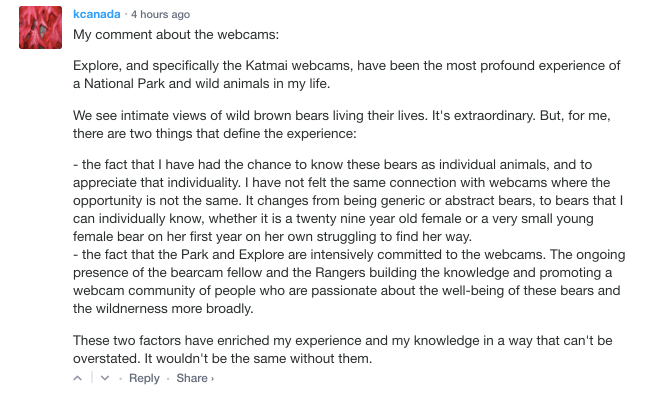
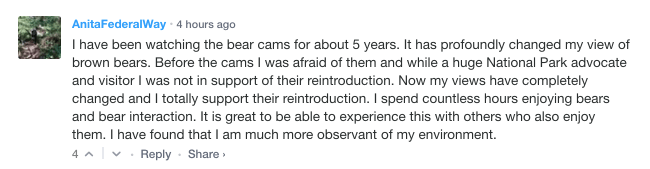
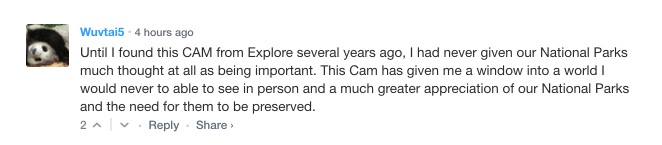
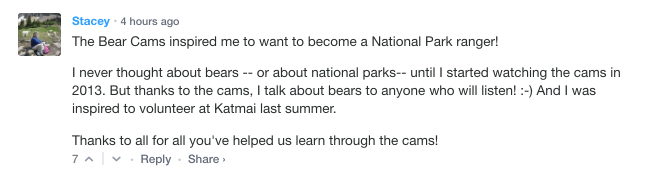
If you haven’t experienced a national park through a webcam, then it might be difficult to envision that watching a park through a webcam can be meaningful. But, friends, it is true. A study comparing and contrasting on-site (i.e. in-person) and online (webcam) visitors to Brooks River found that webcam viewers emotionally connected with bears at higher levels than on-site visitors. The same study found that webcam viewers also support protections for bears at higher levels than people who visit in-person. In fact, support for bears and national parks among webcam viewers equalled or exceeded those reported by on-site visitors on almost all metrics evaluated in the study. Subsequent research has found that the bearcams provide mental health benefits and that people greatly value the individual animals that they see through webcams. To expand these lines of research, I’m collaborating with Dr. Lynne Lewis from Bates College, Dr. Leslie Richardson from the NPS and Dr. Jeffrey Skibins from East Carolina University to conduct and analyze more on-site and online surveys of Katmai’s visitors. Our analyses of online surveys from 2019 and 2020, for example, have confirmed previous results and have even underscored the importance of individual, easily recognized bears in people’s experience.
As the aforementioned crowding issues demonstrate, providing space for everyone who wants to visit parks in-person isn’t feasible or sustainable for Katmai or any other national park. It is feasible, however, to provide meaningful, memorable wildlife and nature-based experiences through the democratizing and stewardship-raising force of webcams. (And if you don’t believe me after all this, please go to the bearcams and ask for yourself in the comments.) It’s long past time for more national parks to utilize webcams to bridge barriers that hinder people from finding meaning and value in national parks and other wild spaces.
I’ll be the first to admit that the bearcam experience is different than visiting Katmai in-person, and my advocacy for the use of webcams does not mean I believe webcams can or should replace the in-person park experience. Nothing that a computer screen provides can truly replicate the wellspring of awe that I feel while standing at Brooks Falls and seeing a dozen bears compete for fishing spots. But, for almost everyone except very fortunate individuals like me, the in-person bear watching experience is ephemeral. Only a tiny fraction of Brooks Camp’s visitors return more than once, according to the two most recent in-depth visitor surveys (2006 and 2014). It’s a once-in-a-lifetime trip for many. For others, it’s not feasible at all.
We can’t build our way out of crowding and access issues like we did after the post-WWII tourism boom or try to shove people into parks during increasingly crowded “non-peak hours” or “shoulder” seasons, not if we want to ensure a high-quality experience, the integrity of park ecosystems, or address the systemic barriers that prevent many people from visiting parks. In contrast, webcams in national parks can provide a form of nature-based equity. They create life-long and devoted stewards among those who may never visit in-person. They help our nature-starved societies find connections with the non-human realm. They heal people.
National parks rank among the nation’s most revered landscapes, and their place within American culture is no accident. In the 150 years since Yellowstone National Park’s establishment, the national park idea has evolved. Yellowstone and other parks are much more than places “set apart as a public park or pleasuring-ground for the benefit and enjoyment of the people.” We value parks for the solace they give us, the fun we experience in them, the wonder and awe they inspire, the opportunity to consider our shared history, and, of course, for the plants, animals, and natural processes that parks harbor. I cherish my time in parks. Everyone deserves access to similar opportunities.
In the United States at least, many of us are eager to return to some semblance of normalcy in a COVID-positive world. Our governments and public discourse are a hot mess of arguments about how to best achieve this. In the context of national parks, other public lands, and wild areas, however, “normal” does not equate universal access. It never has. This upcoming spring and summer, national parks will once again be overwhelmed with people. Rangers will do their best to cope, but without more rangers and the regulatory and policy tools to address congestion, the NPS will go back to its default mode: put out active fires, ignore the tinder, and hope the flames don’t spread.
Katmai National Park existed within the standard visitation paradigm for decades. For those who visit to watch bears in-person, it is an amazing and profound experience. When I worked there as an interpretive ranger, when I’ve visited during my free time, and when I’ve returned as a fellow with explore.org, those moments when I watched bears expressing their survival instincts are experiences more meaningful and memorable than almost any thing else I’ve done in my life thus far.
I last worked as a ranger in Katmai in 2016 though. Without webcams Brooks River would be a fading memory by now, no matter how many photos I took or journal pages I wrote. With the bearcams I, along with anyone else with an internet connection, can return at any time to find inspiration in the beauty of our world as well as the tenacity and intelligence of wild animals. Watching bears, whether in-person on online, creates life-long memories and inspires stewardship. Are national parks truly spaces for everyone? Not yet, but if more parks use webcams as a tool to reach people there’s no reason they can’t be.

















 Wandering at Large