Thirteen Mountain Months

Truly knowing a place might be a capacity only of the omniscient or for earthly beings, perhaps, something gained through multi-generational experience. Lacking omniscience, living in an area far from where I was raised, and having lived in my home only for a few years, I’m forced to make do as best I can. I’ll never know a place in its totality, but I’ve come to realize that I can get closer if I experience it in every season, which is how I found myself trekking to the top of Mount Chase, Maine during every month of the year. 

December 11, 2022 
The first trip in the journey and the most treacherous. Snow has yet to establish itself for the winter and ice covers many sections of trail. The summit is frosty. The hike down is much slower than the hike up.

A trail ascends through a thick forest. The trees are generally less than 6 inches in diameter and grow closely together. The trail is covered in ice like a steep stream that has frozen. About 30-40 feet of the trail is visible before it disappears at center.
Ice covers the Mount Chase Trail on Dec. 11, 2022.

View of forested landscape. Lightly frosted spruce and fir fill the foreground. A lake is visible at center in the lower elevation forest. A ridge of mountains forms the horizon at left center.
Looking west from the Mount Chase summit toward Upper Shin Pond, Sugarloaf Mountain, and Traveler Mountain.

January 8, 2023
With snow now covering the ice, the trip is far easier than last month and the snow is not yet thick enough that I have to ski to the trailhead. My trusty fat tire bike, Large Marge, gets me there. At the summit, visibility is exceptional and perhaps only limited on this day by the curvature of the Earth. On the way down, I hear a raspy-sounding chickadee. A boreal? Yes. I see it fluttering from branch to branch in the spruce-fir forest maybe 200 – 300 feet in elevation below the summit.
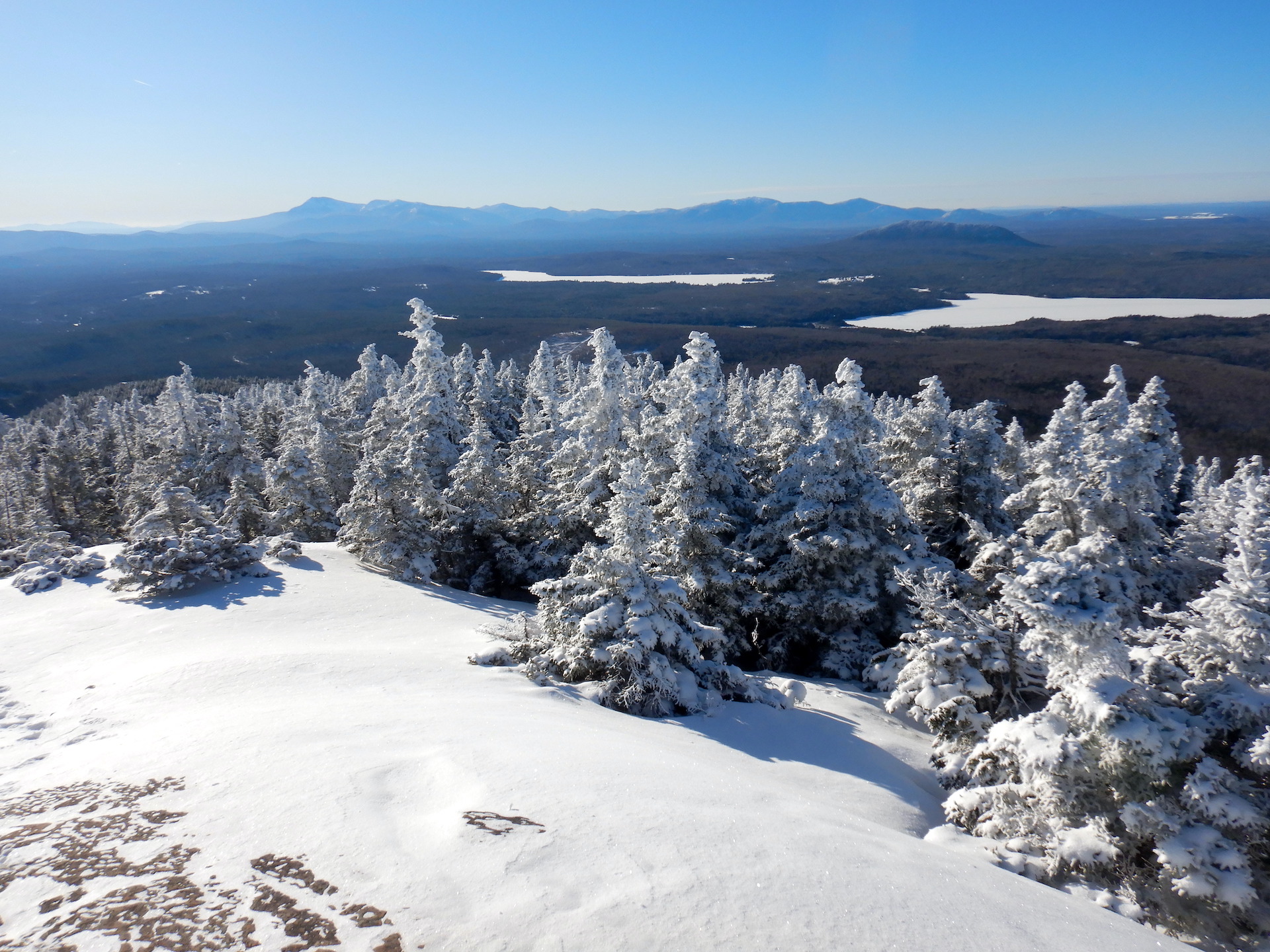
View from a mountain of a forested landscape. A ridge of large mountains form the horizon, although they appear small in the photo. Snow covered trees form the foreground just above windswept rock. Frozen ponds and forest sit in between the
The view to the west-southwest from the Mount Chase summit on Jan. 8, 2023. The mountains of Baxter State Park including Katahdin form the horizon.

A boreal chickadee perches in a frost covered dead spruce tree. The bird is at left center. It has a brown cap with is diagnostic of boreal chickadees.
A boreal chickadee perches in a dead spruce.

February 12
Peak winter. Minus 60˚ F wind chills during the week prior and low air temps approaching -30˚ F at home. I know arctic peoples cope with those temperatures routinely, but I’m too poorly prepared to survive those conditions. Thankfully, this day is warmer, so much so that snow fleas are active on the snow surface. I ski as far as I can up the trail. Eventually, I abandon my skis and walk the rest of the way when the trail steepness beyond my comfort level. The trail is also too narrow to ski down safely and I don’t own the the right style of skis or the skills to do that anyway. On the way up, though, I miss their floatation. The snow pack on the upper mountain must be at least 36 inches. I post-hole to my waist on two occasions.

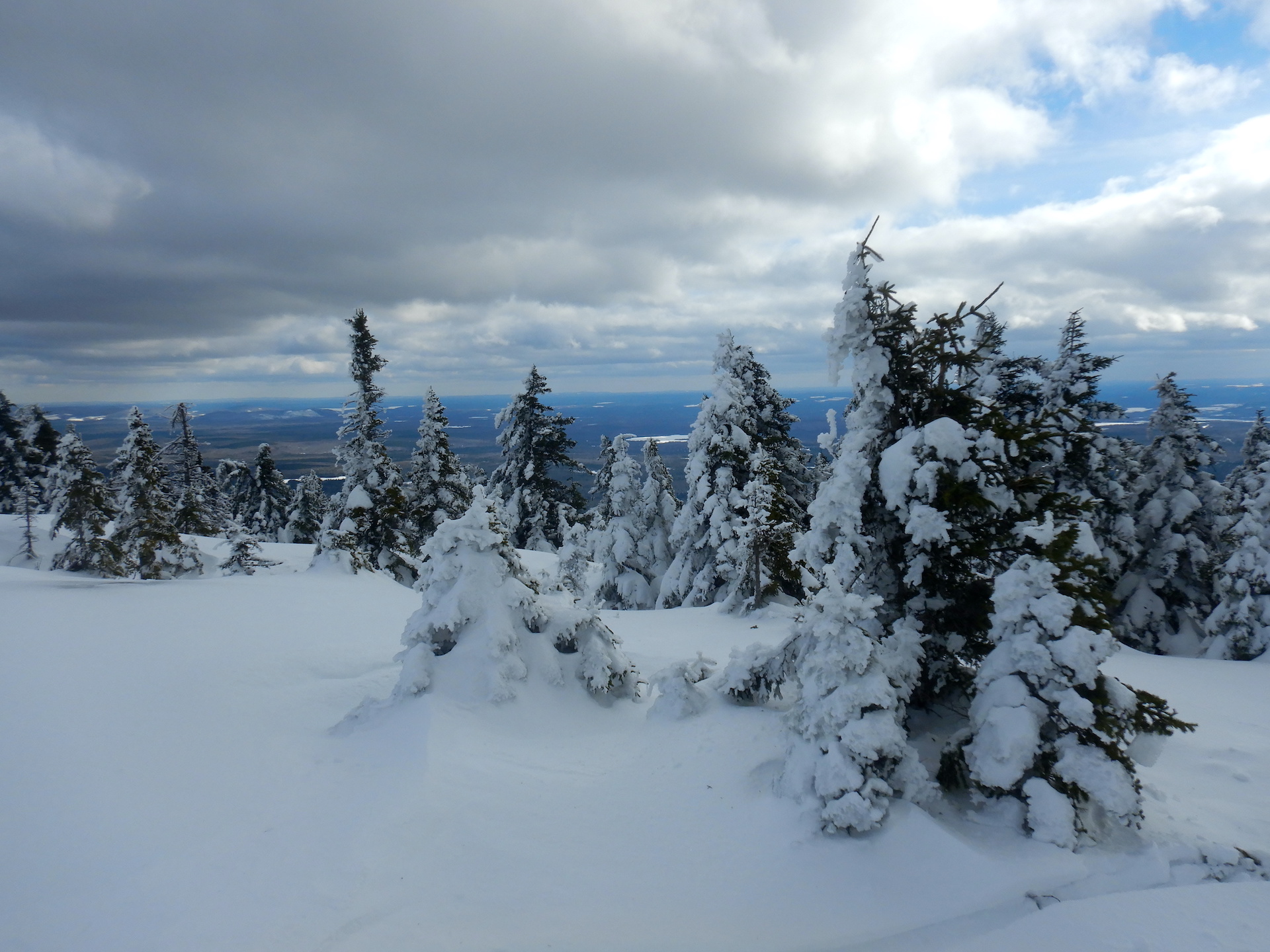
View of mountain from a low elevation. The mountain is covered in trees that transition from deciduous to coniferous from low to high. The foreground is snow covered.
The destination: Mount Chase on Feb. 12, 2023.

View from a mountain of a forested landscape. Only a sliver of the lowlands are visible. Snow and trees fill the fore and middle ground. The trees are snow covered, especially on their left side.
The view looking south from the Mount Chase summit on Feb. 12, 2023.

March 11
The snow seems deeper than February, but maybe this will be the last deep snow trip of the year? Along an alternative route I like to take to the main trail, I find a set of lynx prints in the snow. Farther up the mountain I ditch my skis again at a point above the abandoned fire warden’s cabin where the slope gets too steep. A few snowmobiles have made the trip, though, and I continue with relative ease in their trackways.
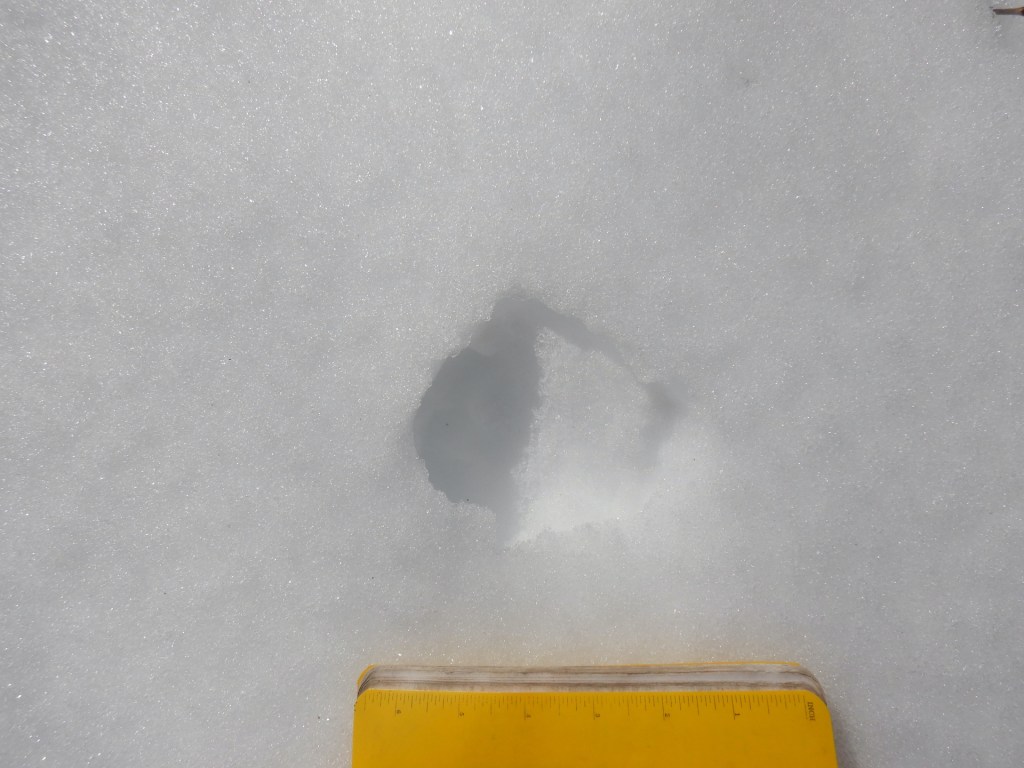
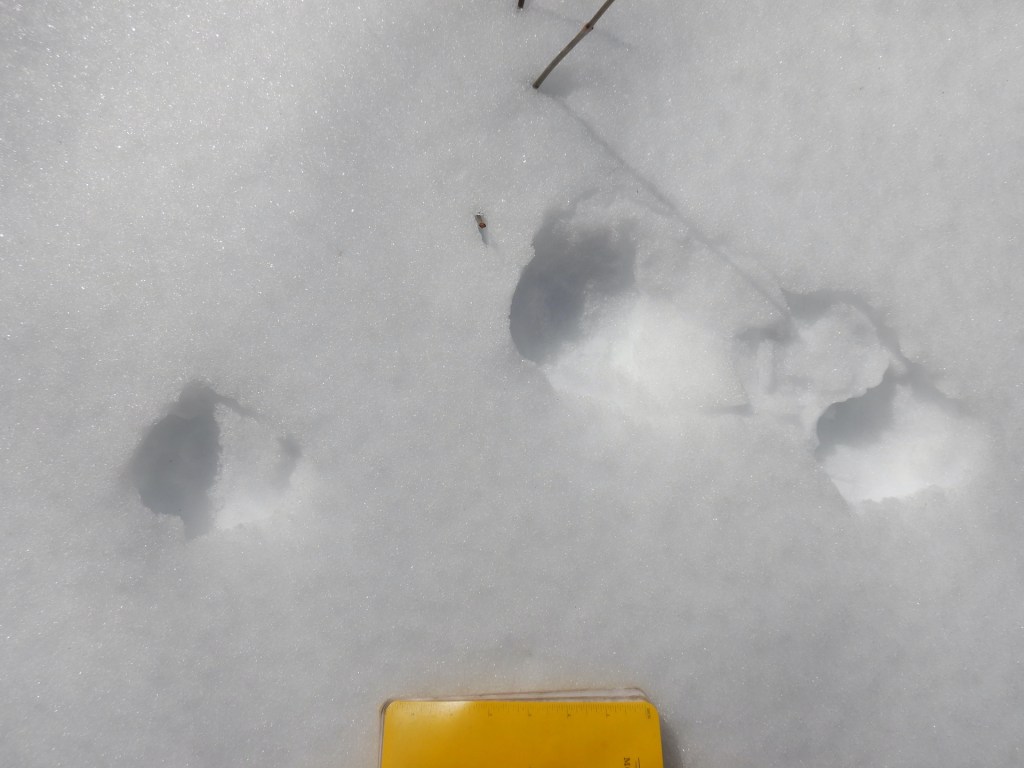
A single lynx track. Photo is taken from directly above it. The notebook at bottom is about 7 inches long.
A single lynx track. The feline was traveling from right to left.
The 3x4 gait of a lynx in snow. Photo is taken from directly above tracks looking down. The tracks are several inches in width and length.
Although these lynx tracks aren’t well defined, the size and shape are distinctive. I find one set of these tracks per winter on average. Lynx are rare in Maine and have large territories.
Portrait view of forest. Spruce and fir trees fill the scene with spruce growing the tallest. A narrow trail is visible at bottom center.
The coniferous forest on the upper slopes of Mount Chase.

April 22
A difficult trip to the top and back (the hardest of them all, in hindsight). Mud season has fully enveloped the region. The dirt roads that approach the trailhead are slop. Large Marge gets me to the trailhead but not without extra effort from my legs. The trail remains almost wholly snow-covered above the abandoned fire warden’s cabin and the remaining snow is soft. Still, I’m thankful winter’s dormancy is broken. Near the trailhead, I hear wood frogs looking for love in a nearby a vernal pool. The calls of juncos, robins, and sapsuckers—birds that do not overwinter here—fill the deciduous forest nearby.

Two trails intersect at lower right. Both have water flowing on them. A sign at left points to the center of the photo. The sign is mounted on a post has a homemade look. It says "trail." An arrow points to the right toward the trail. Both "trail" and the arrow are outlined in permanent marker.
The official Mount Chase trailhead.

A derelict cabin in a forest. Wet, late season snow covered the bare area in front of the cabin. A mixed forest surround the cabin. The windows and door of the cabin is missing and the brick red lead paint is peeling from the outside.
The abandoned fire warden’s cabin on Mount Chase.
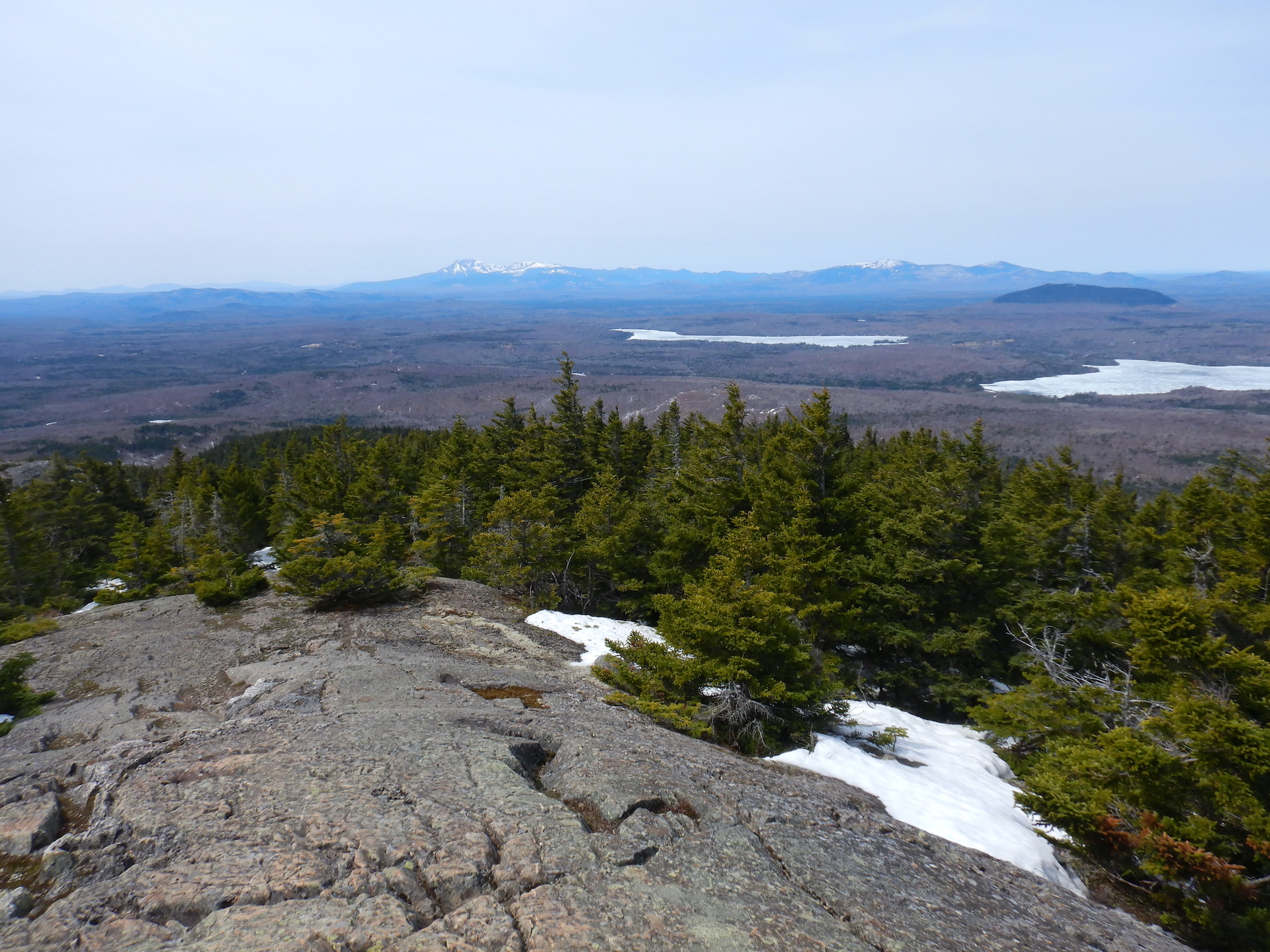
View from a mountain of a forested landscape. A ridge of large snow capped mountains form the horizon, although they appear small in the photo. Snow covered trees form the foreground just above windswept rock. Frozen ponds and forest fill the middle ground.
Looking west-southwest toward Katahdin and Baxter State Park from the Mount Chase summit on April 22, 2023.

May 17
I thought I’d be done with snow on the mountain by now. I was wrong. It falls on the way up and on the summit. Some small patches linger in the shadiest areas among the spruce and fir. Bud break might be advancing fast at lower elevations, but the plant phenology seems at least a week delayed on the mountain’s mid elevations and maybe two weeks behind in the summit area.
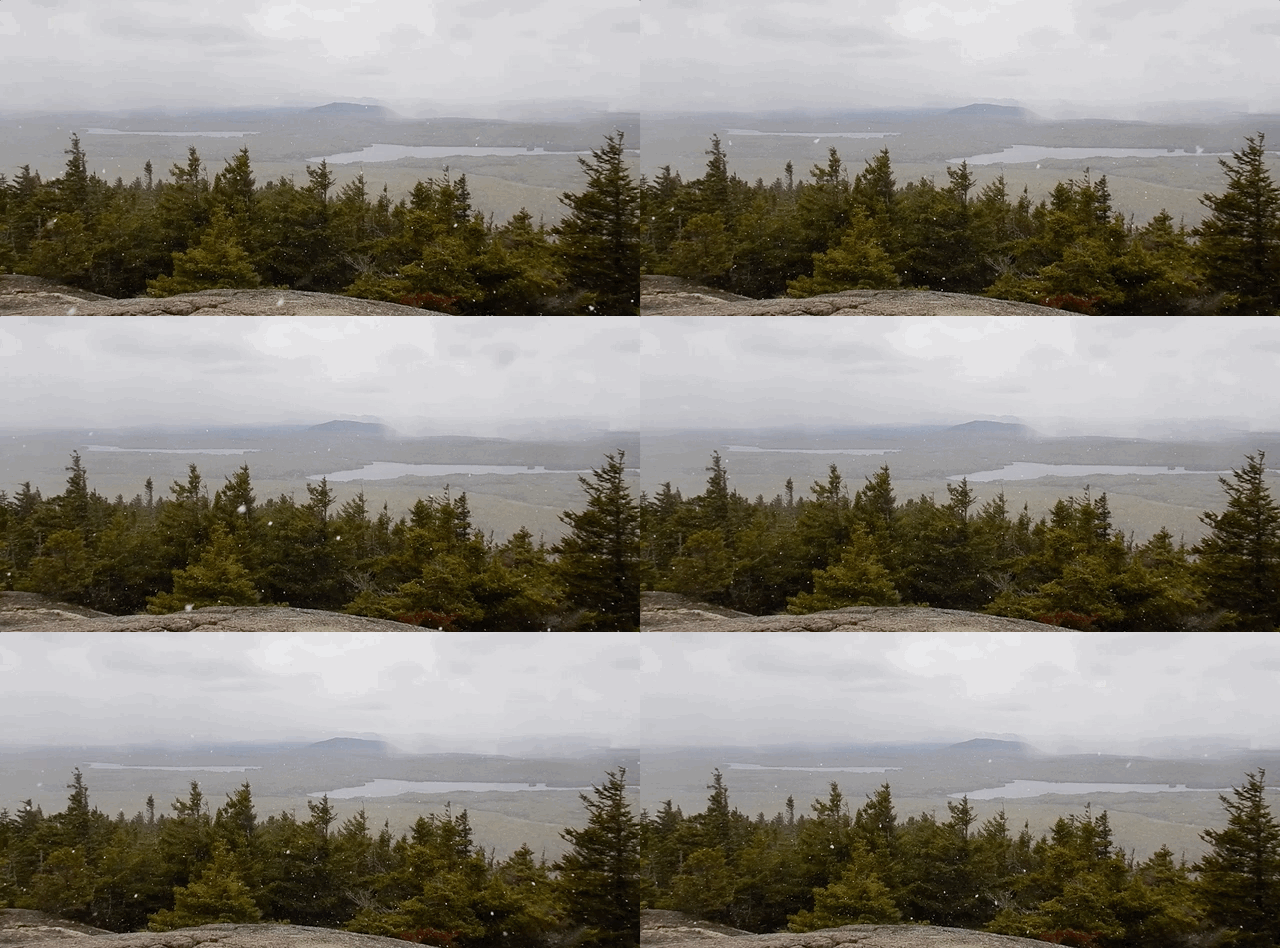
GIF of landscape view from a mountain top. Stunted spruce and fir fill the foreground. Forested lowlands fill the middle ground to the cloud obscured horizon. Snow flakes fall in the air.

Close up photo of flower in deciduous forest. The flower petals face the camera. The three petals are maroon.
Trillium erectum on the lower slopes of Mount Chase.

June 19 
A busy day on the trail with a whopping three cars at the trailhead! Large Marge, as usual, doesn’t have any other bicycles to keep her company. The forest has come to life. I note more than 20 plant species blooming. Biting insects are surprisingly few in contrast to home where the abundance of mosquitoes and black flies force me to don long sleeves, long pants, and a headnet almost anytime I intend to spend more than a few minutes outside. In the spruce-fir forest, I enjoy listening to the songs of blackpoll warbler. Sadly, they are categorized as a threatened species in the state.
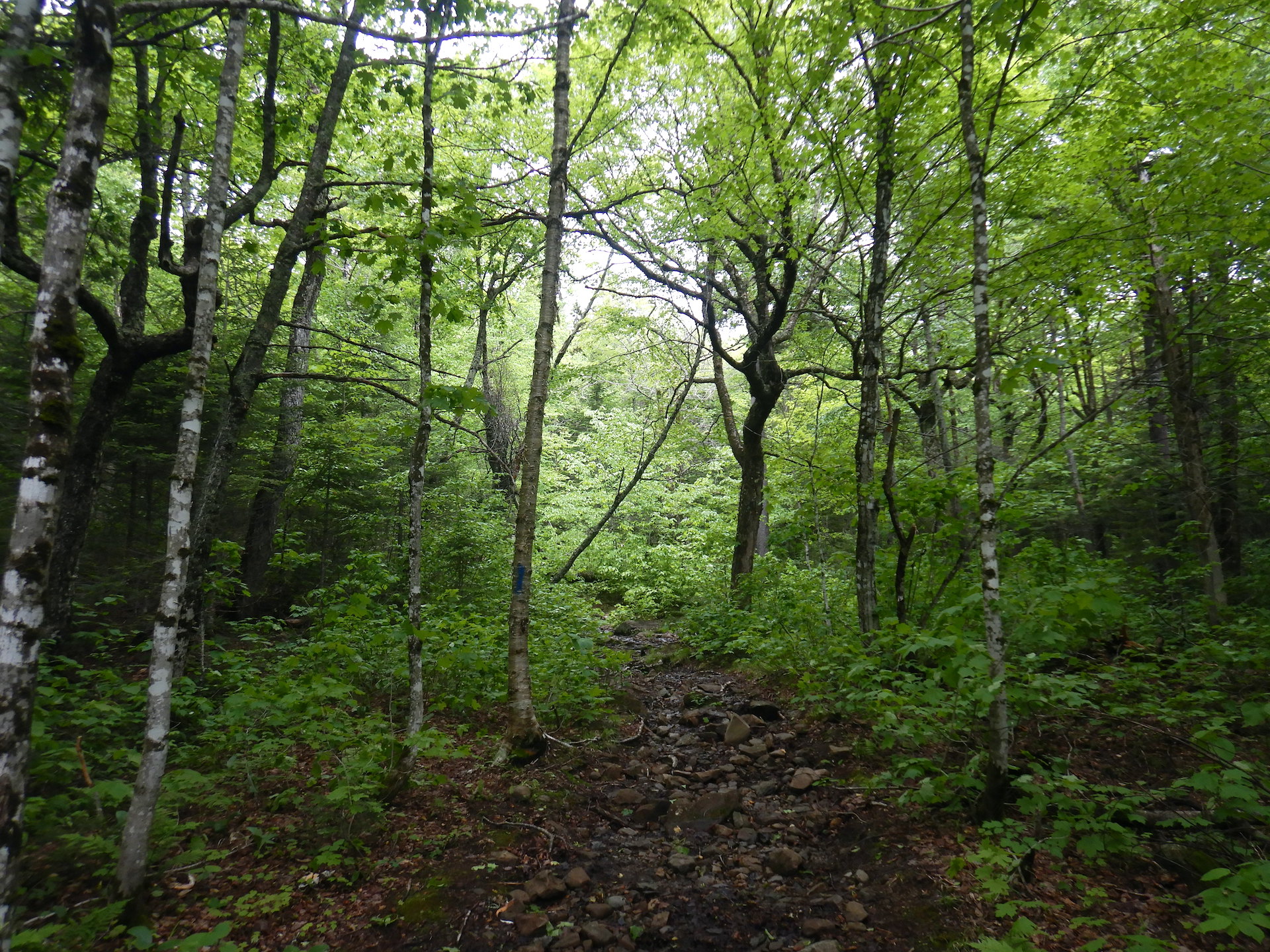
A rocky trail disappears into a green forest. Trees with bright green leaves obscure the sky. The understory is also thick with green plants.
Late spring on the Mount Chase Trail.

This is the song of a blackpoll warbler recorded in the spruce-fir forest of Mount Chase. The song is a rapid series of high-pitched notes near the beginning of the track. The audio also captures part of the songs of Swainson’s thrush and winter wren.

July 21
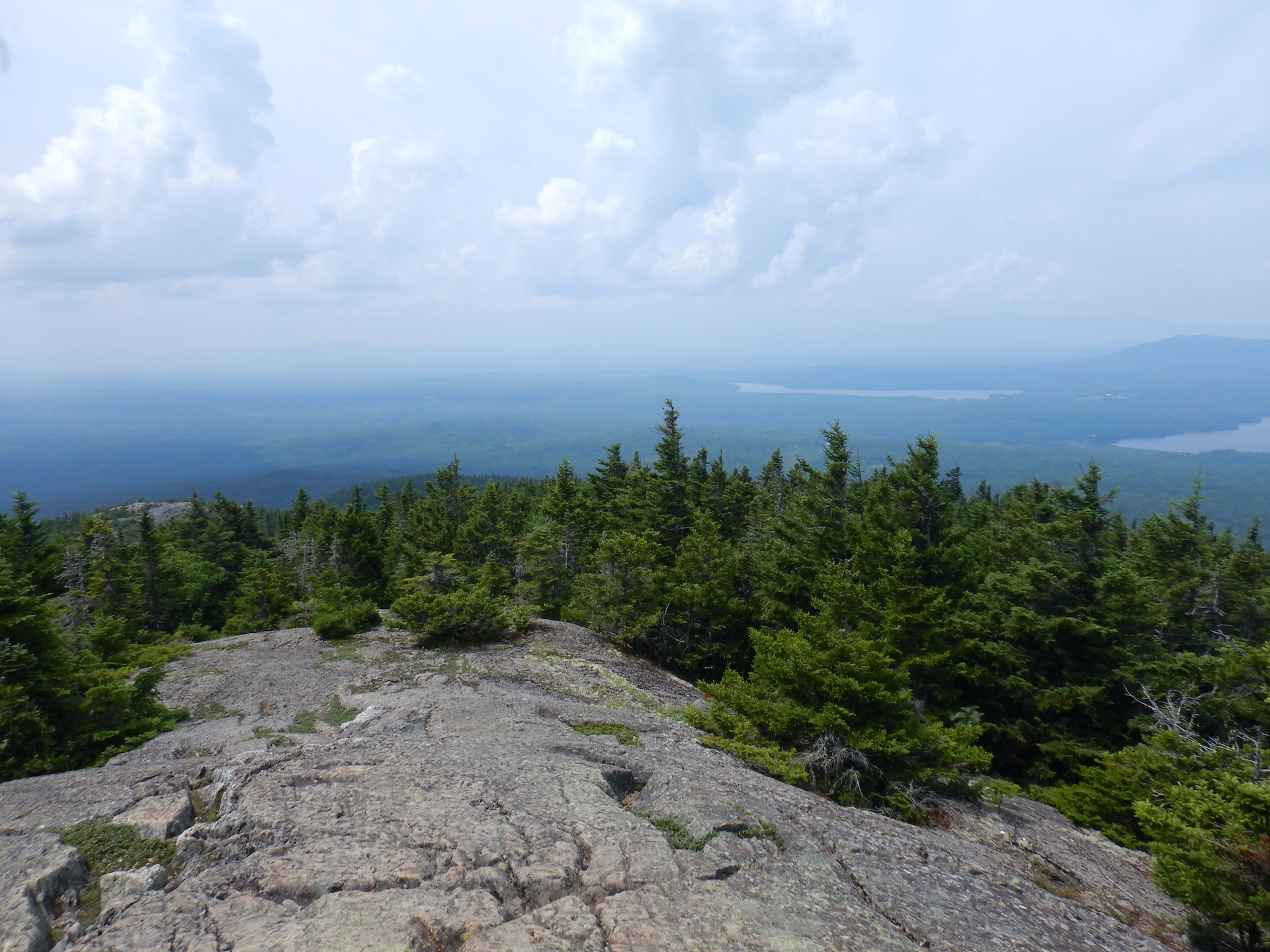
The air feels and looks heavy due to high humidity and hazy, smoke-filled skies. This isn’t the first day of the summer with these conditions, and the past two summers had days like this too. Is the presence of smoke becoming the new normal for summertime Maine? I concentrate on observing the trees, which are in “peak green,” a phase in summer when the foliage has reached its max yet still retains some of the freshness of spring. Fledgling birds are the latest addition to the animal community. Golden-crowned kinglets and red-eyed vireos feed noisy babies. On the summit, hundreds of dragonflies zip between the stunted trees.
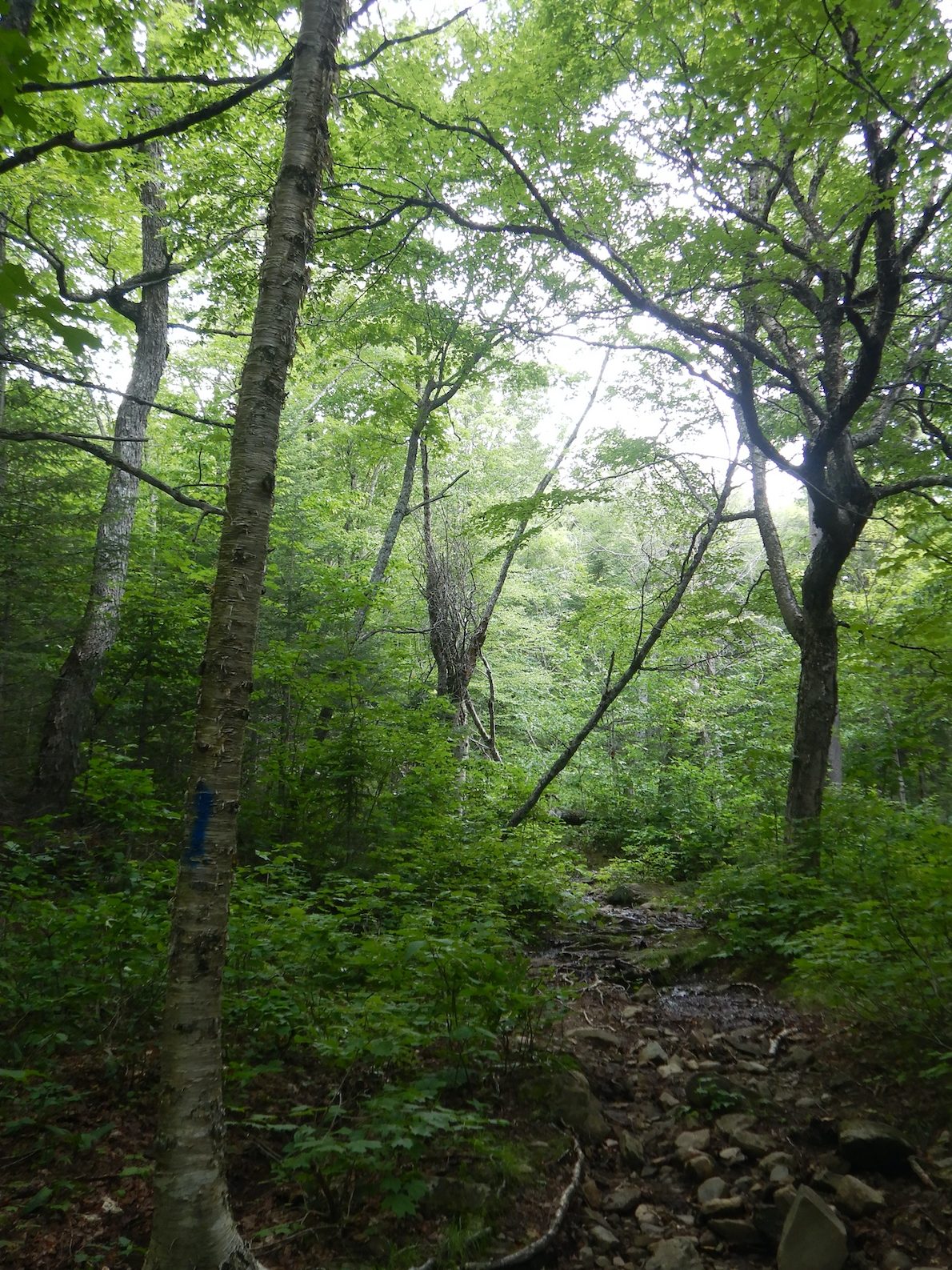
Portrait view of rocky trail through a green forest. The trail starts at lower right and disappears at center.Trees with bright green leaves obscure the sky. The understory is also thick with green plants.
Peak green on Mount Chase trail. July 21, 2023.

View of forested landscape from mountain summit. Bare rock covers the ground at bottom while spruce and fir trees slope off the mountain. The lowlands and horizon are obscured by haze in the air.
Looking west-southwest through smoky haze toward Katahdin and Baxter State Park from the Mount Chase summit on July 21, 2023.

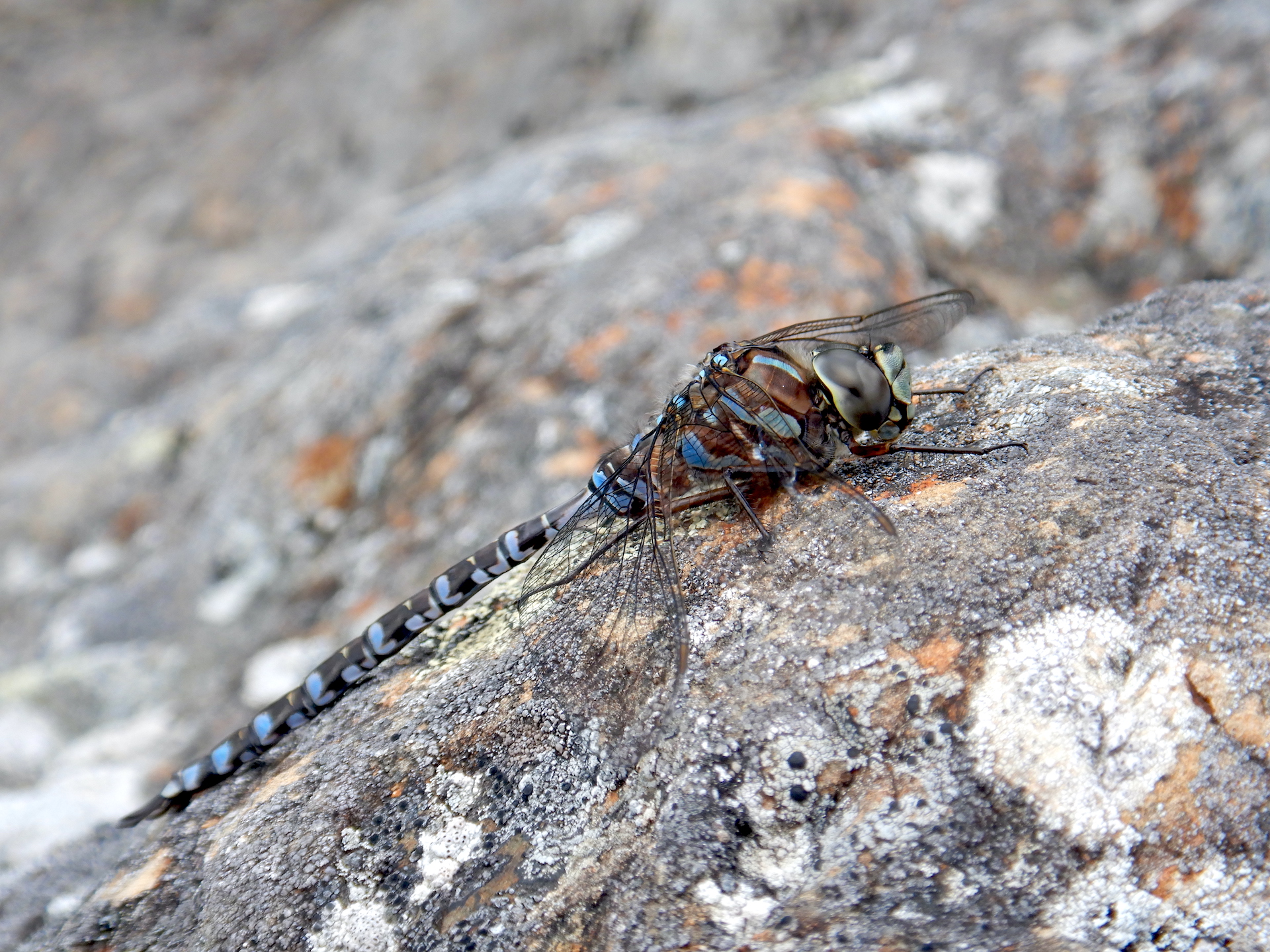
Close up view of a dragonfly. The insect rests on rock speckled with small crusty lichens. It has a blue-spotted abdomen and holds its wings flat parallel with the rock.
A darner dragonfly of genus Aeshna rests on at the summit of Mount Chase. If you know what species it is, please identify it on iNaturalist.

August 20 
A quiet hike now that songbird nesting season is done. Only white-crowned sparrows sing in the summit area. The summer foliage has reached “tired green.” The work of photosynthesis as well as insect attacks have rendered the previously vibrant leaves a darker, less vibrant hue. I experienced a stressful week. Yet, I’m fortunate to have an escape for some brief solace.

View of forest that is a mix of young and old spruce and fir trees. Dead standing trees are among them. A large trunk is at left.
A section of old growth forest on upper Mount Chase.

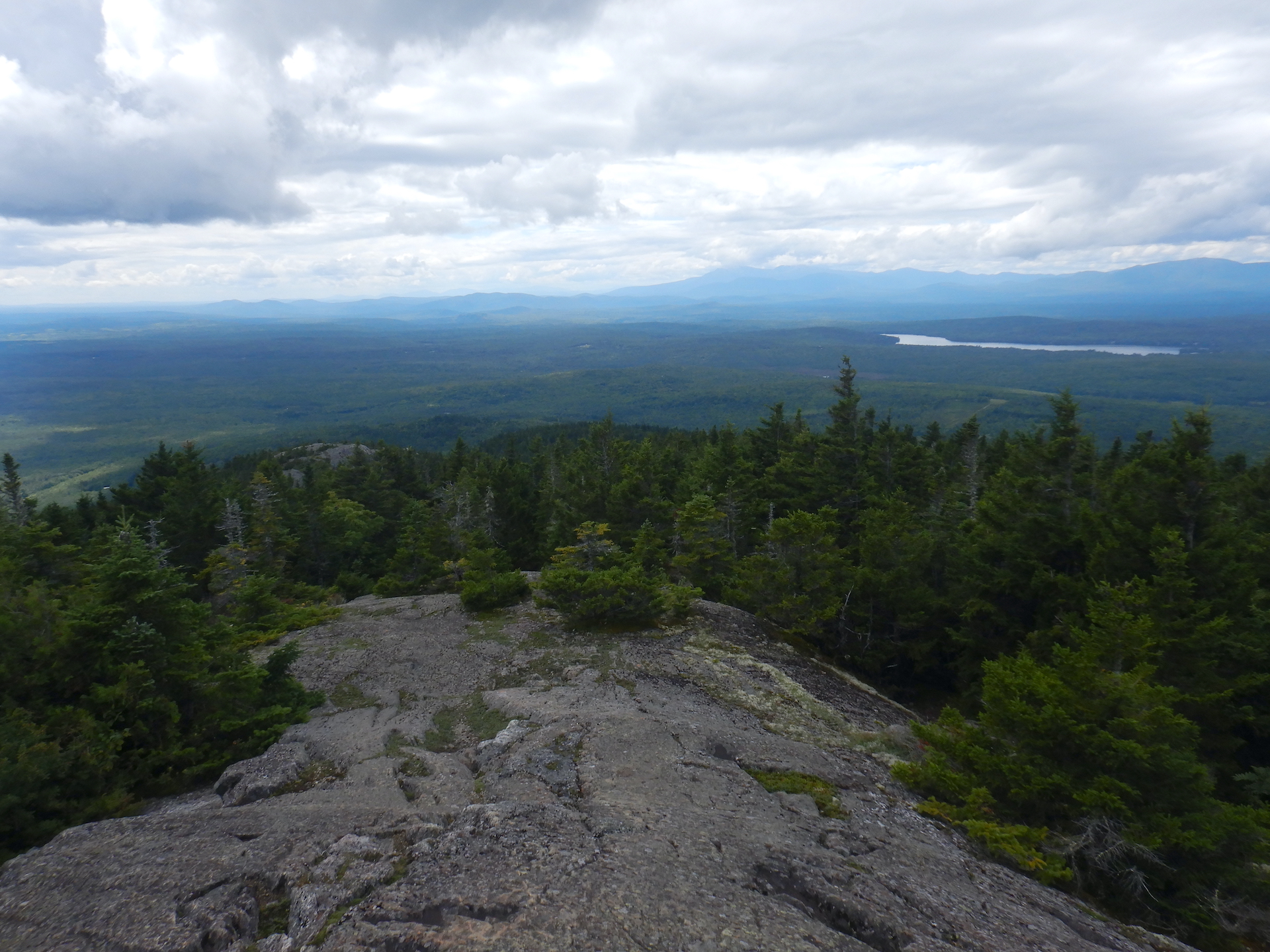
View of forested landscape from mountain summit. Bare rock covers the ground at bottom while spruce and fir trees cover the near slopes. The skies are mostly cloudy. Forest fills the lowlands. A pond and mountains can be seen near the horizon at center left.
Looking west-southwest toward Katahdin and Baxter State Park from the Mount Chase summit on August 20, 2023.

September 24 
I discover (for myself) the remnants of a long abandoned cabin maybe 20 yards off the trail. It’s collapsed to its foundation. Still, I’m surprised by its presence. I walked by it many times previously without seeing it. The forest tends to make things disappear. Hazy conditions have returned to the area. A thick band of wildfire smoke clouds the north horizon and the mountains of Baxter State Park are mostly obscured. A few red-tailed hawks ride the thermals on the mountainside on their migration south. A raven family doesn’t tolerate their presence. They move to chase one of the soaring hawks. We’re approaching peak fall colors, although the colors are quite muted compared to normal.

A collapsed cabin rests in the forest. Vegetation has yet to grow over the structure but the wood at the base in the foreground is rotted and moss covered. The rest of the structure forms a pyramid shape.
The forest and weather will soon consume this collapsed cabin.

The Mount Chase Trail on Sept. 24, 2023.

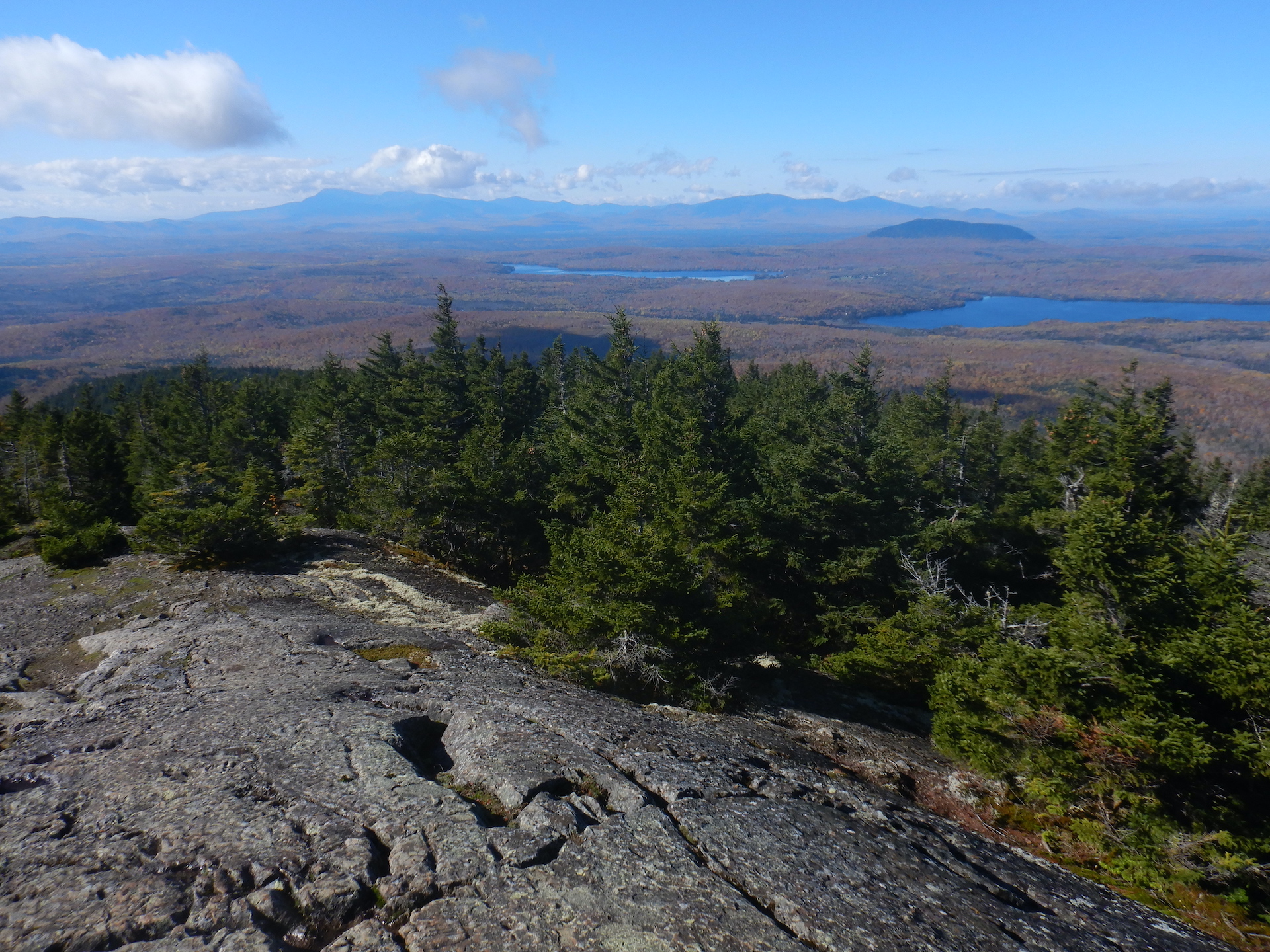
View of forested landscape from mountain summit. Bare rock covers the ground at bottom while spruce and fir trees cover the slopes. A pond is visible at center left. Haze obscures the horizon. The low elevation forest is speckled with yellow foliage.
Looking west-northwest from the Mount Chase summit on Sept. 24, 2023.

October 18
The forest trends brown. A solid layer of newly fallen leaves cloaks the forest floor. I somehow sleepwalk most of the way to the summit, a habit I’ve been trying to break for years with greater mindfulness. I find myself stopping to focus on my breath and immediate surroundings. Something distracted me, probably precipitated by a media culture that profits from distraction and rage-inducing social networks. It is possible to walk through a forest and not see it at all.

Landscape view of rocky trail through a forest. The trail starts at bottom center and disappears at left of center. The canopy is mostly bare of leaves. The leaves that remain are mostly yellow. A larger tree bisects the image from top to bottom.
The Mount Chase Trail on October 18, 2023.

View of forested landscape from mountain summit. Bare rock covers the ground at bottom while spruce and fir trees cover the upper slopes. The lowland forest is mostly brown and bare of leaves. Tall mountains form the horizon although they look small due to the perspective. A pond is visible in the forest at center right.
Looking west-southwest toward Katahdin and Baxter State Park from the Mount Chase summit on October 18, 2023.

November 16
I begin at an alternative trailhead that I’ve used a few times this year. The route isn’t maintained. It’s nothing more than a decades-old skidder trail, but it is a quicker and more secluded course than the main trailhead. The year has been wetter than average, so water has consistently flowed over parts of the trail. Mid fall brought a prolonged stretch of dry weather though, and the trail is drier than it has been over the entire year. Winter will soon be here. The canopy is bare. Patchy snow sits in the shady areas of the mountain’s spruce-fir forest.

View of forest that is a mix of young and old spruce and fir trees. Dead standing trees are among them. A large trunk is at left. Tiny patches of snow sit on fallen tree trunks.
The old growth forest on upper Mount Chase on November 16, 2023.

View of forested landscape from mountain summit. Bare rock with some patchy snow covers the ground at bottom while spruce and fir trees cover the upper slopes. The lowland forest is bare of leaves. Tall mountains form the horizon although they look small due to the perspective. A pond is visible in the forest at center right.
Looking west-southwest toward Katahdin and Baxter State Park from the Mount Chase summit on November 16, 2023.

December 8, 2023
Winter is a time of dormancy for many life forms, although it brings vibrancy in other ways. None of the previous trips were as beautiful or as quiet. Several inches of snow coat the ground at low elevations and about 12 inches linger higher on the mountain. No human footprints are discernible on the trail. Snow and hoarfrost cover the conifers like cake icing. The landscape appears clean in a way that I don’t find in spring, summer, and fall.
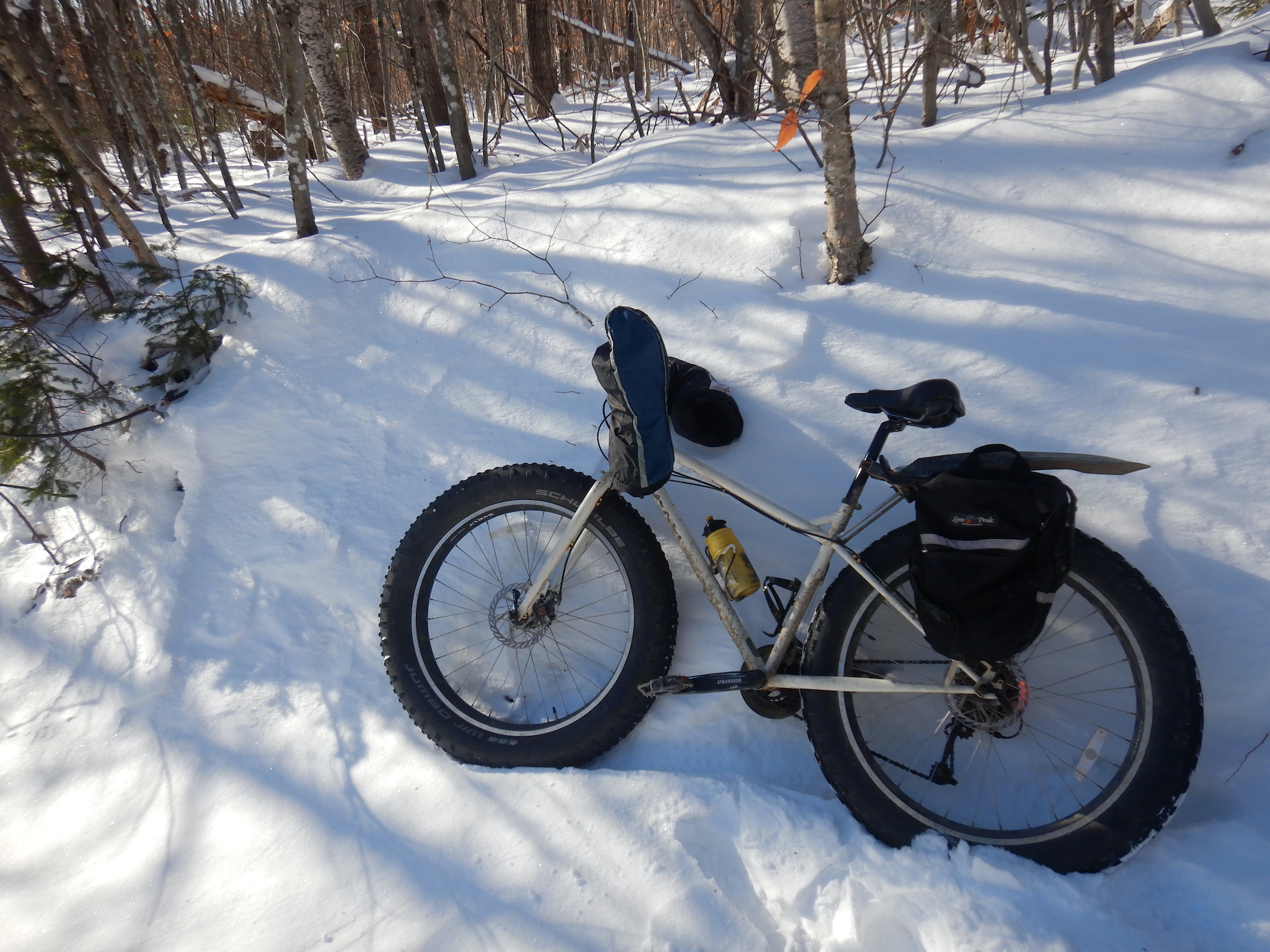
A fat tire bicycle rests against a snow covered bank. Trees fill the background at top. The bike has a rear pannier and bar mitts.
Large Marge

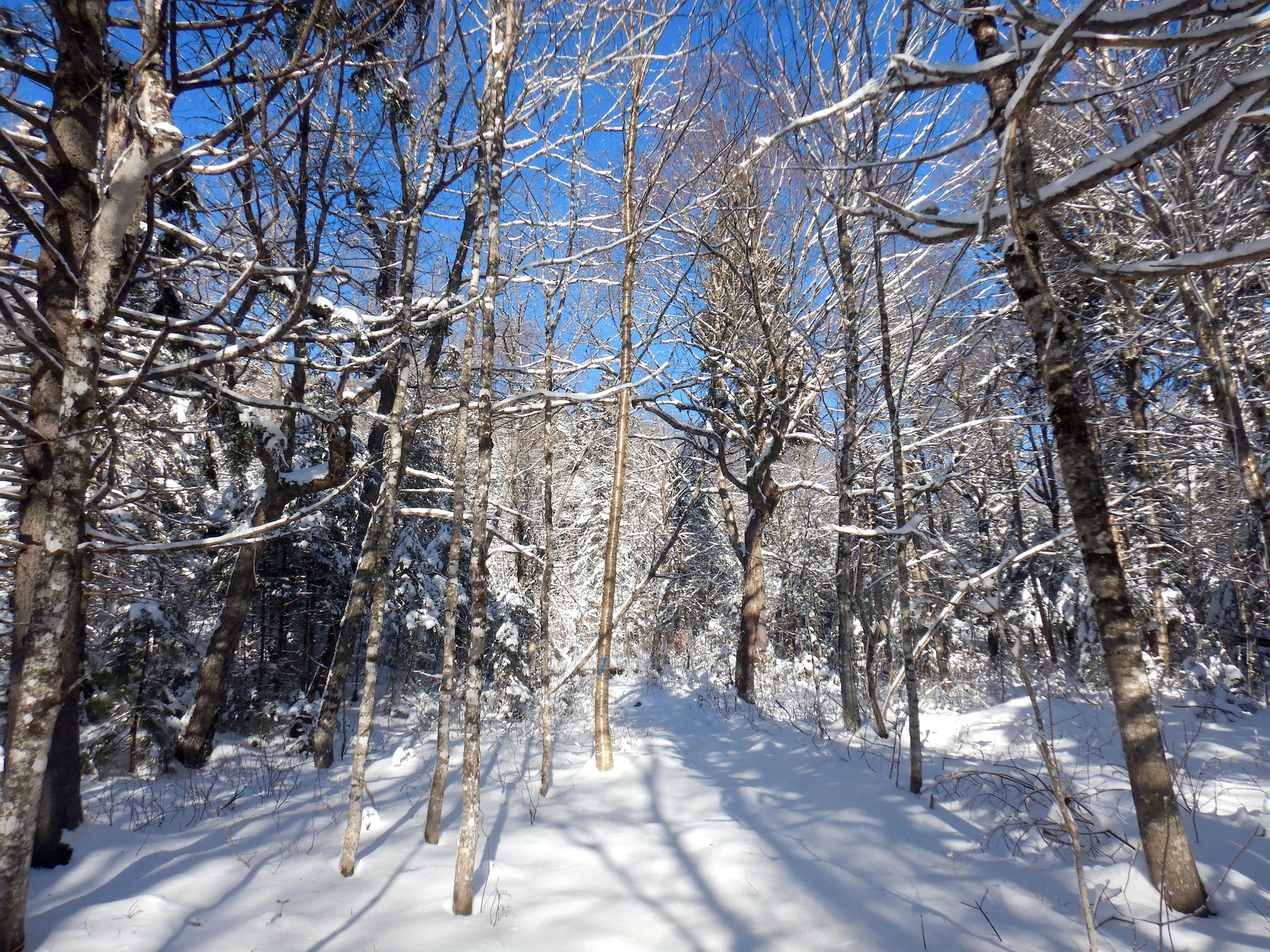
view of snowy forest. The trees are mostly deciduous and bare of leaves. Snow covered the ground.
The Mount Chase Trail on December 8, 2023.
The final approach to the Mount Chase summit on December 8, 2023.

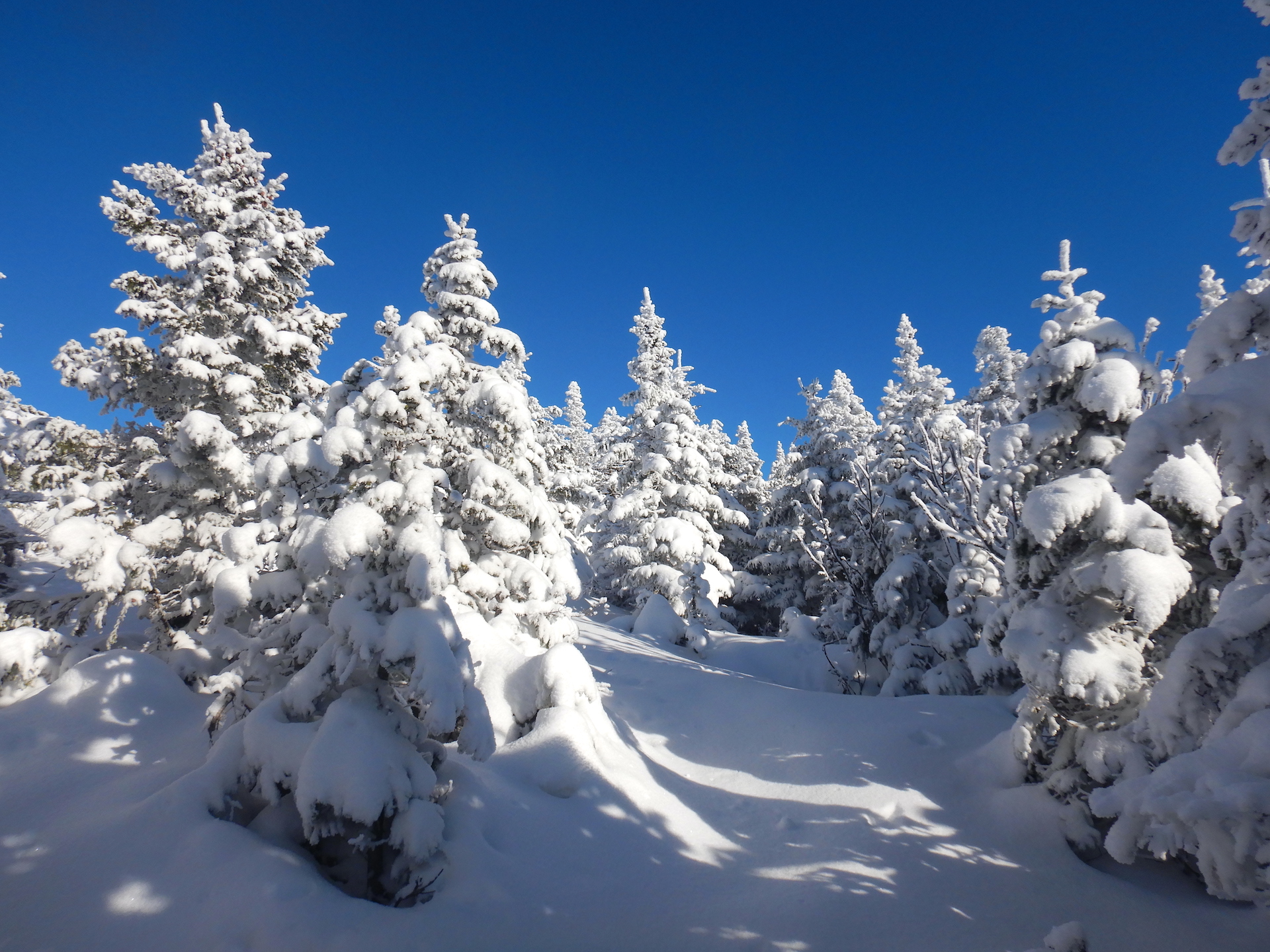
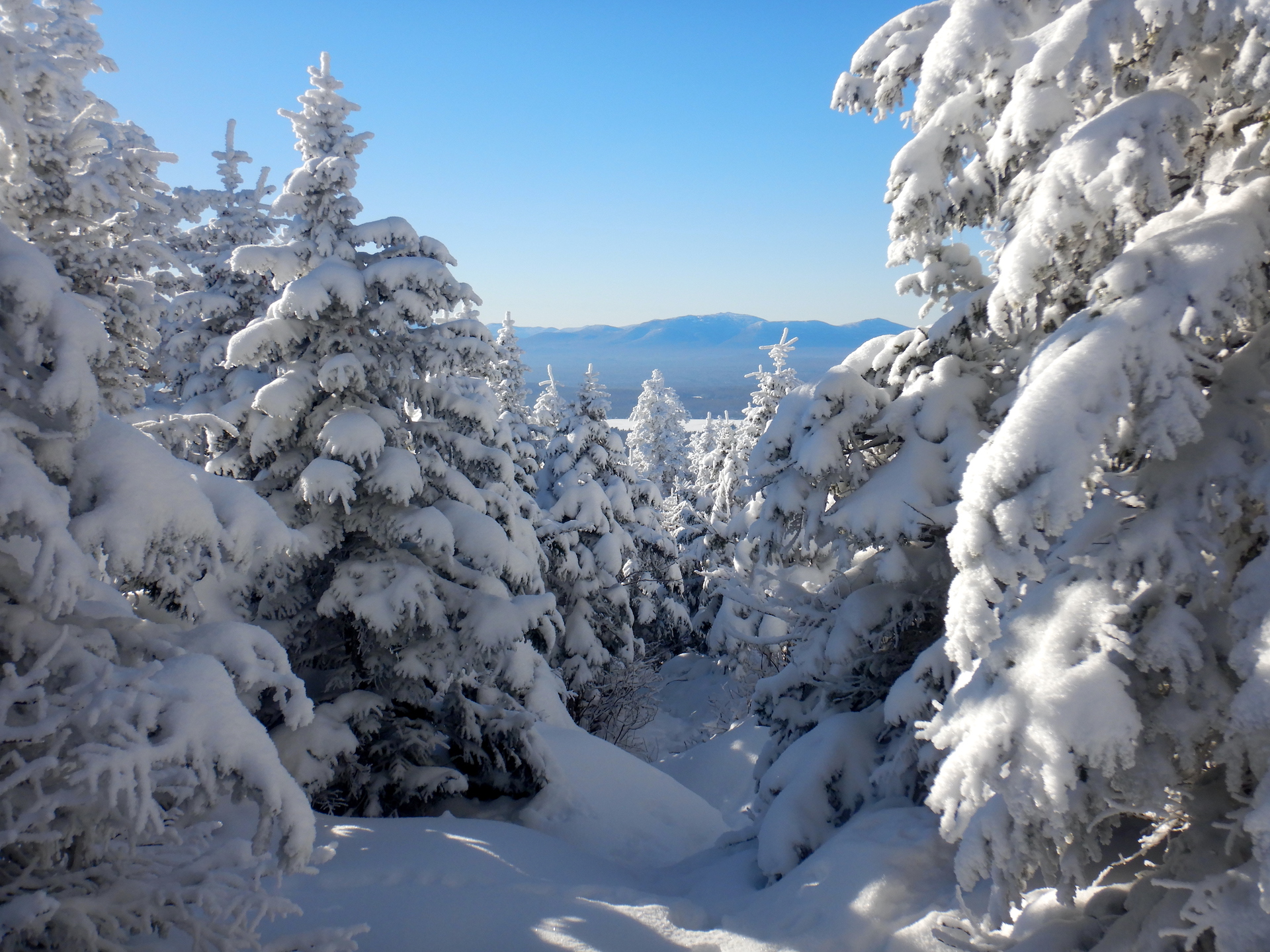
View of snowy conifer trees looking toward mountains on a far horizon. The trees are pyramidal in shape and their branches are covered in thick snow. The ground is fully snow covered. A blue sky fills the upper half of the photo.
Looking down the Mount Chase Trail near the summit on December 8, 2023.

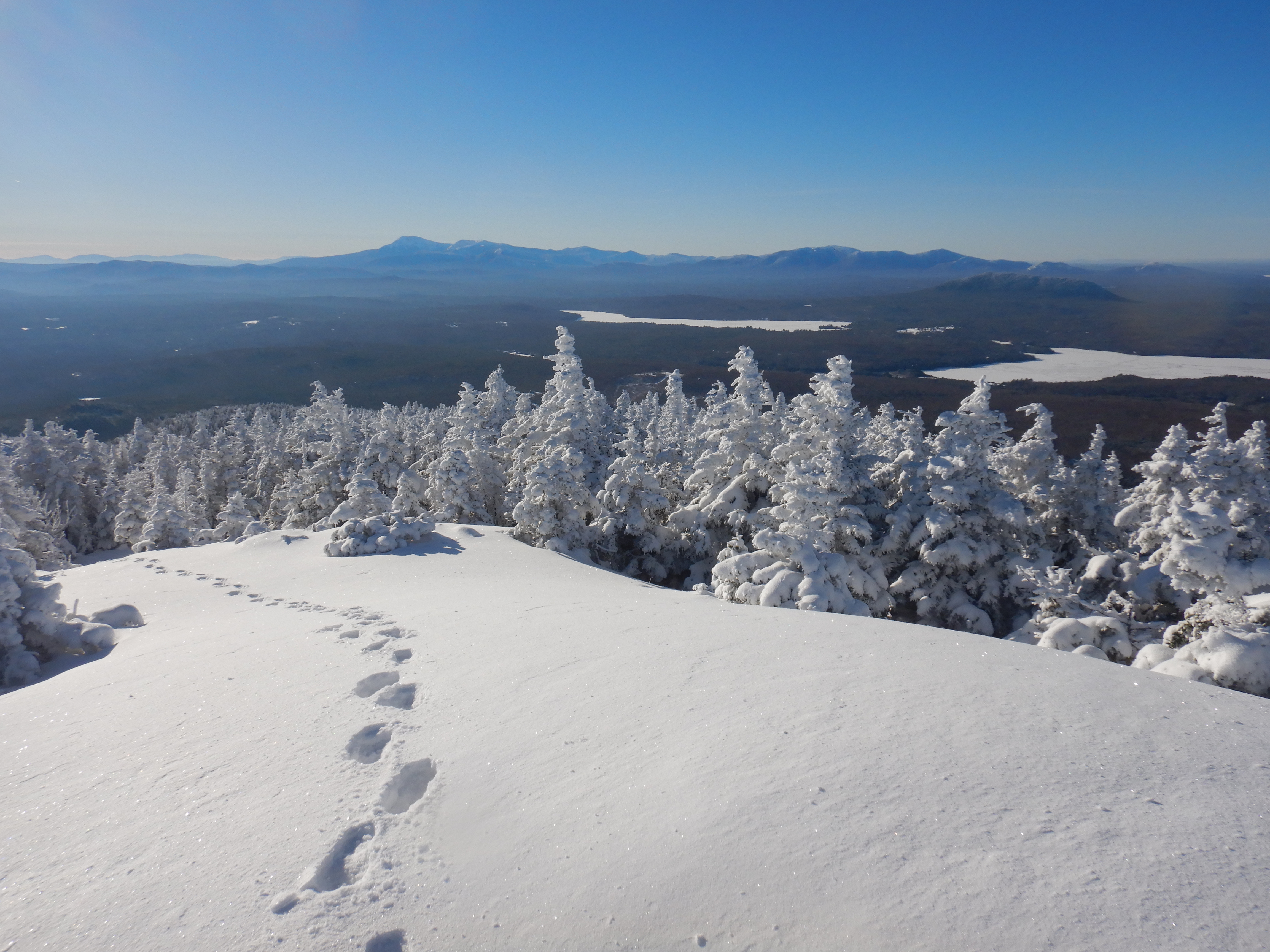
View of forested landscape from mountain summit. Snow covers ground at bottom. A single set of human footprints cross them toward the perspective of the camera. Snow-covered spruce and fir trees cover the near slopes. Ice covered ponds and forest fill the lowlands. A line of mountains forms the horizon.
Looking west-southwest toward Katahdin and Baxter State Park from the Mount Chase summit on December 8, 2023.

Time spent in the forest is never wasted and every moment offers the potential to discover new perspectives. I’m no closer to profound insights after thirteen trips to the summit of Mount Chase, although I’ve walked away with a greater appreciation for the mountain’s rhythms. The experience is both the same and vastly different every time. 

Mount Katmai Caldera

We found ourselves hanging over the brink of an abyss of such immensity that, as the event proved, we were powerless even to guess its size. Down, down, down, we looked until the cliff shelved off and we could follow it no further.

–Robert Griggs in The Valley of Ten Thousand Smokes describing the moment he first peered into Mount Katmai’s caldera

Standing on the rim of the Mount Katmai caldera, staring at the gaping hole where a mountain once stood, elicits a profound awe. At the caldera and across the Valley of Ten Thousand Smokes, the Earth’s power and ability to foment change is laid bare.

About a year ago, I disappeared into one of the most unique landscapes on Earth, the Valley of Ten Thousand Smokes in Katmai National Park, a trip I partly chronicled in a blog post for explore.org. I hadn’t specifically planned on ascending to the caldera rim on that trip, knowing that the weather along the crest of the Aleutian Range is fickle at best and an inviting window of opportunity may never materialize. When I woke at daybreak on June 10, 2019 to see a cloudless sky though, I left my base camp eager to reach one of Katmai National Park’s most spectacular features.

I slept the previous night at Novarupta, the lava dome that marks the eruptive center of the 1912 Novarupta-Katmai eruption, the largest eruption of the twentieth century and one of the five largest volcanic eruptions in recorded history. The lava dome represents the eruption’s last gasp, forming anywhere from days to months after the 60 hour eruption waned on June 9, 1912.

view of pumice-covered flats and snow fields dark-colored lava dome at center

Novarupta lava dome

I began walking not long after the first light of dawn cast a pink alpenglow on the surrounding volcanoes. The rivulets of snowmelt where I gathered drinking water the prior evening had run dry as overnight temperatures dropped below freezing. Thankful for the firm footing, however, I traveled quickly across frozen snowfields to the base of the Knife Creek Glaciers, a badlands of pumice-covered ice attached to the north faces on Trident and Katmai volcanoes.

view of snowfields and mountain peaks

Early morning light on Trident Volcano

Not one, but many meltwater streams pour from the snout of these glaciers, and the permanent channels have eroded deeply into the pyroclastic deposits that form the Valley of Ten Thousand Smokes proper. Finding places to hop over or ford these streams is straightforward, although tedious work as you climb in and out of their past and present floodplains. They can be crossed most safely within a few hundred yards or less of the base of the ice. Farther downstream, they create impassible gorges, akin to southern Utah’s famed slot canyons only filled with a torrent of glacially cold water.

view of pumice flat and small stream with ash and pumice covered glaciers in background

Lower sections of the Knife Creek Glaciers are a badlands of ice covered with as much as six feet of ash and pumice.

Compared to the scale of geologic time, Katmai’s volcanoes forced their way to the surface relatively recently. Over the last several hundred thousand years, upwelling magma buckled and fractured its way through thousands of feet of Jurassic-aged rocks, although these sedimentary layers have deformed little since they were deposited. The rock of “Whiskey Cleaver” a wedge of 150 million year-old marine sediments buttressing the north flank of Mount Katmai, are nearly as level as when they accumulated on the bottom of the seafloor.

The first time I reached the caldera in 2011, I stuck to the base of the cleaver, following the margin of the glacier to the west while hugging the exposed rock and glacial till until I needed to step onto the glacier leading to the caldera rim. This time while looking to avoid glacial travel as much as possible—dying alone, trapped in a crevasse seems like a horrible way to go—I chose a slightly more direct route up a steep ash and snow-covered slope slightly east of the main glacier. The sun had yet to soften the frozen snow as I ascended. I couldn’t kick sufficient steps into the crust, which forced me to avoid the steepest snowfields where I felt the risk of falling was too great. This turned into the diciest part of the route and was the one place that I wished I carried an ice axe.

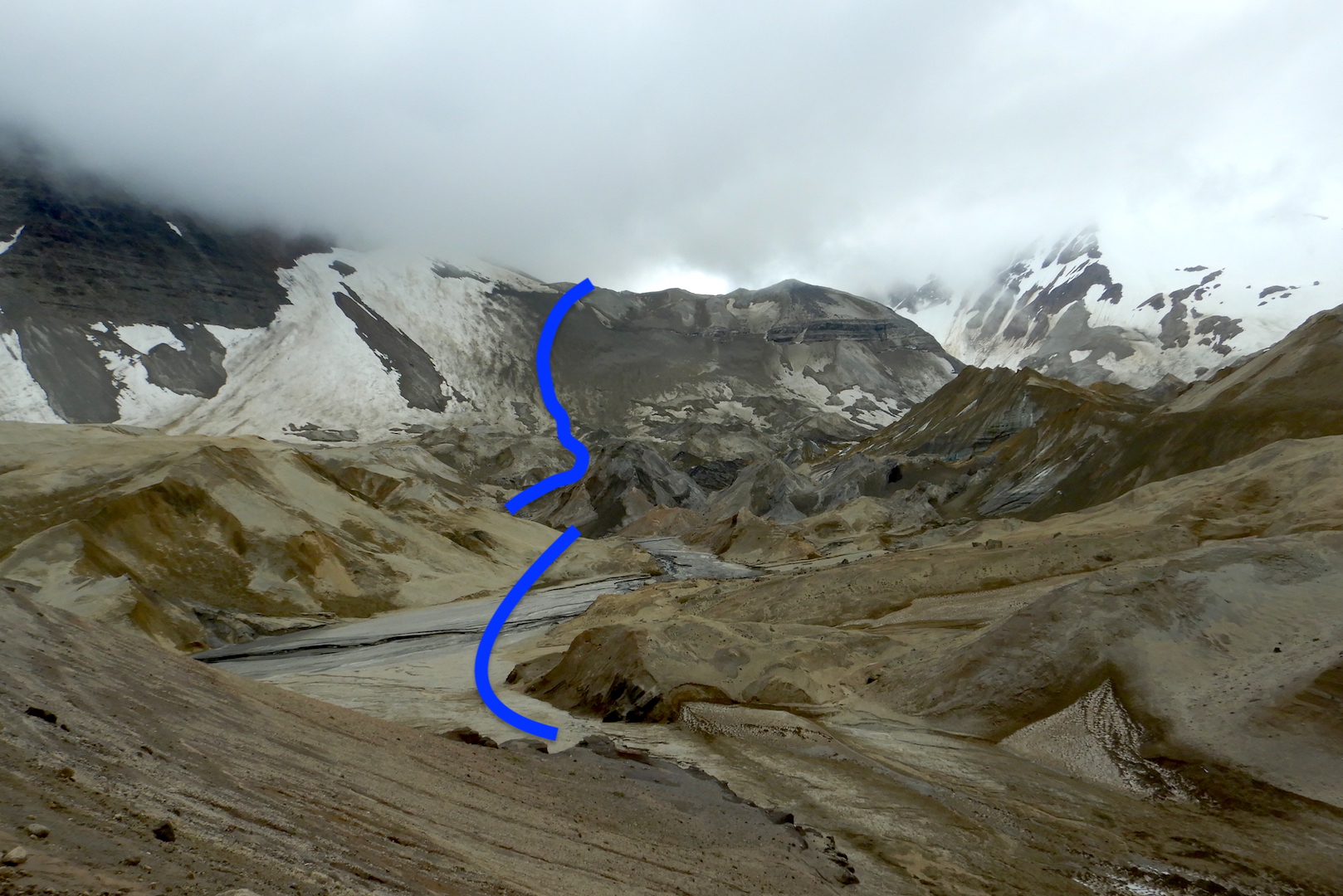
View of hummocky landscape created by ash and pumice covered glaciers at the foot of mountains hidden in clouds. Blue line near center represents route.

I explored the termini of the Knife Creek Glaciers the day before my ascent to the caldera, partly to scout a way through the badlands. My approximate route through a corner of the Knife Creek Glaciers is shown in blue. The view looks east toward the caldera.

At the top of this slope, I reached a bench where the gradient lessened in steepness, kept me temporarily off the glacier, and away from areas prone to rock fall. From here, it was a simple task of avoiding the steep sidewalls prone to sodden late spring avalanches and the center of the glacier where crevasses are more likely to open in June. Not a single cloud hung in the sky, the air was dead calm, and the caldera was only two miles away.

view of mountains with vast snowfields with some small pumice-covered areas in fore and middle ground

The final two miles leading to the caldera

When the 1912 eruption began, Mount Katmai was a triple-peaked and glacially clad 7,600-foot tall volcano. Around midnight on June 7, 1912—in the midst of eruption’s most violent outbursts—Mount Katmai began to collapse. Over the next twenty-four hours, the summit fell inward, generating fourteen earthquakes between magnitudes 6 and 7.

No one witnessed the collapse. Thick ash replaced daylight with an inky blackness across the region. Not until the eruption ceased and skies cleared on June 9 could anyone see that the mountain had lost its top. Because Mount Katmai collapsed, for decades people considered it to be the source of the eruption. In a sense it is, but not from the perspective of explosiveness. Careful study of the eruption’s fallout and pyroclastic flow deposits in the Valley of Ten Thousand Smokes revealed relatively little originated from Mount Katmai. Instead, the vent that opened at Novarupta siphoned away its magma. Perhaps not coincidentally, the elevation of the caldera floor and Novarupta are nearly the same.

Human eyes would not look into the caldera until Robert Griggs and his expedition team slogged their way to the rim from the Pacific coast in 1916. While I enjoyed the advantage of ascending on clear snow with stable footing along with the fore-knowledge of how to get to the rim, Griggs clawed up the volcano’s still muddied and pumice-covered southern slopes, all-the-while pioneering his route, not quite knowing what he’d see or what challenges he’d face until he got there.

When Griggs reached the unstable and knife-edge caldera rim caldera, he found glaciers cleaved flush with the precipitous walls where several thousand feet of mountain once stood. Peering into the gaping earth, Griggs had difficulty comprehending the caldera’s scale, and he stared amazed at a horseshoe-shaped island of lava in a milky, robin-egg-blue lake deep within the bowels of the volcano.

panoramic black and white photo of volcanic caldera.

Jasper Sayer took this remarkable photograph of the Mount Katmai caldera in 1919. It had been seen for the first time only three years prior. I reached the caldera on the opposite side from this photo, near the low point in the rim at left.

From the sight lines along my route, the terrain provides no hint the caldera exists. Although the route’s gradient lessened the closer I got to the rim, the caldera appeared in sudden and spectacular fashion.

panorama view of Mount Katmai caldera on clear sunny day

During a 2011 ascent here, I was forced to retreat within 15 minutes by howling winds, a cloud ceiling which allowed on the scantest of peeks into the bowl, and the threat of snow. On this day though, I sat on the rim for more than two hours, attempting to embed the scene into memory. I couldn’t help but consider how ephemeral it was. The shallow lake first witnessed by Griggs has grown more than 800 feet deep and continues to rise. New glaciers hug the interior walls and calve small icebergs into the water. I watched avalanches of rock and snow tumble more than a thousand feet from the rim to the lake. Water discharged from hydrothermal vents at the bottom of the lake creates greenish-brown swirls with the deep blue of the lake’s surface.

Like the dozen-plus other volcanoes in Katmai, the mountain will churn with unrest again. Its next eruption is unlikely to be as large and landscape changing as the 1912 event, but Mount Katmai’s potential to unleash the power of the Earth remains ever-present. As I sat on the rim, looking at the hole where a several thousand feet of rock once stood, I enjoyed the long moments of calm, wonderfully alone with a mountain only temporarily at rest.

view of mount katmai caldera with steep snow covered cliffs at right and center
view of mount katmai caldera with steep snow covered cliffs at left and center

To learn more about the Valley of Ten Thousand Smokes, read Robert Grigg’s 1922 book about its discovery and exploration. Volcanologists Wes Hildreth and Judy Fierstein authored the authoritative text on the eruption’s geology in The Novarupta-Katmai Eruption of 1912—Largest Eruption Eruption of the 20th Century Centennial Perspectives. Lastly, I devote two chapters in my forthcoming book, The Bears of Brooks Falls: Life and Survival on Alaska’s Brooks River, on the 1912 Novarupta-Katmai eruption’s significance to the region and the creation of Katmai National Park. Look for The Bears of Brooks Falls late this year via Countryman Press.

Cross Country By Rail Day One

Since I live across the continent from most of my family, I’m obliged to return east periodically. During my time in Alaska I flew almost exclusively on this migration, primarily because it was the most expedient way to get to where I needed to go. If I have the time though, I’d rather travel by other means. With some time to spare before my summer job at North Cascades National Park begins, I traveled by train from Bellingham, WA to Pittsburgh, PA.

I’m not a train fanatic, but the railroad allows me see a good deal of the landscape and perhaps some wildlife without the risks involved with highway driving. On the train, I could sit in my seat and gaze eagerly out the window to watch the landscape pass by. My first wildlife sighting began even before I stepped onboard.

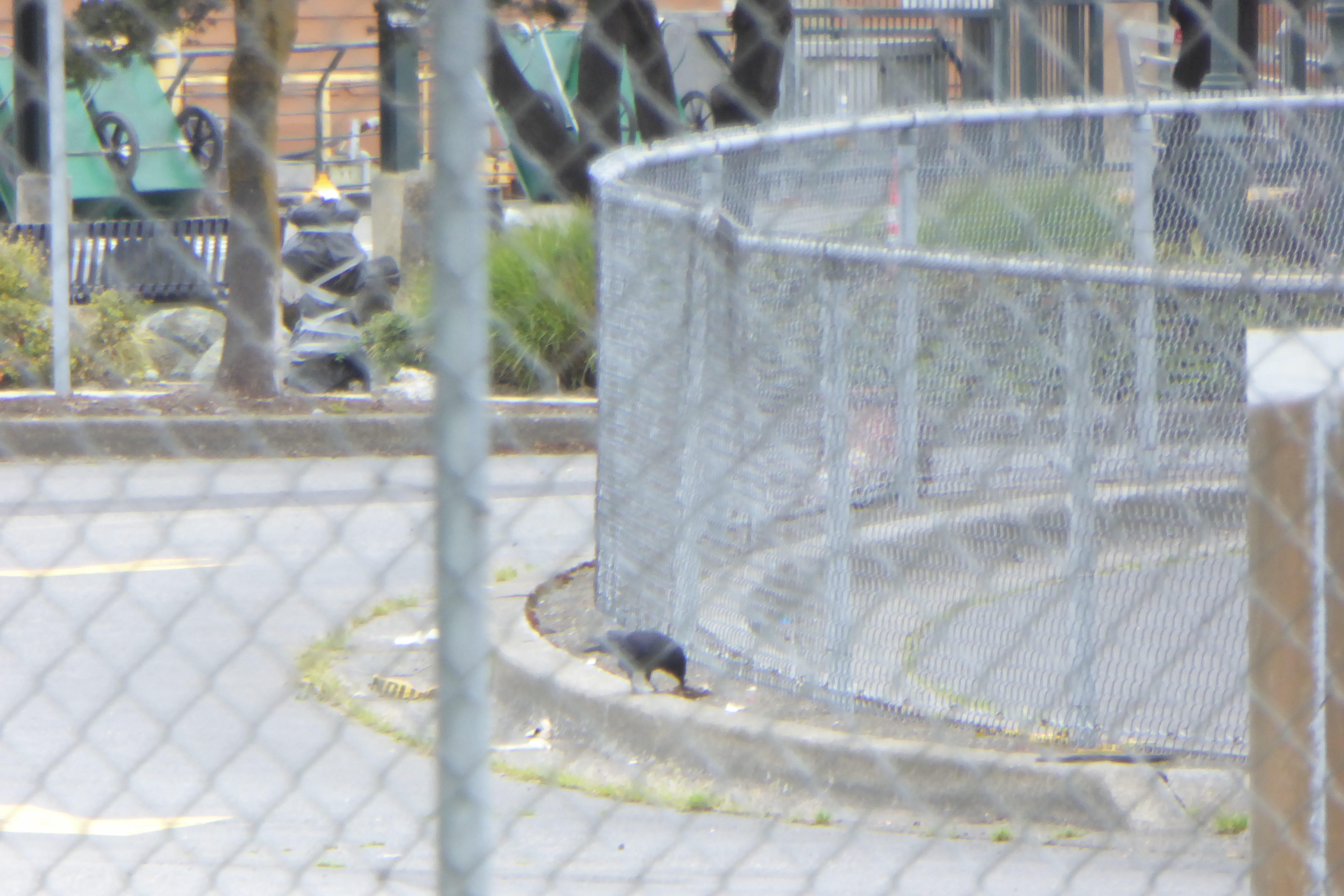
While waiting for the train in Bellingham, I watched a crow land in a parking lot with something large in its bill. This was nothing unusual as crows are fond of scavenging garbage, but as soon as the crow landed I noticed its prize was moving. I hurriedly yanked my binoculars out of my daypack to get a better look.

The crow had caught and was killing a semi-neonate cottontail rabbit. After it dispatched and partly consumed its prey, the crow returned to catch and kill another kit. With more than it could eat, the crow cached pieces of the rabbits in nearby trees and shrubs. It was a fairly gruesome death for the rabbits, but crows gotta eat too.

view through fence of crow

Life and death struggles happen even in city parking lots.

Once onboard the train and traveling from Bellingham to Seattle, I witnessed no more battles between predator and prey. The rest of the ride, in fact, was quite pleasant. The Cascade route provided plenty of views of Puget Sound, where many birds lounged and fished in the water near shore. I enjoyed glimpses of birds like blue herons, cormorants, gulls, more crows, and brant.

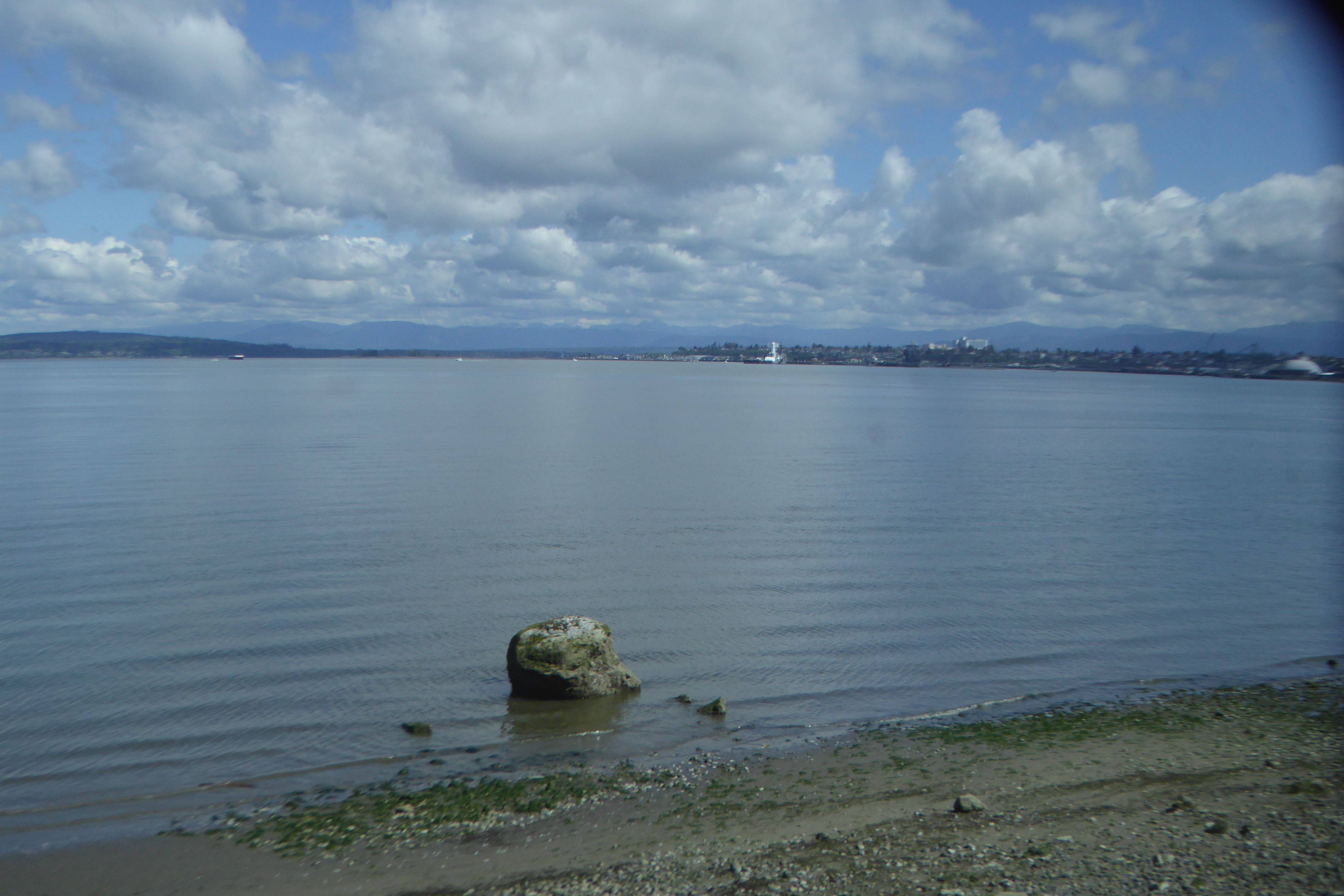
view of water with clouds and boulder in middle foreground

Puget Sound is a glacially carved trough. The boulder in the middle foreground is likely a glacial erratic.

Where I couldn’t see the water, the route often passed through rich farmland where large rivers like the Skagit and Snohomish have deposited broad floodplains.

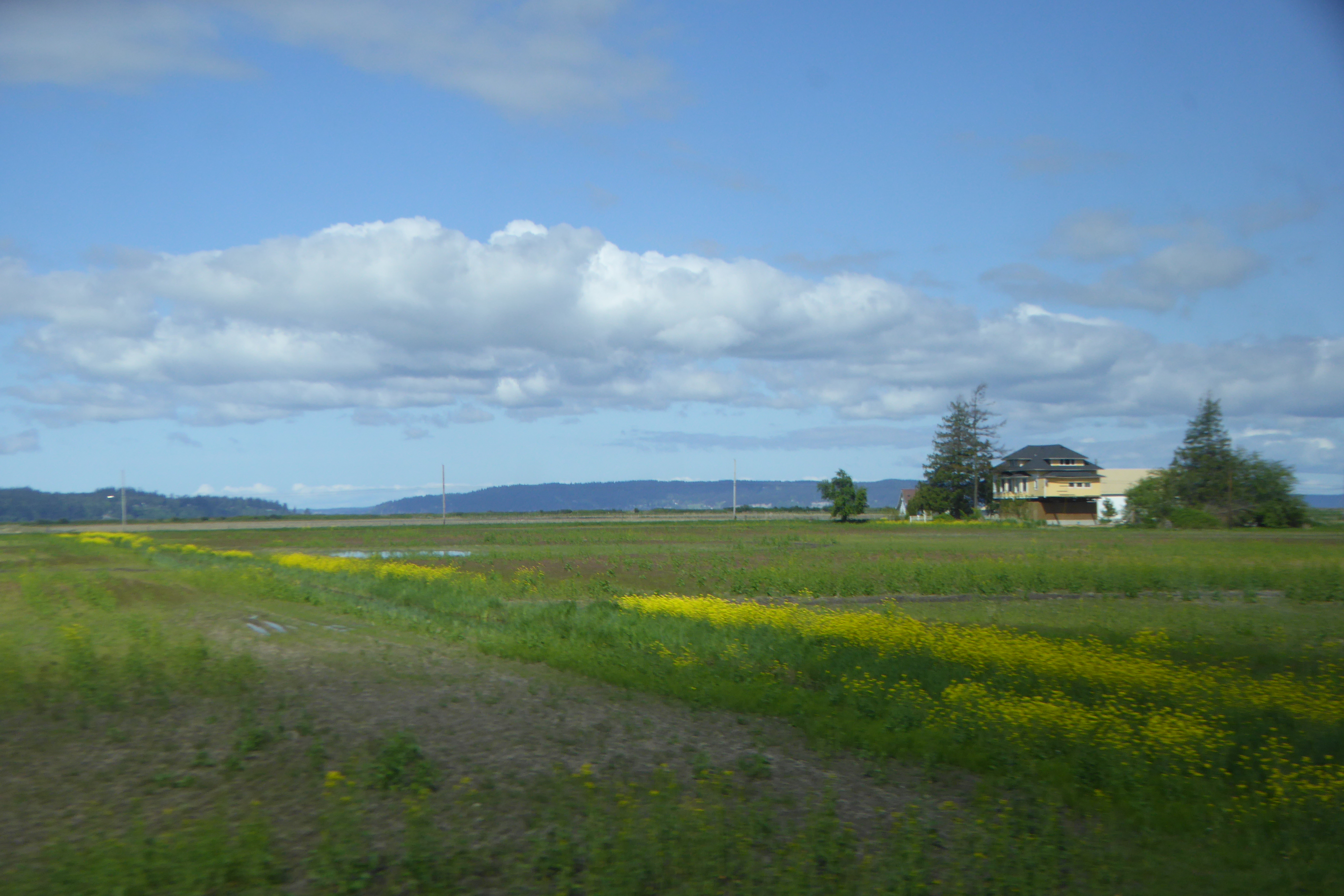
Fallow farm fields and farmhouseAfter transferring to the Empire Builder in Seattle, my route reversed north before it turned east up the Snohomish and Skykomish rivers valleys toward the Cascade Mountains, which were quite showy under clear skies.

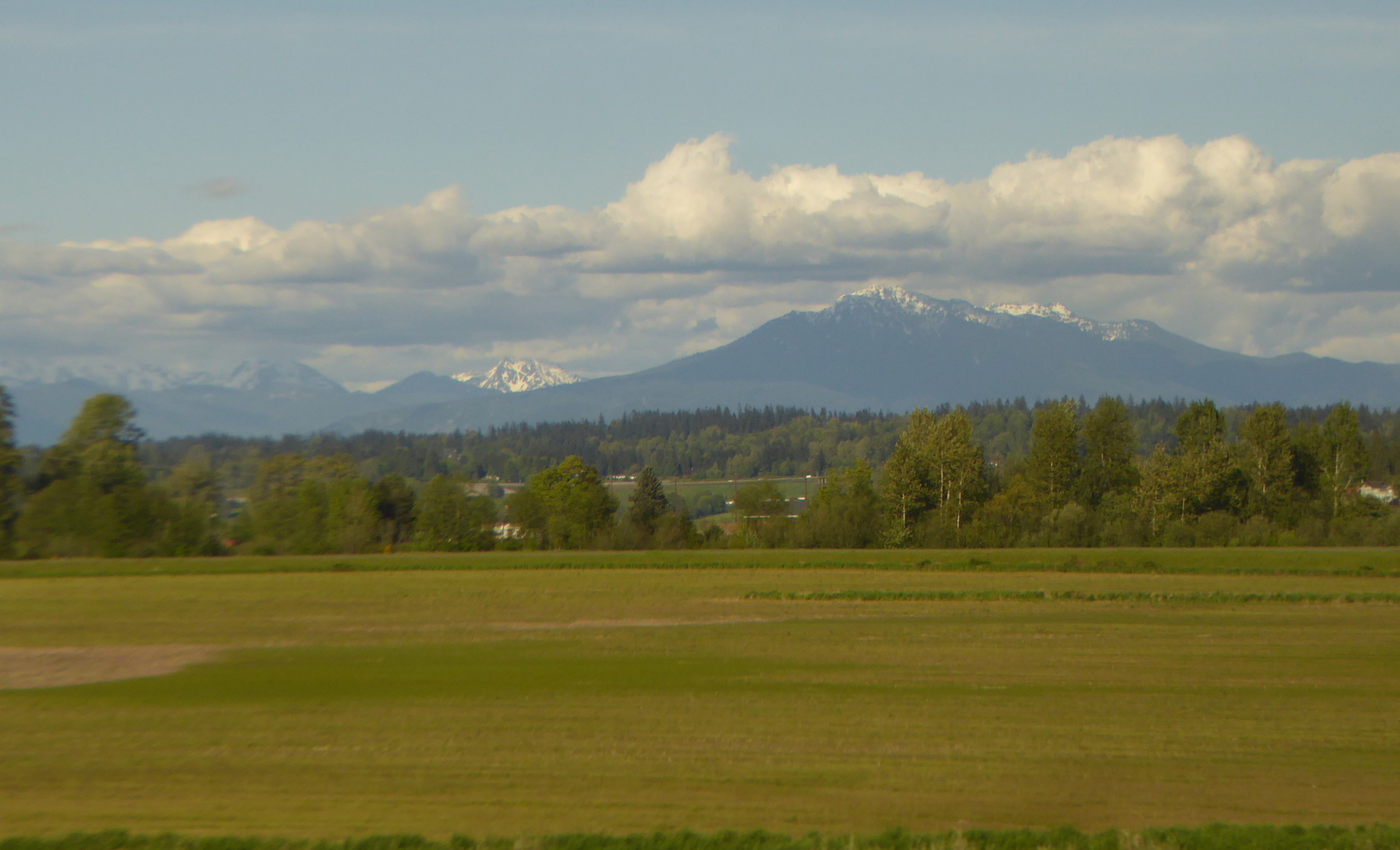
Farmland with view of tall snowcapped mountains in backgroundThis section of rail, besides letting me enjoy scenes of lush forest, provided a conspicuous example of habitat changes due to climate, particularly the Cascades’ rain shadow effect. When moisture-laden storms from the Pacific reach the Cascades, the rising air cools and drops a considerable amount of its moisture on the west side of the mountains. Far less remains to wet the mountains’ eastern slopes.
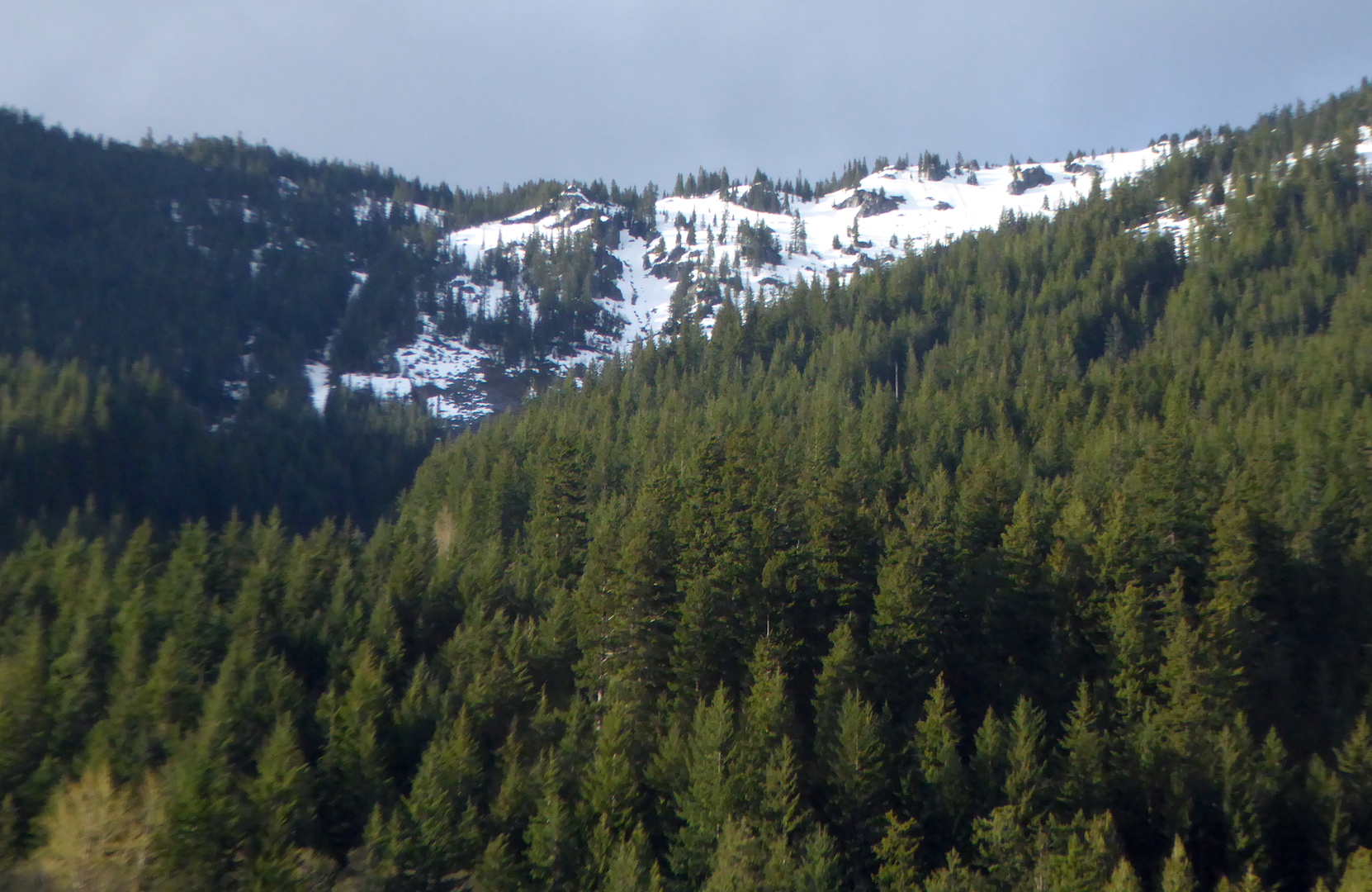
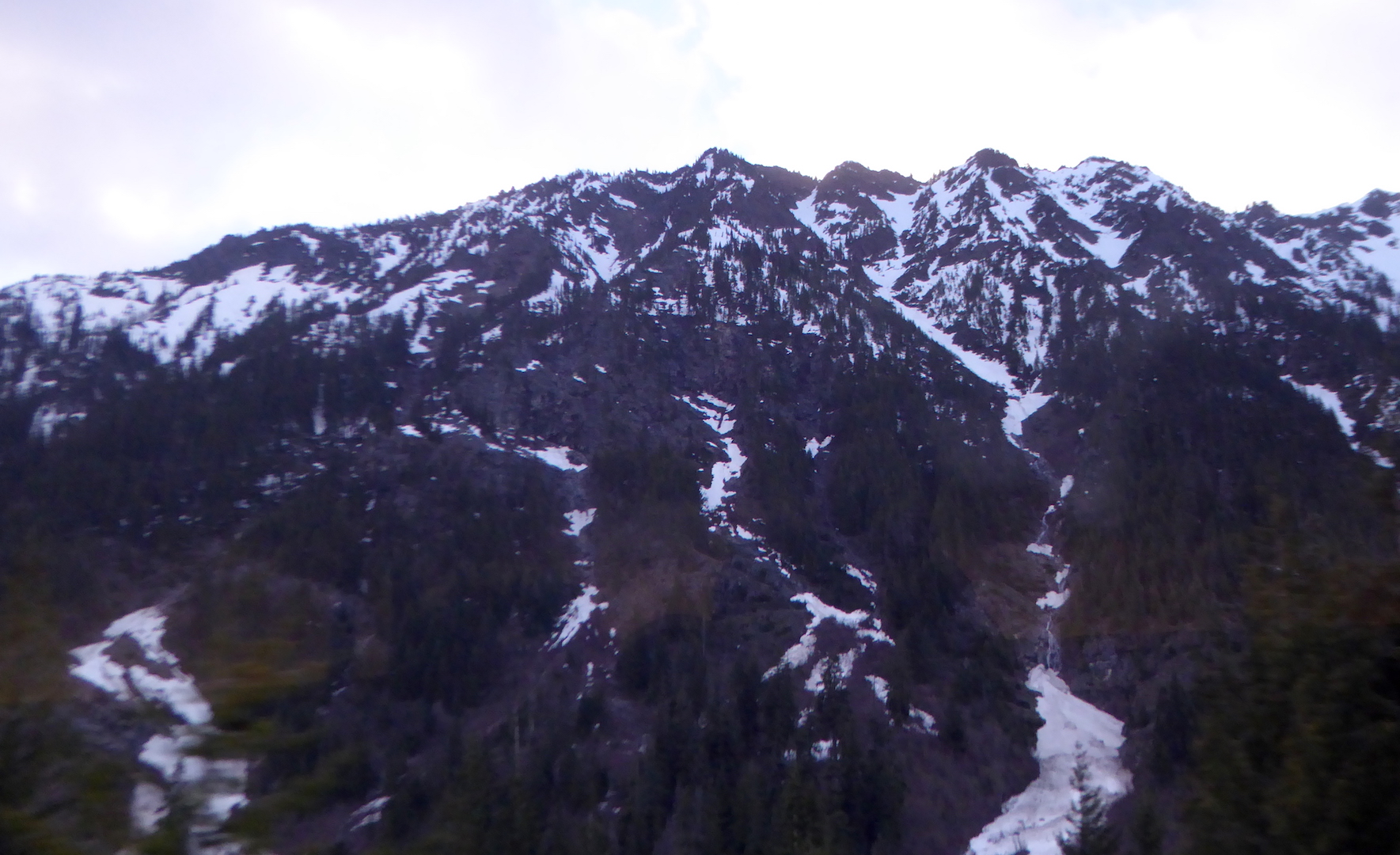
Skykomish, WA at 900 feet in elevation, for example, receives a whopping 91 inches of precipitation per year. The forests of this valley, except where recently clear-cut, are lush and thick and moss hangs prominently from stout big leaf maple branches.

Forests on snow-covered mountainside

Lush forest cloak the western slopes of the Cascades.


Around 2900 feet in elevation, the train entered an eight-mile long tunnel and passed underneath the Cascade crest. When the train exited the tunnel on the east side of the Cascades, the forest was noticeably different. Trees were sparser and included a higher proportion of drought tolerant species like ponderosa pine.

Sparsely snow covered mountain

Many mountainsides east of the Cascade crest are noticeably drier and less forested than equivalent areas to the west.

As the train descended the Wenatchee River valley to the Columbia River, the climate became drier and drier. Soon enough, sagebrush and bitterbrush mixed with widely scattered trees as we approached Wenatchee around sunset. About 780 feet in elevation, Wenatchee receives only 11 inches of annual precipitation. Along the Columbia River, as night fell, the route crossed a dramatically drier environment compared to the lush forests not far to the west. I could see few trees except those planted by people.

Darkness concealed central and eastern Washington’s landscape, which I knew would happen but was still disappointing because I missed viewing any of the unique and spectacular channeled scablands. I went to bed looking forward to more sightseeing.

In a future post, I’ll describe days two and three on the train where the land continued to offer more reasons to be glued to the window.