Brown Bear Fatness Index

Brown bears get fat, often really fat. They also lose a lot of weight and sometimes become really skinny. They are often fat and skinny in the same year. When you watch brown bears, either in person or via bearcam, you can sometimes make a fairly accurate determination of a bear’s body fat and relative health by looking at its shape.

Fatness can be used as an indicator of health in brown bears. Brown bears need to eat a year’s worth of food in six months or less to survive, and body fat is the key their survival. They can lose 30% or more of their body weight during hibernation and can continue to lose weight throughout the spring when few high calorie foods are available. In the Brooks River area, only after green plants begin to grow and salmon have arrived do most bears begin to regain lost weight and start to accumulate body fat.

While fat is important to bears, a thin bear isn’t necessarily an unhealthy bear. Young subadult bears and yearling cubs, for example, often appear thin in spring and early summer before many high calorie food sources are available. These bears usually regain lost body mass in summer and early fall.

Polar Bear International developed a handy scorecard to measure the relative fatness of polar bears. I’ve adapted it for brown bears. My brown bear fat index uses the same categories as the polar bear index, which ranges from skinny/emaciated to very fat/obese. I also included additional information for each category such as the age/sex class most likely to be in a category and the time of year bears are most likely to be in a category.

Please note, my brown bear index is subjective and based on my observations at Brooks River, Katmai National Park, Alaska. The polar bear fatness index is also subjective, but less so than mine because researchers who handle immobilized bears can palpate the animal to estimate its body fat content. (Katmai’s Changing Tides project also tracks body fat content in female brown bears, but uses bioelectric impedence analysis.)

Brown Bear Fatness Index

Emaciated: bear appears skinny with ribs, vertebrae, and hip bones usually clearly visible unless covered by fur.

  • Time of year most likely to happen: late winter through early summer, but can happen in all seasons.
  • Age/sex Class: Older bears, especially older mothers with newborn cubs and injured bears
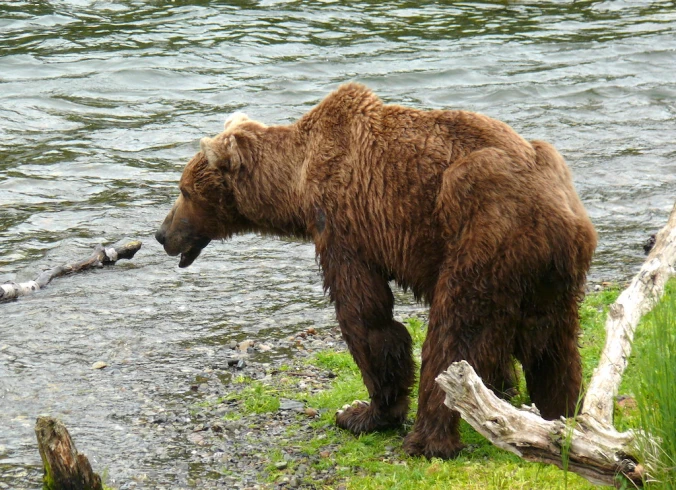
emaciated 16 Cinnamon.jpg

16 Cinnamon shows an emaciated figure in July 2010. Notice his prominent hip bones and shoulder blades. If he had less fur, his ribs would also be noticeable.
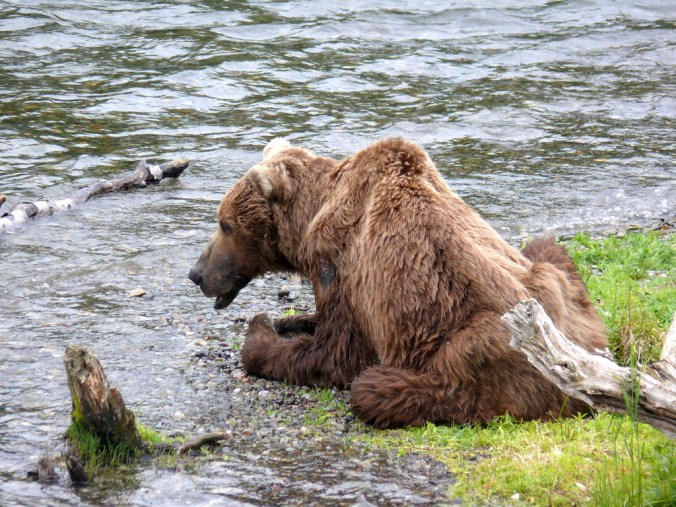
emaciated 16 Cinnamon_2.jpg

In this photo, also from July 2010, Cinnamon’s vertebrae seem visible through his fur. Despite his lack of body fat in July, he survived winter and returned to Brooks in 2011. At the time, he was estimated to be at least in his late 20s, but could’ve been older.

Thin: vertebrae and hip bones partly visible; narrow body

  • Time of year most likely to happen: late winter through early summer, but can happen in all seasons.
  • Age/sex class: subadults, yearling cubs, 2.5 year-old cubs, older bears, and mothers with newborn cubs
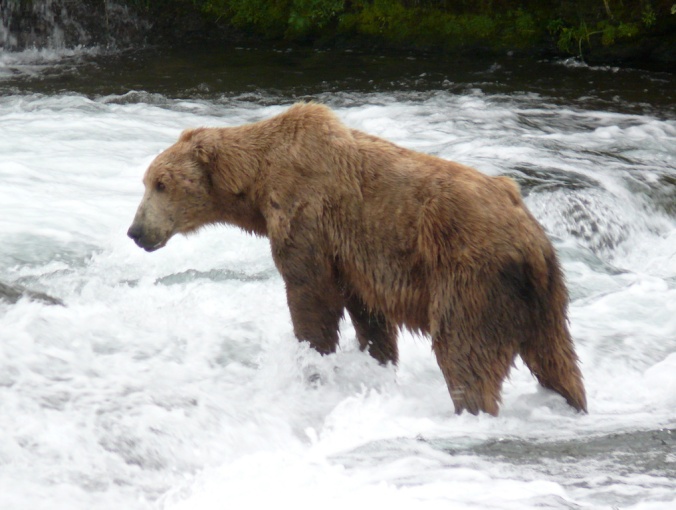
thin 234 Evander fishing near the far pool 2.jpg

234 Evander in July 2010 displays a thin body with noticeable hip bones. Evander was an older bear (probably older than 20 years) in 2010.
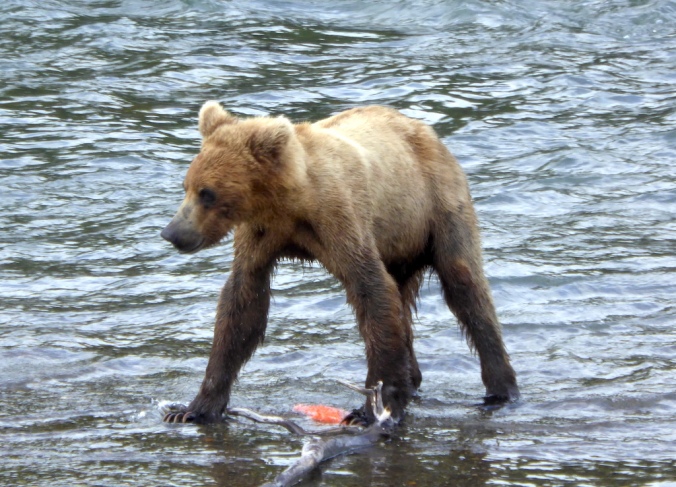
thin 503.JPG

In this photo from early July 2016, 503 Cubadult appears thin with slightly visible hip bones. His narrow body shape is not uncommon for young subadult bears (he was 3.5 years old in July 2016), and does not necessarily indicate poor health. Rather it reflects the time of year and his low rank in the bear hierarchy.

Average: hip bones and ribs not visible; the bear’s body, neck, and head are evenly proportioned

  • Time of year most likely to happen: all year, but most often summer
  • Age/sex class: all ages
average 505.JPG

This adult female, 505, is well proportioned and a good representative of average fatness for an early to mid summer bear. Photo taken on July 8, 2016.

Fat: fat over rump, stomach hangs low; bear’s neck is semi-fat but doesn’t distort the size of the head

  • Time of year most likely to happen: late summer and fall
  • Age/sex class: adult males in prime of life in mid summer, all bears late summer and fall
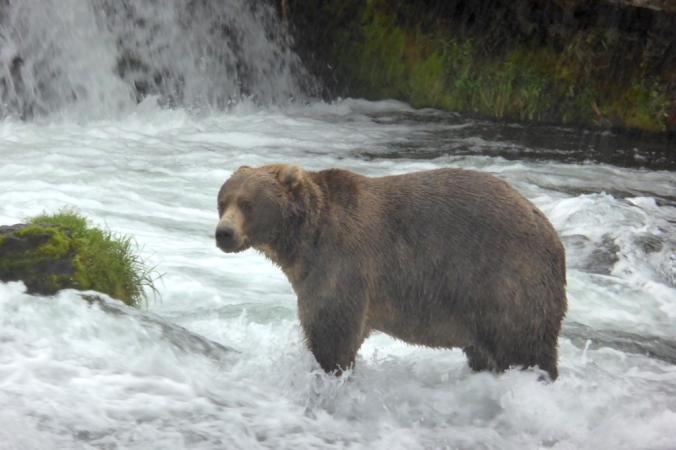
Fat 89 Backpack_03_09132015.JPG

Katmai’s brown bears most often reach the fat class in late summer and fall when salmon are readily accessible and have been so for two months or more. In this photo from September 2015, 89 Backpack displays the typical body shape of a fat bear. Most bears attain this body shape before they hibernate.
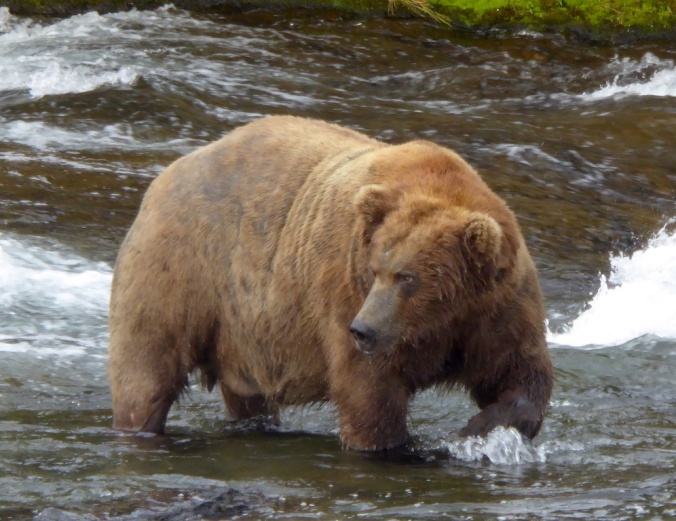
fat 747.JPG

Sometimes large adult males, like 747, can reach the fat category by the end of July. Some bears aren’t this fat when the go into the den, yet 747 reached this size months before hibernation. This photo was taken in late July 2015.

Obese: stomach hangs very low; bear’s neck is very fat and makes head appear smaller in proportion to its body

  • Time of year most likely to happen: very late summer and fall
  • Age/sex class: adult males in prime of life and adult females without cubs
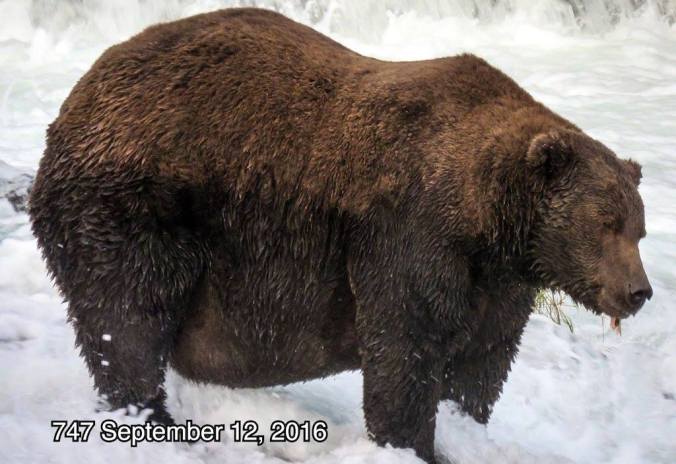
Obese 747.jpg

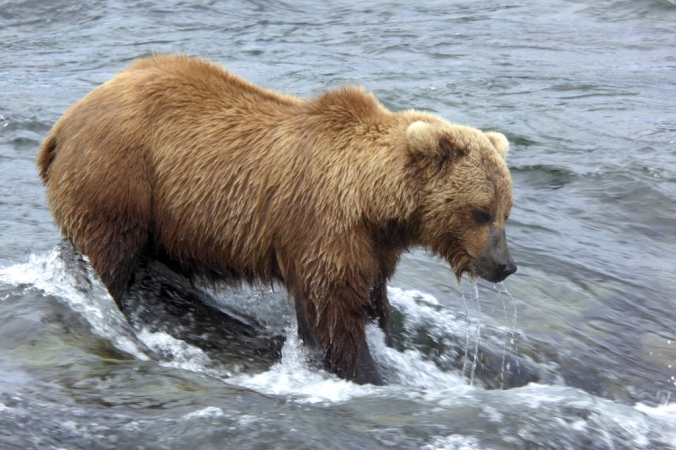
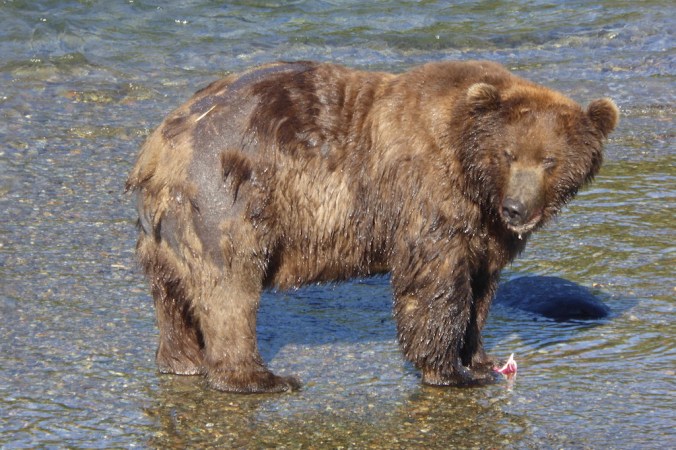
This NPS photo of 747 epitomizes an obese bear. (He should’ve won #FatBearWeek. Election was rigged!) Seriously, this is an extremely obese bear. I don’t think I’ve ever seen a bear this fat before. His belly hangs nearly to the ground (the water is not very deep where he stands in the photo). 747 is a very dominant adult male at Brooks Falls. As such, he has access to his choice of fishing spots. His well-endowed figure is proof of his dominance, health, and fishing skills.
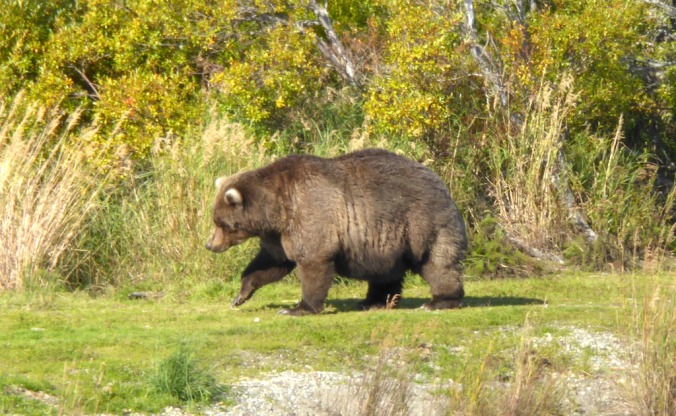
Obese 409 Beadnose_45_09232015.JPG

409 Beadnose shows the ample proportions of an obese female in September 2015. Females with cubs do not usually attain this level of fatness because of the energetic costs associated with raising cubs. Beadnose did not have cubs in 2015.
Strut Your Stuff

In my last post, I broke down an interaction between two mother bears, one of whom was particularly defensive. Bears though don’t always charge and threaten violence to make their point. As this video illustrates, bears communicate through body language to establish dominance and avoid conflict. (Warning: Long Video.)

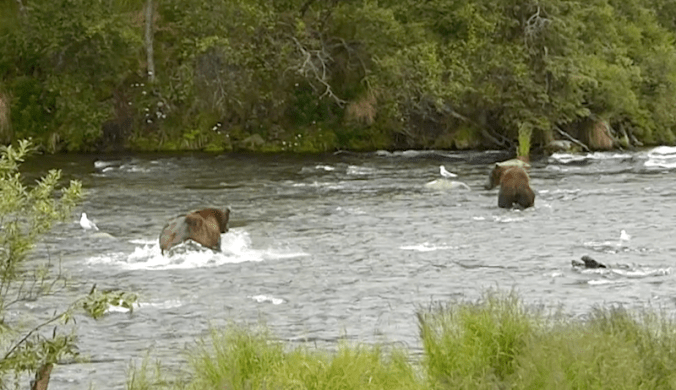
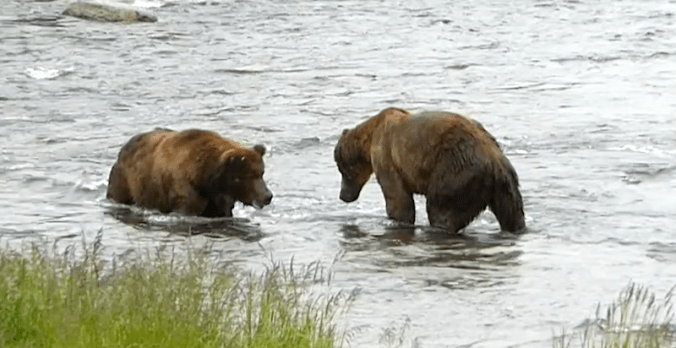
In the video, 747 is the heftier, darker bear. 68 is the tall, lanky bear. Both are mature adult males, likely in the prime of their lives. As I see it, bear 747 comes out of this on top as he asserts his dominance over the newcomer, 68. This took some time, however. 68 didn’t exactly yield like most would upon the approach of 747.

As the video starts, 747 (left) immediately approaches the newcomer on the island. 68 subtly skirts 747, but continues his approach toward the falls. You can see that 747 is much bulkier than the newcomer, but the new bear is just as tall, if not taller.

Screen Shot 2016-10-14 at 10.49.25 AM.png

747 (left) approaches 68 on the island downstream of Brooks Falls.

When 747 turns his back on the new bear, 68 takes the opportunity to mark some grass (0:50). 68 is not acting submissive or yielding.

Screen Shot 2016-10-14 at 10.50.10 AM.png

After a brief do-si-do, 68 (left) marks grass while 747 does the same.

The new bear approaches 747. 747 stands and watches. At this point, the outcome is very much undecided (1:12).

Screen Shot 2016-10-14 at 10.51.34 AM.png

68 (left) approaches 747.

After a little more posturing, 747 turns to mark the willow on the island. This is a bold display of dominance in front of 68. The newcomer though continues to cowboy walk away from 747, still not submissive but very focused on 747’s movements (2:00).

Screen Shot 2016-10-14 at 10.52.50 AM.png

747 marks a willow tree while 68 postures nearby.

747 follows the exact same route on the island as 68, probably following the newcomer’s scent and leaving his own on the way (2:20). 68 postures more in the grass. 747 again marks the tree. This time for almost 30 seconds (3:18).

Screen Shot 2016-10-14 at 10.53.28 AM.png

747 says, “This is my turf.”

747 then goes to the grass where 68 just was and rubs it on his body. He seems to want to leave a scent trail everywhere his competitor has (4:05).

Screen Shot 2016-10-14 at 10.53.59 AM.png

747 (center) marks the grass where 68 had just walked.

68 walks downriver. 747 follows. In the riffles, 747 catches up to him. Instead of fighting, the bears posture more. Here’s where 747 seems to assert his dominance more clearly. 68, instead of posturing further, stands in the riffles and watches 747 approach then walk away (5:00).

Screen Shot 2016-10-14 at 10.54.21 AM.png

747 pursues 68 downstream.

The video cuts to a moment a few minutes later when 68 makes his way back to the island. This draws 747’s attention and he approaches 68 again. 747’s ears remain upright and forward, a sign of dominance in this context. The new bear’s ears are oriented back against his head, a sign of defensiveness (6:40).

Screen Shot 2016-10-14 at 10.55.34 AM.png

747 (left) directly approaches 68 one last time. Note the bears’ ears. 747’s are pitched forward like he is not intimidated by 68.

747 circles 68. 747 walks away and the newcomer stands and watches, indicating that 747 successfully asserted his dominance in the interaction. 747 then goes back to the island and marks the vegetation again (7:05). 68 continues to stand and watch. Winner: 747.

747_06272016.JPG

747 is one of the largest and most dominant bears at Brooks River.

During encounters between adult male bears, the “winner” is the bear who ends the interaction, usually by walking away. This is exactly what 747 did. (Exceptions are when bears compete over a resource they want like food, a fishing spot, or access to a female. In those cases, the dominant bear stays where he wants, displacing the subordinate bear who usually moves away.)

Any time a new bear arrives at Brooks Falls, my interest piques. Newcomers are often wildcards. They may or may not know how to fish the falls and must weave their way into the river’s hierarchy. 68 was never identified at Brooks Falls in July. I didn’t recognize him when he arrived. He seemed to show some familiarity with the falls area and wasn’t particularly wary of other bears. When 747 saw the newcomer I thought, “This could get interesting.” It did, just in a non-violent way.

68 and 747 communicated their intentions clearly through posturing and marking vegetation. Throughout the entire video, these bears get very close to each other, but never make physical contact. Both want to hold high places in the hierarchy, because dominance confers many advantages. Through a continued, confident approach and more exaggerated posturing, 747 asserts his dominance over the newcomer. This is a classic, albeit lengthy, example of bears using body language to communicate their intentions, avoid physical conflict, and establish dominance.

For more information on Katmai’s bears, download the latest edition of Bears of Brooks River: A Guide to Their Identification, Lives, Identification, and Habits.

When Mother Bears Collide

What happens when two mother bears, both with spring cubs, meet?

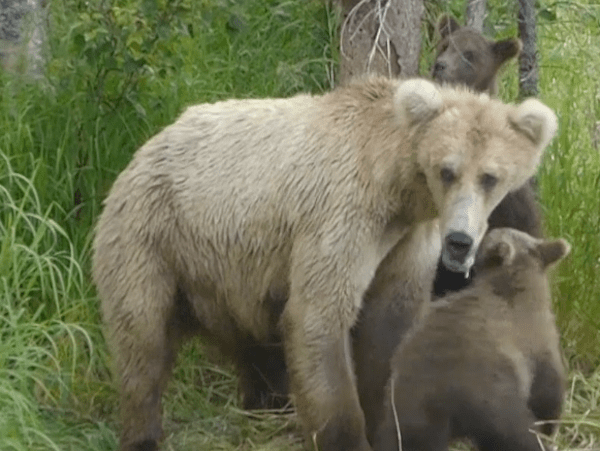
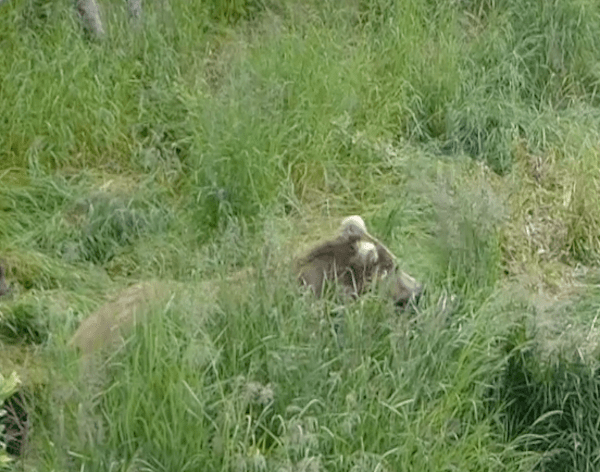
Defensiveness is a trait of all mother bears. In the video, 128 Grazer is the blonde bear with three spring cubs, and her defensiveness is immediately evident. She jaw pops and salivates as 409 approaches.

Mother bear standing near cubs at base of a tree.

128 Grazer stands next to her cubs. Her excessive salivation is a sign of stress.

Meanwhile, 409 shows no signs of aggression. She probably just wants to get to the river and fish. Her two cubs are behind her.

Bear standing in grass.

409 Beadnose stands the in grass right before Grazer charges.

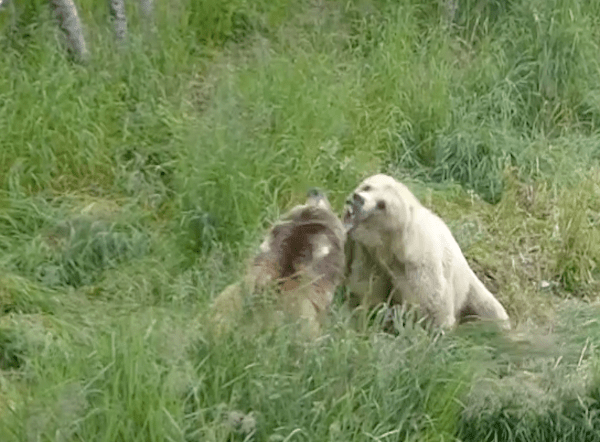
128 charges 409. If you listen carefully, you can hear one or both bears utter a low bellow.

Two bears with open mouths in grass.

Beadnose (left) and Grazer (right) face off as Grazer stops her charge just short of contact.

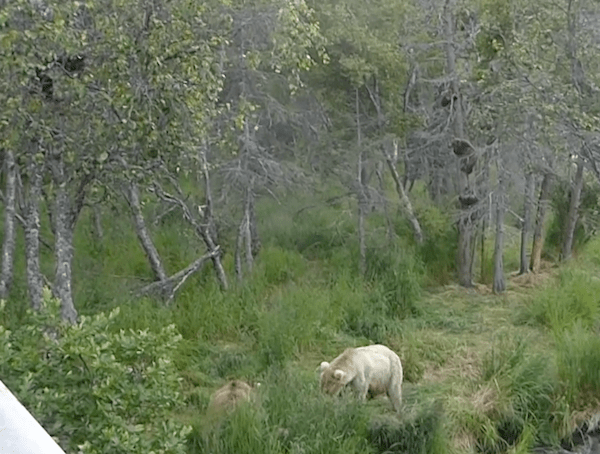
409 stands her ground (unlike an adult male who encountered a charging 128) likely because she’s protecting her cubs too. 409’s cubs climb separate birch trees. Now both sets of cubs are up trees. The mother bears can’t go far in this situation.

Bears in grass with cubs in trees.

Beadnose and Grazer face one another while their cubs remain in nearby trees.

The situation de-escalates quickly, which is not uncommon in encounters between bears. 128 then moves back to the tree holding her cubs. Beadnose slowly approaches the river then turns toward her cubs, almost like nothing happened. Both mothers keep watchful eyes on the other.

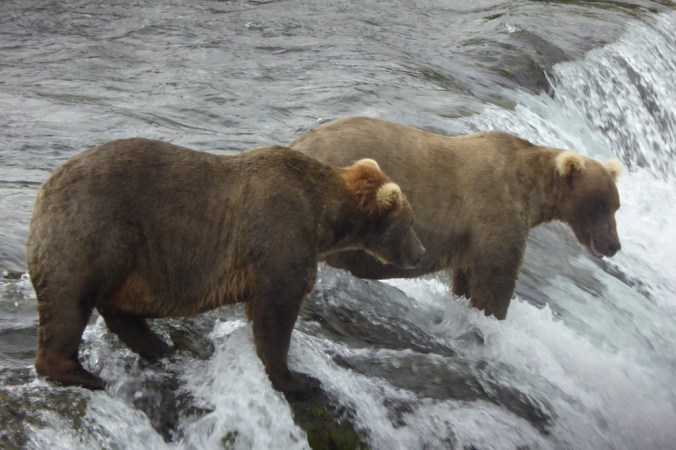
bears standing at the edge of a waterfall

409 Beadnose (left) stands near 128 Grazer on the lip of Brooks Falls in 2015.

Last year, these bears were extremely tolerant of each other. Cubs change the dynamic though. As a new mother, 128 behaved particularly defensive around bears and people in late June and early July. Beadnose’s relatively calm disposition may reflect her greater experience raising cubs (this is her fourth litter) and her high tolerance for certain bears like Grazer. Perhaps Grazer’s aggression is a product of her inexperience. This is her first known litter.

The bears’ experience and disposition factored into the interaction. Each encounter between bears (and bears and people, for that matter) is unique. Defensiveness is one possible reaction when mother bears collide.