Marathon Creatures

Before I began training for a marathon last winter, my running efforts were casual and rarely exceeded six miles. I ran when I felt I needed to maintain a modicum of fitness and when the weather was too poor for the other activities that I typically find more enjoyable such as bicycling or long hikes. I’ve walked more than 20 miles in a day at least twice and ridden a few century rides on a fully loaded touring bicycle, but—as I discovered—running a marathon is not those things.

Reactions of friends and family toward news of my marathon goal were two-pronged. First, I received a quizzical you-might-regret-it look. The conversation then shifted to the inevitable question, “Which marathon?” My own, was my simple reply. The thought of running an organized marathon seemed much too stressful. What if I wasn’t feeling well the day of the race? What if I didn’t sleep well the night before? What if I didn’t want to be around other people? Running on my own time at a place I chose solved those dilemmas.

That’s how I found myself in April 2025 running the Northern Maine Mike Fitz Memorial Fun Run 42K Act-like-a-tough-guy Marathon Classic. By using quiet roads during Maine’s infamous springtime mud season, my marathon became a solo event where I avoided anyone else on foot. It also gave me a lot of time to think.

On training runs I often wondered about other organisms that regularly achieve amazing feats of endurance. Who could I compare my efforts to? After feasting all summer in Alaska, humpback whales migrate to Hawaii or the Pacific coast of Mexico. Bar-tailed godwits fly for eight days without stopping between Alaska and New Zealand. I’m on the other side of the continent, however. A local connection would be more appropriate. Wood frogs endure winter frozen like an ice cube in the leaf litter of my woods. But that’s a slow endurance, maybe even best considered a tolerance for challenging conditions. Black bear hibernation wouldn’t be an apt comparison either, since that process revolves around energy conservation and limited movement. White-tailed deer make local migrations to wintering yards with thinner snowpack like under a dense canopy of conifers, but that is a bit of a browse-as-you-go strategy and may not cover long distances. What about a migrating songbird such as a thrush, warbler, wren, or vireo? They are small-bodied, energetic, warm-blooded, and achieve amazing migrations. There are many I could’ve compared my marathon with. My area of Maine hosts at least 22 species of wood warblers. All of them migrate south for the winter. One warbler makes the journey unlike any other, however.

Dear Blackpoll Warbler,

What do you feel when you leave Maine in October? What forces draw you south to fly non-stop over the Atlantic to the north coast of South America? Are you nervous or anxious to begin? Is it anything like wanderlust or it is more powerful? Do you feel relief when you arrive? Do you feel hunger along the way? If so, does it feel different than normal?
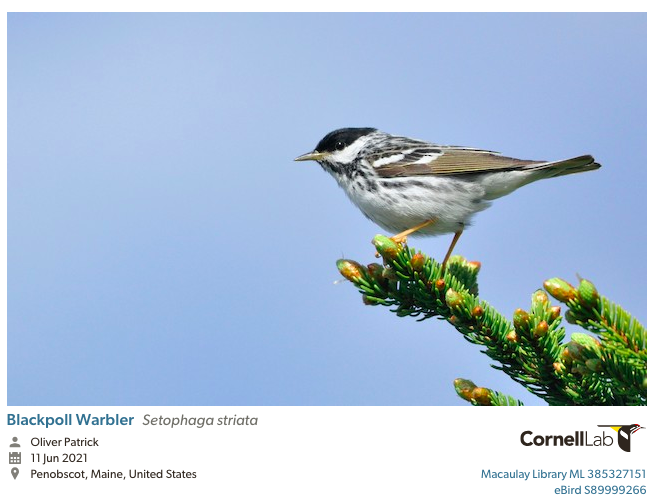
A warbler with a black cap, white cheeks, white wing bars, and a white breast streaked with black feathers stands on a spruce twig. Photo taken by Oliver Patrick. 11 Jun 2021. Penobscot, Maine, United States.


Blackpoll warblers (Setophaga striata) are smaller-than-sparrow-sized, primarily insectivorous birds. Summers are spent nesting in coniferous forests of northern North America from Alaska to Nova Scotia. In my area, I find them among dense stands of spruce and fir trees, especially on mountains like Mount Chase, but they also breed at sea level in conifer-dominated forests along Eastern Maine’s coastline where the ocean temperatures chill summer’s heat.

Blackpolls are part of an explosion of migratory songbirds that breed in Maine every summer, and after a long quiet winter I long to hear the forests filled with their shouts again. Unlike some of the bouncier and louder songs of sparrows, other warblers, and ruby-crowned kinglets, the blackpoll’s song is easy to miss. Its frequency range is among the highest known among birds. Whenever I hear it, I know I’ve entered a boreal place.

A male blackpoll warbler’s song recorded on Mount Chase in Maine on June 19, 2023. M. Fitz’s audio.

Their migration routes vary, although their month-long northward journey in spring typically utilizes many overland stopovers from South America across the Caribbean to Florida and the mainland U.S. The southward migration is when the birds express their greatest endurance. Blackpolls in Maine and Nova Scotia frequently launch due south in early fall on a route that takes them directly over the Atlantic Ocean. They follow prevailing winds out past the island of Bermuda until trade winds bring them back toward the Caribbean shore of South America. The three day trip is one of the longest, non-stop overwater flights yet known among migratory songbirds.
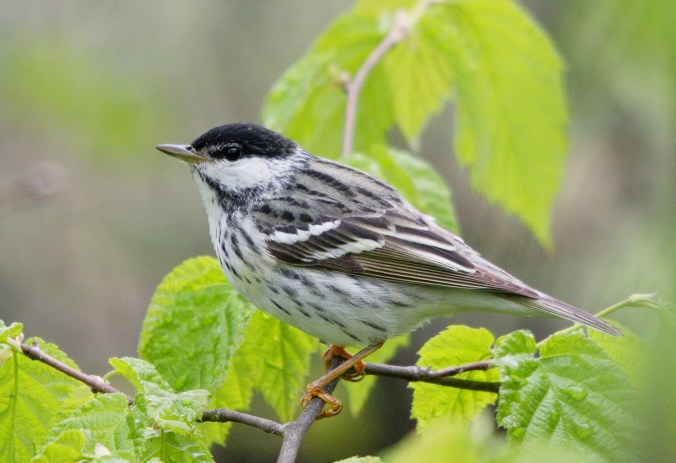
A warbler with a black cap, white cheeks, white wing bars, and a white breast streaked with black feathers stands on a birch twig with bright green leaves.
A male blackpoll warbler perches on a birch twig. Photo by Cephas, CC BY-SA 3.0 https://creativecommons.org/licenses/by-sa/3.0, via Wikimedia Commons.

Humans are well adapted for running. Sweat shunts body heat to the skin where evaporation carries it away to prevent overheating. Our upright posture offers an efficient stride and improves our line of sight, all the while freeing our hands to carry tools and other objects. In contrast, long-distance running is hard for lots of other animals, so their running efforts are usually measured to take advantage of their particular suite of adaptations. The white-tailed deer, moose, and black bears that I share my forest with can easily outpace me in a 100 or 1000 meter dash (among mammals, humans are not great sprinters), but those species also overheat quickly, especially on a warm day, while a person could still be trotting along, sweating, yes, but also clearheaded enough to consider tactics and communicate with other people.

It would’ve been a mistake to attempt my marathon without training, so I started building running endurance about 16 weeks before I ran the full length. Following the recommendations outlined in The Non-Runner’s Marathon Trainer, I ran three times per week. The two shorter runs were of equal length and the long run was about 1/3 longer. Total mileage increased each week. I had to get used to eating and drinking during the longer runs and pay attention to my stride to prevent injury from repetition of movement.

The blackpoll prepares for migration in his own way too. Cues from day length calibrate his internal clock with the season so he knows to leave at the optimal time. Freed from the burden of chick rearing, he has the energy to replace old feathers with new plumage. He aims to double his body mass in the days leading up to departure from the Maine coast. To accomplish such rapid weight gain, he doubles or triples the amount of food he eats. His stomach, liver, and intestines increase in size too. It is a temporary change, however. Blackpolls migrating over the ocean have no opportunity to eat. He sheds unnecessary mass at the same time he sequesters fat by shrinking the size of his gut and liver during last days before migration. In late September or early October when he alights on a spruce crown hugging a rocky headland, overlooking waves crashing beneath, the bird is ready.

I broke my run into five sections, each punctuated by a short break to drink water and eat food. I divided the warbler’s effort similarly in my mind, although he does not stop or ingest any food or water while migrating over the Atlantic Ocean. The five divisions of his migration are merely an arbitrary method to frame the comparison. He weighs anywhere from 20-23 grams upon departing Maine. His species’ over-ocean route averages 3,000 kilometers (1,864 miles). Radar observations of migrating songbirds have found a flight speed of 38 – 43 kilometers per hour. At a 40 kilometer per hour pace, the blackpoll will need 75 hours to arrive in Puerto Rico. If he decides to skip the Caribbean islands, he may fly non-stop for 88 hours. I aimed for a 5-hour, 42-kilometer (26.2-mile) run. It is not the same.

I felt ready for my run when I began on April 5, although I would also make mistakes along the way.

Mike’s Marathon. Section 1: 7.4 miles. Total distance: 7.4 miles.
I follow my short loop route from home plus a mile-long spur to increase the mileage on the first leg. I run a combination of town roads, logging roads, and ATV trails. The trails remain snow covered and a little squirrelly underfoot, but the snow is compacted and shallow enough that it isn’t a burden to run through. I feel fine at the end of the section, like this is just a warmup. Upon reaching home, I’m not very hungry or thirsty. Still, I fuel up with cookies, chocolate milk, and water knowing that I need the energy and liquids in my body later.

Blackpoll migration. Late September. Section 1. Total flight time: 21 hours. Total flight distance: 840 kilometers.
A passing cold front brings northerly winds. The blackpoll cannot be still. He expresses zugunruhe, a German word which means migratory restlessness. He relieves it at nightfall by launching over the Gulf of Maine. Challenges lay ahead, but he’s made for flying. Pneumatic bones offer reduced mass without compromising bone strength. His blood binds to and carries oxygen at higher affinities than mammals so he can better supply oxygen to flight muscles under challenging conditions. Importantly, the blackpoll breathes with an ease that I can’t match. Unlike my dead-end, mammalian lungs where inhaled air mixes with the previous breath, his respiratory system is unidirectional. He uses a system of air sacs to inhale and exhale. None of a bird’s nine air sacs contain blood vessels. They play no part in the exchange of oxygen and carbon dioxide. Birds have no diaphragm either, so the air sacs serve as bellows and air storage areas for the lungs in addition to connecting with hollow bones in their bodies. As the blackpoll inhales, half the incoming air fills one lung while the other half enters a pair of caudal air sacs. This breath also moves previously inhaled, deoxygenated air from the lungs to cranial air sacs. Exhalation pushes air from the lungs and the cranial sacs out through the trachea, while fresh air stored in the caudal air sacs moves behind the departing air into the lungs. The cycle ensures that his lungs always receive fresh, oxygenated air. It is an elegant, efficient system. I wish I had it. Despite his flight time and distance covered thus far, the bird still has 54 hours to go.

Mike’s Marathon continued. Section 2: 3.6 miles. Total distance: 11 miles.
I run to the east end of my road and back. The route undulates and this is no burden at this stage of the run. I remain energetic, although I am in no way pushing my pace beyond a comfortable level. It’d be hard to participate in a conversation as I run, but I’d have the breath to try. I eat and drink more upon returning home.

Blackpoll migration continued. Section 2. Total flight time: 31.5 hours. Total flight distance: 1,260 kilometers.
It is the second full day of his obligatory flight. The effort is directly tied to his survival. He cannot survive the cold temperatures of a North American winter. He could utilize an overland route to escape. Some blackpolls do, especially those in poorer body condition. Stopping frequently can reduce the risk of exhaustion, but it can also slow the pace of migration and increase the bird’s vulnerability to predators. One big leap over the ocean, so to speak, can save overall flight time and reduce the risk of predation. Natural selection has determined this is his best bet.

Mike’s marathon continued. Section 3: 5.4 miles. Total distance: 16.4 miles.
I run west from home to the end of the road and back. The road is straight and hilly. Navigating remains easy. I don’t even need to think about it, having run this way dozens of times previously. I only need to remember how far to go. I feel thirsty at the end of each section, yet I still pee about every hour. The cool weather helps reduce my body’s need for liquids. Between 25˚ and 35˚ F are the perfect temperatures for running, IMO, and that’s the weather provided today. Perhaps I should take better advantage of it. The original goal was a 20-mile training run, which the training book does not call for, after completing an 18-miler last week, yet my legs still feel good at the end of this section. I begin to believe I can finish the marathon if I commit to it. With the favorable weather and my body cooperating so far, I decide to get it over with.

Blackpoll migration continued. Section 3. Total flight time: 46.5 hours. Total flight distance: 1,860 km.
The bird has flown through another night. After dark, he becomes an astronomer by using the apparent rotation of the stars in the sky to determine direction. Has favorable weather eased the journey south or has it become a barrier to progress? Headwinds close to a bird’s flight speed can stall forward movement. Wind from the wrong direction can blow him off course or force him to use extra energy to stay on course. A tailwind, in contrast, would provide the extra push needed to get him over the last dangerous stretches of open sea. Is the blackpoll feeling different compared to when he started? Do his flight muscles ache? He’s been flying for two days, non-stop. A lack of sleep, surprisingly, isn’t an issue. Birds can sleep only one half of their brain at a time. Even when flying, they keep at least one eye open.

Mike’s marathon continued. Section 4: 4.6 miles. Total distance: 21 miles.
I go east again with a short detour off the main road to add an extra mile. I feel worked but not exhausted. The greatest discomfort exists at the bottom of my feet and toenails from the constant pounding of footfalls. I’m losing a toenail from a long run I completed a couple of weeks ago. I do not want to lose any more. I try to adjust my stride on the downhills to compensate. There is no flat section, however. Just false flats at best. I’m tired, but I also still think I can finish another five miles. At the end of this section, I eat and drink again. It won’t be enough as I’ll soon discover.

Blackpoll migration continued. Section 4. Total flight time: 60 hours. Total flight distance: 2,400 km.
The ocean and clouds do not provide reliable landmarks to aid his navigation. He’s not flying blind, though. Unlike me, the blackpoll does not rely on landmarks to follow his migratory route. Cells in his upper bill contain magnetite. Scientists theorize this allows the bird to sense the strength of the magnetic field. His retina includes special light gathering cells, known as a cryptochromes. Light at the blue and turquoise end of the spectrum excites electrons within the cryptochromes, which may allow the bird to actually see direction. It would be a stunning ability to possess. The blackpoll has flown far enough that he might be able to land on a Caribbean island if necessary. He could also choose to keep going to the north coast of South America. Do hunger and energy levels make the decision for him?

Mike’s marathon finale. Section 5: 5.4 miles. Total distance: 26.4 miles. Destination: Home.
The first few miles of the last section are tolerable. I’ve slowed considerably since the start of the run more than four hours ago, but at least my energy hasn’t bottomed out. Until it does. About three miles from home and my finish line, I feel gassed. Runners call it hitting the wall. Cyclists call it bonking or blown-out legs. No matter what, it sucked. I should’ve consumed more fuel at my last pit stop. I could use that energy now and I regret not carrying some snacks with me for the final leg. The bottom of my feet ache. Each trot is an effort. I am a little light-headed. There is a weird tingling sensation from my elbows to my fingertips. But the only choice is to move forward. Stopping would be worse. There’s little chance of hitching a ride if I quit. I see two cars in the last hour of running. I can’t remember if I needed to run all the way to the end of the road but do anyway so I don’t end up short of a full marathon when I get home. In between thoughts of food and water, with no alternative transportation other than my legs and feet, I set mini goals. Get to the next knoll. Get to the base of that hill. Get to that dirt road a few hundred yards ahead. Be glad you’re not at the start of the race. The last half of the marathon was harder than the first. The last five miles was harder than the previous five miles. The last three miles was harder still. The last mile was hardest of all. Cresting the last rise in the road, I can see the house. Near exhaustion becomes relief.

Blackpoll migration finale. Section 5. Total flight time: 75 hours. Total distance: 3,000 km. Destination: Puerto Rico.
My energy tanked when I failed to eat during the last five miles of my marathon. The blackpoll hasn’t eaten any food or drank any water since leaving Maine three days ago. Fat has been his primary fuel. The warbler used special enzymes to better mobilize stored body fat, specialized transporter proteins to carry fat through the bloodstream, and additional special enzymes to get fats into muscle cells and deliver it to the cells’ mitochondria. Burning fat also produces metabolic water, just enough hydration to keep him going. The blackpoll’s abdomen bulged with fat upon departure three days ago when he weighed about 20 grams. He now weighs about 13 grams. The effort cost him one-third of his body mass. He’s nearly emaciated as he reaches Puerto Rico. He’ll stay here for a few days to refuel before continuing to South America. He needed all his physiological and metabolic tricks to make the journey successfully. Does he also feel an avian equivalent of relief when sighting his final destination?

Running a marathon and then comparing it to the blackpoll’s migration has been humbling. I’m glad I finished the marathon, although I’m still not sure why I did it. Maybe I ran it just for the challenge, which I suppose is as good of a reason as any. The blackpoll, in contrast, migrates because instinct compels him. Nevertheless, my marathon was in no way equivalent to the blackpoll’s fall migration. I didn’t gain any immediate reproductive or survival benefits. The blackpoll did. I didn’t have to worry about drowning in the ocean if I stopped. The blackpoll did. I didn’t have to evade predators waiting to take advantage of my exhaustion upon arrival. The blackpoll did. I didn’t move non-stop for three days. The blackpoll did. I didn’t have to forage for wild foods when I finished. The blackpoll did. I don’t have to repeat the journey next year. The blackpoll does, all the while achieving feats of endurance no human can replicate.

References:

  • DeLuca, W. V, et al. (2015) Transoceanic migration by a 12 g songbird. Biology Letters. 11(4): 20141045. https://doi.org/10.1098/rsbl.2014.1045.
  • DeLuca, W., et al. (2020) Blackpoll Warbler (Setophaga striata), version 1.0. In Birds of the World (A. F. Poole, Editor). Cornell Lab of Ornithology, Ithaca, NY, USA. https://doi.org/10.2173/bow.bkpwar.01.
  • Lovette, I. J. and J. W. Fitzpatrick, eds. (2016) Cornell Lab of Ornithology Handbook of Bird Biology. Third Edition. Princeton University Press.
A Sisterly Brown Bear Bond

One thing I find fascinating about bears is the complexity of their behaviors. Bears are intelligent and mentally flexible. They understand who can be friendly and who is not. They recognize each other as individuals and, despite their asocial reputation, bears can also be quite social when the right mood and circumstances strike.

In 2022, I, along with millions of bearcam viewers, watched two sister bears, each with their own cub, form their own version of a bonded, extended family.

Although this was not unprecedented among brown bears, the bonding between bears 909, 910, and their cubs was something that I had never seen before. I was fascinated by the story—so much so that I wrote a paper for the peer-review journal Ursus. Please head over to explore.org’s blog to read more and check out the paper in Ursus.

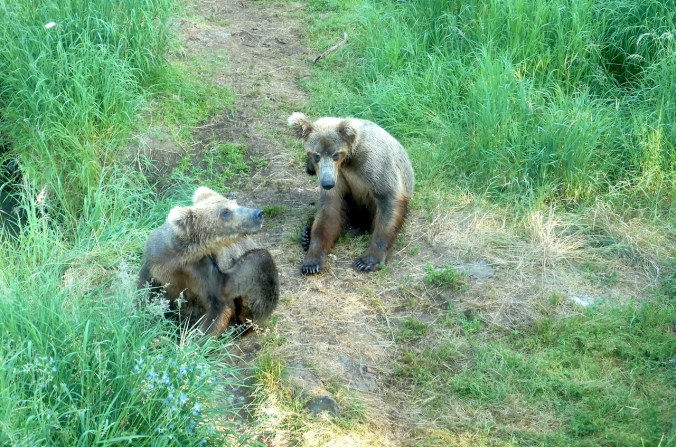
Two young, independent bears sit in grass near a river. The photo is taken from in front and above them.
Bears 909 and 910 sit next to Brooks River in 2019, which was their second year of independence.

PS: Readers of my blog likely know that U.S. public land agencies and the civil servants within them are facing threats like I’ve never seen. Unjust firings of rangers and other National Park Service employees are gutting the NPS’s ability to protect and manage parks and extraordinary budget cuts may lead to the shuttering of park areas. The NPS may lose an additional 5,500 employees under the presidential administration’s proposed 2026 budget. Some members of Congress are also contemplating the sale of public lands.

Please contact your members of Congress and demand they oppose actions that are intended to harm public lands and public land agencies. Explore.org has set up some suggestions if you want to get started.

One of the difficulties that the NPS, among many federal agencies, is facing is the presidential administration’s freezing of funding that Congress has already appropriated. This is on top of the loss of thousands of employees already this year due to (often coerced) resignations and unjust firings. None of those actions were approved by Congress. Congressman Jared Golden, who represents my congressional district, has recently introduced the Protect our Parks Act of 2025 which would require the Secretary of the Interior to use funds that were already appropriated to complete NPS projects and fully staff national parks and reinstate employees that were unjustifiably fired. It is good legislation. A stop gap, for sure, but worth urging your member of Congress to vote for.
The Immorality of Extinction

North America was once home to the world’s most abundant wild bird. Although passenger pigeons could be found anywhere east of the Rocky Mountains, they concentrated their abundance between the Atlantic Ocean and the Mississippi River, especially from the Great Lakes to the Mid Atlantic and east to Massachusetts. No one knows how many passenger pigeons roamed North America a mere two hundred years ago, but credible estimates suggest three to five billion—a population size that may have exceeded that of any population for any other bird species on Earth. Flocks of pigeons could be so numerous and so dense as to block the light of the sun “as by an eclipse” as John James Audubon experienced in 1813.

Passenger pigeons were also intensely social. Their roosts were communal. So many birds could alight on a tree that branches and sometimes whole trees broke under their collective weight. Their guano collected on the ground like snow. Successful reproduction hinged on a critical mass of birds finding suitable food. They were omnivores, yet fruits and seeds formed the bulk of their diet even when nesting. Masting species such as beech and oaks were preferred. A year with a good acorn crop could sustain breeding flocks that included tens of millions of individuals.

When men arrived with firearms, the pigeon’s sociability and flocking behavior proved to be their Achilles heel. Passenger pigeons lived a nomadic lifestyle—moving between areas with enough food to support their prodigious numbers—but when they settled in an area to breed, people flocked to them like the birds flocked to acorns. Hunters shot into flying flocks and as they roosted in trees, often killing and maiming dozens at a time. Nets and traps were designed to capture hundreds of birds at once. Nestlings, known as squabs, were knocked out of their nests with poles before they could fly or the trees with squabs were cut down or burned. Barrels of dead birds were shipped away and sold in city markets. They were often captured and used for target practice and shooting competitions. “Clay” pigeons in modern shooting sports are replacements for shooting live pigeons, including passenger pigeons.

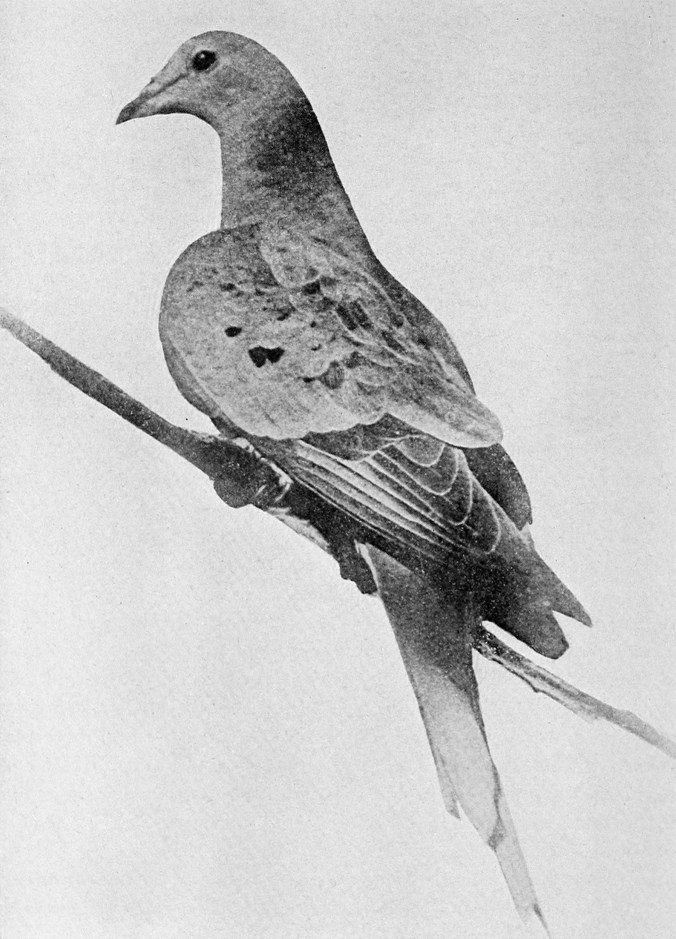
The human toll was so intense that passenger pigeons went from the planet’s most numerous bird to extinct within one human lifetime.1 We’ll never experience them again. Martha, the last remaining passenger pigeon, died on September 1, 1914 at the Cincinnati Zoo.

Black and white photo of a pigeon sitting on a branch. The bird is looking to the left and is facing away from the camera so we mostly see its back, left wing, and tail.
Martha, that last surviving passenger pigeon, photographed in 1912. Few photographic subjects are as sad as a photo of the last surviving member of its species.

Uncontrolled, unregulated hunting was the ultimate cause of the passenger pigeon’s extinction, although their demise coincided with intense deforestation across the majority of their range. By the late 1800s, all but shreds of forest were removed from the pigeon’s range. They faced unrelenting human pressure on two fronts: direct killing and habitat loss. I wonder if passenger pigeons could have survived the slaughter if enough undisturbed forest remained for them to find refuge and raise their young until market hunting was outlawed in the U.S. and the Migratory Bird Treaty Act of 1918 provided formal protection.

All this makes a proposed regulatory change to the Endangered Species Act2 (ESA) all the more asinine. Segments of our society and culture have yet to understand the necessity of habitat in preventing extinction or realize the immorality of extinction.

Since its passage, the ESA has been the most powerful and impactful regulatory tool in preventing extinction in the United States. The ESA is not perfect, but it has helped prevent the extinction of more than 99 precent of threatened and endangered species under the act’s protection. It works well largely because the ESA includes habitat loss alongside hurting/killing of threatened or endangered individual organisms in its definition of “harm.” If, for example, an endangered plant lives in a wetland then you couldn’t excavate a ditch to drain the wetland. That would prevent the plant from surviving and reproducing. Draining the wetland alters the plant’s habitat negatively when the plant needs the wetland’s hydrology intact to survive. Current federal ESA regulations would consider such a scenario as “take” because draining the wetland would caused clear harm to the endangered plants. The ESA would prohibit altering the wetland even if no person went into the wetland to kill or damage the plants.

For wildlife and plants, habitat is equivalent to home. Protecting habitat is a logical and necessary step to prevent extinction. Often, it is the first step.

Yet the federal government proposes to redefine “harm” as it relates to the ESA so that habitat loss and destruction are not sources of harm for threatened or endangered species. The summary for the rule change states, “The existing regulatory definition of ‘harm,’ which includes habitat modification, runs contrary to the best meaning of the statutory term ‘take.’” In other words, harm to an organism’s home is not equivalent to harm to individuals. (The background and summary info then attempt to justify this point by arguing the ESA was never really meant to protect habitat, and “harm” should be limited to killing, capturing, or injuring. It cites Supreme Court cases and dissents about what “take” means. I’m not a lawyer or legal scholar so I won’t attempt to weigh an opinion on whether the cases are applicable to the ESA but, frankly, if there is any ambiguity then Congress should amend the ESA so that habitat destruction is “take” and “harm.” That’s an unrealistic dream in today’s political climate, I know.)

Limiting the ESA’s definition of harm to only killing and hurting individual organisms is a vastly unscientific and illogical decision. The consequences of the proposed change could be catastrophic for endangered species. It would allow the federal government to ignore the importance of habitat when evaluating development and other activities on threatened and endangered species. Building a dam that blocks endangered salmon from migrating would not be “harm” because the dam didn’t outright kill salmon returning to spawn; they just couldn’t spawn. Cutting down a condor’s nesting tree wouldn’t be “harm” as long the condors weren’t injured when the tree fell. Draining an endemic salamander’s stream wouldn’t be “harm” because you didn’t kill or capture any salamanders; they simply lost their home and food. Building an oil rig in a polar bear maternal denning area wouldn’t be “harm” if the mother polar bears aren’t in the dens; it wouldn’t matter if they couldn’t find denning habitat elsewhere. Building a parking lot on a sage grouse lek wouldn’t be “harm” because the grouse didn’t die during construction; they simply couldn’t court and reproduce. Polluting a river so that sea grass beds die wouldn’t be “harm;” it didn’t directly poison any manatees to death, just led to their slow starvation.

Perhaps with adequate habitat protections in place, passenger pigeons could still be part of our shared landscape. We’ll never know.

Since Martha’s death, extinction rates have accelerated due to human pressure. Market hunting may be a thing of the past in the United States at least, but habitat loss is not. A 2022 study found that habitat destruction was the main threat of extinction for 71 percent of endangered species worldwide. (Overexploitation, which is another way of stating human hunting/harvest was the main factor for 7.4 percent of endangered species.) The International Union for Conservation of Nature (IUCN) lists 28 percent of all assessed species as threatened with extinction. Humans and our livestock and pets outweigh wild vertebrates globally. Vertebrate animals populations have declined more than 70 percent worldwide since the 1970s. In North America alone, bird populations are reduced 3 billion compared to the 1970s—a stat that doesn’t include the loss of passenger pigeons. Most fish populations are overexploited and many are near collapse. We’re poised to mine the deep sea even though we have seen almost none of the life that exists there. All this has happened within my lifetime, and while people in our government argue with a straight face that habitat considerations should not be included in ESA’s regulations. The ultimate legacy of my generation and my parents’ generation may be to leave behind an ecologically impoverished planet. It is a moral failing.

I recently read Apocalypse Never, a book that, through a great deal of cherry-picked data, contends (unsuccessfully IMO) that climate change and biodiversity loss aren’t big deals. At the end of the book, the author Michael Shellenberger writes, “Scientists have long named self-interest as the reason for why humans should care about endangered species like the mountain gorilla. But if the mountain gorillas were ever to go extinct, humankind would become spiritually, not materially, poorer.”

In our short time on Earth, segments of humanity have been insulated from the material costs of extinction, largely because the nature supporting different groups of people wasn’t directly tied to the survival of any one species. When the last mammoth died, were people in Australia or Africa affected? When Steller’s sea cow vanished, did the farmer watching pigeons in Pennsylvania notice? When the last passenger pigeon died, did people in Japan or Bangladesh or Sweden mourn?

Yet extinction is an impoverishing event. We don’t know, and can’t know, how we’d value passenger pigeons today. We know that we are materially poorer because we’ve been denied the opportunity to integrate passenger pigeons into a possible sustainable economy—which, yes, could include hunting. Culturally and spiritually, we’ll never experience the joy and awe that some people must have felt as they watched pigeons blot out the sun like an eclipse. We don’t know what else they might have offered. We cannot truly understand or evaluate the possible effects that billions of pigeons had on temperate forests in eastern North America. We were denied the opportunity to know. Likewise, the extinction of mountain gorillas would affect communities in parts of Central Africa. What’s the value—materially, culturally, spiritually—of a gorilla? It is not our place to decide. It is our place to give future generations the opportunity to discover.

When sitting in a comfortable chair surrounded by material wealth it is easy to shrug your shoulders when a species winks out of existence, but allowing extinction is an immoral act. We should know better. Leopold in Sand County Almanac and Kimmerer in The Serviceberry have envisioned better futures. I’m not sure that we are wise enough to heed their advice.

It is immoral to deny future generations the wealth—however you define it—that non-human organisms provide. Moreover, humanity doesn’t own Earth or the organisms we share the planet with. Governments and corporations don’t either. Our non-human neighbors belong to themselves and the future. Morality compels that we don’t arbitrate whether a species is worthy of existence.3 We can continue to be complicit in extinction by allowing governments and corporations to sacrifice species for material wealth or we can build a sustainable future.

Nature is life. Earth is the Ark. We can be its caretakers or simply its takers.

  1. I recommend A Feathered River Across the Sky by Joel Greenberg you want to learn more about passenger pigeons. ↩︎
  2. The public comment period for the proposed regulatory change closed on May 19, before I published this post. ↩︎
  3. This isn’t an absolute. We can defend ourselves from organisms that cause us harm such as the Guinea worm or the protozoan that causes malaria. It is ethical to remedy the suffering certain organisms cause us. These are decisions to make on a case-by-case basis. ↩︎

A Dammed Opportunity

In Maine, Atlantic salmon are highly endangered. Prior to European colonization and, later, industrialization of the landscape’s rivers, hundreds of thousands of salmon returned to spawn in Maine every spring. Now, however, a so-called good year includes the return of 1,500 fish to the Penobscot River, which is Maine’s most productive salmon river, and maybe 2,000 fish total statewide. Maine is also the only state with runs of wild Atlantic salmon.

Kennebec River used to be one of Maine’s great salmon rivers, but its Atlantic salmon are nearly extinct. The recent 10-year average (from 2014-2023) of annual returning adult salmon at the Lockwood fish lift in Waterville, Maine is a mere 51 fish. Salmon fare so poorly in the Kennebec because they encounter four impassible dams between Waterville and Skowhegan. Even so, there’s an opportunity to save the Kennebec’s salmon run if we act now. 

The Federal Energy Regulatory Commission (FERC) is considering relicensing operations on four hydropower dams on the Kennebec River. For decades, these dams have lacked any effective fish passage for salmon and have prevented salmon from reaching upstream spawning areas. If the dams are kept in place, even with improved fish passage efforts, we can expect the dams to continue to harm salmon and heighten their risk of extinction. 

Unfortunately, FERC’s draft environmental impact statement (DEIS) for the dams calls for relicensing the facilities at the expense of salmon. At the end of this post, you’ll find the comments that I submitted to FERC about its DEIS. I found reason for extraordinary concern in FERC’s conclusions.

We know that dam removal works to restore fish runs. One of the first and best examples was on the Kennebec in Augusta. The 1999 removal of the Edwards Dam led to a great resurgence of shad, sturgeon, striped bass, river herring, and alewives to the lower Kennebec. Elsewhere in Maine, many people and organizations have worked diligently over the last few decades to restore Atlantic salmon with the largest success occurring on the Penobscot River. (This short podcast explores current efforts to restore sea-run fish in the Penobscot.) On the West Coast, the removal of dams on Washington State’s Elwah River allowed salmon to return in numbers not seen there in 100 years. In California right now, efforts are underway to remove large dams on the Klamath River to open hundreds of miles of river to Chinook and other salmon. In Washington and Idaho there is a growing chorus of support to remove impassible dams on the Snake River for the benefit of salmon and the species (including people) who depend on them.

The upper Kennebec River, though, remains imperiled because four dams block passage of sea-run fish. The few salmon that attempt to return to the upper Kennebec must be captured and transported by truck around the dams to reach any spawning habitat. 

In its DEIS, FERC proposes to relicense the dams of the Shawmet Project on the Kennebec. This seems to be another example of conservation minimalism, which was defined in a 2023 paper as “Any minimal standard [that] inevitably excludes some worthwhile conservation targets—values, obligations, and principles that ought to be upheld, or specific ecosystems and species that ought to be protected—by factoring them out as irrelevant to the specified minimum.” That is, humans taking everything but the bare minimum. We allow a species to persist only in greatly restricted ranges or low overall numbers or both. Regarding salmon, the cost-benefit analysis of dams are too often viewed through a lens that obscures the ecological and cultural benefits of fully restored salmon runs. That viewpoint does not allow for the restoration and maintenance of salmon at their fully realized ecologic potential. 

Too often, “balancing” the wants of people and needs of wildlife, including fish such as salmon, has meant a cumulative degradation and loss of wildlife habitat. Therefore, the so-called balance is not a compromise with wildlife but harm forced on wildlife and their habitats. These decisions eat away at our natural heritage, piece by piece, leaving each successive human generation with a more impoverished environment than the last. FERC is on the cusp of repeating that mistake on the Kennebec unless the FERC requires stronger, more effective fish passage structures for the Shawmut Project beyond what is already proposed in the DEIS or the dams are removed. These dams are not worth more than salmon. Extinction cannot be an option.

Please comment on the DEIS (docket 2322) if you can (which is not a simple process so see these instructions). But I realize this is a last minute request since the comment period closes today (June 4), and most people don’t have time to wade into a 400-page environmental impact statement. So if you can’t comment this time, then I ask you to keep salmon and other sea-run fish in mind when you make your daily decisions. Vote for people who support wild, sustainable populations of fish and will work to improve protections for salmon, which includes tackling climate change ASAP. Don’t eat farmed salmon, as farmed salmon are one of the greatest threats to the viability of Atlantic salmon in North America, especially in Maritime Canada. Finally, please share the amazing journeys of salmon with people you know. The more people who appreciate the remarkable lives of salmon the better.

Thanks for reading and for your support of wild salmon. Below are my comments on the Shawmut Hydroelectric Project. (FERC restricts comments to 6000 characters, which is quite limiting considering that the documents about relicensing dams often run for hundreds of pages. Nevertheless, I tried my best with the character limit.)

I’m writing to urge FERC to recommend the decommissioning of the Shawmut Hydroelectric Project No. 2322 (Shawmut Project) on the Kennebec river. The fish passage measures outlined in the draft environmental impact statement (DEIS) are inadequate and will likely prevent the restoration of self-sustaining runs of sea-run fish, especially Atlantic salmon. FERC should recommend the Shawmut Project’s dams be removed on the Kennebec River. 

We lack the necessary skill and knowledge to engineer fish passage that allows all migratory fish species to overcome the challenges created by dams. On the Kennebec River, it is particularly difficult to provide adequate fish passage around dams because the river is home to at least ten diadromous species that migrate at different times of day, different times of the year, and under different hydrologic conditions. 

Of utmost concern is the Kennebec’s run of Atlantic salmon, a distinct population that is highly endangered. Their recovery is doubtful as long as dams exist on the Kennebec. The DEIS contains no substantive evidence that adding additional fish passage to the four dams on the lower Kennebec will favor Atlantic salmon and enhance their recovery to a point where the population is no longer endangered. 

I’m greatly concerned that Brookfield’s proposed fish passage measures will not provide salmon with the opportunity to migrate rapidly upstream or downstream. For example, page xx of the draft EIS states, 

“Brookfield also intends to achieve an adult salmon upstream passage effectiveness standard of 96% within 48 hours of a fish approaching each project, in order to achieve a cumulative upstream effectiveness standard of 84.9% through all four projects within 192 hours.” 

“Resident time” is double speak for substantial, harmful migration delays imposed on salmon. A 192-hour delay is an 8-day delay for a salmon to travel about 18 river miles between the lowermost and uppermost dam of the Shawmut Project. Since Atlantic salmon are reliant on stored body fat and protein to fuel upstream migration, this will cost adult salmon vital energy reserves as they attempt to find a way past the dams with negative consequences on their reproductive survival. 

Dams make river water warmer and slow its flow. Under future climate conditions, the Kennebec may become warmer during salmon migration periods. Warmer water holds less dissolved oxygen and increases the metabolism of salmon. Therefore, the effects of an 8-day delay will decrease salmon survival and reproduction upstream, regardless of the modeled 84.9% effectiveness. 
Pages 55-57 of the DEIS explore the risks of such a delay on salmon, yet somehow the significant, cumulative, and negative consequences of delays due to the dams are deemed acceptable by FERC. Pg 57 of the DEIS states, “Brookfield’s proposal to test the fishway effectiveness and implement additional adaptive management measures … is a reasonable approach.”

However, FERC’s conclusions on page 57 are not consistent with the science cited in the DEIS. For example, page 56 of the DEIS includes the remarkable statistic that under a four dam scenario on the Kennebec 37.4% of the run would die before spawning. As the Kennebec Atlantic salmon population is close to extinction–the recent 10-year average (from 2014-2023) of annual adults returns at the Lockwood fish lift is a mere 51 fish (DEIS page 44)–then a nearly 40% mortality due to dam-caused migration delays is completely unacceptable. 

Additionally, on page 52 of the DEIS notes that Brookfield “would modify or construct additional fishways only if needed after its proposed fishways are complete and have been tested for effectiveness.” This position also risks further harm to salmon. If new fish passage structures are ineffective, then the Kennebec’s salmon may already be faring worse than now. The most parsimonious and beneficial strategy for Atlantic salmon would be to require, beyond doubt, reasonable and effective fish passage as part of the relicensing process or decommission the dams. Based on the best scientific evidence, FERC’s position is neither reasonable or scientifically justifiable.

Additionally, the reasons why certain species of fish do not take to artificial fish passageways is sometimes unknown. Rivers are complex systems and artificial fish passageways only grossly approximate the conditions the fish would experience in the absence of dams. 

A free-flowing Kennebec River and naturally self sustaining runs of diadromous fish are worth more—economically, ecologically, and culturally—than anything the Shawmut Hydroelectric Project can provide.

Maine’s rivers likely never supported tens of millions of salmon, but they could and should support hundreds of thousands of salmon and tens of millions of sea-run fish collectively. Instead, status quo industrialization threatens to keep our watersheds impoverished. It is difficult to imagine the richness of a river full of salmon in Maine because that phenomenon hasn’t been experienced here in many generations. We suffer from a multi-generational amnesia that has us collectively accepting the near or complete absence of salmon and other sea-run in our rivers when their absence is not at all normal. The DEIS somehow tries, and fails, to justify that the current status quo is okay when it is not.

The electricity generated by the dams can be replaced easily by wind and solar installations. Energy conservation measures across the state could also be implemented to mitigate the loss of the hydropower. As long as these dams exist, the Kennebec’s Atlantic salmon are likely to remain endangered or, at best, exist only as a remnant population, while people and the ecosystem will never experience the full benefits of healthy runs of Atlantic salmon and other diadromous fish. Do not relicense the dams. It is the wrong decision and guarantees, with near certainty, that Atlantic salmon will remain endangered for the foreseeable future.

Fisher and Other Trails

Compared to summer, winter can seem like a dull companion, especially in my corner of the globe. The buzzing of insects ceased months ago. The forest floor rests under one to three feet of snow. Trees, shrubs, invertebrates, amphibians, and fungi lie dormant. Ice insulates wetlands that were vibrating with life not long ago. Migrating birds vanished months ago. Then, there’s the dangers posed by cold weather. Numbed toes and fingers aren’t pleasant, nor are the perpetual threats of frostbite and hypothermia. All-in-all, I could convince myself that winter is a season to be endured rather than embraced. This would be a mistake, though. 

While I miss the sheer volume of aliveness that accompanies summertime, winter has many endearing qualities. It helps me appreciate the abundance of summer. Off-trail travel is often easier when wetlands are frozen and snow smooths the terrain. And few experiences are as peaceful as the immense quiet that accompanies a snowstorm in an isolated grove of trees.

But this post isn’t about falling snow. Rather, it’s about a story written in the snow. Instead of looking at the wintertime forest as lonesome and empty, snow allows me to better understand how the landscape is a fully inhabited place. 

Last Monday, I highlighted the travels of a fisher during More to Explore, a bi-weekly highlight show on explore.org cohosted by Brian Byrd and me.

In the interest of brevity for the show, I skipped some details of the fisher’s trail. Tracking is an art that I’m still learning and I argue that I’m a slow study, but a few clues revealed I was looking at a fisher’s trail rather than a fox, coyote, marten, or lynx, all of whom inhabit the area.

  • Claw marks registered in most of the prints that I examined carefully, effectively ruling out felines since their claws are retractable and don’t register reliably in tracks.
  • The clearest tracks had five toes—an important clue that rules out the canines such as foxes and coyotes. Porcupines, bears, skunks, hares, and rodents can make five-toed tracks too, but they have other features that make them distinctive.*
  • The tracks’ size were too large for other members of the weasel family who live here such as short- and long-tailed weasels, mink, and marten. I could rule out river otters too since there was no evidence that the animal slid across the snow (something otters routinely do) or sought liquid water. The trackway crossed a beaver-created swamp but the tracks did not lead to water as an otter would have.
  • The animal’s gait was a mostly loping in a 3 x 4 pattern, which is a common way for fishers to travel. The 3 x 4 lope is a method of travel where a fisher places a front and rear foot from one side of the body in the same place, while the feet on the other side do not overlap. This gives the impression of only three tracks instead of four. Fishers walk, lope in a 2 x 2 pattern, and gallop too, but in my experience they’ll use a 3 x 4 pattern much more often in firm snow than American martens.
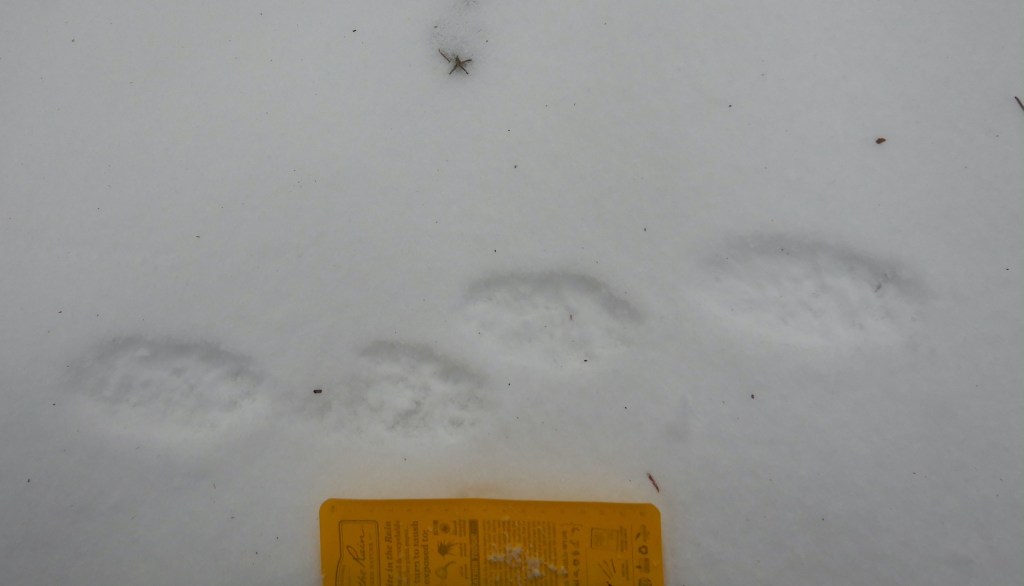
A set of fisher tracks in the snow. Four tracks are visible. The fisher moved from left to right. The yellow notebook at bottom center is ~17 cm wide.
A clear set of fisher prints. Her five toes are perhaps easiest to see in the second track from left. Also note that the fisher created four prints here so she slightly deviated from her typical 3 x 4 lope.

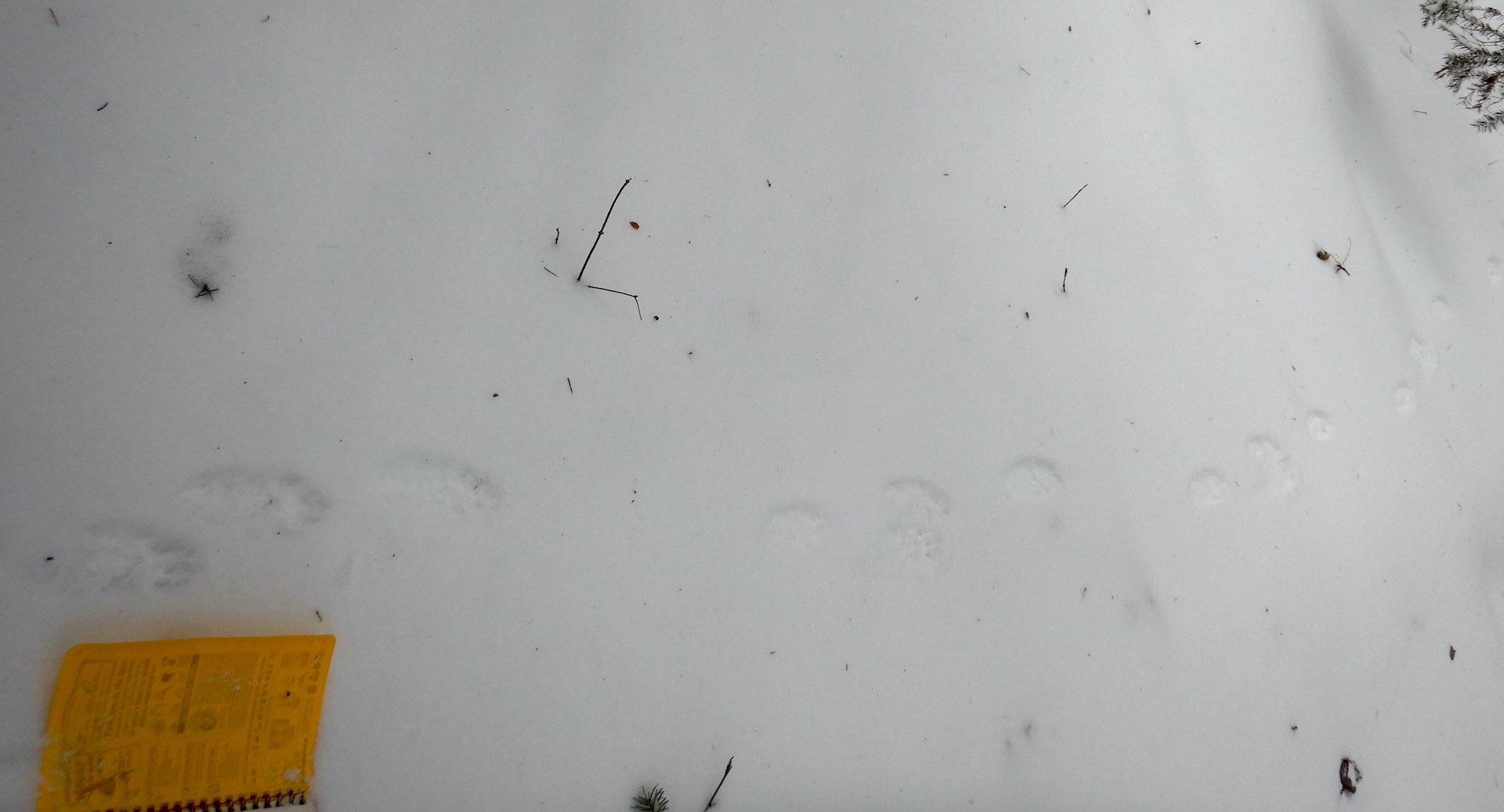
A fisher trackway in snow. The yellow notebook at bottom left is ~17 cm wide. The fisher moves mostly in a 3 x 4 lope. It was headed from left to right in the photo. The tracks are shallow, maybe only a centimeter deep.
A trackway from the fisher. She was moving with a 3 x 4 lope across firm snow. My notebook is about 17 cm wide for scale.

Several other mammals were active that day as well. Snowshoe hares, red fox, red squirrels, mice, and voles all left tracks or scat to reveal their presence. I was only lucky enough to be chastised by a couple of squirrels and didn’t see any other mammals for the majority of the day but walking slowly and quietly gives one the opportunity to be surprised. In a moment of quiet contemplation, the kind you experience while gazing through trees pondering your next move, a glimmer of movement appeared in the corner of my eye. I turned my head to find a weasel bounding through the snow. I didn’t dare reach for my camera knowing I’d spook it into hiding, although I remember clearly my confusion upon seeing it. 

A long-tailed weasel changes its fur color from summer brown to winter white and back again with the seasons. In winter, they are nearly pure white except for the tip of their tail, which is black—a feature that seems to misdirect attacking predators away from the head. This weasel, however, appeared to have a dark tail and head. 

My brain needed to register a few more bounds by the weasel to clear the confusion. it wasn’t oddly colored. The weasel was carrying a vole or mouse in his mouth. As he disappeared in a thicket, I was offered a special opportunity to examine its prints for clues about that may help me better understand how small weasels move in snow when they are burdened by the weight of their prey. 

Long-tailed weasels and the smaller short-tailed weasel (ermine) travel most often in snow by using a 2 x 2 lope. When you see them traveling in this way, it looks almost like a long hop, with the front feet hitting the ground first. The front feet quickly lift into the air while the hind feet land in the same place. The weasel I watched used this method and he seemed to carry his rodent cargo with ease—an impressive display of relative strength. His prey, though, left an important clue. Each of the weasel’s bounds were accompanied by a slash in the snow, which must have been created by part of the dead rodent (a foot? a tail?) dragging in the snow with each leap of the weasel.

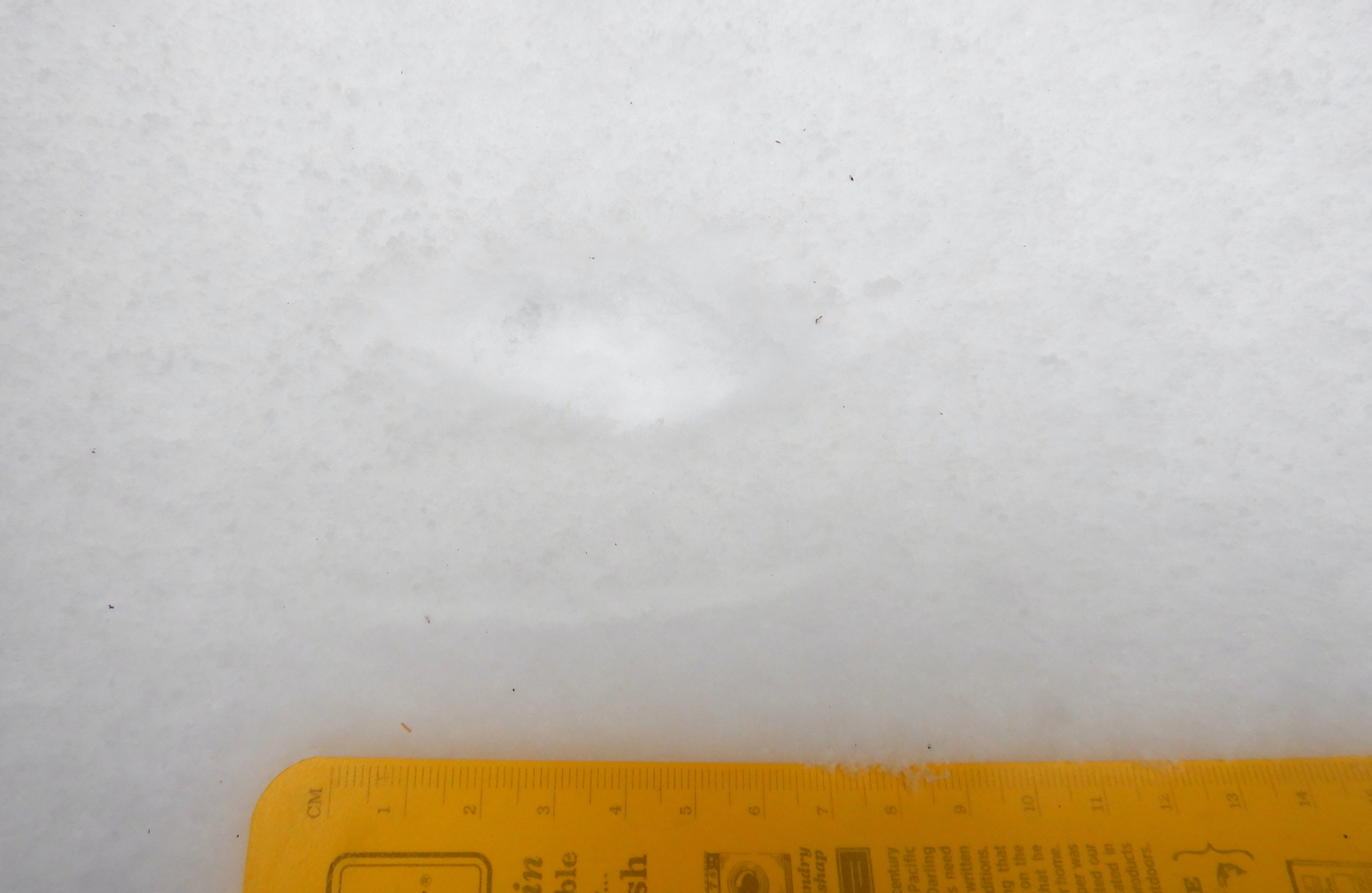
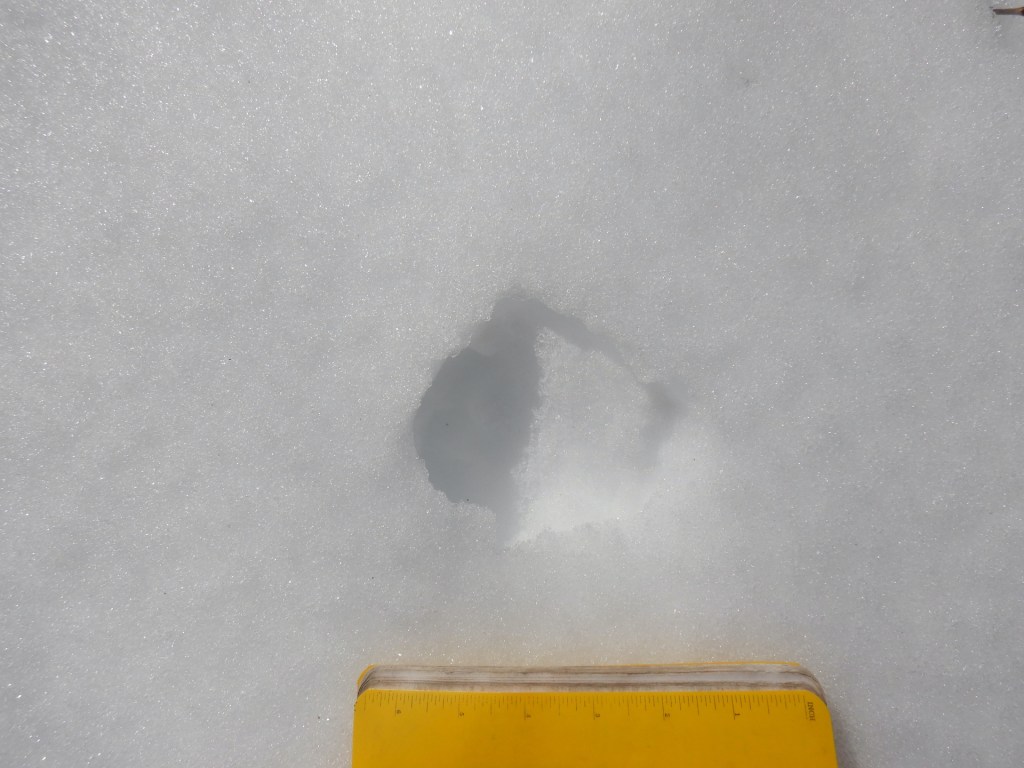
A single set of long-tailed weasel tracks. They make a single depression in snow in the center of the photo. A light slash is visible beneath the weasel prints. The width of the yellow notebook at bottom is about 15 cm.
A long-tailed weasel’s prints are underscored by a slash in the snow created by the rodent prey it carried.

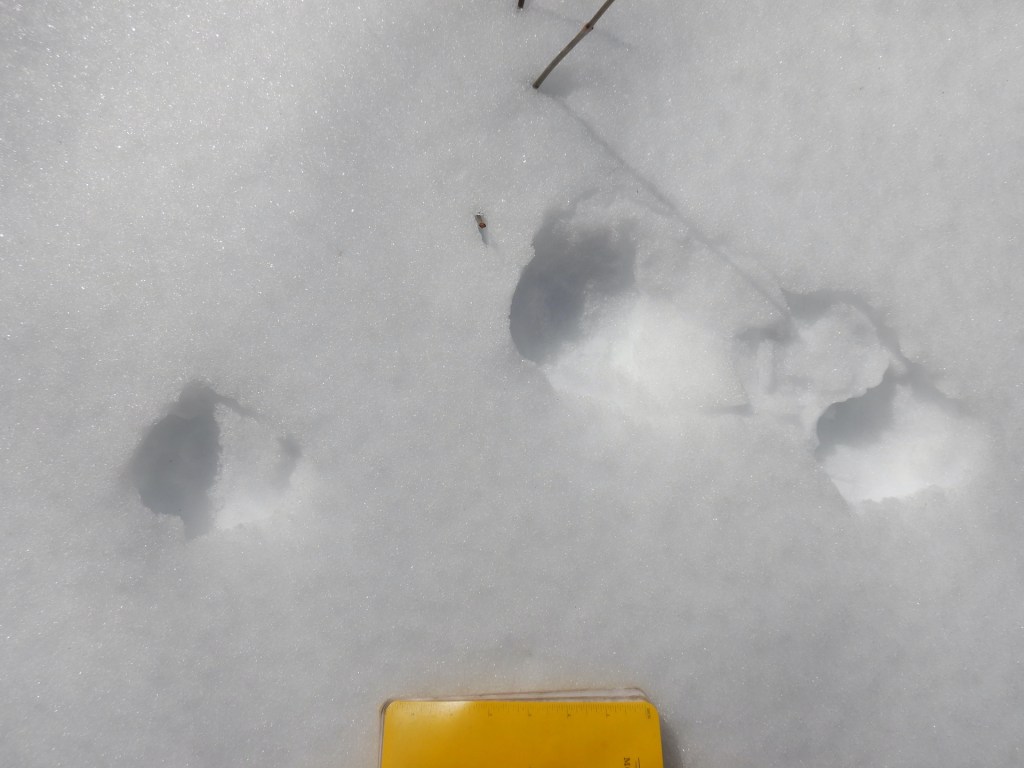
Two sets of long-tailed weasel tracks. Each set makes a single depression in snow. A light slash is visible beneath the weasel prints. The width of the yellow notebook at bottom is about 17 cm.
Two sets of prints from a long-tailed weasel. Note the repeating slash next to each track. The weasel traveled from right to left.

As I discussed in the video segment above, the life of a fisher would be far more mysterious without the record it leaves in snow. I would have no real clue how much fishers leave scent marks or climb trees without reading their trackways. Likewise, if I’d not been in the right place at the right time or been looking in a different direction I would have missed the weasel and its meal completely. Had I stumbled upon its trail with the strange, repeating mark next to each print I’m not sure I’d reason it was from the weasel’s prey. But now, I’ll be looking for other examples like it.

I hope you have the opportunity to utilize snow to learn more about your neighbors. When the snow pack melts in spring, I welcome the change although I must admit that forest seems a bit lonelier when I don’t know who has been visiting. 

*Mammal Tracks and Sign: A Guide to North American Species by Mark Elbroch is an invaluable resource if you want to learn more.

Thirteen Mountain Months

Truly knowing a place might be a capacity only of the omniscient or for earthly beings, perhaps, something gained through multi-generational experience. Lacking omniscience, living in an area far from where I was raised, and having lived in my home only for a few years, I’m forced to make do as best I can. I’ll never know a place in its totality, but I’ve come to realize that I can get closer if I experience it in every season, which is how I found myself trekking to the top of Mount Chase, Maine during every month of the year. 

December 11, 2022 
The first trip in the journey and the most treacherous. Snow has yet to establish itself for the winter and ice covers many sections of trail. The summit is frosty. The hike down is much slower than the hike up.

A trail ascends through a thick forest. The trees are generally less than 6 inches in diameter and grow closely together. The trail is covered in ice like a steep stream that has frozen. About 30-40 feet of the trail is visible before it disappears at center.
Ice covers the Mount Chase Trail on Dec. 11, 2022.

View of forested landscape. Lightly frosted spruce and fir fill the foreground. A lake is visible at center in the lower elevation forest. A ridge of mountains forms the horizon at left center.
Looking west from the Mount Chase summit toward Upper Shin Pond, Sugarloaf Mountain, and Traveler Mountain.

January 8, 2023
With snow now covering the ice, the trip is far easier than last month and the snow is not yet thick enough that I have to ski to the trailhead. My trusty fat tire bike, Large Marge, gets me there. At the summit, visibility is exceptional and perhaps only limited on this day by the curvature of the Earth. On the way down, I hear a raspy-sounding chickadee. A boreal? Yes. I see it fluttering from branch to branch in the spruce-fir forest maybe 200 – 300 feet in elevation below the summit.

View from a mountain of a forested landscape. A ridge of large mountains form the horizon, although they appear small in the photo. Snow covered trees form the foreground just above windswept rock. Frozen ponds and forest sit in between the
The view to the west-southwest from the Mount Chase summit on Jan. 8, 2023. The mountains of Baxter State Park including Katahdin form the horizon.

A boreal chickadee perches in a frost covered dead spruce tree. The bird is at left center. It has a brown cap with is diagnostic of boreal chickadees.
A boreal chickadee perches in a dead spruce.

February 12
Peak winter. Minus 60˚ F wind chills during the week prior and low air temps approaching -30˚ F at home. I know arctic peoples cope with those temperatures routinely, but I’m too poorly prepared to survive those conditions. Thankfully, this day is warmer, so much so that snow fleas are active on the snow surface. I ski as far as I can up the trail. Eventually, I abandon my skis and walk the rest of the way when the trail steepness beyond my comfort level. The trail is also too narrow to ski down safely and I don’t own the the right style of skis or the skills to do that anyway. On the way up, though, I miss their floatation. The snow pack on the upper mountain must be at least 36 inches. I post-hole to my waist on two occasions.

View of mountain from a low elevation. The mountain is covered in trees that transition from deciduous to coniferous from low to high. The foreground is snow covered.
The destination: Mount Chase on Feb. 12, 2023.

View from a mountain of a forested landscape. Only a sliver of the lowlands are visible. Snow and trees fill the fore and middle ground. The trees are snow covered, especially on their left side.
The view looking south from the Mount Chase summit on Feb. 12, 2023.

March 11
The snow seems deeper than February, but maybe this will be the last deep snow trip of the year? Along an alternative route I like to take to the main trail, I find a set of lynx prints in the snow. Farther up the mountain I ditch my skis again at a point above the abandoned fire warden’s cabin where the slope gets too steep. A few snowmobiles have made the trip, though, and I continue with relative ease in their trackways.

A single lynx track. Photo is taken from directly above it. The notebook at bottom is about 7 inches long.
A single lynx track. The feline was traveling from right to left.
The 3x4 gait of a lynx in snow. Photo is taken from directly above tracks looking down. The tracks are several inches in width and length.
Although these lynx tracks aren’t well defined, the size and shape are distinctive. I find one set of these tracks per winter on average. Lynx are rare in Maine and have large territories.
Portrait view of forest. Spruce and fir trees fill the scene with spruce growing the tallest. A narrow trail is visible at bottom center.
The coniferous forest on the upper slopes of Mount Chase.

April 22
A difficult trip to the top and back (the hardest of them all, in hindsight). Mud season has fully enveloped the region. The dirt roads that approach the trailhead are slop. Large Marge gets me to the trailhead but not without extra effort from my legs. The trail remains almost wholly snow-covered above the abandoned fire warden’s cabin and the remaining snow is soft. Still, I’m thankful winter’s dormancy is broken. Near the trailhead, I hear wood frogs looking for love in a nearby a vernal pool. The calls of juncos, robins, and sapsuckers—birds that do not overwinter here—fill the deciduous forest nearby.

Two trails intersect at lower right. Both have water flowing on them. A sign at left points to the center of the photo. The sign is mounted on a post has a homemade look. It says "trail." An arrow points to the right toward the trail. Both "trail" and the arrow are outlined in permanent marker.
The official Mount Chase trailhead.

A derelict cabin in a forest. Wet, late season snow covered the bare area in front of the cabin. A mixed forest surround the cabin. The windows and door of the cabin is missing and the brick red lead paint is peeling from the outside.
The abandoned fire warden’s cabin on Mount Chase.
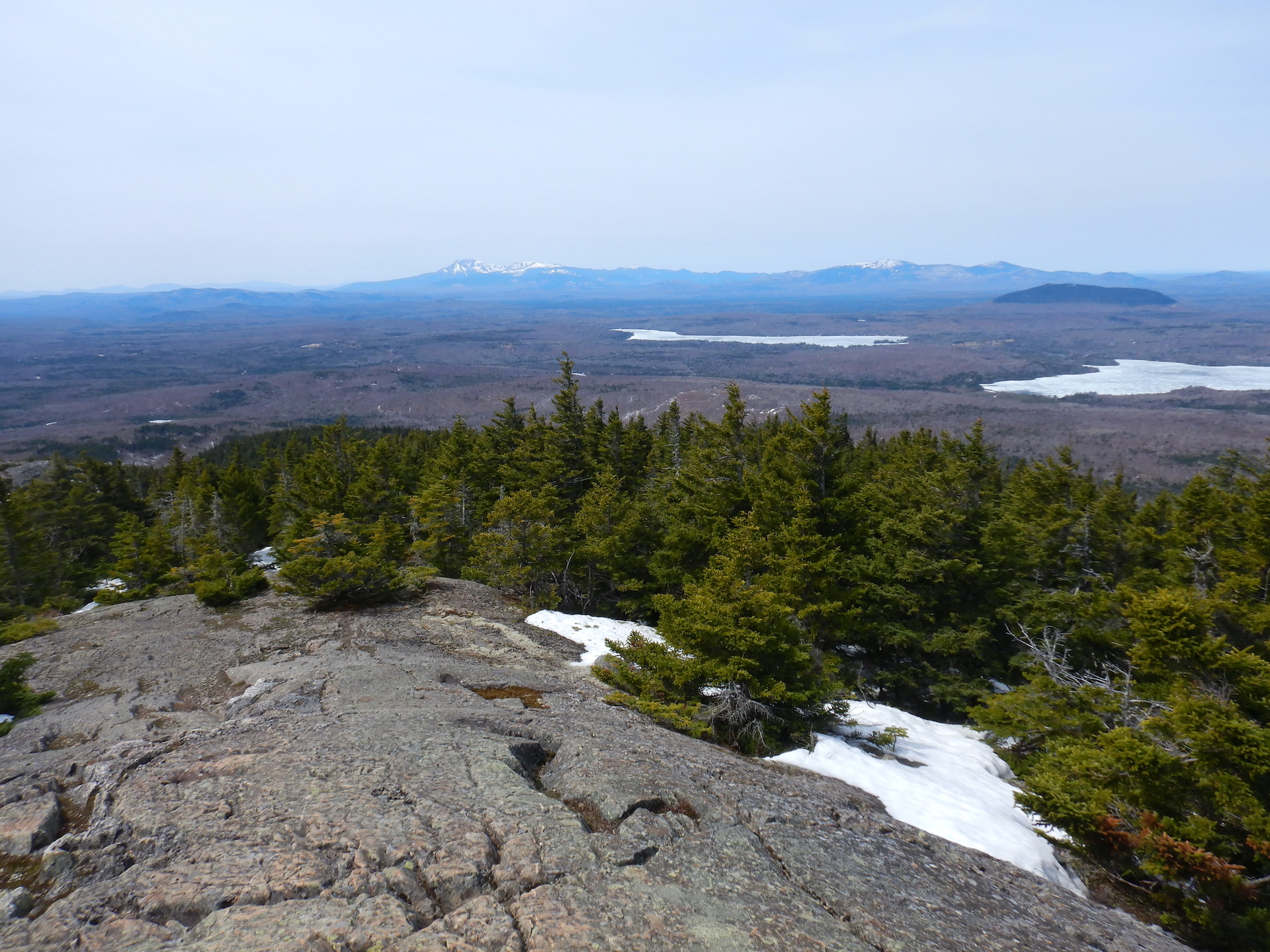
View from a mountain of a forested landscape. A ridge of large snow capped mountains form the horizon, although they appear small in the photo. Snow covered trees form the foreground just above windswept rock. Frozen ponds and forest fill the middle ground.
Looking west-southwest toward Katahdin and Baxter State Park from the Mount Chase summit on April 22, 2023.

May 17
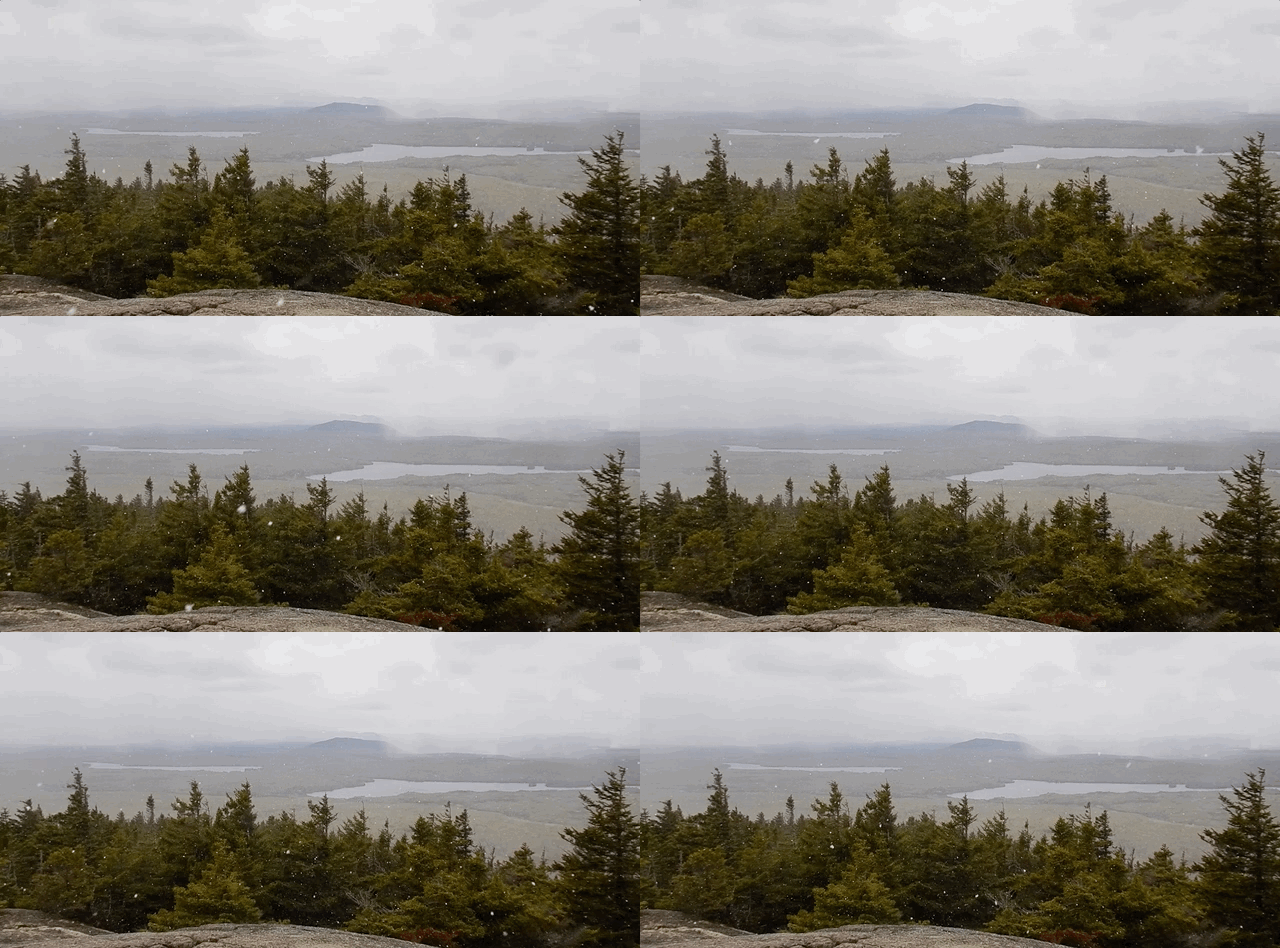
I thought I’d be done with snow on the mountain by now. I was wrong. It falls on the way up and on the summit. Some small patches linger in the shadiest areas among the spruce and fir. Bud break might be advancing fast at lower elevations, but the plant phenology seems at least a week delayed on the mountain’s mid elevations and maybe two weeks behind in the summit area.

GIF of landscape view from a mountain top. Stunted spruce and fir fill the foreground. Forested lowlands fill the middle ground to the cloud obscured horizon. Snow flakes fall in the air.

Close up photo of flower in deciduous forest. The flower petals face the camera. The three petals are maroon.
Trillium erectum on the lower slopes of Mount Chase.

June 19 
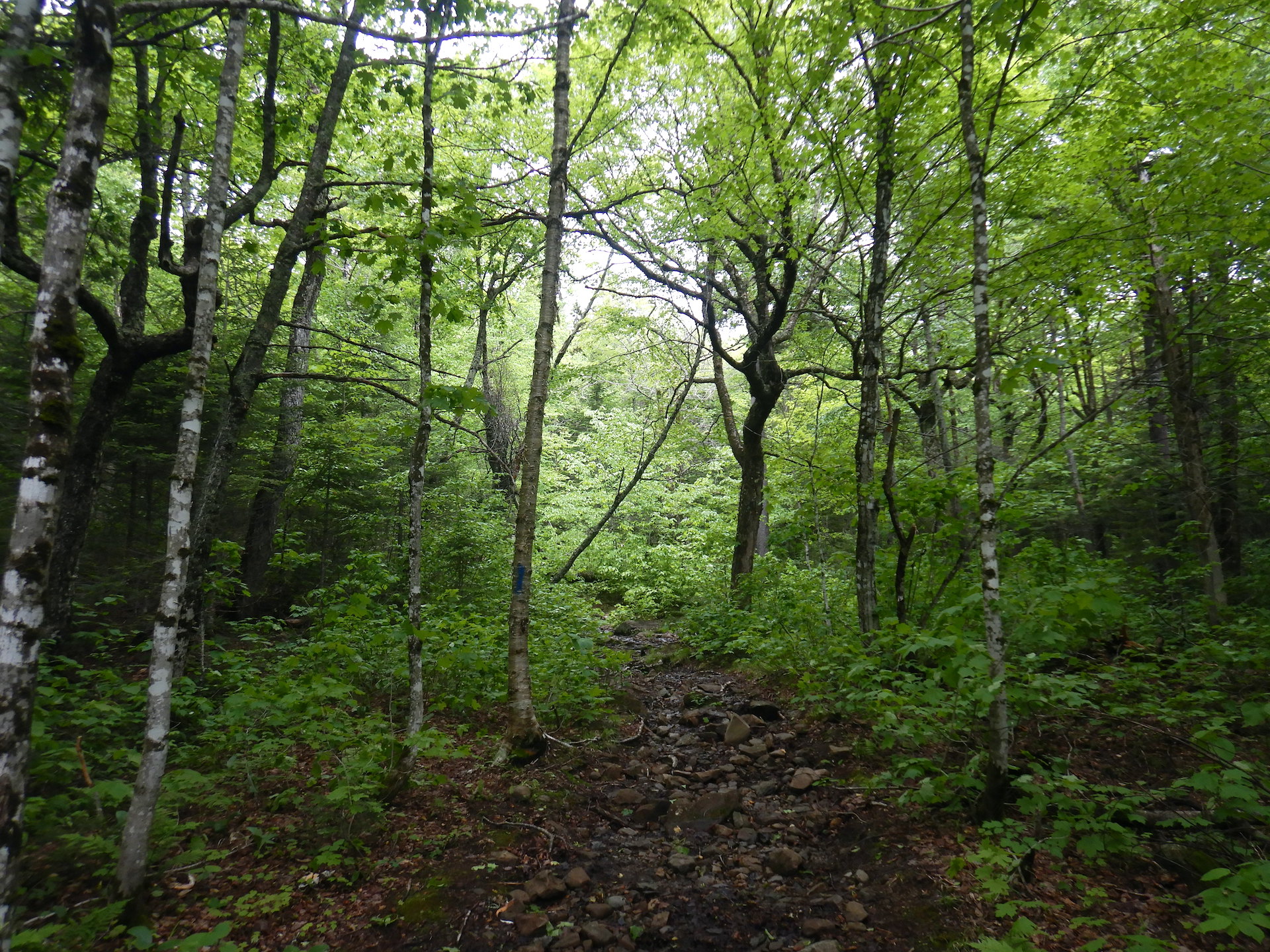
A busy day on the trail with a whopping three cars at the trailhead! Large Marge, as usual, doesn’t have any other bicycles to keep her company. The forest has come to life. I note more than 20 plant species blooming. Biting insects are surprisingly few in contrast to home where the abundance of mosquitoes and black flies force me to don long sleeves, long pants, and a headnet almost anytime I intend to spend more than a few minutes outside. In the spruce-fir forest, I enjoy listening to the songs of blackpoll warbler. Sadly, they are categorized as a threatened species in the state.

A rocky trail disappears into a green forest. Trees with bright green leaves obscure the sky. The understory is also thick with green plants.
Late spring on the Mount Chase Trail.

This is the song of a blackpoll warbler recorded in the spruce-fir forest of Mount Chase. The song is a rapid series of high-pitched notes near the beginning of the track. The audio also captures part of the songs of Swainson’s thrush and winter wren.

July 21
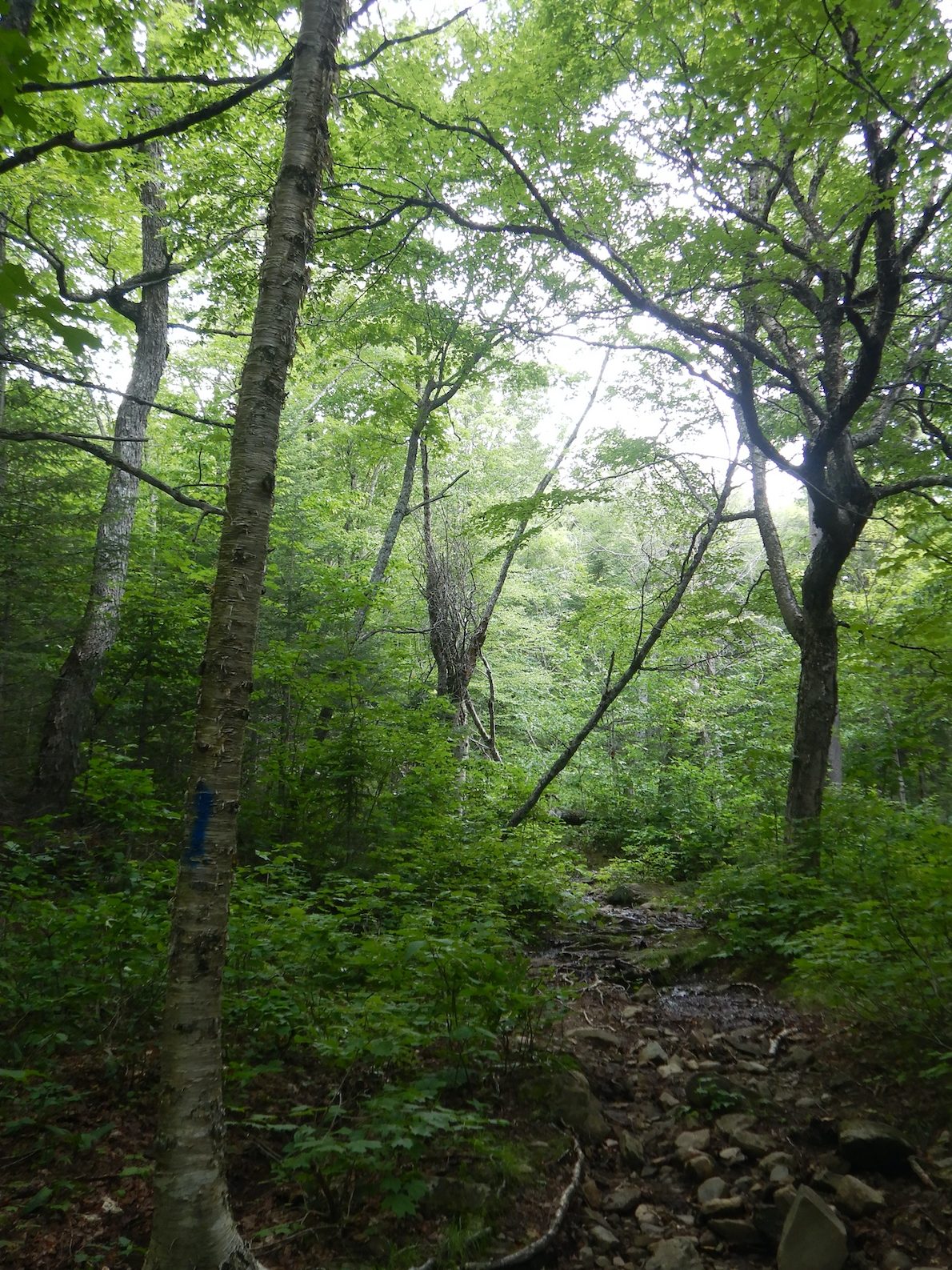
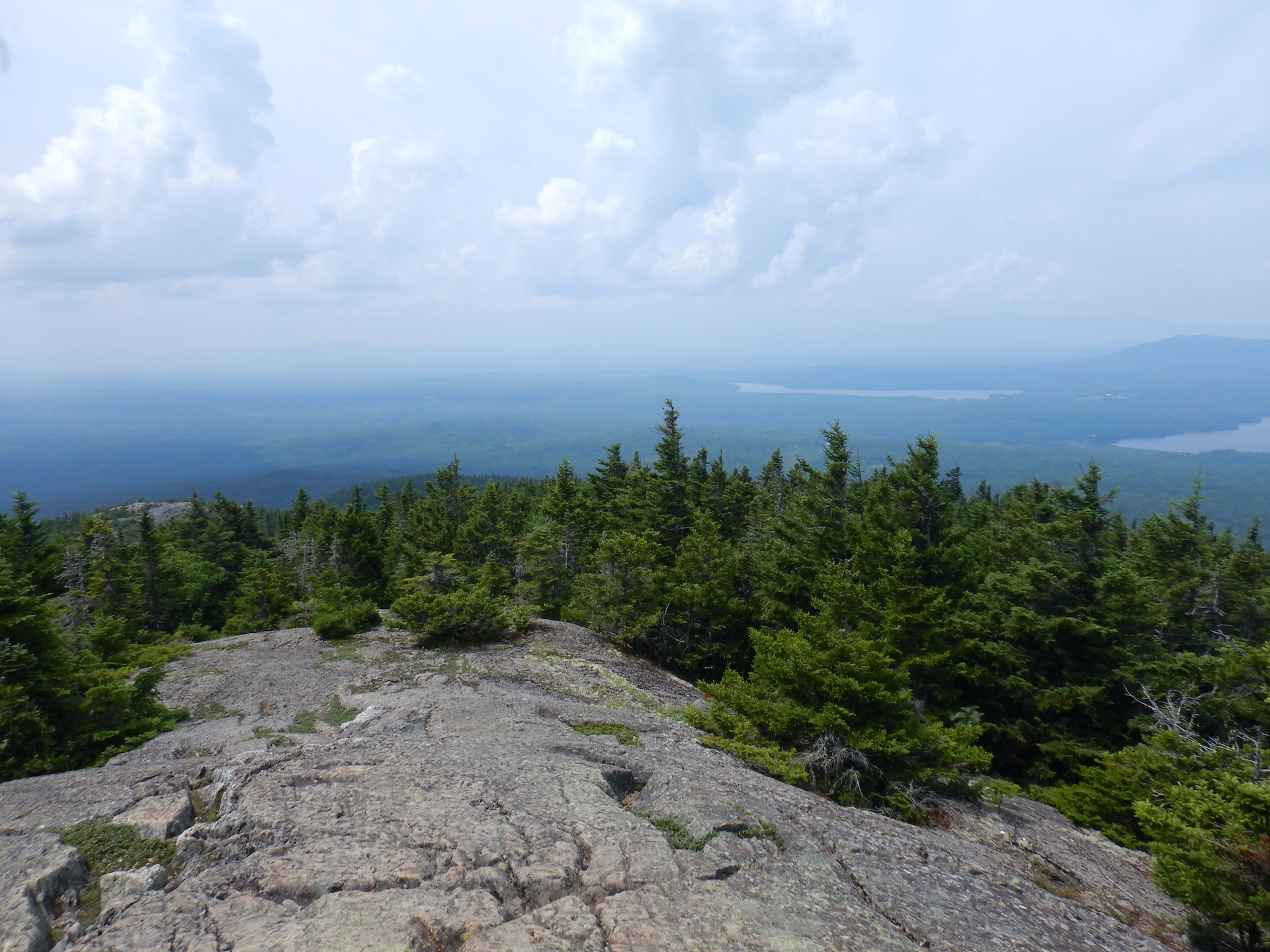
The air feels and looks heavy due to high humidity and hazy, smoke-filled skies. This isn’t the first day of the summer with these conditions, and the past two summers had days like this too. Is the presence of smoke becoming the new normal for summertime Maine? I concentrate on observing the trees, which are in “peak green,” a phase in summer when the foliage has reached its max yet still retains some of the freshness of spring. Fledgling birds are the latest addition to the animal community. Golden-crowned kinglets and red-eyed vireos feed noisy babies. On the summit, hundreds of dragonflies zip between the stunted trees.

Portrait view of rocky trail through a green forest. The trail starts at lower right and disappears at center.Trees with bright green leaves obscure the sky. The understory is also thick with green plants.
Peak green on Mount Chase trail. July 21, 2023.

View of forested landscape from mountain summit. Bare rock covers the ground at bottom while spruce and fir trees slope off the mountain. The lowlands and horizon are obscured by haze in the air.
Looking west-southwest through smoky haze toward Katahdin and Baxter State Park from the Mount Chase summit on July 21, 2023.

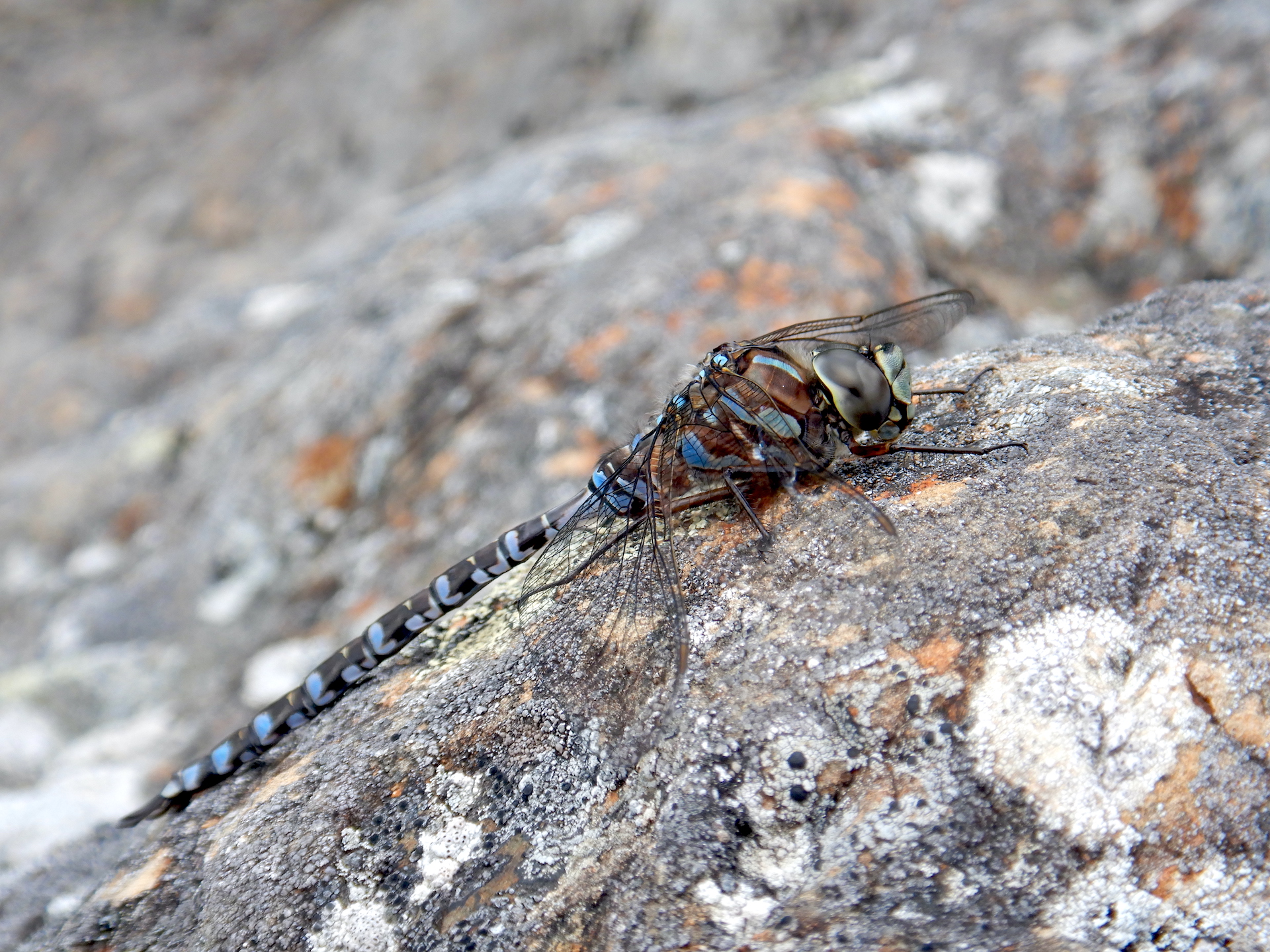
Close up view of a dragonfly. The insect rests on rock speckled with small crusty lichens. It has a blue-spotted abdomen and holds its wings flat parallel with the rock.
A darner dragonfly of genus Aeshna rests on at the summit of Mount Chase. If you know what species it is, please identify it on iNaturalist.

August 20 
A quiet hike now that songbird nesting season is done. Only white-crowned sparrows sing in the summit area. The summer foliage has reached “tired green.” The work of photosynthesis as well as insect attacks have rendered the previously vibrant leaves a darker, less vibrant hue. I experienced a stressful week. Yet, I’m fortunate to have an escape for some brief solace.

View of forest that is a mix of young and old spruce and fir trees. Dead standing trees are among them. A large trunk is at left.
A section of old growth forest on upper Mount Chase.

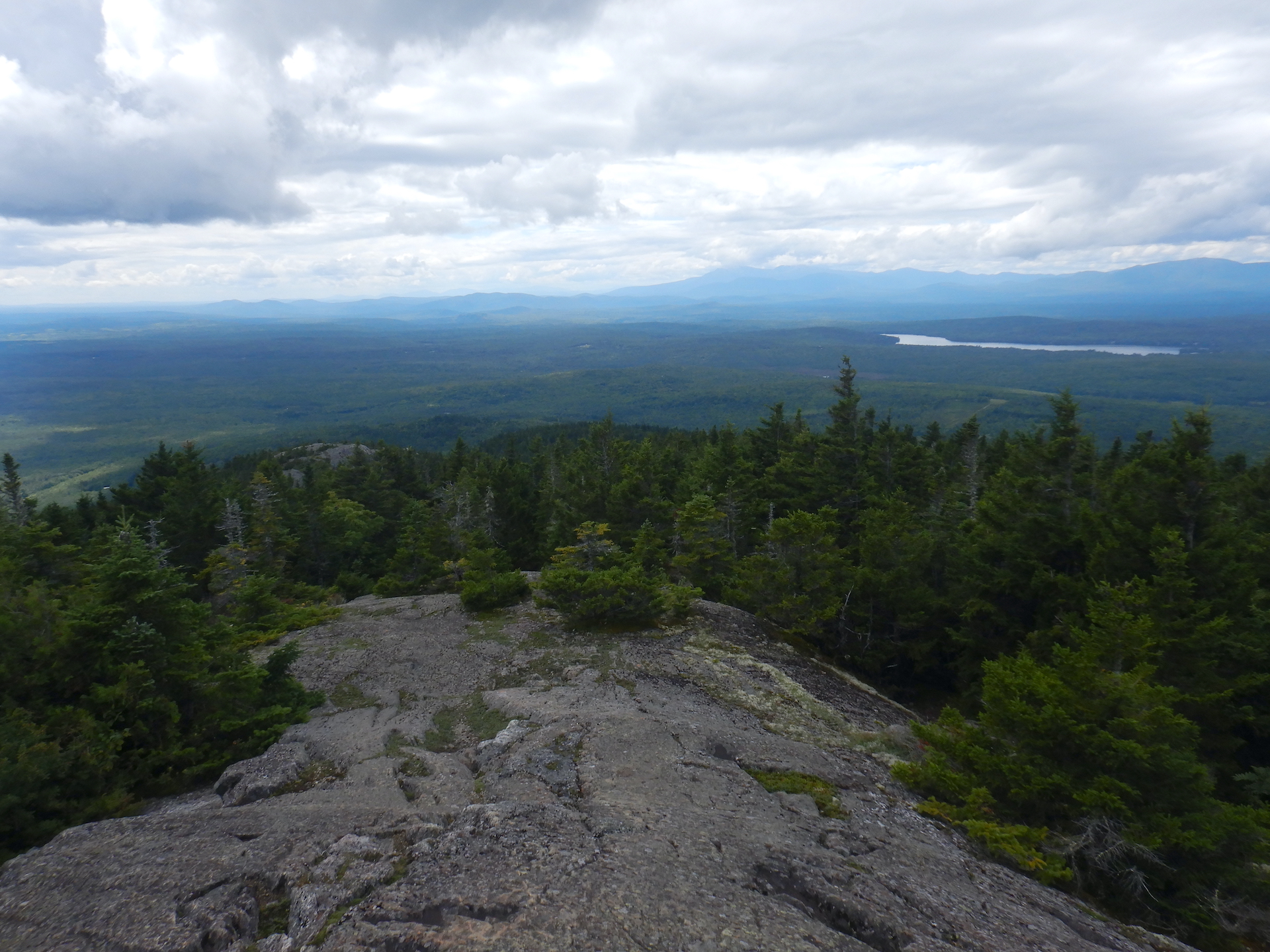
View of forested landscape from mountain summit. Bare rock covers the ground at bottom while spruce and fir trees cover the near slopes. The skies are mostly cloudy. Forest fills the lowlands. A pond and mountains can be seen near the horizon at center left.
Looking west-southwest toward Katahdin and Baxter State Park from the Mount Chase summit on August 20, 2023.

September 24 
I discover (for myself) the remnants of a long abandoned cabin maybe 20 yards off the trail. It’s collapsed to its foundation. Still, I’m surprised by its presence. I walked by it many times previously without seeing it. The forest tends to make things disappear. Hazy conditions have returned to the area. A thick band of wildfire smoke clouds the north horizon and the mountains of Baxter State Park are mostly obscured. A few red-tailed hawks ride the thermals on the mountainside on their migration south. A raven family doesn’t tolerate their presence. They move to chase one of the soaring hawks. We’re approaching peak fall colors, although the colors are quite muted compared to normal.

A collapsed cabin rests in the forest. Vegetation has yet to grow over the structure but the wood at the base in the foreground is rotted and moss covered. The rest of the structure forms a pyramid shape.
The forest and weather will soon consume this collapsed cabin.

The Mount Chase Trail on Sept. 24, 2023.

View of forested landscape from mountain summit. Bare rock covers the ground at bottom while spruce and fir trees cover the slopes. A pond is visible at center left. Haze obscures the horizon. The low elevation forest is speckled with yellow foliage.
Looking west-northwest from the Mount Chase summit on Sept. 24, 2023.

October 18
The forest trends brown. A solid layer of newly fallen leaves cloaks the forest floor. I somehow sleepwalk most of the way to the summit, a habit I’ve been trying to break for years with greater mindfulness. I find myself stopping to focus on my breath and immediate surroundings. Something distracted me, probably precipitated by a media culture that profits from distraction and rage-inducing social networks. It is possible to walk through a forest and not see it at all.
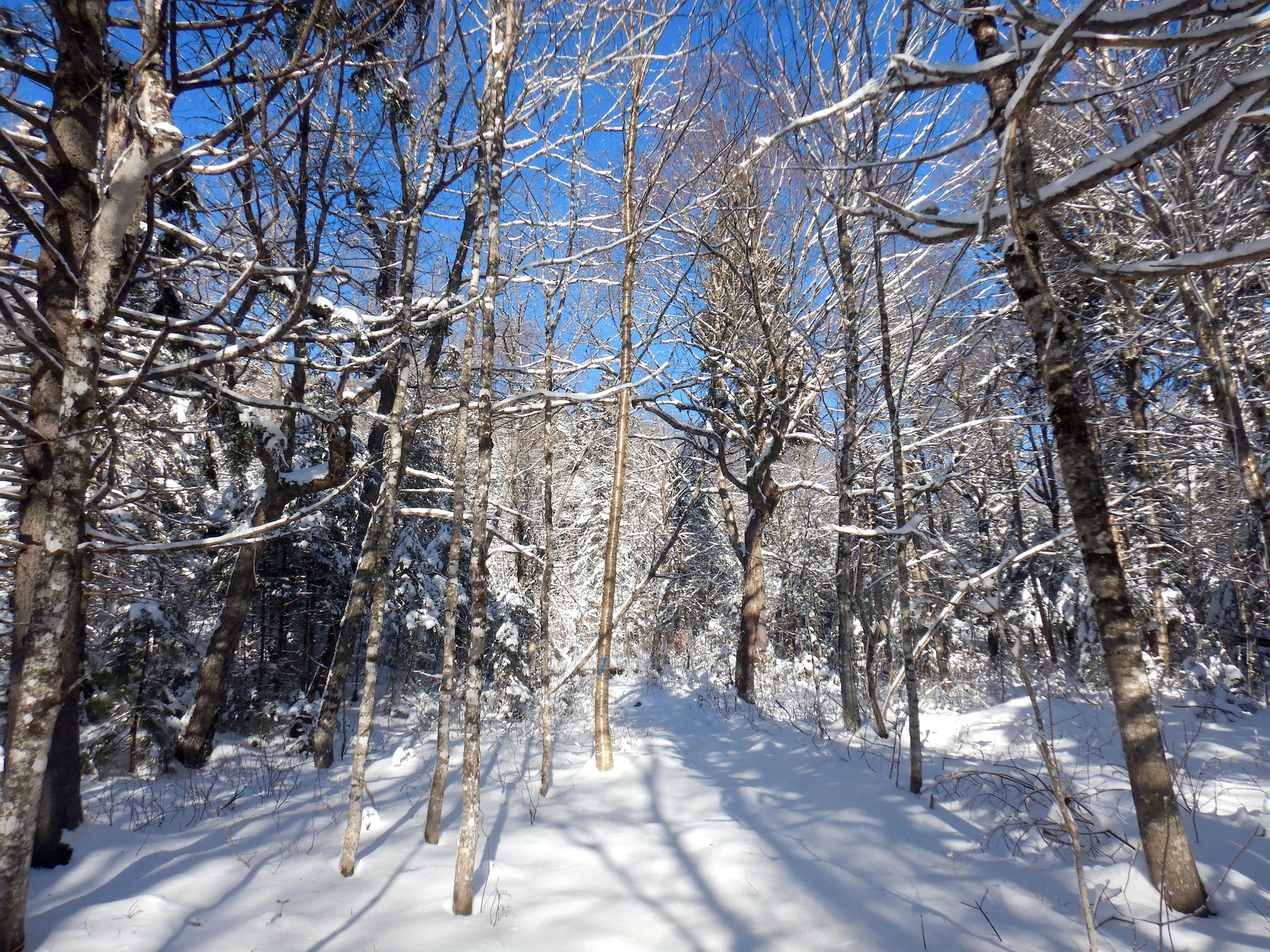
Landscape view of rocky trail through a forest. The trail starts at bottom center and disappears at left of center. The canopy is mostly bare of leaves. The leaves that remain are mostly yellow. A larger tree bisects the image from top to bottom.
The Mount Chase Trail on October 18, 2023.

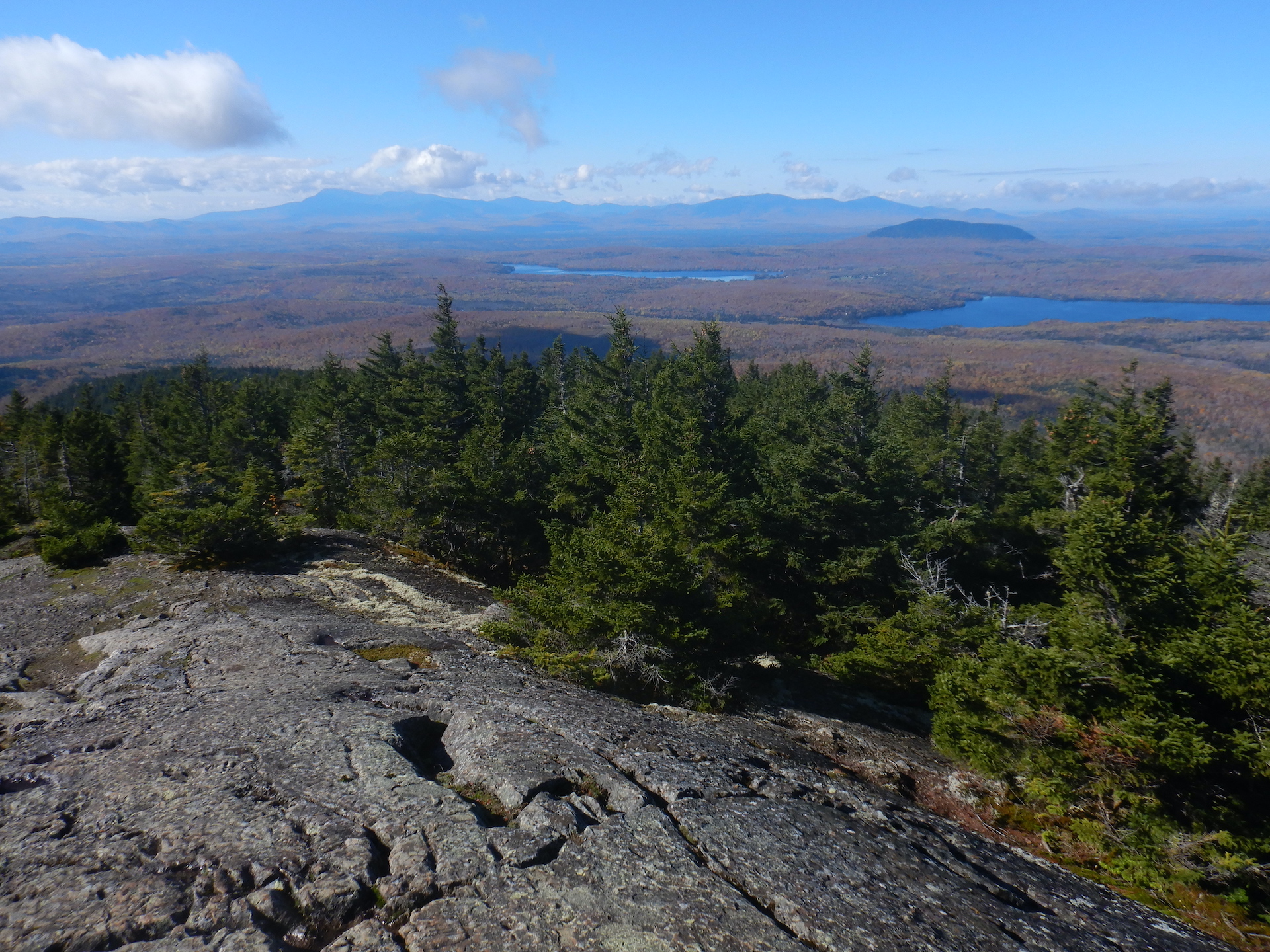
View of forested landscape from mountain summit. Bare rock covers the ground at bottom while spruce and fir trees cover the upper slopes. The lowland forest is mostly brown and bare of leaves. Tall mountains form the horizon although they look small due to the perspective. A pond is visible in the forest at center right.
Looking west-southwest toward Katahdin and Baxter State Park from the Mount Chase summit on October 18, 2023.

November 16
I begin at an alternative trailhead that I’ve used a few times this year. The route isn’t maintained. It’s nothing more than a decades-old skidder trail, but it is a quicker and more secluded course than the main trailhead. The year has been wetter than average, so water has consistently flowed over parts of the trail. Mid fall brought a prolonged stretch of dry weather though, and the trail is drier than it has been over the entire year. Winter will soon be here. The canopy is bare. Patchy snow sits in the shady areas of the mountain’s spruce-fir forest.

View of forest that is a mix of young and old spruce and fir trees. Dead standing trees are among them. A large trunk is at left. Tiny patches of snow sit on fallen tree trunks.
The old growth forest on upper Mount Chase on November 16, 2023.

View of forested landscape from mountain summit. Bare rock with some patchy snow covers the ground at bottom while spruce and fir trees cover the upper slopes. The lowland forest is bare of leaves. Tall mountains form the horizon although they look small due to the perspective. A pond is visible in the forest at center right.
Looking west-southwest toward Katahdin and Baxter State Park from the Mount Chase summit on November 16, 2023.

December 8, 2023
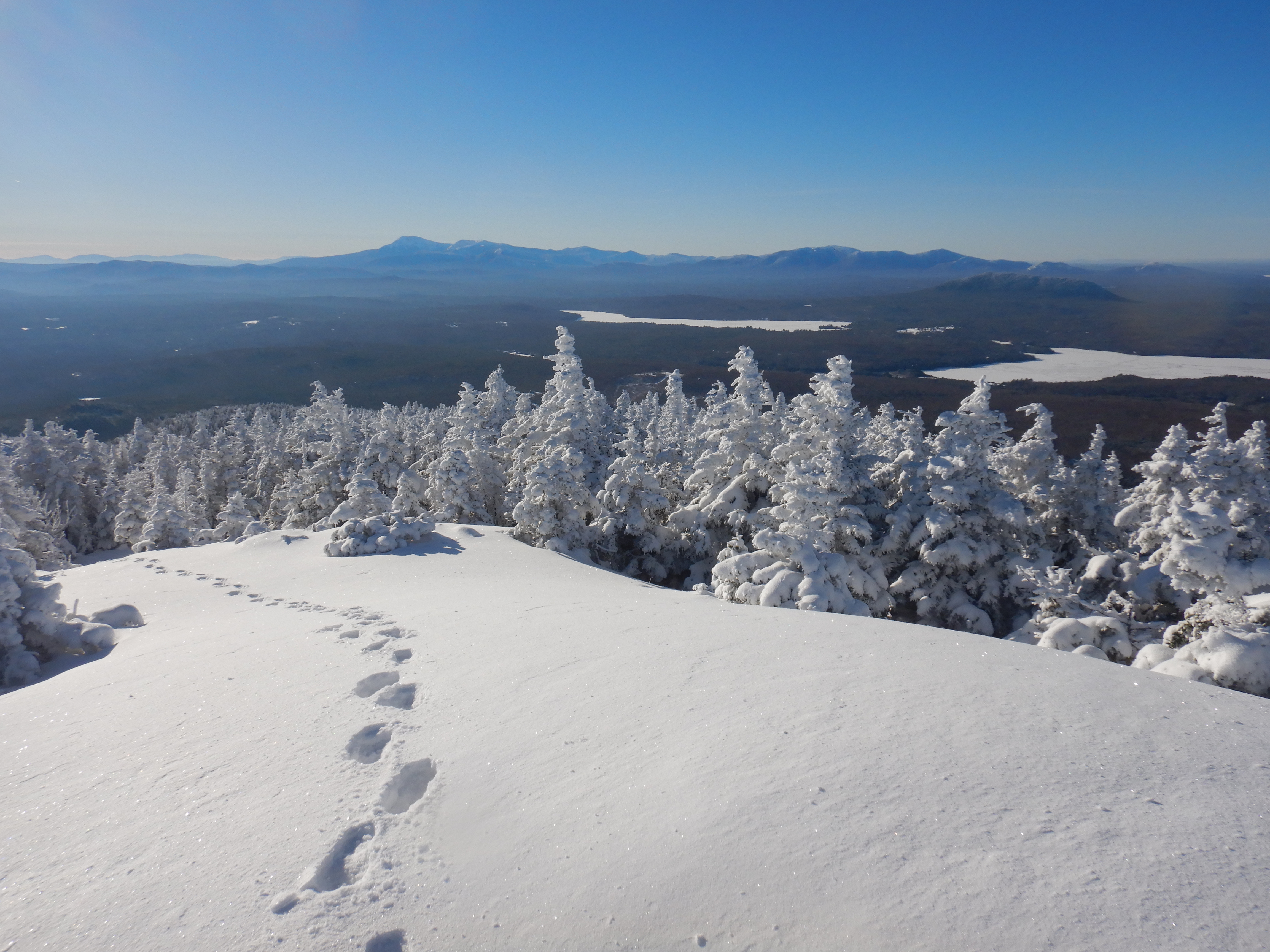
Winter is a time of dormancy for many life forms, although it brings vibrancy in other ways. None of the previous trips were as beautiful or as quiet. Several inches of snow coat the ground at low elevations and about 12 inches linger higher on the mountain. No human footprints are discernible on the trail. Snow and hoarfrost cover the conifers like cake icing. The landscape appears clean in a way that I don’t find in spring, summer, and fall.

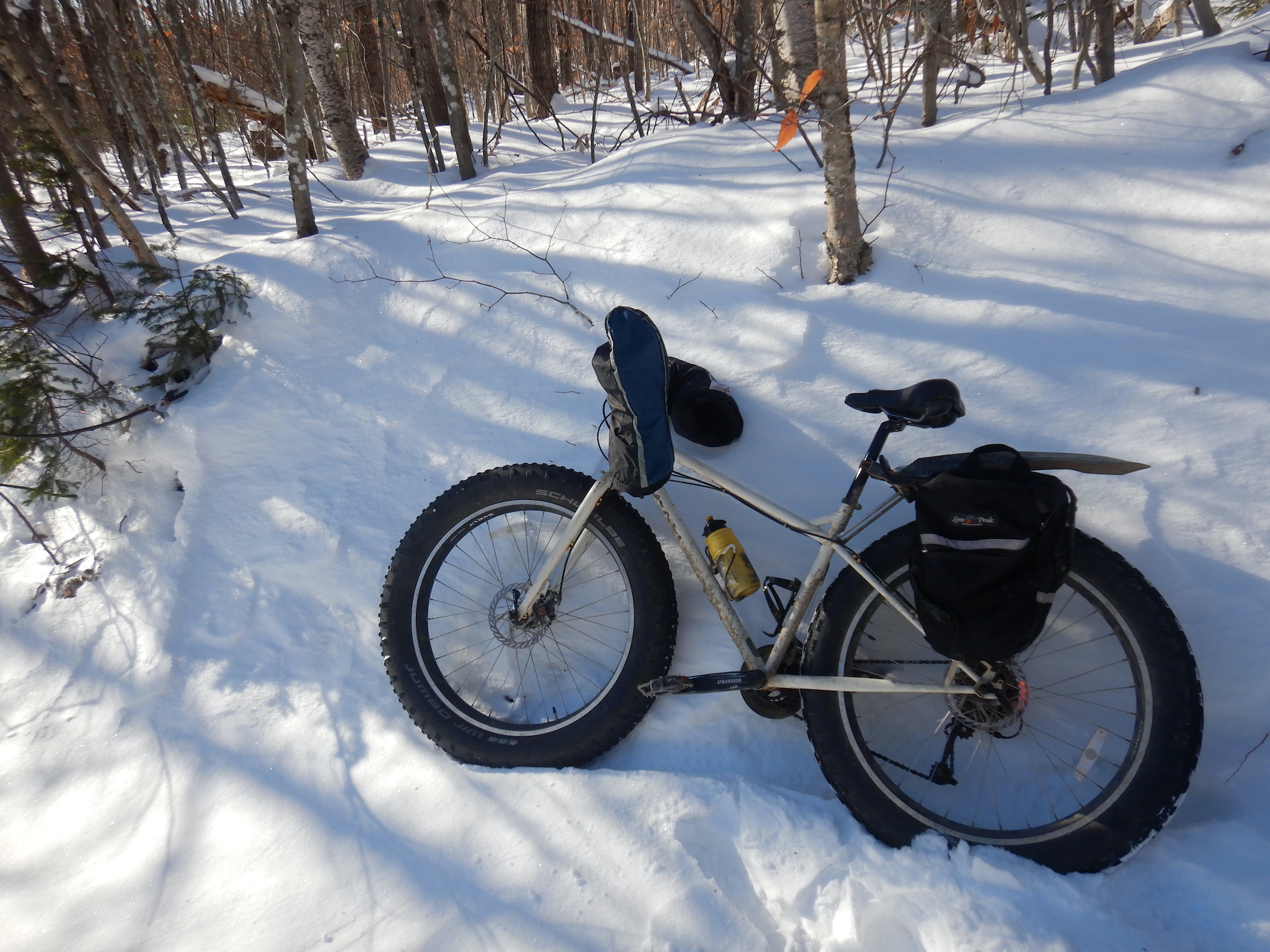
A fat tire bicycle rests against a snow covered bank. Trees fill the background at top. The bike has a rear pannier and bar mitts.
Large Marge

view of snowy forest. The trees are mostly deciduous and bare of leaves. Snow covered the ground.
The Mount Chase Trail on December 8, 2023.
The final approach to the Mount Chase summit on December 8, 2023.

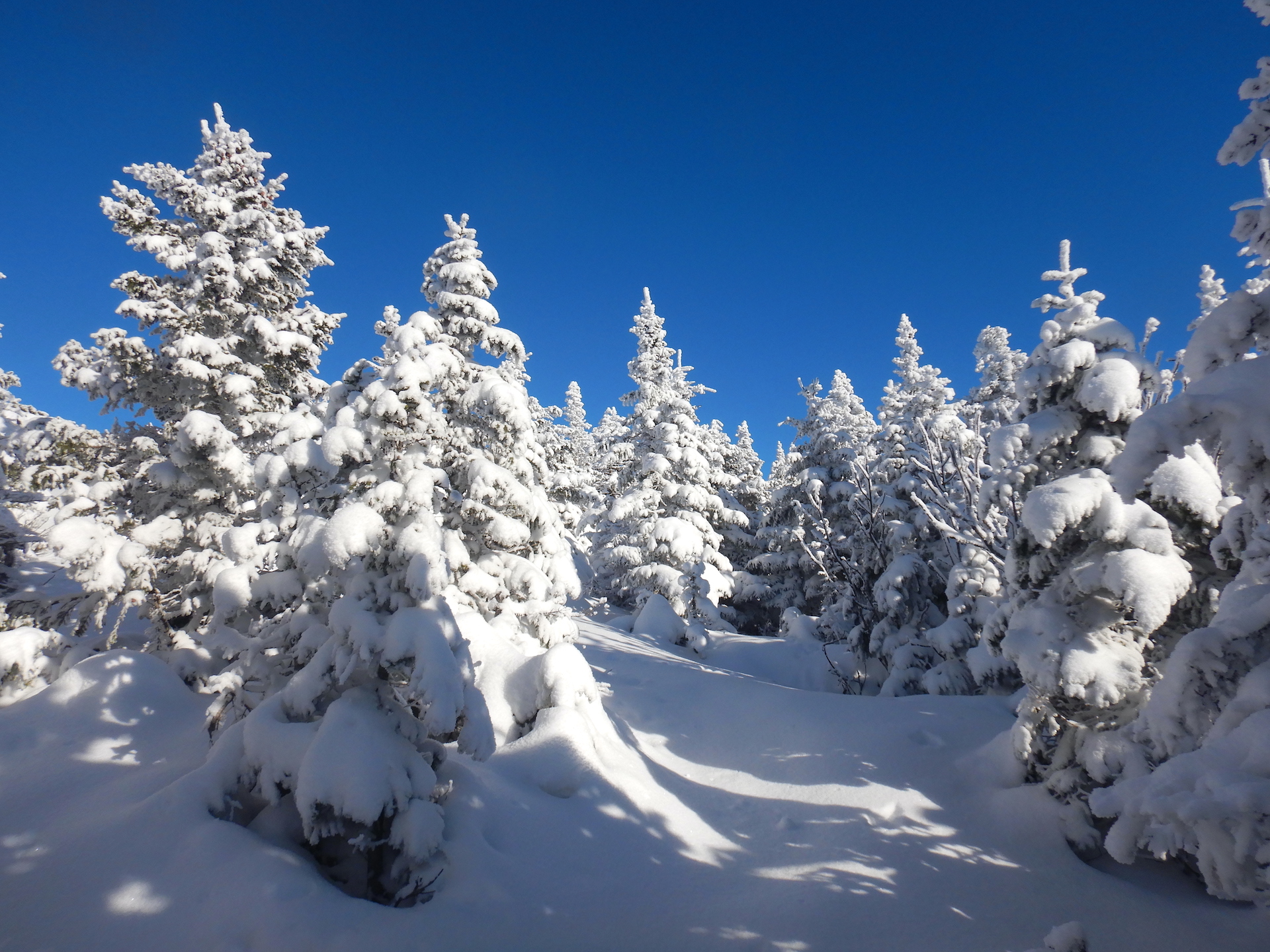
View of snowy conifer trees looking toward mountains on a far horizon. The trees are pyramidal in shape and their branches are covered in thick snow. The ground is fully snow covered. A blue sky fills the upper half of the photo.
Looking down the Mount Chase Trail near the summit on December 8, 2023.

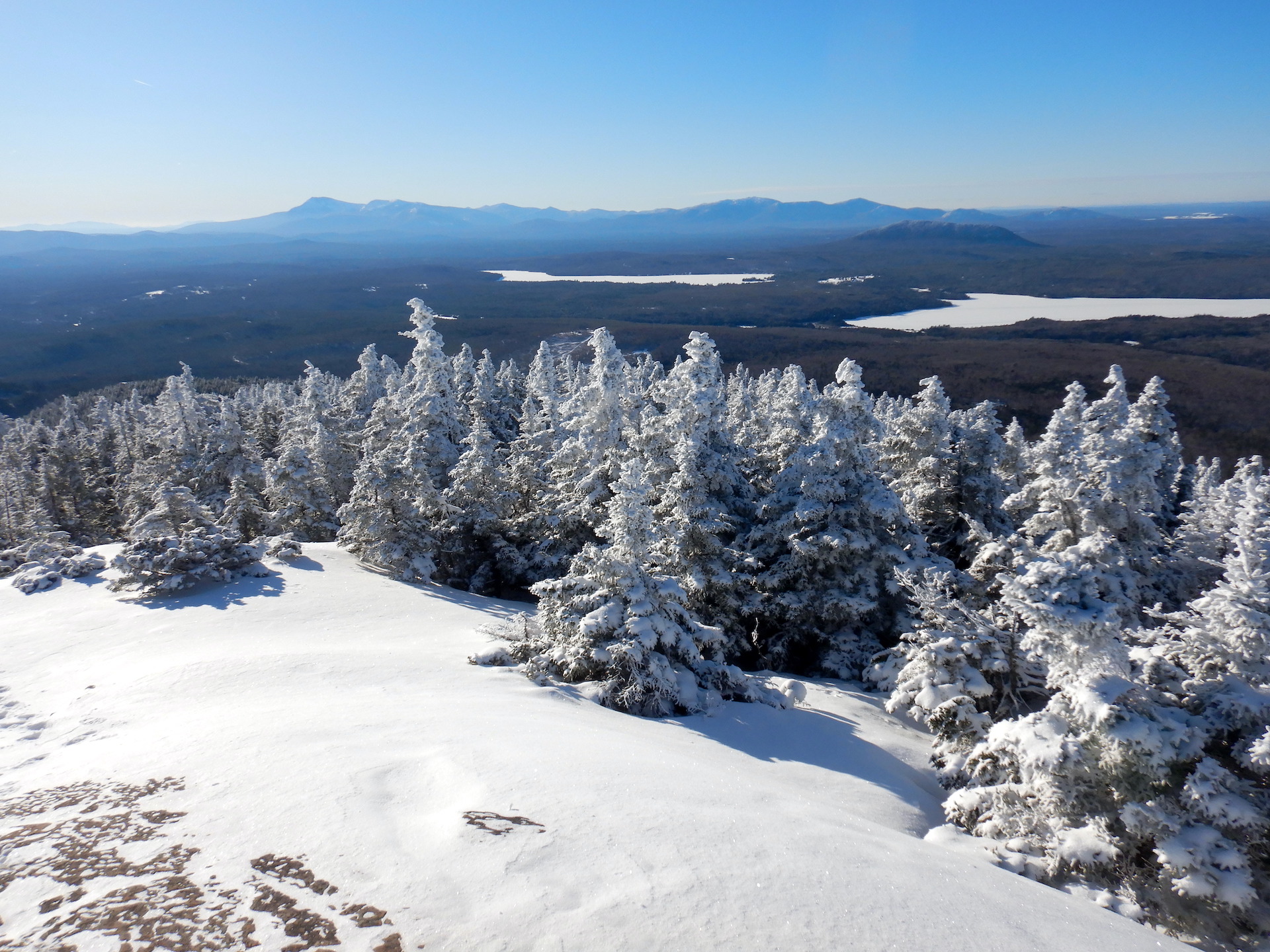
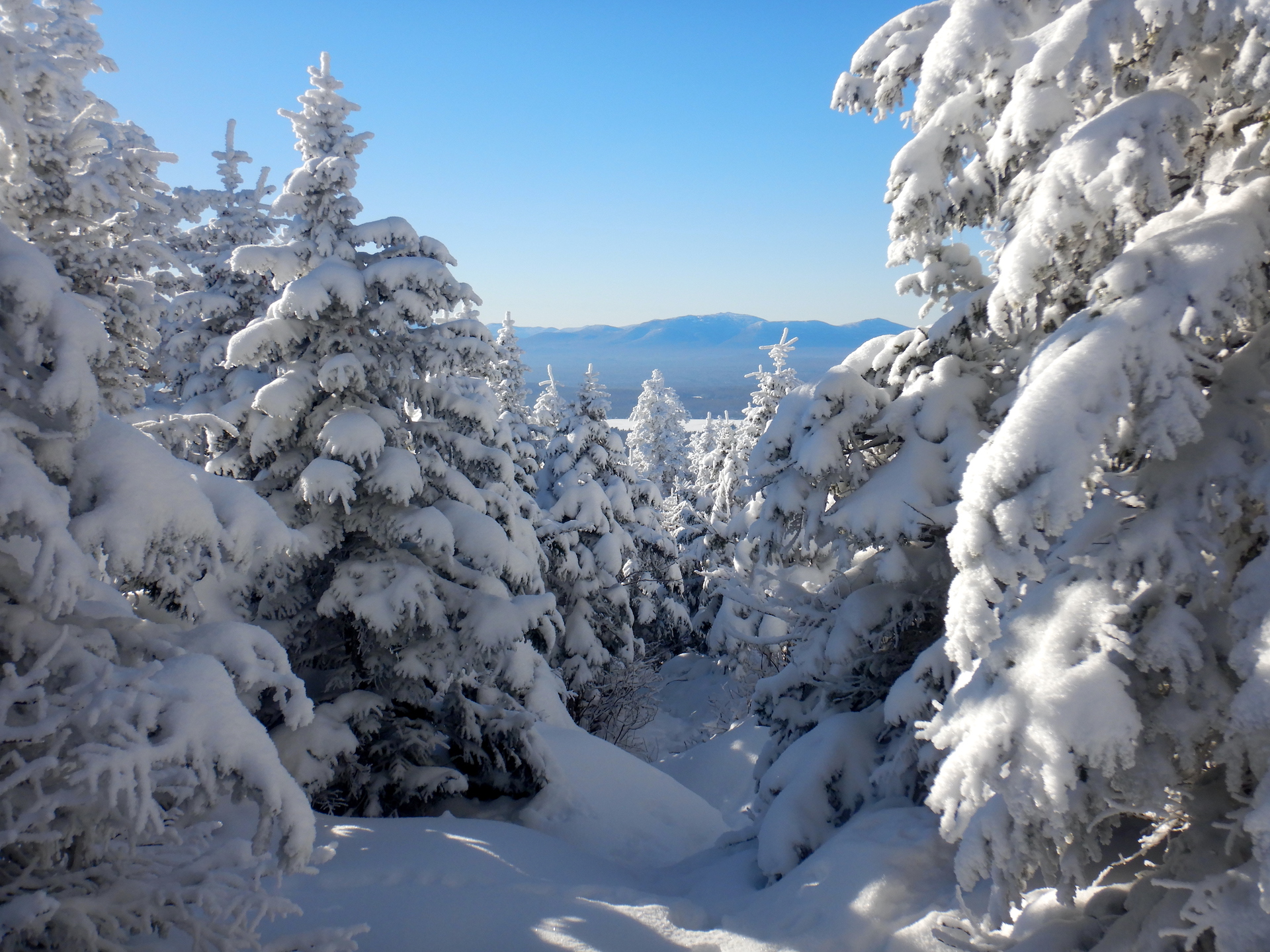
View of forested landscape from mountain summit. Snow covers ground at bottom. A single set of human footprints cross them toward the perspective of the camera. Snow-covered spruce and fir trees cover the near slopes. Ice covered ponds and forest fill the lowlands. A line of mountains forms the horizon.
Looking west-southwest toward Katahdin and Baxter State Park from the Mount Chase summit on December 8, 2023.

Time spent in the forest is never wasted and every moment offers the potential to discover new perspectives. I’m no closer to profound insights after thirteen trips to the summit of Mount Chase, although I’ve walked away with a greater appreciation for the mountain’s rhythms. The experience is both the same and vastly different every time. 

2023 Fat Bear Week Endorsement

Think of a mama bear. What does that idea conjure in your mind? Perhaps it is fierceness, since mother bears are ornery and defensive when necessary. Maybe it is commitment, because mother bears dedicate years to raise a single litter. Perhaps it is sacrifice, since mother bears provide cubs with time and energy that could otherwise serve to promote her own physical health.

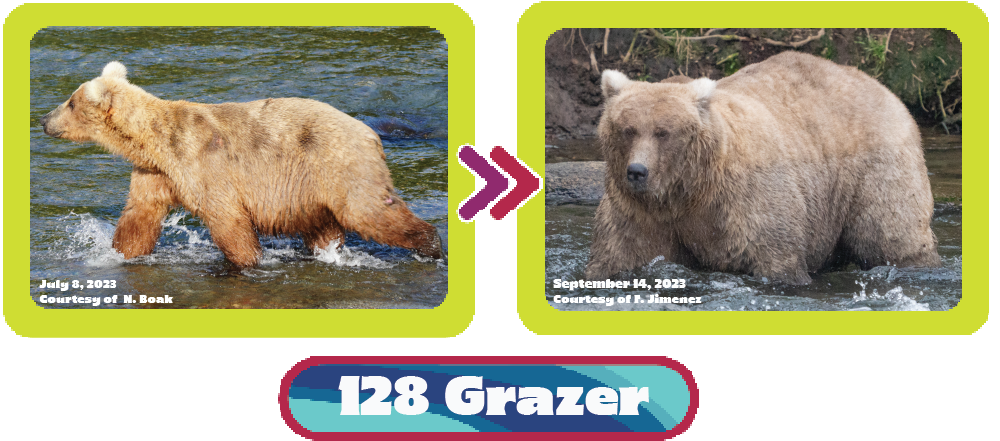
We’re fortunate to watch many different female bears at Brooks River in Katmai National Park. Yet there is one whose maternal efforts are legend. One who can fish successfully almost anywhere. One whose fearsome reputation is long-lived among other brown bears, including large adult males. Don’t get in her way. Don’t lurk near her fishing spot. Don’t look at her cubs. Do give 128 Grazer your 2023 Fat Bear Week vote.

Early and late summer photos of 128 Grazer. Photo on left is Grazer on July 8. She is facing left and walking through water. Photo on right is from September 14, 2023. She is facing left and standing in belly deep water. She is round.

Grazer | ɡrāzər |

  • (2005 – Present) A female brown bear documented to use Brooks River in Katmai National Park, Alaska. Also known as bear 128.
  • verb. [with object]
    The effort of a mother bear to maul or attack another bear with little provocation, especially in defense of her cubs: She grazered him.
  • Origin: Bear cam slang. Circa late 2010s and early 2020s.

Grazer is famous among people and (maybe) infamous among brown bears for her extraordinary defensiveness. When she arrived at Brooks River in 2016 with three cubs representing her first known litter, she would confront and attack other bears with little or no provocation. Sometimes it appeared that another bear only had to look in her family’s direction to draw her ire, as bear 83 knows well. 

Her behavior didn’t mellow when those first cubs grew into yearlings the following summer. Nor did she rethink her aggressiveness toward other bears when raising her second litter. While mother bears can change their parenting strategy as they gain skill and experience, Grazer continued on the path forged with her first litter—the best defense is a good offense.

Grazer separated from her most recent litter at the beginning of summer 2023. Since then, she’s lived a brown bear bachelorette’s life. Her pheromones attracted the attention of male bears during the mating season. They chased her tail, with varying degrees of success, right bear 164? After the mating season, and also during it, she focused on eating. A lot. Her waistline carries the weight of her success.

Grazer’s formidable reputation carried into this summer. She ranked high in the hierarchy among bears and was perhaps the river’s most dominant female. Notably, 151 Walker deferred to her frequently in early summer. Walker is a big dude and he’s not shy about displacing bears from preferred fishing spots. Bears have good memories, though. Maybe he had too many bad experiences with her in the past and didn’t want to risk more dangerous confrontations.

In this video, Walker is in full dominance mode as he works to displace another adult male at Brooks Falls. But watch his behavior when Grazer shows up on the boulders above.

And in case you need more examples of Grazer bulldozing bears, here you go. (Watch with sound on for the full effect.)

During my brief time at Brooks River early last summer, I watched bears fish largely without success because the expected salmon run was slow to arrive. Some of the big guys caught some fish. 747, for example, sat at Brooks Falls like he always does and let the fish come to him, but even he wasn’t catching many. Most other bears fared worse. They roamed from one place at the river to another, searching for the few early arriving salmon.

Grazer, though, has practiced—no, perfected—her fishing tactics in many different places. If fish are jumping Brooks Falls, she’ll catch them there. If there’s space in the waterfall’s far pool, she’ll catch them there. She’ll work the jacuzzi below the falls. She’ll fish in the middle of the night. She’ll use her strength and agility to chase down salmon. 

One evening last summer, I stood on the riffles platform watching her work the river in front of me. While the riffles provides brown bears with fishing opportunities, it is often a more challenging place for bears to catch salmon than the falls. The riffles doesn’t provide the same pinch points in topography as the falls and salmon have many escape routes. There aren’t many bears who can make the best of that situation consistently, especially when few salmon are in the water and bears are forced to run through the water to get them.

Grazer parks herself on the near bank upstream of me. She moves into the water after several minutes and spots a lone salmon. She lunges and misses. She chases. Another lunge, another miss. She continues running at full speed through the water while somehow keeping an eye on the salmon. With a final lunge, she fully submerges into a two to three-foot-deep pool and surfaces with the salmon in her jaws. I can see the fish gasping in the air as blood runs from deep puncture wounds in its body. Grazer eats all of it—tail to head—even the gill plates and mandibles.

In early summer when few bears were catching salmon, Grazer found success. She is perhaps the best angler at Brooks River. 

Brown bear standing in river. Water is flowing over boulders forming riffles. Bear is moving in direction of camera. Water drips off her fur. She holds a sockeye salmon in her mouth.
Bear 128 Grazer with a catch in the riffles on July 6, 2023.

Let’s not lose sight of Grazer’s goals either. She’s working to build the fat reserves necessary to sustain her survival during winter hibernation. She’s also building fat in case she gives birth in the den. Bear cubs are born mid winter while mother hibernates. Abundant fat reserves are necessary for mother bears to reproduce, so getting fat is vital to a bear’s reproductive success.

In a way, my 2023 Fat Bear Week endorsement is a recognition of Grazer’s full-bodied and fat-addled collection of work since 2016. When she is raising cubs Grazer is the archetypal mama bear. She’s formidable, strong, brave, skilled, and  successful. She deserves your vote in Fat Bear Week 2023.

Fat Bear Week bracket. Four bears (806 cub vs 428; 402 vs 901) in two first round matches on left. Two bears (32 and 480) are in bye round on left. Four bears (128 Grazer vs 151; 284 vs 164) in two first round matches on right. Two bears (747 and 435) are in bye round on right. Graphical cartoon bears fill the top and bottom center of the bracket.
My Fat Bear Week bracket predictions for 2023. Yes, yes, I know. I don’t predict that Grazer will win. There’s a difference between who I think should win and who I think will actually win, after all. Which bear’s corner are you in? Download your bracket from FatBearWeek.org.

A Turd of a Time

While every season has much to admire, I find springtime especially enthralling. Something new appears nearly every day. At first, maple sap runs heavy during March’s warm days and sub-freezing nights. Around then, a trickle of meltwater in a ditch and a bare patch of matted leaves on the edge of a snow bank promise room for other plants to break dormancy. Soon after, the first golden catkins appear on the hazelnut and gray alder. Rainy evenings bring amphibians out of hibernation. In a short time, the soon-to-flower ephemeral herbs emerge from the crust of leaves. By late April and early May, the forest canopy bursts to life again with bird song, the blossoms of red maple and quaking aspen, and finally the unfurling of leaves that will soon thoroughly shade the ground where I trod.

Each of these are little events that promise a lot more. I’m unsure if non-human animals contemplate these changes like I do. Yet, I’m certain they pay attention to them. Black bears, recently emerged from their dens, know the pattern and are eager to exploit the change of the season to their advantage. If I’m lucky, their efforts to find their first substantial meals of the year might allow me to investigate what they are up to.

A section of Katahdin Woods and Waters National Monument sits to the east of Sebois River. It’s a quiet area of the park since there are no campsites, less than a mile of developed hiking trails, and only a few maintained roads. Bicycling through it is fun and is made even more enjoyable when I afford myself the time to go slow and pay attention. It’s one of the best places in park that I’ve yet found to look for bear sign in the spring.

Riding the single lane spur that loops off and back to American Thread Road last weekend I came across many piles of bear scat, which I was hoping to see. Not because I particularly admire turds, but because bears are cryptic here. They are frequently hunted throughout northern Maine and consequently have a substantial fear of people. The thick forest also limits my ability to watch a bear if I happen to see one. The signs that bears leave behind—such as marking trees and scat—are like pages in a book. A single page may not reveal much but look at enough pages and you’ll get a good story

A large pile of dark colored, almost black, bear scat on gravel. The bear scat is framed by grass blades and wild strawberry leaves. The background is open forest.

In particular, scat can reveal how recently a bear was in the vicinity and what it was eating. Black bears are omnivores that are well adapted to survive on plants, and the vast majority of their annual calories come from plant foods. In north-central Maine, though, there are no calorie-rich berries to eat in the spring. Perhaps there are some leftover acorns, but oak trees are not common in the forests as this area is near the northern end of their range in the northeastern U.S. So other plant foods are a bear’s best springtime bet.

While a black bear’s digestive track remains essentially one of a carnivore, it utilizes adaptations such as an elongated gut and slightly flattened molars to extract nutrition from tough to digest plant foods. A bear also consumes plants when they are most nutritious and digestible. Newly emerged green vegetation like grass, sedge, and clover contains relatively high amounts of protein, for example. As those plants mature, protein content declines while indigestible fiber increases. Fiber helps keep the bear on a so-called regular schedule, but the bear is really after the protein. Even though hibernating bears maintain their muscle health without eating or exercise, if they’ve exhausted their fat reserves by springtime then their body is forced to tap into their lean tissue reserves. Young, tender veg helps bears stave off muscle loss and even build muscle before sugary, fat-building foods become available in mid to late summer.

All but one of the scat piles I found were filled with herbaceous plants. Although most looked older than a day–when bears eat green veg, the resulting scat quickly oxidizes when exposed to air to form a black surface crust–this was a promising sign. I knew that the lightly used roads are good travel corridors for bears and the sunlight reaching the road edges allows vegetation to green-up more quickly than the forest interior, which attracts bears to the roadsides. Perhaps I might see a bear if I pedaled slowly and remained observant.

The effort paid off near the crest of a hill when I spotted a dark mass of animal on the edge of the road. I stopped to watch.

The wind was at my back, which is a welcome push when cycling uphill but also carried my scent to the bear. Once it caught my scent, the bear only needed a couple of seconds to decide to run into the forest. Had the wind been blowing the other way, I probably could’ve watched it much longer with less chance of disturbing it unintentionally. Still, I was grateful for the moment and the small insights into its world.

Before widespread logging and, later, roadbuilding encroached on the area’s forests, grassy areas in northern Maine were likely much less common than today. Black bears always sought the first spring greens, but they had to look in other places—riverbanks, stream sides, and beaver meadows for example. They continue to go to those areas, of course, even as roadsides have opened another foraging opportunity. Roads are risky places that expose bears to people though. Bears weigh the risk along with the potential reward of a good meal.

I knew the bear I saw was eating well even as it still had a long way to go until it was fat enough to enter its winter den next fall. Its effort is a journey recorded in its scat—pages, if you will, in the Book of Turds.

Action Needed: Support a Permit System for Brooks River

Brooks River in Katmai National Park, Alaska is historically, culturally, and ecologically unique. The river corridor has harbored Alaska Native peoples for thousands of years, is one of the densest archeological sites in Alaska, and remains a place of profound significance for Alutiiq descendants of former Katmai residents. The underlying geology records stories of great volcanic and glacial change. Hundreds of thousands of sockeye salmon annually use the river for migration and spawning. And, during the last 40 years it has become especially famous for its brown bears and wildlife viewing opportunities. There’s no other place like it.

A mother bears swims through water in front of a grassy shoreline. Her two first year cubs ride on her back. She swims from right to left.
Bear 482 Brett searches for salmon in Brooks River while her two cubs hang on for the ride. July 14, 2021.

Brooks Camp is also experiencing more people than ever before. 

In the midst of skyrocketing visitation last year, Katmai National Park implemented a pilot permit program for Brooks River. The permit system didn’t change wildlife distance regulations at Brooks River or limit the overall number of people who could visit. Instead, it applied only to those who wish to physically enter the river or its banks outside of the designated trails, roadways, bridge, and platforms. No one needed to reserve a permit unless they planned to enter the river or walk off trail along the riverbanks (two activities that I suggest should be avoided to give bears the space they need).

The pilot program appeared to be successful. It provided National Park Service (NPS) staff with an additional opportunity to communicate the special circumstances, rules, and responsibilities that apply to Brooks River. The NPS could revoke the permit in instances where permit holders did not adhere to wildlife distance or fishing regulations, which effectively prohibited the person(s) from reentering the river. It allowed approved Brooks River Guides to continue to give their clients the mandatory bear-safety orientations. And finally, it did not restrict or interfere with subsistence fishing associated with the traditional redfish harvest.

Now, the NPS is looking for public comments about the permit system. If you have the time and care about the bears who make the river their summer home, then please support the plan with a comment on or before April 28. As the Katmai Conservancy suggests, say yes to the permit and ask the NPS to limit the number of permits on a daily or weekly basis.

Modified satellite map image showing permit area for Brooks River. Title text reads, "Brooks River Permit Corridor (Permit Needed Within 50 Yards of River). Areas highlighted in blue represent the permit corridor. The area outlined in red represents the area closed to people from June 15 to August 15.

Why are permits necessary? The relative ease and accessibility of the bear-viewing experience at Brooks Camp has attracted increasing numbers of people. More than 16,000 people visited in 2022—an all time record high—and almost double the visitation of 2008. Brooks River is a mere 1.5 miles (2.6 km) long, yet dozens of brown bears use it during the salmon migration and spawning seasons of summer and early fall. 

People who enter in the river directly occupy the habitat that bears need to fish for salmon. Numerous scientific studies (reviewed here) have documented that human recreation can displace bears in time and space. The presence of people can cause bears to switch from diurnal to crepuscular activities in response to bear-viewing, angling, hiking, and camping. Bears decrease in number and are present for shorter time spans when exposed to people, angling, and bear-viewing. Bears also spend less time fishing and have less fishing success when anglers and bear-viewers are present.

View of river surrounded by boreal forest looking downstream. Five bears are in the water. Nearby, a group of four people stand in the water photographing the bears.
Bears gather at Brooks River to fish for salmon. People in Brooks River risk displacing bears from important foraging areas in the river. This is especially true for bears who do not habituate to our presence. In these situations, we unwittingly become a competitor in the bear’s mind for space, and most of the time that bear won’t challenge us for it.

Studies specific to Katmai National Park have found that the presence of people can affect when bears fish (Olson et al. 1998) and cause bears to avoid or alter their use of foraging areas (Rode et al. 2007; Smith 2002; Turner and Hamon 2016). Therefore, even a small number of well-behaved and well-intentioned people in the wrong place (like in the river) can have a disproportionately negative effect on brown bears. Disturbance of wildlife can also result in decreased visitor satisfaction (Skibins et al. 2012) and create user conflicts between visitors who are recreating in different ways (bear watching from the platforms or online via webcams vs fishing or photographing bears in the river).

Importantly, and tucked away in the park’s newsletter about the permits, is this: “There is no limit established to the number of permits issued during the permit-required time frame currently, but this will be considered if public feedback to the plan supports a limitation or if conditions change within the Brooks River Corridor to warrant a limitation.” Therefore, I recommend that comments ask the NPS to go beyond merely requiring permits. Comments about the permits should encourage the NPS to establish limits to permits on a daily or weekly basis and perhaps even greater seasonal closures to Brooks River to adequately protect habitat for bears.

I didn’t visit Brooks River in person last year, but rangers and some people I know who had traveled there reported to me that the pilot permit system worked well. While it does not address over-crowding and congestion issues at Brooks Camp caused by record-high levels of visitation, it is certainly a big step in the right direction to ensure the river’s bears have access to the habitat they need to survive. None of the existing regulations would change at Brooks Camp. The permits only make it easier for the NPS to enforce them. But permits alone are not enough. Existing protections for bears can be made more effective if permits were limited in availability. Our national parks, and indeed Brooks Camp, cannot support unlimited numbers of people. The Brooks River corridor is a small area overall. It has limited space for bears and a limited carrying capacity for a high-quality bear-viewing or fishing experiences. Please let the NPS know you support their efforts to protect habitat for bears in the river through the permit system and that the number of permits should be limited on a daily or weekly basis when bears are actively fishing in the river.

Submit your comments here on or before April 28, 2023.

For additional information, please see the comments I wrote on behalf of the Katmai Conservancy, an example comment that you can use, and my Brooks River pledge. As always, when commenting please stay polite and respectful. The people who manage Katmai are intelligent and well-meaning. They do not deserve insults or personal attacks.

Book Talk at Veteran’s Memorial Library

Mark your calendars if you’re based in northern Maine. I’ll be giving a talk at the Veteran’s Memorial Library in Patten at 6 p.m. on February 28. While I’ll discuss some of the main storylines in my book, The Bears of Brooks Falls: Wildlife and Survival on Alaska’s Brooks River, I also talk about how those stories might provide lessons for our relationship with the Maine landscape.

This will be a new talk, so now it is time for me to stop procrastinating and get to work polishing the presentation. I hope to see you there.

Flyer for a book talk. Background image is a bear swimming through water with two cubs clinging to her back. Above the bears is a book cover with the title "The Bears of Brooks Falls." The descriptive text reads, "What can brown bears and Pacific salmon teach us in Maine? Join Mike Fitz as he discusses his book, The Bears of Brooks Falls: Wildlife and Survival on Alaska’s Brooks River, and how that landscape offers lessons for our relationship with Maine’s wild spaces. Date: Tuesday, February 28, 2023. Time: 6 p.m. Location: Veteran’s Memorial Library at the Patten Lumbermen’s Museum."