National Parks Aren’t Pure

National parks are often billed as places of change and integrity (even by me), where nature can take its course. Yet, they face unprecedented challenges and are managed so that nature doesn’t take its course in many cases. Some parks cull wildlife through controlled hunts or periodic roundups (Wind Cave, Badlands). Biologists occasionally control one species to benefit an endangered animal (Cape Cod). Now, the National Park Service has developed a draft plan to prevent the extirpation of wolves from Isle Royale National Park in Michigan. Plans such as this, which suggest increasing levels of intervention in ecosystem management, are the future of conservation in national parks. This is a future, and a current reality, where humans have so fundamentally altered the planet that nature doesn’t exist outside our influence. Parks aren’t pure anymore.

In the early 20th century, national parks and monuments were managed primarily for aesthetics, spectacle, and recreation. Park superintendents and rangers had preconceived notions of what parklands should look like and the experiences they should provide visitors. Caves were manipulated and became showcases to march people through sensitive areas. Predators like wolves and mountain lions were vilified and persecuted. Bears were a sideshow. Feeding them at dumps and roadsides was often encouraged. Insecticides were sprayed to control native insect outbreaks. The long-standing philosophy was: parks ought to be pretty and tidy.

As respect for wilderness and ecological integrity grew, people began to reconsider how national parks were managed. In 1963, an advisory board for the Department of Interior issued Wildlife Management in the National Parks, or the Leopold Report after the board’s chair, A. Starker Leopold. Admittedly “conceptual,” the Leopold Report fundamentally altered natural resource management in parks.

The Leopold Report catalyzed a time of real soul searching for park managers. The report asked, “How far should the National Park Service go in utilizing the tools of management to maintain wildlife populations?” It acknowledged that few parks are large enough to be self-regulating ecosystems. It went further by stating the biological communities in parks are artifacts and that management is often essential to maintain some biotic communities. The report famously recommended the National Park Service manage parklands as “vignettes of primitive America,” a philosophical shift that on the surface represents a more pure vision of what national parks should and could be—places that resemble the prevailing conditions experienced by the first Europeans.

While noble, this ideal is wrought with fallacy. The Leopold Report admitted primitive America could never be recreated fully. Just to list a few examples: passenger pigeons are extinct, American chestnuts are functionally extinct, wild bison almost became extinct, and wolves were extirpated across most of their range in the United States. It also made no accommodation for Native American use and manipulation of the land. Essentially, any recreation of “primitive America” is artificial, but something to strive for.

What should we do when the line blurs between maintaining a primitive landscape and acknowledging there is no longer any such thing? Isle Royale National Park is one of the most recent parks to grapple with this issue. Isle Royale is the largest island in Lake Superior, sitting about twenty miles east of Grand Portage, Minnesota, and most of it is designated federal wilderness. The upper Great Lakes region was one of the few places in the Lower 48 states where wolves maintained a foothold throughout the 20th century, but Isle Royale was wolf-free in the early 1900s. Wolves only returned to the island in the late 1940s after crossing the ice on Lake Superior.

Only two wolves were observed on the island in 2016 (the historical average, according to the draft wolf introduction plan, is 20-30). The population plummeted because disease (canine parvovirus) and a lack of connectivity with the mainland reduced genetic diversity. The animals are now extremely inbred and remain in a genetic bottleneck they probably won’t escape. Even though Isle Royale has numerous moose (the wolves’ primary prey), the wolves will likely disappear from the island without human intervention. Is it wrong to let the wolves disappear?

Yellowstone National Park’s effort to reintroduce wolves is the most famous wolf reintroduction program in history. It is also a remarkable success, from the standpoint of the wolf. The reintroduction of wolves arguably shifted the ecosystem into top-down mode where large predators like wolves exert strong influence on the behavior and abundance prey species. Yellowstone’s effort corrected a wrong—people extirpated the park’s wolves through hunting, trapping, and poisoning. Now, a strong case can be made that humans are driving Isle Royale’s wolves to extirpation, just in a less obvious way.

At first, disease and a lack of connectivity with the mainland seem like natural influences, after all Isle Royale is an isle and many diseases infect wolves. Canine parvovirus is not native to the island, however. This disease caused the wolf population to decline drastically in 1981, from 50 to 14, and the population has never fully recovered. Wolves immigrate and emigrate from the island over ice bridges on Lake Superior. A warming climate trend has drastically reduced the frequency of the ice bridges, so much so that only one formed in the first decade of the 20th century. As the climate continues to warm, ice bridges will form less and less. For those reasons, you could easily make a case that humans precipitated the decline of wolves and therefore we should intervene.

The island would become a different place without wolves. Vegetation changes would become more pronounced and happen at a faster rate. Moose browsing threatens the persistence of big-tooth aspen, red oak, and balsam poplar on the island, but vegetation changes are not tied to moose alone. Computer models indicate many dominant tree species (balsam fir, white spruce, black spruce) may disappear from the island due to a warming climate. Paper birch and quaking aspen are expected to undergo serious declines. Park managers expect that in the presence of wolves, moose herbivory would be less likely to exacerbate climate change’s influences on vegetation. Looking at the issue from the perspective of ecosystem health and biological integrity, the presence of wolves is probably necessary to prevent habitat degradation, or at least slow it. Therefore, should we intervene? The NPS thinks so, and I don’t necessarily disagree.

There is no ecological difference between humans supplementing wolves on the island and wolves immigrating naturally across an ice bridge. The only difference is mental, cultural. We’d know we did it. We’d know we manipulated the ecosystem. We know we messed with primitive America. For some people, that trammels the island’s wilderness and severely impacts its natural quality.

We need to get over any of that if we want to maintain some biological integrity in the future.

In The End of Nature, Bill McKibben argues that by burning fossil fuels, we’ve fundamentally altered Earth’s atmosphere causing global warming, and nature, as it is classically known (the physical world outside of humanity and human creations), no longer exists. Now, not even the deepest ocean trenches are free of our fingerprints. There is no place untouched by humanity. Even if we did not alter climate, humans are so numerous and so thoroughly dominate most terrestrial ecosystems that McKibben’s hypothesis would still stand. We impact the evolution of life on Earth.

Recognizing that much has changed and much has been learned since 1960s, a National Park System Advisory Board revisited the Leopold Report in 2012 and recommended the NPS manage for constant change, instead of striving for a past ideal. Isle Royale’s plan could be supportive of the old and new philosophies. Wolves are valued members of a primitive America, but under current and projected future climate conditions, Isle Royale’s wolves may indefinitely need a helping human hand to remain viable. If we value wolves on the island, then we’re probably committed to supplementing population in perpetuity. Revisiting Leopold recommends the NPS expand their management strategies to encompass a geographic scope beyond park boundaries. If parks, in order to remain ecologically viable, need greater habitat connectivity to other wild lands, then they should forcefully advocate for that. We can no longer pretend national parks are vignettes of primitive America. Wilderness areas can no longer be considered “untrammeled” and “affected primarily by forces of nature” as stated in the 1964 Wilderness Act. We have to choose what parks represent and what they protect.

I’m not opposed to any of the alternatives proposed to introduce wolves to Isle Royale. It’s probably wrong to let wolves disappear from Isle Royale because climate change limits the chances of more wolves immigrating to the island naturally, but there are a lot of threats to biodiversity and we need to choose our battles wisely. We won’t be able to intervene in every Isle Royale-like scenario.

Are we any more intelligent or sophisticated than managers, rangers, and park visitors in the 1910s and 1920s when wolves were more vilified? They could’ve left animals alone to do their own thing. They didn’t, because they didn’t want to. Because, American culture said we should do otherwise. Now, we face a lot of the same questions. What do we value most in parks? How should we protect the things we value within them?

I like to believe, sometime in the future, humans will have voluntarily reduced our footprint enough so that most plants and animals can evolve without our influence. We’re not there yet, certainly not with 7.4 billion of us living in a market economy driven largely by greater and greater levels of consumption. So, yeah, we should help Isle Royale’s wolves, but let’s not pretend national parks are pure wildlands. There is no purity in national park ecosystems anymore. Perhaps there never was.

(The NPS is accepting comments on the Isle Royale National Park Draft Environmental Impact Statement to Address the Presence of Wolves through March 15, 2017.)

wolf standing in snowy forest

Photo courtesy of Isle Royale National Park.


More Snow? Yes, More Snow.

Yesterday, I wrote about a ski trip in Stehekin Valley’s ample snow. Since I took that trip a few days ago, more snow has fallen. A lot more.

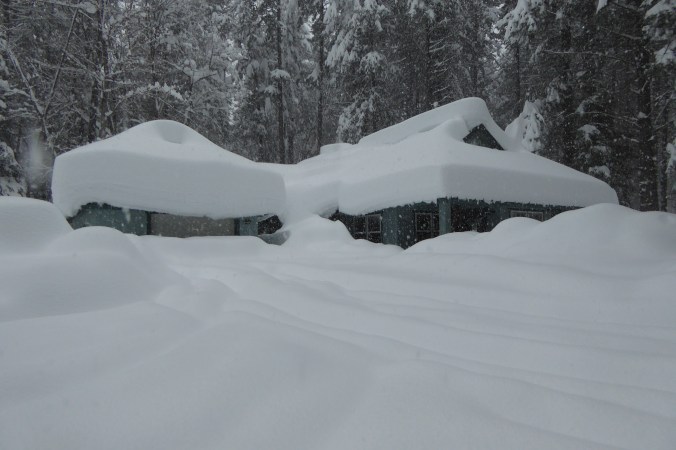
This was the scene I woke to yesterday.

Deep snow outside of home

And, snow was slowly enveloping the neighbor’s house.

deep snow covering home

This is nothing abnormal for the region, and in many way’s it is expected. In winter, the jet stream over Alaska and Canada shifts south over the Pacific Ocean. Air masses traveling across the Pacific at this time of the year are “immodestly moistened,” as Daniel Matthews describes in Cascade-Olympic Natural History, bringing heavy precipitation to Washington, Oregon and California. The Cascade Mountains and Sierra Nevada are effective moisture traps for these storms. When storms encounter the mountains, the air rises and cools causing it to precipitate its moisture. The Stehekin Valley in Lake Chelan National Recreation lies east of the Cascade Crest, so the area experiences drier weather than the wetter Skagit River valley to the west. However, the valley is not far enough east to experience the Cascades’ full rain shadow, hence the ample snowfall recently.

In my estimation, at least three feet (approximately 50-100 cm) of snow has accumulated over the past five days, much of it falling in the last 24 hours. Higher elevations certainly gained more. I was curious to know the exact snow depth near my house, which lies at a modest 1100 feet (335 meters). After the snowfall abated yesterday afternoon I got out the snow shovel prepared to dig in.

I chose to measure the snow out in a small meadow away from the influence of trees, but getting there took some effort. The first few feet of snow was very soft. The base to stand on, if you could call it that, was well under the surface.

After floundering my way into the meadow, I started digging…

snow shovel in deep snow

and digging…

snow shovel in deep snow

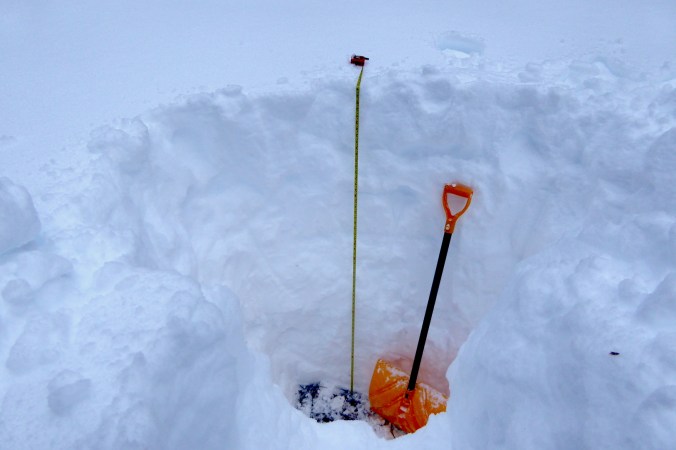
…and digging and digging until I reached the soil.

snow shovel in deep snow

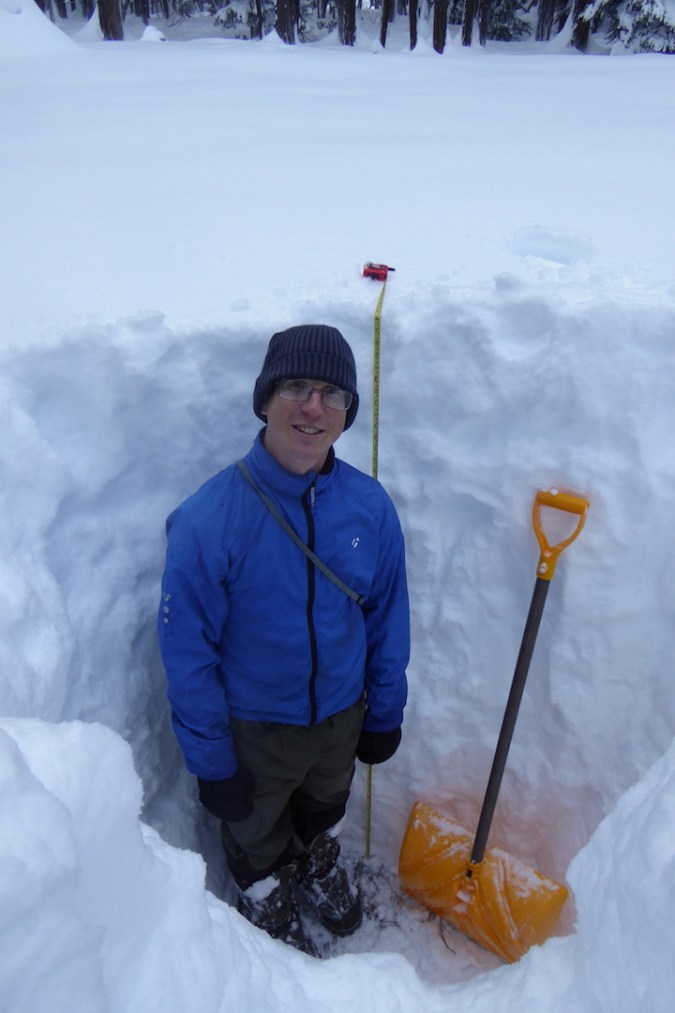
The pit was over 65 inches (166 cm) deep!

Snow shovel in deep snow next to measuring tape. Tape is 65 inches long.

measuring tape in snow. Numbers at top of snow level read 65 inches or 166 centimeters.

Long time residents describe winters with lots of snow and occasional rain too. Rain compacts the snow, increasing its density but decreasing its depth. This winter, I’m told, is a bit of an exception with lots of snow, but without temperatures warm enough for the occasional rain storm.

Winter snowfall is essential to the well being of millions of people across the West, especially farmers who cannot depend on summer rain to sustain crops. Snowmelt in rivers quenches the thirst of residents in Los Angeles, Las Vegas, Phoenix, Salt Lake City, and many, many other places. It’s a reservoir, slowly releasing its water in spring and summer when it is needed most.

Climate models indicate changing weather patterns will come to the West as temperatures rise. The North Cascades region won’t be without snow, but changes will be felt, and in a lot of ways the region is already experiencing them. More rain will fall and less snow will collect on the mountains. At first this may seem insignificant. However, this will change the timing and duration of peak stream flows. Currently, stream discharges peak in the spring and early summer when snowmelt is heaviest. The pattern seems to be shifting toward more frequent peak flows in spring and fall. Rain on snow events can cause heavy flooding, damaging roads and homes. (Stehekin River has experienced three 100 year floods since 1995.) Warmer springs temperatures melt snow faster, affecting sensitive habitats like montane wetlands, places that harbor sensitive species like the Cascades frog. Soils dry faster without snow too, increasing the risk of wildfire.

Snow is often viewed as an annoyance or danger, delaying and restricting travel, but it is a key component of ecosystems where it occurs. Snow on mountains is a water tower, one we can’t afford to lose. (It’s also a lot of fun to play in.)

Person standing in deep snow pit. Pit is 65 inches deep.

(I’m really not that short, am I?)

Let It Snow

After three months of aimless wandering, I’m back in Stehekin and, well, there’s a lot of snow.

snow covered trees under overcast sky

Stehekin and Lake Chelan National Recreation Area lie just east of the Cascade Crest, but well within the Cascade Mountains. When moisture-laden winter storms move east from the Pacific Ocean over the Cascades, they dump prodigious amounts of snow. Stehekin averages 120 inches of snowfall each winter. In 1996, 298 inches of snow fell, almost 25 feet. Although I don’t know how much snow has fallen so far this winter, it’s not a trivial amount.

Earlier this week, I was eager to explore the snow-shrouded landscape, so I strapped some skis on to Large Marge and headed out.

No, not that Large Marge. This Large Marge, my fat tire bike.

fat tire bike with skis strapped horizontally on it

Two tools of winter exploration: Large Marge and cross-country skis.

I cycled on an icy, freshly plowed road to the Stehekin landing strip to ski the Stehekin River Trail, which parallels the Stehekin River downstream to Lake Chelan. It’s a pleasant hike in summer when the trail is easy to follow. The snow changed this familiar trail greatly. Where thick snow obscured the exact route I had to watch gaps in the vegetation carefully to stay on the trail.

deep snow and trees

Where’s the trail?

I needn’t worry about getting lost though. The trail is bordered by Stehekin River one on side and 8,000 ft. tall mountains on the other. I only had to stay in between. The trail has no significant elevation gain, but traverses some tricky spots for someone like me who sucks at skiing.

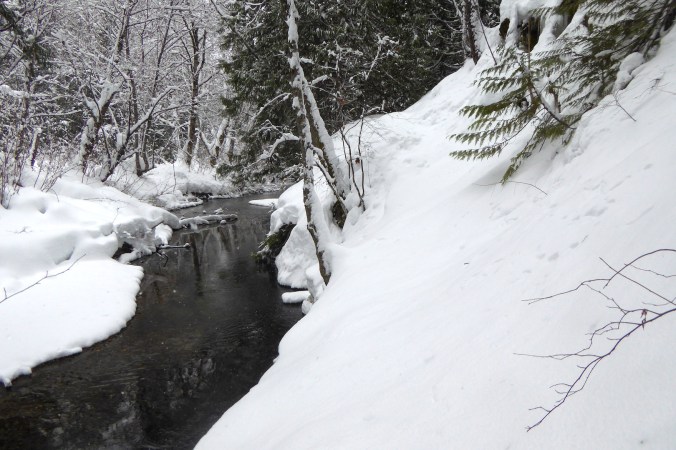
small open water channel next to steep slope

Caption: Short, steep bluffs next to the river’s side channels were difficult to negotiate on narrow skis. I often side-stepped up and down these places instead of risking a fall into open water.

The scenery was worth the effort, however.

River and snow covered trees

Stehekin River.

Animal tracking is always on my mind when there’s snow. The snow records much about an animal’s behavior as it moves through the landscape. The deep snow of the Cascade Mountains present a very difficult challenge for large and medium-sized animals, however. If you’re not a small mammal that can live under the snow or in the trees, then you either hibernate or abandon the high country and migrate to areas with less snow pack.

Partly because of lots of fresh snow and partly because most animals are either under the snow or in a different area altogether I didn’t see many animal tracks. A few Douglas squirrels were out and barked a warning when I skied under their tree, but there were few fresh signs of large animals on the upper half of the trail in the deep, soft snow.

Where the trail passed under a thick canopy of Douglas-fir and grand fir, I found the skiing easier. Tall conifers intercept a lot snow before it falls to the ground. When it does fall, it often does in large clumps that compact quickly on the ground. In these areas, deer and elk often “yard-up” to avoid getting mired in the deeper snow of open areas. Might I find deer and elk sign here?

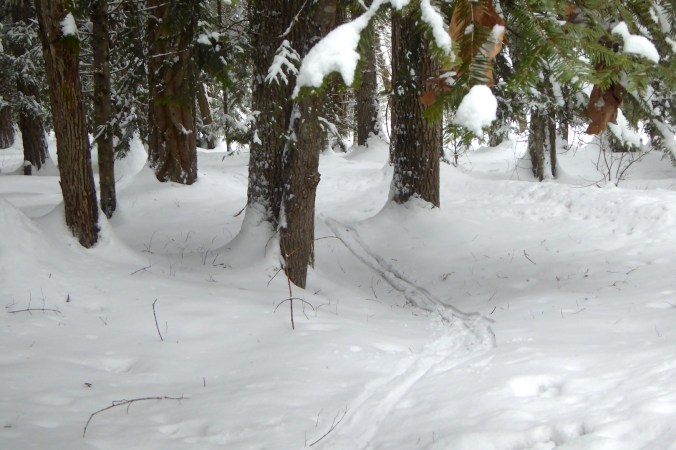
ski tracks through forest

I encountered little fresh powder where conifer trees grew thickly. These areas are often preferred places for deer and elk to travel and rest. In open areas, my feet plowed through at least 20 centimeters of newly fallen snow, making travel more difficult.

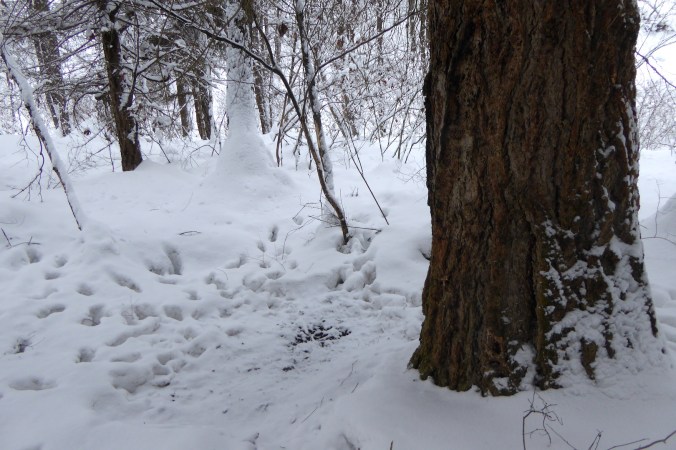
On the river’s floodplain, under a tall Douglas-fir, I found a depression where barely an inch of snow covered the ground. Elk tracks radiated away from it, and a few pellets of elk scat lay within it. Evidently, this was a frequently used resting place for at least one elk.

depression in snow from resting elk

An elk had repeatedly used this bed to rest. For scale, the Douglas-fir trunk is larger than one meter in diameter.

Shortly afterward, my approach spooked an elk away from the fallen branch it was feeding on.

conifer twig clipped by browsing elk

Twigs nibbled by members of the deer family have ragged edges. An elk recently nipped the end of this Douglas-fir twig.

I only caught a glimpse of the elk, but it was a bull with sizable antlers. Carrying antlers into late winter seems counterintuitive and a waste of calories. Those antlers weigh a lot, and it can’t be cheap, energetically speaking, to keep them on your head. Shouldn’t this animal have shed its antlers by now?

Unlike deer and moose, who shed their antlers in early winter, elk often keep their antlers until spring. Different selection pressures may have controlled the timing of antler shedding. Antlers can be used for defense, but they are most often used to maintain dominance. This is especially important during the fall rut. For elk, antlers may be needed to help maintain dominance in the winter as well when access to food is limited. Deer and moose tend to overwinter in small groups or solo where competition with fellow moose or deer for browse may not be an issue. Elk, in contrast, overwinter in larger herds where antlers may be needed to maintain dominance; not for access to females of course, but for access to food.

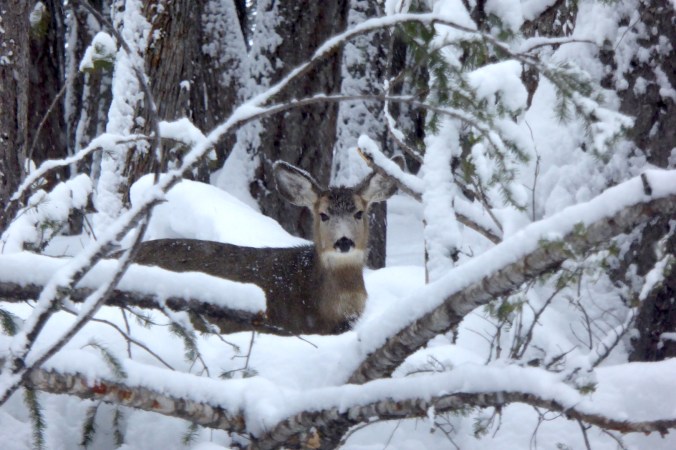
That elk appeared to be alone, but as I approached the end of the trail near the lake, I skied past two deer, at least one of which was a buck, sans antlers.

mule deer looking at camera through fallen trees

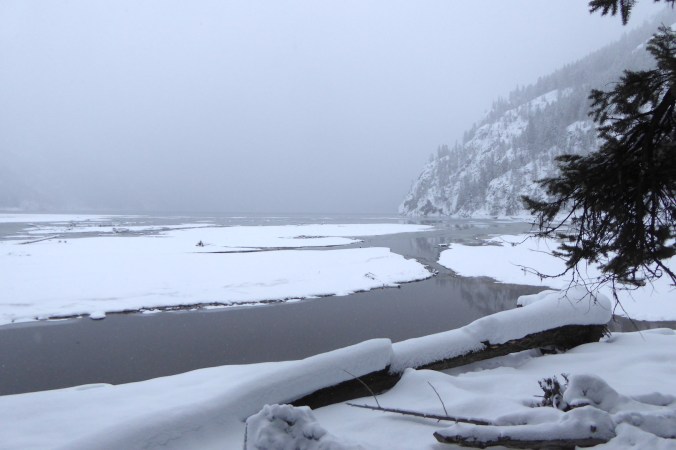
The Stehekin River Trail ends at Weaver Point where the National Park Service maintains a boat-in/hike-in campground. Snow reduced visibility in the dim afternoon light, but the scene was gorgeous.

snow covered mud flats and steep mountainside

Lake Chelan seen from Weaver Point.

Seeing the land blanketed in a meter of snow gives it a very different appearance. It was almost as if I was exploring the area for the first time. In a way, I was. Winter in the Stehekin Valley is wholly different than summer.

Joyce Kilmer Memorial Forest

Old growth forests in the eastern U.S were formidable barriers to colonization, places to be subdued and civilized, to fuel industrialization, not preserved. Today, we view old growth forests differently. They give refuge to rare species, support diverse ecological communities, and often provide the conditions necessary for trees to attain their maximum size and age. While visiting Joyce Kilmer Memorial Forest in the Nantahala National Forest, I thought about why these forests remain so important despite the some negative changes they’ve recently undergone.

Prior to European colonization, forests in the eastern U.S. formed a mosaic of complex habitats, owing to natural disturbance regimes and the influences of American Indian nations. An unbroken old growth canopy stretching for the Atlantic Ocean to the Mississippi River is mythical and never existed. Lightning-caused fires, human-caused fires, tornadoes, ice storms, hurricanes, and insects imparted constant change. Some forests were likely disturbed every few decades at minimum, while others grew undisturbed for hundreds of years.

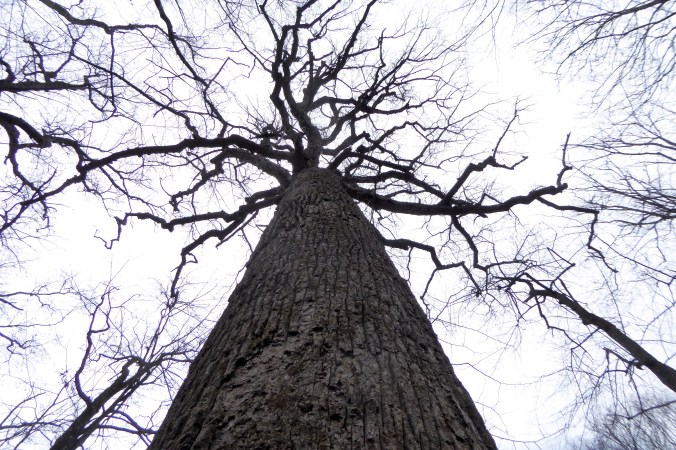
Joyce Kilmer Memorial Forest is one of those places that grew relatively undisturbed. It is a pocket of old growth tucked away in the rugged mountains of western North Carolina. While many impressive trees grow here, the most impressive and largest trees are Liriodendron tulipifera, the tulip tree. Also known as tulip-poplar or yellow-poplar, tulip trees grow fast and tall (the tallest individual tree in the eastern U.S. is currently a tulip tree) and are easy to identify in summer because of their distinctively-shaped leaves.

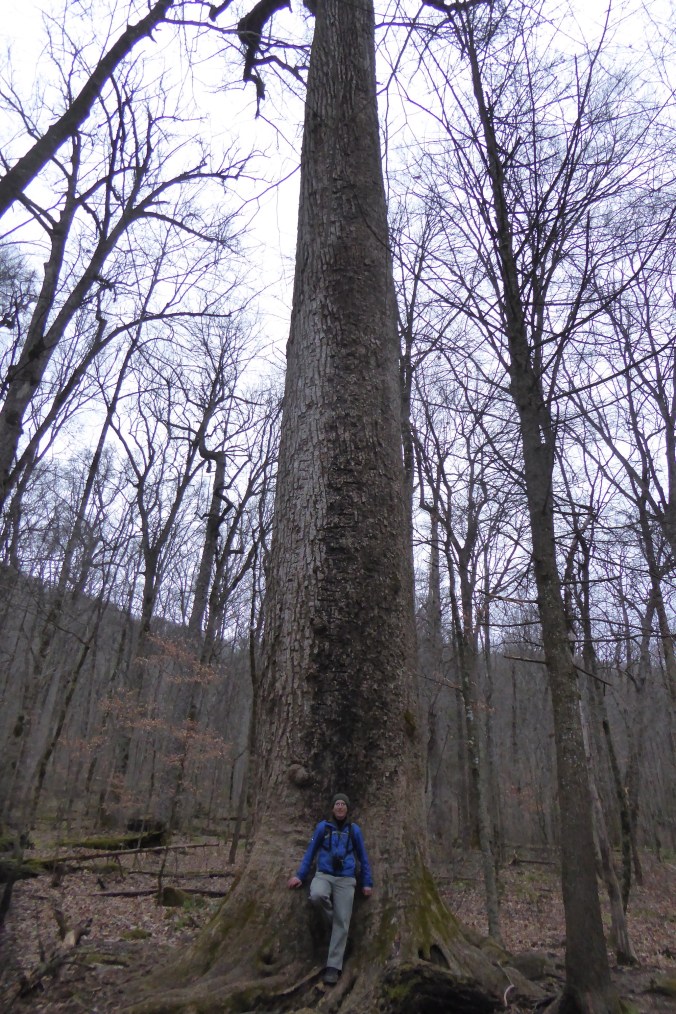
No live leaves hung from the tulip trees on the overcast, early January day when I visited, but this allowed me to contemplate the trees’ full scale. The tulip trees at Joyce Kilmer are the largest of the species that I’ve ever seen. Many exceed 15 feet in circumference at chest height, approach 150 feet tall, and are several hundred years old.

person standing at base of large tree

I was impressed by complex crowns of the largest trees. Most trees in the eastern U.S. today don’t attain such large, complex crowns. They simply aren’t allowed to grow long enough. Many of the crowns were scarred and broken by centuries of battles with wind, ice, and other forces that try to break the tree down.

crown of large tulip tree

Since tulip poplars are intolerant of shade, the largest tulip trees at Joyce Kilmer likely sprouted and began to dominate the canopy after a major disturbance, like a fire or tornado, swept through the area several hundred years ago. The now towering tulip trees effectively shade the understory, suppressing the germination and growth of their offspring. Instead of young tulip trees, the understory of the forest was filled with more shade tolerant species like sugar maple and American beech. In a couple of hundred years future visitors may see giant sugar maples growing over the decaying remnants of tulip poplars.

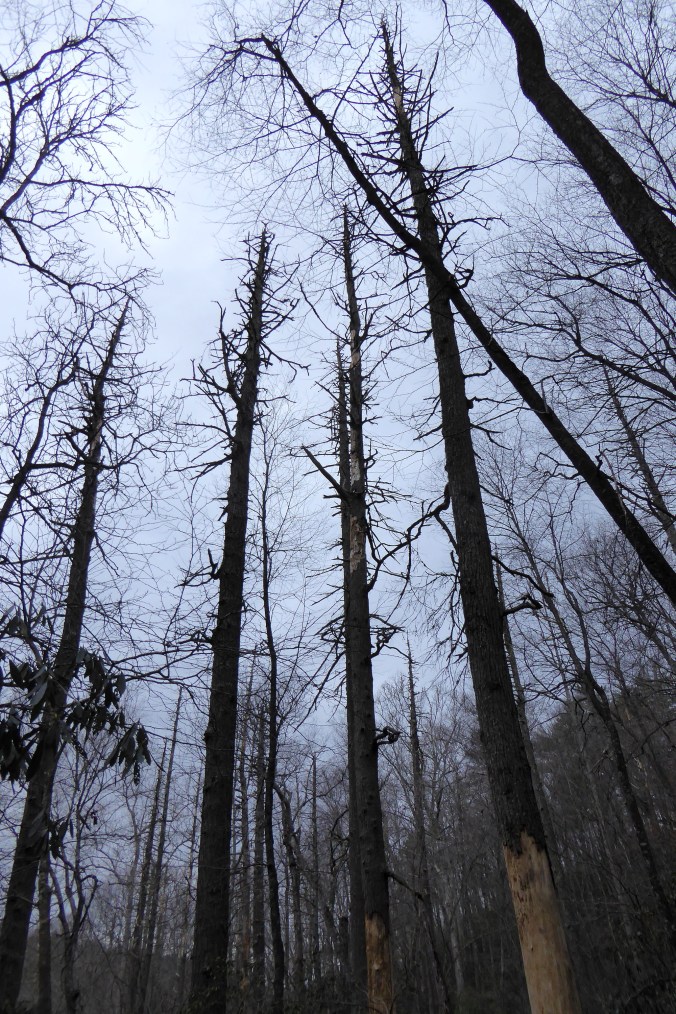
Despite the beauty and stateliness of the trees at Joyce Kilmer, this isn’t forest primeval. No such thing exists in the eastern U.S. Evidence of significant, human-caused changes are easy to find here. Until recently, Joyce Kilmer Memorial Forest contained many large eastern hemlock trees. Now, however, almost every hemlock tree in the grove has been killed by hemlock woolly adelgid, a non-native, invasive insect that basically sucks starch out of the hemlock. I found only a handful of live hemlocks in the grove, and none were particularly large.

dead hemlock trees

These hemlocks were killed by hemlock woolly adelgid.

Disturbed, young forests are easy to find. Joyce Kilmer Memorial Forest is different. It represents the forests which used to exist and provides examples of the threats forests face today. The tulip trees at Joyce Kilmer are massive, dwarfing almost everything there, especially me. I walked under the trees in wonder even though this place is very changed. I can’t pretend this is the same forest with the same species composition as it was even a hundred years ago. Among other changes, the hemlocks are dead or dying, American chestnuts are functionally extinct, and passenger pigeons no longer darken the skies. Still, I don’t want to demean this place as less special because it’s not what it once was. On the contrary, it is more special because forests like this are so rare.

person standing at base of large tree

In the Salt Marsh

Along the Atlantic Ocean and Gulf of Mexico, from Newfoundland to Florida, you can find a special habitat—the Spartina salt marsh. A transition zone between the land and the sea, this is a challenging place to live for many organisms. I found myself with some spare time while visiting family in South Carolina, so of course I couldn’t resist exploring a nearby salt marsh, one of the most productive ecosystems on Earth. This habitat produces more biomass per meter than almost any other biome. Only tropical rainforests are more productive.

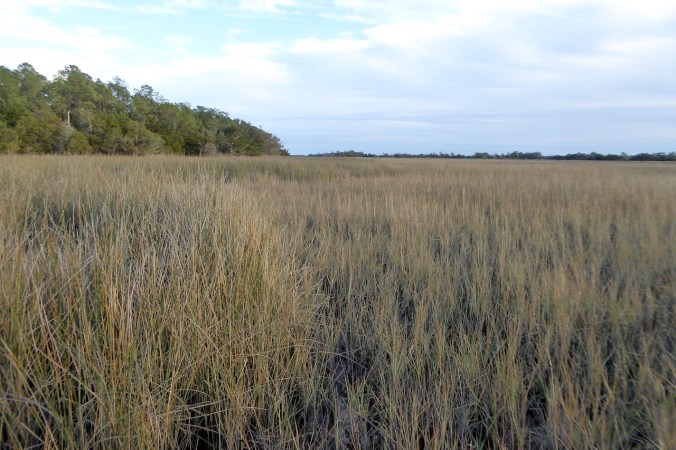
brown grass in salt marsh meadow

A typical salt marsh scene in winter: golden-colored cordgrass.

I reached the marsh near low tide, which exposed soggy ditches and mud flats. The mud was soupy in places, sucking at my boots.

Looking down on boots in soupy, dark brown mud.

Oysters clung together in the lowest reaches of the tidal flats and ditches. The tips of their shells may be fragile, but they are also extremely sharp, as sharp as a surgeon’s scalpel. I don’t know whether the shell’s sharpness is an accident of evolution or an adaptation to protect them from predators like drums, rays, and clumsy humans like me. I do know that I’ll never forget the first time I tried to walk over a few oysters while only wearing flip flops. Trust me, it’s not a pleasant experience.

oyster shell with sunlight passing through translucent upper portion of shell.

The edges of many oyster shells are thin and fragile, but also very sharp.

Walking was easier where vegetation was firmly established. On the U.S. Atlantic coast, most salt marshes are dominated by Spartina grasses. There are several species of Spartina, but the most abundant is salt marsh cordgrass (Spartina alterniflora). Cordgrass thrives in this habitat, despite the harsh conditions—flooded twice-daily by tides, exposed to high salinity, and mired in anoxic (oxygen-free or oxygen-limited) mud.

golden brown grass, trees seen on horizon

Salt marsh cordgrass is the most abundant and ecologically important plant in East Coast salt marshes.

Most flowering plants have a fairly low tolerance for salt, but the cordgrass is watered by the ocean twice a day. Cordgrass meets the salty challenge by sequestering salt in its shoots and excreting the salt through glands in its leaves. The grass deals with the challenge of low oxygen levels in the deep mud by exchanging gases from roots in the upper few centimeters of mud to those underneath. Few plants have these dual abilities, which is the reason cord grass so thoroughly dominates salt marshes. Once you learn to identify salt marsh cordgrass, you can easily and accurately judge the average level of high tide, since cordgrass is usually limited to areas that receive substantial flooding with each high tide.

brown grass of salt marsh, taller rushes on left of photo, trees on horizon

The transition between the low marsh to the high marsh is marked by plants other than salt marsh cordgrass. The high marsh lies above the typical high tide line. Plants like black needlerush (Juncus roemerianus), salt meadow hay (Spartina patens), salt grass (Distichlis sp.), and saltwort (Salicornia sp.) begin to compete with cord grass where tidal flooding is less frequent. Needlerush is the taller plant on the left of the photo.

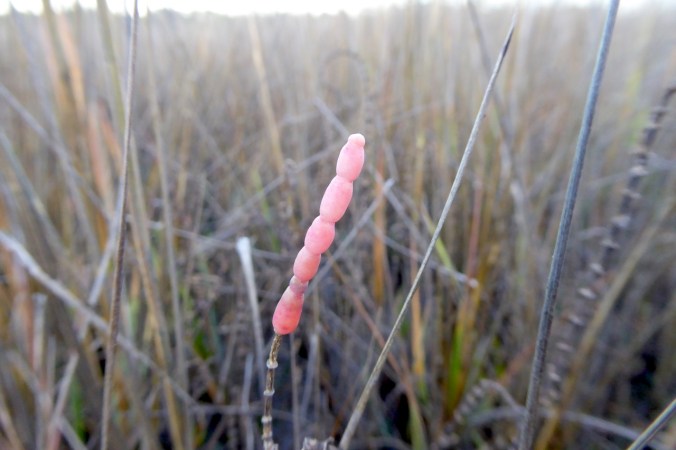
pinkish, segmented stem of saltwort

Saltwort is a noticeable member of the mid to high marsh community.

Unlike salt marsh cord grass, saltwort tolerates high salt levels through its ability to retain water in its stems, but it cannot withstand the same level of submersion that cordgrass can. Saltwort always captures my attention though, not only because it is a pretty plant, but because it is tasty. Late December is not a choice time for nibbling on saltwort stems. Few were even standing, but the sight of them reminded me of their pleasing salty bite. (I’ve also pickled saltwort using a recipe I found in a Euell Gibbons book. It tasted surprisingly good.)

Before leaving the marsh, I took some time to watch birds out on the lower fringes of the exposed mud. A casual scan through binoculars revealed over a hundred semipalmated plovers. On the edge of the marsh, these birds work to survive the winter before returning north to their breeding grounds from Newfoundland and Labrador west to Alaska.They were also finding a few more invertebrates than I was.

shorebird pulling a worm out of mud with its bill

Worms are yummy for plovers.

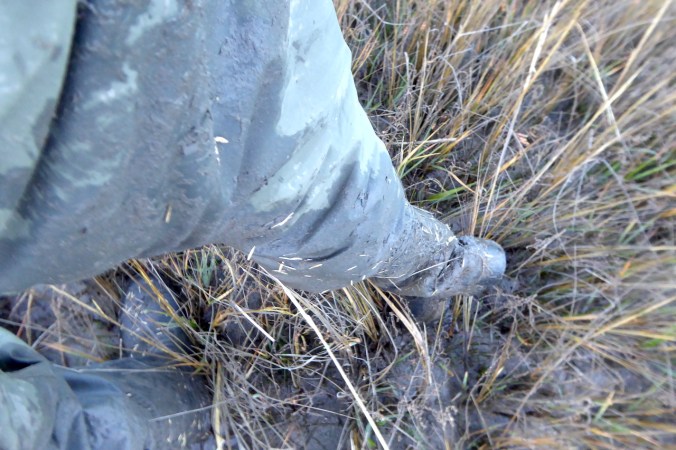
My urge to get a little closer to the exposed mudflats brought me to the edge of the cord grass where the mud was very soft. While plovers were pulling invertebrates out of the mud, I was having some difficultly extracting my boots from the mud. Salt marshes are challenging places to live and, if you’re human, difficult places to travel.

looking down on very muddy pants and footware

Salt marsh trekking is dirty business.

Earth Time Lapse

Nothing is completely static on geologic timescales, but some features—like volcanoes, barrier islands, glaciers, and human development—change faster than others. To see these changes, I’ve been playing around with Google’s Earth Engine. By combining over 30 years of Landsat imagery it offers a remarkable look at how Earth’s surface has changed recently. I found reason for concern, but was reminded just how beautiful the planet is.

Volcanoes

Volcanoes are the most dynamic landforms on Earth. While the above GIF’s imagery starts a few years after Mount Saint Helen’s 1980 eruption, it captures the volcano’s awakening from 2004-2008 when a large lava dome grew in the crater. Very cool.

Surtseyan eruptions are island forming eruptions that happen in shallow water. In 2011 and 2012, you can see new islands suddenly appear on the sea’s surface in the Zubair Group, volcanic islands in the Red Sea. Few people have seen new islands form, but there they are. Super cool.

Barrier Islands

Barrier islands move, often rapidly. Toms Cove Hook is protected as part of Assateague Island National Seashore and Chincoteague National Wildlife Refuge. Unlike most barrier islands on the Atlantic coast of the U.S., Assateague is almost free of permanent structures and roads. Toms Cove Hook has no development at all. Here is an increasingly rare opportunity to watch a barrier island dance. Beautiful.

Fire Island is a national seashore off of Long Island in New York. Before the 2012 breach, watch the sand slowly creep across the island. Barrier islands move shoreward when sea levels rise. They are not permanent features. When allowed to move naturally I find these islands exceptionally beautiful, but they are no place for permanent roads or structures. It’s human folly to build on these islands. They simply change too quickly.

Glaciers

Carbon Glacier carves the north slope of Mount Rainer. Worldwide, glaciers have undergone significant declines over the last 30 years and Carbon Glacier is no exception, but that doesn’t mean glaciers still don’t flow downhill. Even receding glaciers continue to erode the land as Carbon Glacier demonstrates. It carries sediments downhill in a conveyor belt-like manner while its terminus shrinks. I find a glacier’s flow mesmerizing.

Human Development

This is, sadly, probably the easiest example of rapid change to find on Earth today. Cranberry Township, Butler County, PA is a typically example of the development much of the U.S. has experienced in my lifetime. I grew up about 20 miles north of here and witnessed its semi-rural farmland transform into a maze of tract homes and strip malls.

That rainforest destruction I heard about as a kid really hasn’t abated either. GIF showing destruction of Amazon rainforest

Who knew it would be so easy to watch decades of change? Tools like the Earth Engine are amazing and they allow me to see the world like never before. As I browsed I was awed by power and beauty of natural changes and saddened by the rate humans are altering the planet. Hopefully, we can use information like this to inspire everyone to protect what we have left.

Brooks River Bears Need Your Help

two sleeping bear cubs

402’s spring cubs rest near the Lower River Platform at Brooks River on October 24, 2013.

Addendum: Please read the response to this issue by Katmai’s Superintendent, Mark Sturm.

In 2017, an elevated bridge and boardwalk will be constructed at Brooks River. In this post, you’ll find a letter that asks Katmai National Park to further restrict the timing of staging and construction for the bridge. My reasoning is outlined in the letter. I wrote it because I believe no staging or work on the project should happen from late June to late July or September and October. Brooks River’s bears, especially those who are not habituated to people, need complete access to the lower river area in the fall. That is their last chance to gain weight before hibernation. The current work schedule allows staging and work to begin when bears need Brooks River most. This is not acceptable.

You are welcome to use the letter to contact the park. You can use it as is, or personalize it as you see fit. You can copy the letter’s text below or download the rich text file which can be used with almost all word processing software.

Before you contact Katmai with your thoughts, please consider the following…

  • The construction dates for the bridge project are in a federal contract which has already been awarded. If the dates can be modified it won’t be a simple process since it’s currently a contractual obligation. Don’t expect any change, if it comes, to be quick.
  • Form letters are easy to respond to, because the recipient only needs to write one response. Personalized messages often require more in-depth responses.
  • Phone calls can be more effective than written correspondence.
  • Be polite and respectful when you contact the park. The people who manage Katmai are intelligent and well-meaning. They do not deserve insults or personal attacks.

You can contact the park in several ways.

And now the letter:

Superintendent Sturm,

As you know, an elevated bridge and boardwalk will be constructed at Brooks River in 2017. The summary of work outlined in the project’s construction specifications generally restricts work and staging of equipment and supplies outside of July. Yet, it places minimal restrictions on staging and construction in late summer and fall. This will have serious impacts on bears who need full access to the river in September and October. I urge you to reconsider the construction schedule and modify the current contract to minimize the project’s impact on bears.

The construction schedule allows work in the river corridor to commence as soon as October 1. Work hours outlined in the construction specifications also permits staging on the spit at the mouth of Brooks River anytime after August 1. These activities can potentially displace many bears from the lower river, especially those who are not human-habituated.

Dozens of brown bears gather at Brooks River throughout September and October. The fall feeding period is especially critical, since bears are hyperphagic and need access to Brooks River’s abundant salmon. The river mouth provides salmon catch rates far higher than other areas of the river. Additionally, many bears who use the river in the fall are not habituated to people or vehicles. Habitat use by these bears is already restricted by the presence of people. Staging and construction in the fall will further displace these animals. Impacts to wildlife and the visitor experience from staging and construction of the bridge is of short duration, but can potentially be serious for individual bears who need to utilize the river. Bears that feed at Brooks River may do so because they know of no other or better place. For them, salmon in Brooks River ensures their yearly survival.

I understand that water levels in Naknek Lake provide a narrow window to transport materials and supplies to Brooks River, and often this can only occur in mid to late summer. However, this does not justify displacing bears from the food resources they need to survive, even for one season. Brooks River is a world famous bear viewing area. In FY16, the bearcams received 40 million hits. Brooks River’s wildlife deserves the highest level of protection possible. To do this, I urge you to place further restrictions on the construction schedule for the elevated bridge at Brooks River. Staging should only occur outside of July and September-October. Construction and clearing work in the river corridor should begin no sooner than November 1.

I look forward to your response and thank you for your time.


Addendum: Please read the response to this issue by Katmai’s Superintendent, Mark Sturm.

Sometimes Individuals Lose While Species Win

pine cones on the ground

Many seeds in these cones wait to be released.

Fire is a boon to some species and a detriment to others. When fire sweeps across the landscape there are winners and losers.The cones of lodgepole pine (Pinus contorta) demonstrate adaptations that allow the species to survive potentially catastrophic changes.

Serotiny is an adaptation of some plants to release seeds in response to an environmental trigger. Serotiny is expressed in lodgepole pine through its cones. In fire prone habitats, lodgepole pine cones are glued shut by resin. Heat from fires melts the resin allowing the cone scales to separate and release seeds. Since it’s not safe to watch a wildfire burn through lodgepole pines, I placed a tightly sealed serotinous cone from a lodgepole pine in a toaster oven to watch how it responded to temperature changes.

The cone scales began to expand noticeably when the temperature reached about 50˚C (122˚F).  According to the U.S. Forest Service, more precise lab experiments have found the resinous bonds between the cone scales begin to break between 45˚C and 60˚C, so serotinous cones lying at or near the soil surface can also open with these ground temperatures. If this cone was kissed by fire its scales would have expanded and allowed the seed to be slowly released. (I let the temperature in the oven rise to over 200˚C (400˚F) just because I felt like watching the scales fully expand.) Serotinous cones collect on the ground or on tree branches for many years. The seeds under the scales lie in a state of dormancy, waiting for the opportunity to sprout.

Not all stands of lodgepole pines have serotinous cones. Serotinous cones are not common in eastern Oregon, rare in coastal populations, absent in some fire prone habitats like the Sierra Nevada, and “many stands in the Rockies have less than 50 percent serotinous-cone trees.” Wherever it grows through, lodgepole pine thrives in full sun. Its seeds sprout best in or on bare mineral soil and disturbed duff free of competing vegetation—the exact conditions many fires create.

small pine trees under taller, dead-standing trees

After huge wildfires burned large swaths of Yellowstone National Park in 1988, lodgepole pine sprouted back in earnest. This NPS photo was taken ten years after the ’88 fires. The lodgepole trees are much larger now.

Serotiny in lodgepole pine makes large quantities of seeds available to germinate following a fire. In many cases, especially regarding lodgepole pines, fire may be an enemy to the individual, but not to the species.

Bears Have Long Memories

Mother bear standing on rock. Her cub sits on the rock between her legs.Bear cubs are apt to reflect mom’s mood. When she’s relaxed, they are relaxed. When mom is alert and stressed, her cubs are on edge. Cubs also take a keen interest in anything that their mother investigates. In this way, they learn much about what to eat, where to find food, and many other survival skills. In this way, mother bears are teachers. However, mother bears may teach their cubs behaviors that lead to conflict with humans.

In a study recently published in the journal PLOS One, researchers from the University of Alberta found that behavior that leads to conflict with humans is not genetic. It is learned. Bears who were raised by mothers with a documented pattern of conflict with humans were more likely to be involved in conflict with humans as adult bears. The study identified 213 bears (118 males and 95 females) through DNA extracted from hair samples, then examined behavioral patterns in both father-offspring and mother-offspring relationships. The researchers concluded over 60% of offspring from “problem mothers” were likely to be “problem bears.”* In contrast, only 29% of bears from “problem fathers” were identified in bear-human conflicts. This was very similar to the percent of bears (30%) involved in bear-human conflict raised by mothers with no history of conflict with people. Since male bears have no role in raising cubs, the evidence in the study suggests that behavior leading to conflict with people is learned, not inherited through genes.

If you watch Katmai’s bearcams, you may be familiar with the escapades of 273 and her cub. These bears are famous for their curious and playful nature. Over the past two summers, they were prone to investigate almost anything that caught their attention. In 2015, they damaged buildings at Brooks Camp which prompted rangers to escalate their hazing techniques to deter them.

Tar paper shack surrounded by portable electric fence.

This building was damaged by 273 and cub in August 2015. I helped to erect the electric fence as a temporary deterrent to further damage.

They repeatedly damaged a sign near the bridge over Brooks River.

They caused wildlife technicians to photo-bomb a live chat on archeology.

They even played with unattended construction equipment.

I took the video of 273 and her cub with the construction equipment from inside a cabin last summer. Clearly, this family has demonstrated an interest in human objects and equipment. They are also relatively habituated to the presence of people. Since 273 has exposed her cub to people and buildings, does this increase the likelihood that the cub will repeat those behaviors when he becomes an independent bear? All signs point to yes.

I’ve long suspected that bears raised by highly human-habituated mothers are more likely to demonstrate high levels of habituation toward humans when they are adults. I’ve also suspected the same with bear-human conflict. If mom teaches her cubs to investigate human equipment or seek out human food, then the cubs are going to remember those experiences when they become independent bears. The study from Alberta provides some evidence to support my suspicions.

Does this mean that 273’s cub is destined to damage property at Brooks Camp? Not necessarily as long as rangers, lodge staff, and visitors at Brooks Camp are vigilant and actively work to eliminate conflict between bears and people. (Access to lots of natural food is extremely important too.)

Mother bears are teachers and cubs are students, but not everything cubs learn from mothers is advantageous in a world where habitat is increasingly crowded with people. Mother bears teach their cubs many survival skills, some of which can lead to conflict with humans. We can’t change the way bears live, nor should we. The onus is on us to act in ways that allow bears space to live and survive without learning behaviors that lead to conflict.

——-

*I discourage the use of “problem bears” as a term to describe bears involved in bear-human conflict. The term was used in the study, but this label stigmatizes bears in negative, anthropomorphic ways. These bears are only exploiting opportunities presented to them. The problem isn’t the bear. The problem is the temptations for conflict provided or caused by people.

Squirrels and Truffles

The forest is blooming with fungus in Lake Chelan National Recreation Area. Mushrooms are easy to find on the forest floor, but the mere presence of a few mushrooms does not reflect the abundance of fungus working under the soil, nor their importance.

On most of my recent hikes I’ve stumbled upon small excavations in the soil. Typically, the depressions are a few inches across and deep. Even though I haven’t witnessed the excavation in progress, just the end result, I suspect these are made by rodents searching for fungus in the soil. On the Lake Shore Trail, south of Stehekin, I found clue to support my hypothesis.

small hole in soil with fungus at bottom

The small depression next to the tip of my shoe contains a truffle.

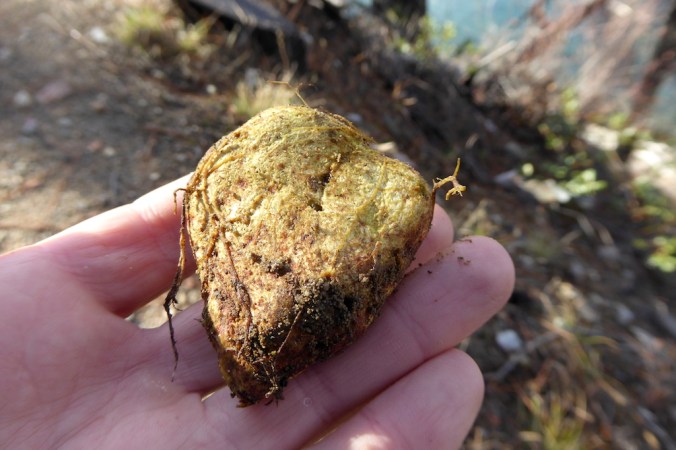
Inside the hole was a truffle. Truffles are mychhorizal fungi. They do not photosynthesize, but these fungi are not parasites. They live in a symbiotic relationship with tree roots. Trees provide the fungi with sugar and the fungi provide trees with water and nutrients like phosphorus and nitrogen.

truffle in hand

This is the truffle at the end of the excavation. Over 350 truffle species in 50 genera inhabit the Pacific Northwest.

Truffles are highly sought after by fungal connoisseurs, human and rodent alike. They are especially important to flying squirrels, but rodents like flying squirrels are equally important to truffles. Unlike your typical toadstool, these underground fungus have no spore dispersal mechanism. They need animals to dig them up to spread their spores.

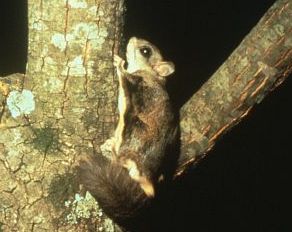
squirrel on tree

Northern Flying Squirrel (Glaucomys sabrinus), USFWS photo.

Flying squirrels, in particular, love truffles. Under the cover of darkness, flying squirrels find truffles by their odor, unearth them, and greedily devour them. Truffle spores are then distributed randomly and effectively in squirrel scat. For reasons unknown, my truffle was not harvested. Small rodents that eat truffles are preferred prey of owls and weasels. Was the excavator of this truffle snatched up by a unseen predator?

I don’t know the end to this particular story, but this is evidence of more than a rodent and hole. It symbolizes how predators need rodents; how rodents need fungi for food and trees for shelter; how trees need fungi for nutrients; how fungi need trees for sugars and rodents for dispersal. The tiny hole I found is more than superficial. It leads to a world of interdependence.

——

For more info on flying squirrels and truffles, check out Squirrels Cannot Live by Truffles Alone and Ties that Bind: Pacific Northwest Truffles, Trees, and Animals in Symbiosis.