Tide Watching at Bay of Fundy

Consider the plight of the northern acorn barnacle. They begin life as planktonic larvae drifting in the vast ocean, motile yet vulnerable. If one survives its many instar stages, it then seeks a more permanent home. The barnacle settles out of the water column and glues their antennae to a rock or other suitable location where they metamorphose into the shelly animal that we’re most familiar with. There’s no going back at this stage of life. The barnacle has become forever sessile with a head cemented to rock and legs filtering food from the water.

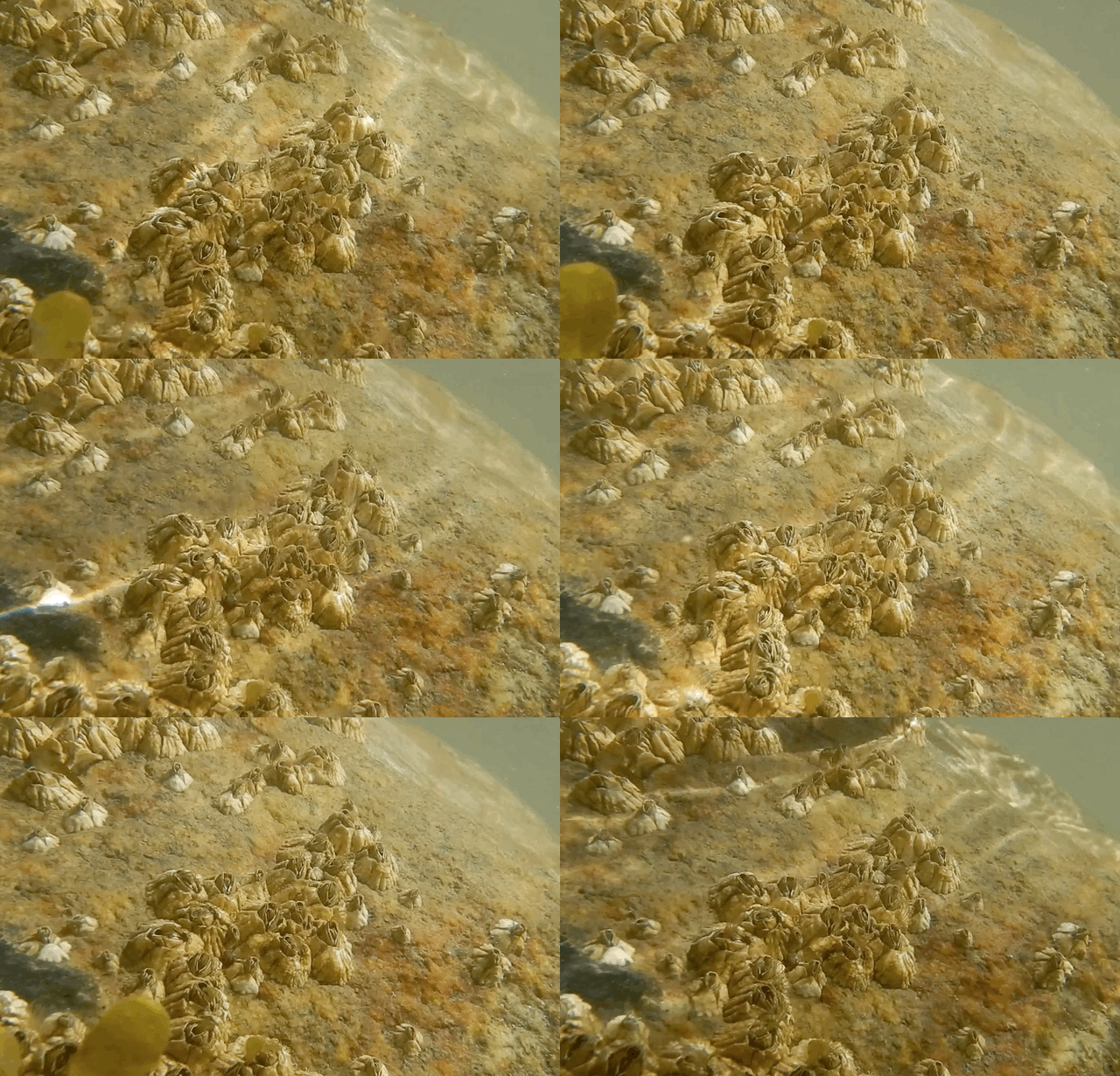
GIF from underwater video showing barnacles on a rock. The barnacles are open and filtering food from the water.
“How else would you attach to a rock?” the barnacle asks. “Certainly not with your feet. You could never eat.”

Many barnacle larvae never get the opportunity to make a permanent home. Predators or some other hazard culls their numbers. They must be choosy in their settled life too. A forever home needs to be close to other barnacles, since mating takes place between closely neighboring barnacles.

Once secured to the rock, flood tides carry life-sustaining nutrients as well as predators like sea stars and dog whelks. Ebb tides expose the barnacle to suffocating air, potential dehydration, intense summer sun, and winter’s freezing temperatures.

Still, their adaptations provide for success despite the risks. I described it as a plight earlier, and although their journey is filled with uncertainty, perhaps I am being unfair to them. Acorn barnacles are common in North Atlantic intertidal zones. Their shell resists the forces that work against them. The acorn barnacle is a tough critter built for enduring uncertainty and extremes of its intertidal habitat.

Tidal zones and the creatures that make a living amongst the habitat’s extremes have always fascinated me. I’m not aware of any habitat that changes its mood and appearance as much as the intertidal, which is why I found myself earlier this year at Canada’s Fundy National Park, wondering about barnacles and power of the ocean as I watched the biggest tides in the world.

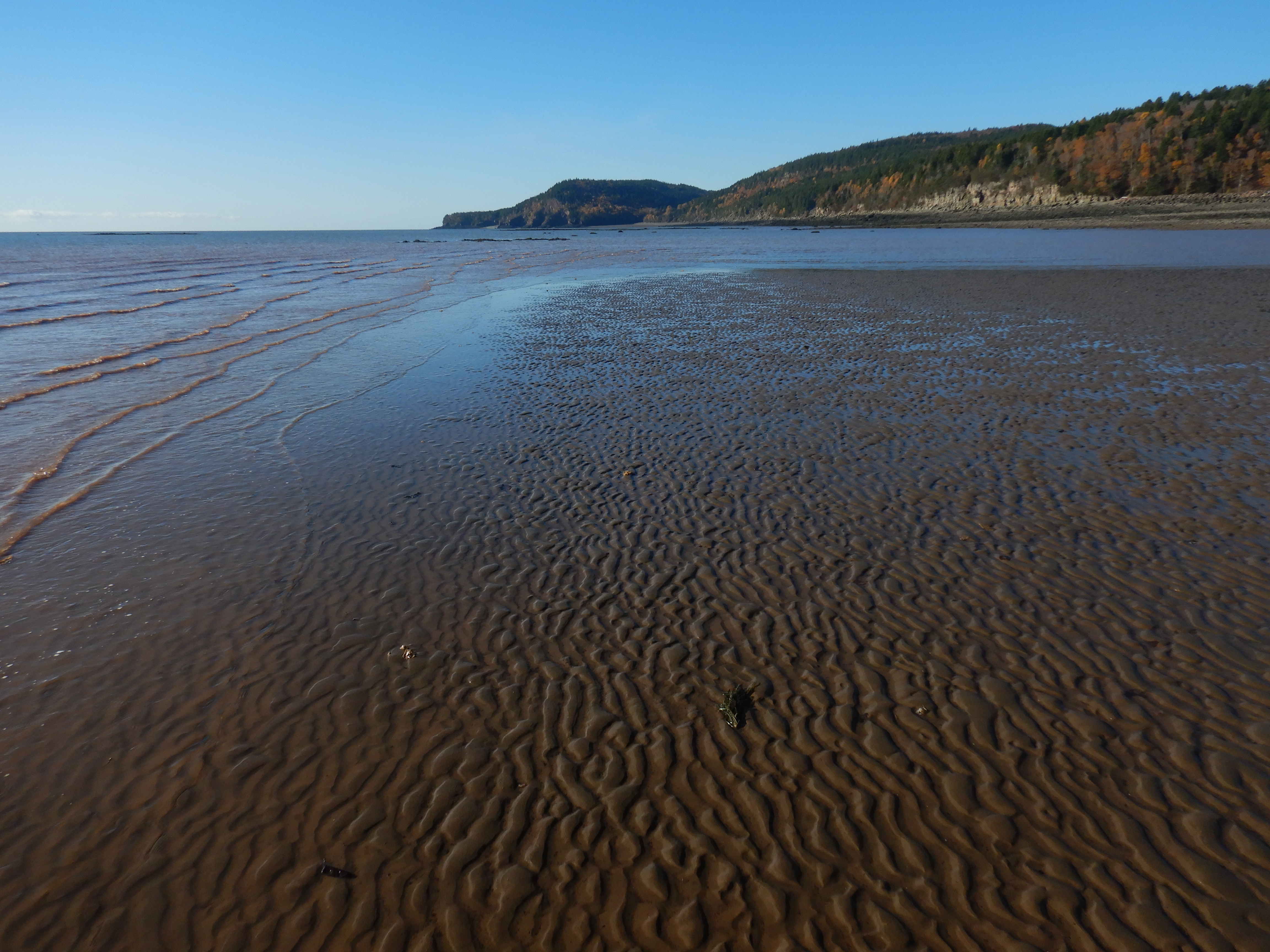
sandy mudflats with a rippled surface border muddy water. Blue skies and tall headlands mark the sky and horizon.
Near Alma, New Brunswick at low tide. The headlands of Fundy National Park encompass the coastline.

My first opportunity to really pay attention to tides was at Assateague Island when, fresh out of college, I spent two summers working at the national seashore. Assateague’s modest three-foot tides never became life threatening (not even when I purposefully got myself stuck in quicksand up to my waist). When the tide got inconvenient, I could mosey away. An incoming Fundy tide demands attention, however. Twelve meters—forty feet—of water rise twice a day along Fundy National Park’s headlands. Places farther north and east can experience even larger tides, perhaps 16 meters or greater in height.

I wanted to watch the tides transition fully from low to high, so I planned the trip to coincide with mid morning low tides and mid afternoon high tides. On my first full day in the park, I set up a chair on the Alma Beach about 30 minutes before the predicted nadir of low tide and walked down to the water’s edge.

The outgoing tide opened access to vast mud and sandy flats, which are extraordinarily tempting to explore. After all, who doesn’t see a mile of mud in front on them and not want to be out in it? I had to remain cautious, though. I lacked knowledge of the shorelines topography and the water’s nuanced interactions with it. I worked to always keep an avenue of escape available.

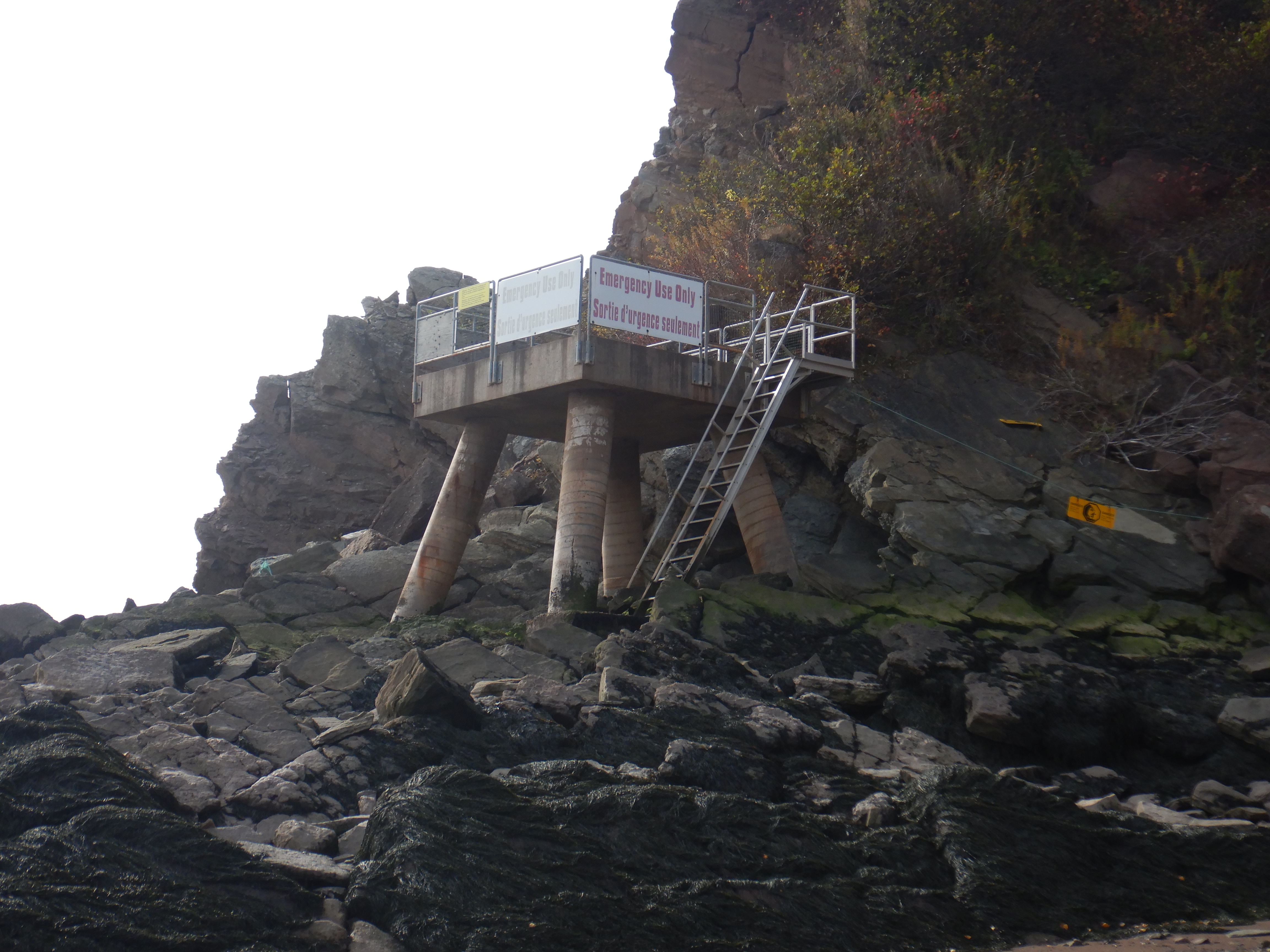
A concrete platform standing on large cyclindrical concrete legs sits against a cliff. A sign on it in red letters says, "Emergency Use Only," and this being Canada, "Sortie d'urgence seulement."
Sortie d’urgence seulement. I found it easy to underestimate the rate at which an incoming Fundy tide swamps the intertidal. Although I avoided it, stranding by incoming tides must have happen often enough to justify the construction of an emergency platform at New Brunswick’s Hopewell Rocks Provincial Park. Respect the water.

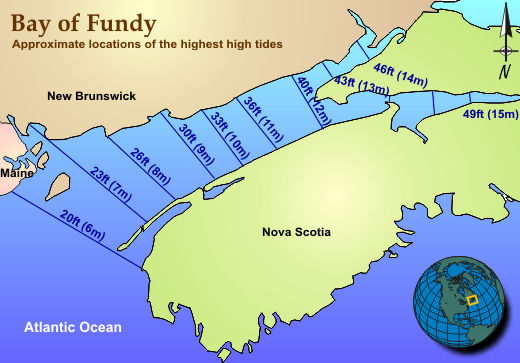
An accident of geography allows Fundy tides to become so large. The bay’s shape accentuates tidal forces. According to NOAA,

“Liquid in a tank, or in this case a basin, will flow back and forth in a characteristic “oscillation” period and, if conditions are right, will oscillate rhythmically. In essence, a standing wave develops. The natural period of oscillation in the Bay of Fundy is approximately 12 hours, which is also about the same length of time for one tidal oscillation (a high/low tide cycle). This coinciding of the tide cycle and the bay oscillation period results in the much larger tidal ranges observed in the bay.”

A graphical map of Bay of Fundy. Header text reads, "Bay of Fundy: Approximate locations of the highest tides." Map shows southern coastal New Brunswick and parts of Nova Scotia. Lines mark the differences in tide levels.
Fundy tide graphic from Siddiqui et al 2015.

The shift from ebb to flood tide was easy to see at the water’s edge. Unlike the in-and-out rhythm of waves on a more exposed seashore with smaller tides, the water on the Fundy tide slapped upward with each successive wave once the tide turned.

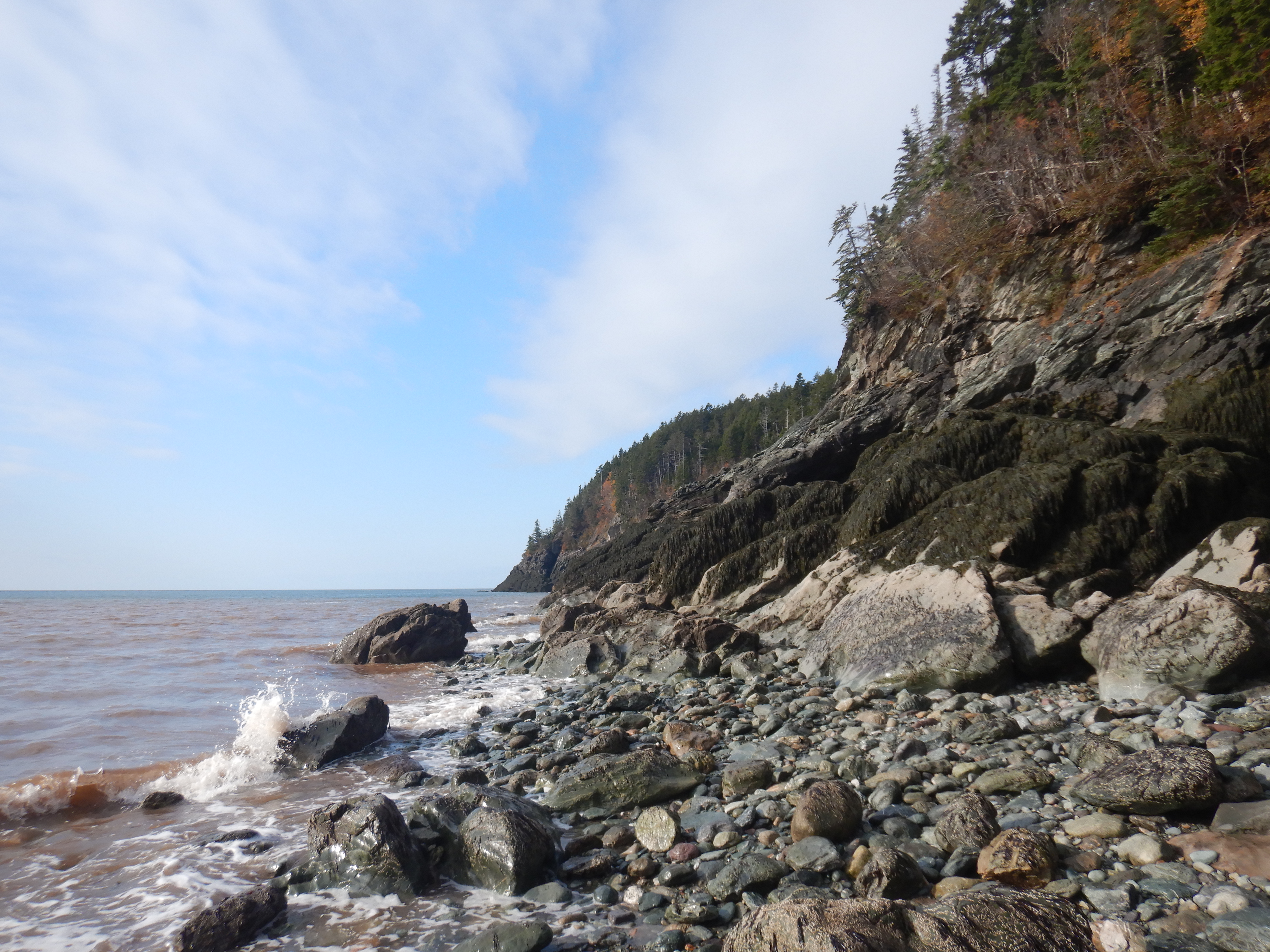
During a low tide cycle the next day, I walked to the exposed headlands at the Point Wolf River estuary. The shoreline showed all the signs of extreme tides, of course, but I still found the height of the tides hard to fathom. I stood far beneath the lower limit of the acorn barnacles and the rockweeds hanging limp in the dry air. The twisting wrack line from the previous high tide was out of sight on the cliff above. I saw evidence of powerful winter storms that uprooted trees and eroded soils approximately 60 feet above me.

A rocky coastline with muddy water splashing against boulders at bottom center. Seaweed covered rocks lead upward to tall headlands with spruce trees at right.
Headlands at the mouth of Point Wolf River.

Within the estuary, the water rolled uphill at the pace of a slow walk.

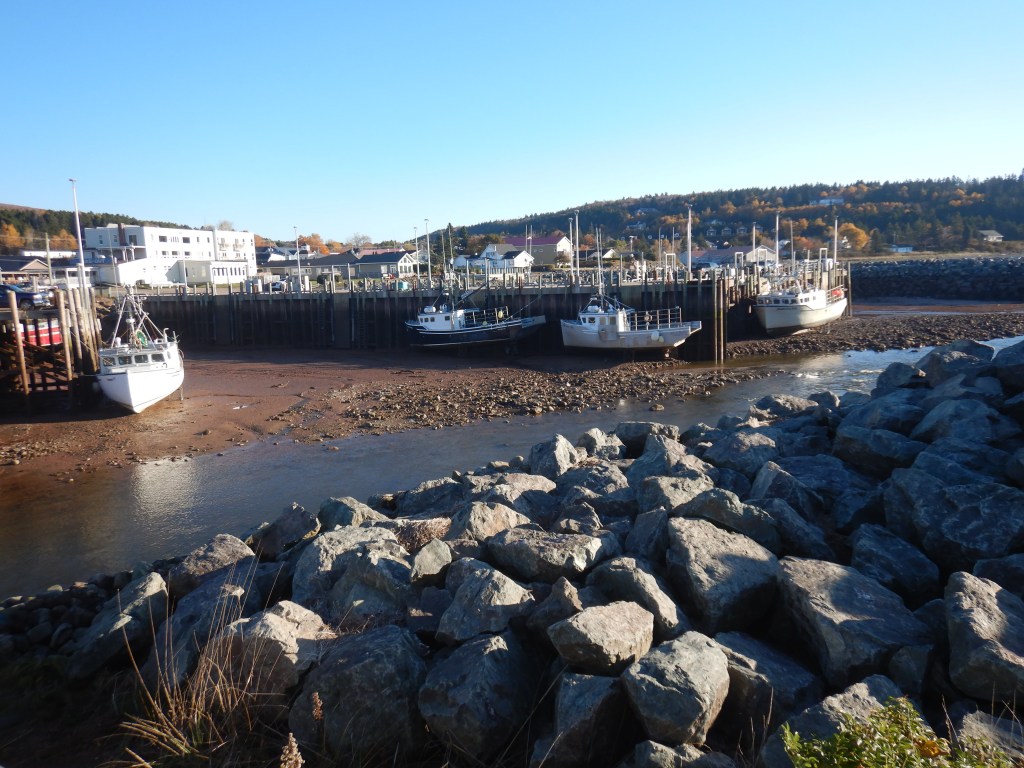
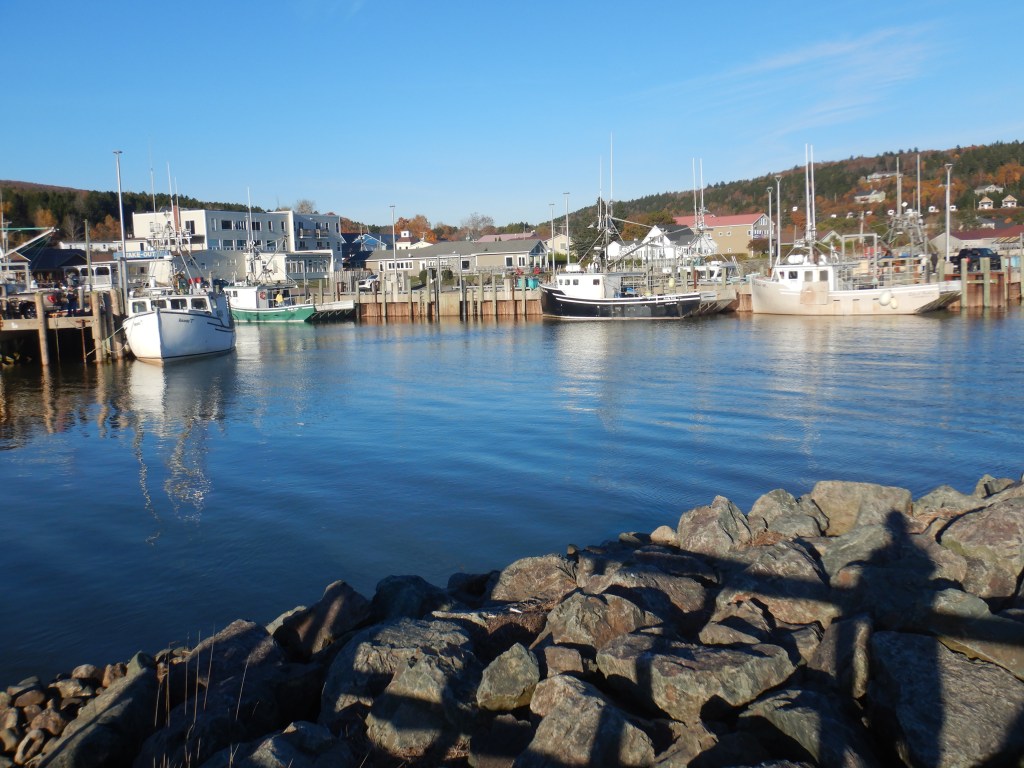
Tides remain a force that humans cannot control. Like the barnacle, we can only adapt to them. In Alma, the small New Brunswick town adjacent to the national park, lobster boats could leave or enter the harbor only at certain tide levels.

Barnacles seem get on with the business of life no matter the phase of the tide. Yet I can’t help consider what their lives must be like secured to a rock for their entire adult lives, living in a habitat changing at a pace that even a lowly human can see. For them, the intertidal might symbolize perfection.

A Dammed Opportunity

In Maine, Atlantic salmon are highly endangered. Prior to European colonization and, later, industrialization of the landscape’s rivers, hundreds of thousands of salmon returned to spawn in Maine every spring. Now, however, a so-called good year includes the return of 1,500 fish to the Penobscot River, which is Maine’s most productive salmon river, and maybe 2,000 fish total statewide. Maine is also the only state with runs of wild Atlantic salmon.

Kennebec River used to be one of Maine’s great salmon rivers, but its Atlantic salmon are nearly extinct. The recent 10-year average (from 2014-2023) of annual returning adult salmon at the Lockwood fish lift in Waterville, Maine is a mere 51 fish. Salmon fare so poorly in the Kennebec because they encounter four impassible dams between Waterville and Skowhegan. Even so, there’s an opportunity to save the Kennebec’s salmon run if we act now. 

The Federal Energy Regulatory Commission (FERC) is considering relicensing operations on four hydropower dams on the Kennebec River. For decades, these dams have lacked any effective fish passage for salmon and have prevented salmon from reaching upstream spawning areas. If the dams are kept in place, even with improved fish passage efforts, we can expect the dams to continue to harm salmon and heighten their risk of extinction. 

Unfortunately, FERC’s draft environmental impact statement (DEIS) for the dams calls for relicensing the facilities at the expense of salmon. At the end of this post, you’ll find the comments that I submitted to FERC about its DEIS. I found reason for extraordinary concern in FERC’s conclusions.

We know that dam removal works to restore fish runs. One of the first and best examples was on the Kennebec in Augusta. The 1999 removal of the Edwards Dam led to a great resurgence of shad, sturgeon, striped bass, river herring, and alewives to the lower Kennebec. Elsewhere in Maine, many people and organizations have worked diligently over the last few decades to restore Atlantic salmon with the largest success occurring on the Penobscot River. (This short podcast explores current efforts to restore sea-run fish in the Penobscot.) On the West Coast, the removal of dams on Washington State’s Elwah River allowed salmon to return in numbers not seen there in 100 years. In California right now, efforts are underway to remove large dams on the Klamath River to open hundreds of miles of river to Chinook and other salmon. In Washington and Idaho there is a growing chorus of support to remove impassible dams on the Snake River for the benefit of salmon and the species (including people) who depend on them.

The upper Kennebec River, though, remains imperiled because four dams block passage of sea-run fish. The few salmon that attempt to return to the upper Kennebec must be captured and transported by truck around the dams to reach any spawning habitat. 

In its DEIS, FERC proposes to relicense the dams of the Shawmet Project on the Kennebec. This seems to be another example of conservation minimalism, which was defined in a 2023 paper as “Any minimal standard [that] inevitably excludes some worthwhile conservation targets—values, obligations, and principles that ought to be upheld, or specific ecosystems and species that ought to be protected—by factoring them out as irrelevant to the specified minimum.” That is, humans taking everything but the bare minimum. We allow a species to persist only in greatly restricted ranges or low overall numbers or both. Regarding salmon, the cost-benefit analysis of dams are too often viewed through a lens that obscures the ecological and cultural benefits of fully restored salmon runs. That viewpoint does not allow for the restoration and maintenance of salmon at their fully realized ecologic potential. 

Too often, “balancing” the wants of people and needs of wildlife, including fish such as salmon, has meant a cumulative degradation and loss of wildlife habitat. Therefore, the so-called balance is not a compromise with wildlife but harm forced on wildlife and their habitats. These decisions eat away at our natural heritage, piece by piece, leaving each successive human generation with a more impoverished environment than the last. FERC is on the cusp of repeating that mistake on the Kennebec unless the FERC requires stronger, more effective fish passage structures for the Shawmut Project beyond what is already proposed in the DEIS or the dams are removed. These dams are not worth more than salmon. Extinction cannot be an option.

Please comment on the DEIS (docket 2322) if you can (which is not a simple process so see these instructions). But I realize this is a last minute request since the comment period closes today (June 4), and most people don’t have time to wade into a 400-page environmental impact statement. So if you can’t comment this time, then I ask you to keep salmon and other sea-run fish in mind when you make your daily decisions. Vote for people who support wild, sustainable populations of fish and will work to improve protections for salmon, which includes tackling climate change ASAP. Don’t eat farmed salmon, as farmed salmon are one of the greatest threats to the viability of Atlantic salmon in North America, especially in Maritime Canada. Finally, please share the amazing journeys of salmon with people you know. The more people who appreciate the remarkable lives of salmon the better.

Thanks for reading and for your support of wild salmon. Below are my comments on the Shawmut Hydroelectric Project. (FERC restricts comments to 6000 characters, which is quite limiting considering that the documents about relicensing dams often run for hundreds of pages. Nevertheless, I tried my best with the character limit.)

I’m writing to urge FERC to recommend the decommissioning of the Shawmut Hydroelectric Project No. 2322 (Shawmut Project) on the Kennebec river. The fish passage measures outlined in the draft environmental impact statement (DEIS) are inadequate and will likely prevent the restoration of self-sustaining runs of sea-run fish, especially Atlantic salmon. FERC should recommend the Shawmut Project’s dams be removed on the Kennebec River. 

We lack the necessary skill and knowledge to engineer fish passage that allows all migratory fish species to overcome the challenges created by dams. On the Kennebec River, it is particularly difficult to provide adequate fish passage around dams because the river is home to at least ten diadromous species that migrate at different times of day, different times of the year, and under different hydrologic conditions. 

Of utmost concern is the Kennebec’s run of Atlantic salmon, a distinct population that is highly endangered. Their recovery is doubtful as long as dams exist on the Kennebec. The DEIS contains no substantive evidence that adding additional fish passage to the four dams on the lower Kennebec will favor Atlantic salmon and enhance their recovery to a point where the population is no longer endangered. 

I’m greatly concerned that Brookfield’s proposed fish passage measures will not provide salmon with the opportunity to migrate rapidly upstream or downstream. For example, page xx of the draft EIS states, 

“Brookfield also intends to achieve an adult salmon upstream passage effectiveness standard of 96% within 48 hours of a fish approaching each project, in order to achieve a cumulative upstream effectiveness standard of 84.9% through all four projects within 192 hours.” 

“Resident time” is double speak for substantial, harmful migration delays imposed on salmon. A 192-hour delay is an 8-day delay for a salmon to travel about 18 river miles between the lowermost and uppermost dam of the Shawmut Project. Since Atlantic salmon are reliant on stored body fat and protein to fuel upstream migration, this will cost adult salmon vital energy reserves as they attempt to find a way past the dams with negative consequences on their reproductive survival. 

Dams make river water warmer and slow its flow. Under future climate conditions, the Kennebec may become warmer during salmon migration periods. Warmer water holds less dissolved oxygen and increases the metabolism of salmon. Therefore, the effects of an 8-day delay will decrease salmon survival and reproduction upstream, regardless of the modeled 84.9% effectiveness. 

Pages 55-57 of the DEIS explore the risks of such a delay on salmon, yet somehow the significant, cumulative, and negative consequences of delays due to the dams are deemed acceptable by FERC. Pg 57 of the DEIS states, “Brookfield’s proposal to test the fishway effectiveness and implement additional adaptive management measures … is a reasonable approach.”

However, FERC’s conclusions on page 57 are not consistent with the science cited in the DEIS. For example, page 56 of the DEIS includes the remarkable statistic that under a four dam scenario on the Kennebec 37.4% of the run would die before spawning. As the Kennebec Atlantic salmon population is close to extinction–the recent 10-year average (from 2014-2023) of annual adults returns at the Lockwood fish lift is a mere 51 fish (DEIS page 44)–then a nearly 40% mortality due to dam-caused migration delays is completely unacceptable. 

Additionally, on page 52 of the DEIS notes that Brookfield “would modify or construct additional fishways only if needed after its proposed fishways are complete and have been tested for effectiveness.” This position also risks further harm to salmon. If new fish passage structures are ineffective, then the Kennebec’s salmon may already be faring worse than now. The most parsimonious and beneficial strategy for Atlantic salmon would be to require, beyond doubt, reasonable and effective fish passage as part of the relicensing process or decommission the dams. Based on the best scientific evidence, FERC’s position is neither reasonable or scientifically justifiable.

Additionally, the reasons why certain species of fish do not take to artificial fish passageways is sometimes unknown. Rivers are complex systems and artificial fish passageways only grossly approximate the conditions the fish would experience in the absence of dams. 

A free-flowing Kennebec River and naturally self sustaining runs of diadromous fish are worth more—economically, ecologically, and culturally—than anything the Shawmut Hydroelectric Project can provide.

Maine’s rivers likely never supported tens of millions of salmon, but they could and should support hundreds of thousands of salmon and tens of millions of sea-run fish collectively. Instead, status quo industrialization threatens to keep our watersheds impoverished. It is difficult to imagine the richness of a river full of salmon in Maine because that phenomenon hasn’t been experienced here in many generations. We suffer from a multi-generational amnesia that has us collectively accepting the near or complete absence of salmon and other sea-run in our rivers when their absence is not at all normal. The DEIS somehow tries, and fails, to justify that the current status quo is okay when it is not.

The electricity generated by the dams can be replaced easily by wind and solar installations. Energy conservation measures across the state could also be implemented to mitigate the loss of the hydropower. As long as these dams exist, the Kennebec’s Atlantic salmon are likely to remain endangered or, at best, exist only as a remnant population, while people and the ecosystem will never experience the full benefits of healthy runs of Atlantic salmon and other diadromous fish. Do not relicense the dams. It is the wrong decision and guarantees, with near certainty, that Atlantic salmon will remain endangered for the foreseeable future.
Fisher and Other Trails

Compared to summer, winter can seem like a dull companion, especially in my corner of the globe. The buzzing of insects ceased months ago. The forest floor rests under one to three feet of snow. Trees, shrubs, invertebrates, amphibians, and fungi lie dormant. Ice insulates wetlands that were vibrating with life not long ago. Migrating birds vanished months ago. Then, there’s the dangers posed by cold weather. Numbed toes and fingers aren’t pleasant, nor are the perpetual threats of frostbite and hypothermia. All-in-all, I could convince myself that winter is a season to be endured rather than embraced. This would be a mistake, though. 

While I miss the sheer volume of aliveness that accompanies summertime, winter has many endearing qualities. It helps me appreciate the abundance of summer. Off-trail travel is often easier when wetlands are frozen and snow smooths the terrain. And few experiences are as peaceful as the immense quiet that accompanies a snowstorm in an isolated grove of trees.

But this post isn’t about falling snow. Rather, it’s about a story written in the snow. Instead of looking at the wintertime forest as lonesome and empty, snow allows me to better understand how the landscape is a fully inhabited place. 

Last Monday, I highlighted the travels of a fisher during More to Explore, a bi-weekly highlight show on explore.org cohosted by Brian Byrd and me.

In the interest of brevity for the show, I skipped some details of the fisher’s trail. Tracking is an art that I’m still learning and I argue that I’m a slow study, but a few clues revealed I was looking at a fisher’s trail rather than a fox, coyote, marten, or lynx, all of whom inhabit the area.

  • Claw marks registered in most of the prints that I examined carefully, effectively ruling out felines since their claws are retractable and don’t register reliably in tracks.
  • The clearest tracks had five toes—an important clue that rules out the canines such as foxes and coyotes. Porcupines, bears, skunks, hares, and rodents can make five-toed tracks too, but they have other features that make them distinctive.*
  • The tracks’ size were too large for other members of the weasel family who live here such as short- and long-tailed weasels, mink, and marten. I could rule out river otters too since there was no evidence that the animal slid across the snow (something otters routinely do) or sought liquid water. The trackway crossed a beaver-created swamp but the tracks did not lead to water as an otter would have.
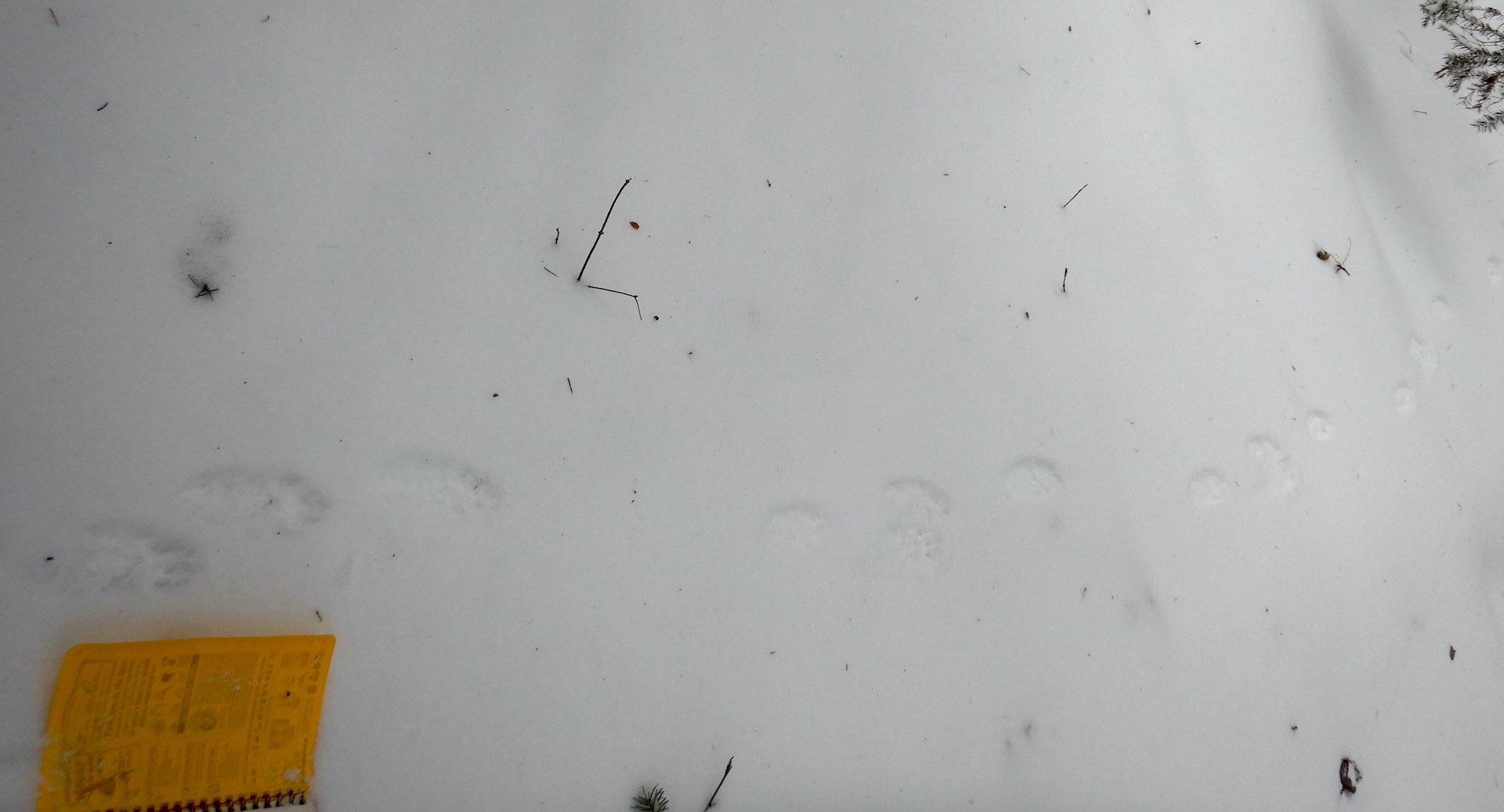
  • The animal’s gait was a mostly loping in a 3 x 4 pattern, which is a common way for fishers to travel. The 3 x 4 lope is a method of travel where a fisher places a front and rear foot from one side of the body in the same place, while the feet on the other side do not overlap. This gives the impression of only three tracks instead of four. Fishers walk, lope in a 2 x 2 pattern, and gallop too, but in my experience they’ll use a 3 x 4 pattern much more often in firm snow than American martens.
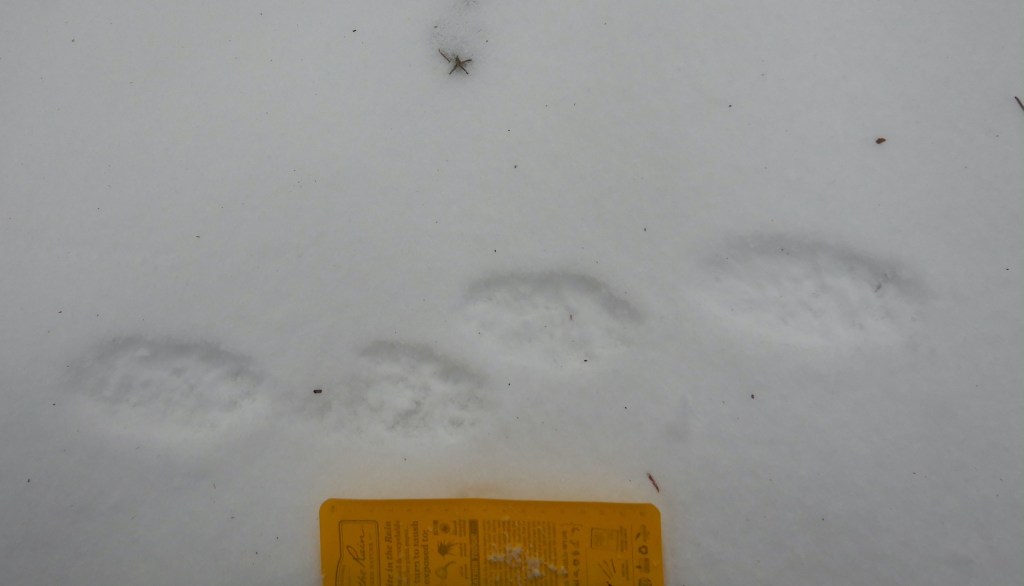
A set of fisher tracks in the snow. Four tracks are visible. The fisher moved from left to right. The yellow notebook at bottom center is ~17 cm wide.
A clear set of fisher prints. Her five toes are perhaps easiest to see in the second track from left. Also note that the fisher created four prints here so she slightly deviated from her typical 3 x 4 lope.

A fisher trackway in snow. The yellow notebook at bottom left is ~17 cm wide. The fisher moves mostly in a 3 x 4 lope. It was headed from left to right in the photo. The tracks are shallow, maybe only a centimeter deep.
A trackway from the fisher. She was moving with a 3 x 4 lope across firm snow. My notebook is about 17 cm wide for scale.

Several other mammals were active that day as well. Snowshoe hares, red fox, red squirrels, mice, and voles all left tracks or scat to reveal their presence. I was only lucky enough to be chastised by a couple of squirrels and didn’t see any other mammals for the majority of the day but walking slowly and quietly gives one the opportunity to be surprised. In a moment of quiet contemplation, the kind you experience while gazing through trees pondering your next move, a glimmer of movement appeared in the corner of my eye. I turned my head to find a weasel bounding through the snow. I didn’t dare reach for my camera knowing I’d spook it into hiding, although I remember clearly my confusion upon seeing it. 

A long-tailed weasel changes its fur color from summer brown to winter white and back again with the seasons. In winter, they are nearly pure white except for the tip of their tail, which is black—a feature that seems to misdirect attacking predators away from the head. This weasel, however, appeared to have a dark tail and head. 

My brain needed to register a few more bounds by the weasel to clear the confusion. it wasn’t oddly colored. The weasel was carrying a vole or mouse in his mouth. As he disappeared in a thicket, I was offered a special opportunity to examine its prints for clues about that may help me better understand how small weasels move in snow when they are burdened by the weight of their prey. 

Long-tailed weasels and the smaller short-tailed weasel (ermine) travel most often in snow by using a 2 x 2 lope. When you see them traveling in this way, it looks almost like a long hop, with the front feet hitting the ground first. The front feet quickly lift into the air while the hind feet land in the same place. The weasel I watched used this method and he seemed to carry his rodent cargo with ease—an impressive display of relative strength. His prey, though, left an important clue. Each of the weasel’s bounds were accompanied by a slash in the snow, which must have been created by part of the dead rodent (a foot? a tail?) dragging in the snow with each leap of the weasel.

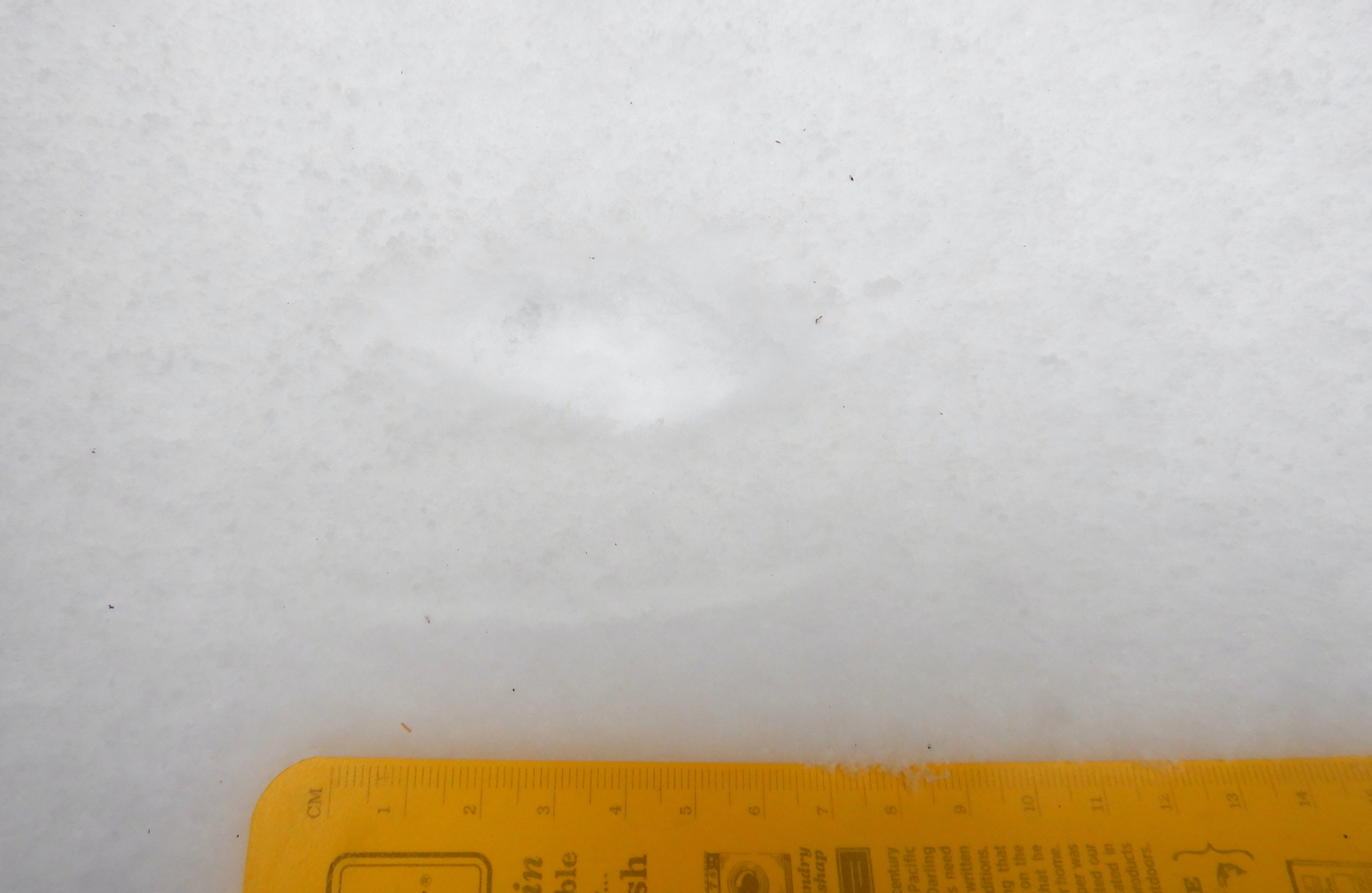
A single set of long-tailed weasel tracks. They make a single depression in snow in the center of the photo. A light slash is visible beneath the weasel prints. The width of the yellow notebook at bottom is about 15 cm.
A long-tailed weasel’s prints are underscored by a slash in the snow created by the rodent prey it carried.

Two sets of long-tailed weasel tracks. Each set makes a single depression in snow. A light slash is visible beneath the weasel prints. The width of the yellow notebook at bottom is about 17 cm.
Two sets of prints from a long-tailed weasel. Note the repeating slash next to each track. The weasel traveled from right to left.

As I discussed in the video segment above, the life of a fisher would be far more mysterious without the record it leaves in snow. I would have no real clue how much fishers leave scent marks or climb trees without reading their trackways. Likewise, if I’d not been in the right place at the right time or been looking in a different direction I would have missed the weasel and its meal completely. Had I stumbled upon its trail with the strange, repeating mark next to each print I’m not sure I’d reason it was from the weasel’s prey. But now, I’ll be looking for other examples like it.

I hope you have the opportunity to utilize snow to learn more about your neighbors. When the snow pack melts in spring, I welcome the change although I must admit that forest seems a bit lonelier when I don’t know who has been visiting. 

*Mammal Tracks and Sign: A Guide to North American Species by Mark Elbroch is an invaluable resource if you want to learn more.

A Turd of a Time

While every season has much to admire, I find springtime especially enthralling. Something new appears nearly every day. At first, maple sap runs heavy during March’s warm days and sub-freezing nights. Around then, a trickle of meltwater in a ditch and a bare patch of matted leaves on the edge of a snow bank promise room for other plants to break dormancy. Soon after, the first golden catkins appear on the hazelnut and gray alder. Rainy evenings bring amphibians out of hibernation. In a short time, the soon-to-flower ephemeral herbs emerge from the crust of leaves. By late April and early May, the forest canopy bursts to life again with bird song, the blossoms of red maple and quaking aspen, and finally the unfurling of leaves that will soon thoroughly shade the ground where I trod.

Each of these are little events that promise a lot more. I’m unsure if non-human animals contemplate these changes like I do. Yet, I’m certain they pay attention to them. Black bears, recently emerged from their dens, know the pattern and are eager to exploit the change of the season to their advantage. If I’m lucky, their efforts to find their first substantial meals of the year might allow me to investigate what they are up to.

A section of Katahdin Woods and Waters National Monument sits to the east of Sebois River. It’s a quiet area of the park since there are no campsites, less than a mile of developed hiking trails, and only a few maintained roads. Bicycling through it is fun and is made even more enjoyable when I afford myself the time to go slow and pay attention. It’s one of the best places in park that I’ve yet found to look for bear sign in the spring.

Riding the single lane spur that loops off and back to American Thread Road last weekend I came across many piles of bear scat, which I was hoping to see. Not because I particularly admire turds, but because bears are cryptic here. They are frequently hunted throughout northern Maine and consequently have a substantial fear of people. The thick forest also limits my ability to watch a bear if I happen to see one. The signs that bears leave behind—such as marking trees and scat—are like pages in a book. A single page may not reveal much but look at enough pages and you’ll get a good story

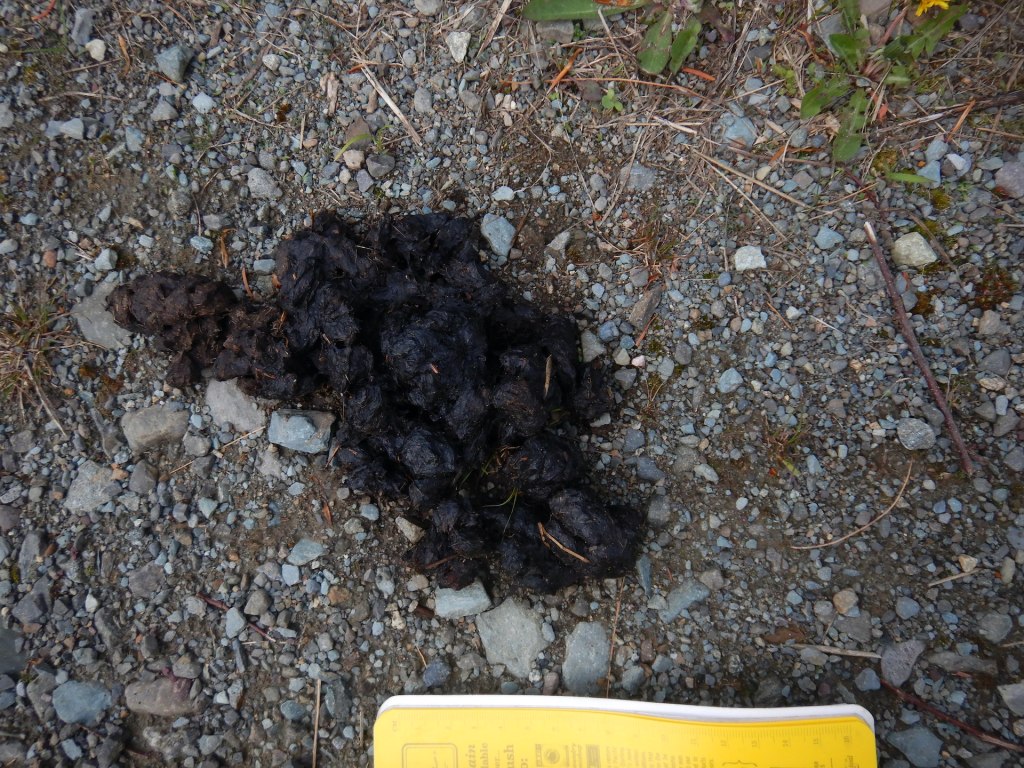
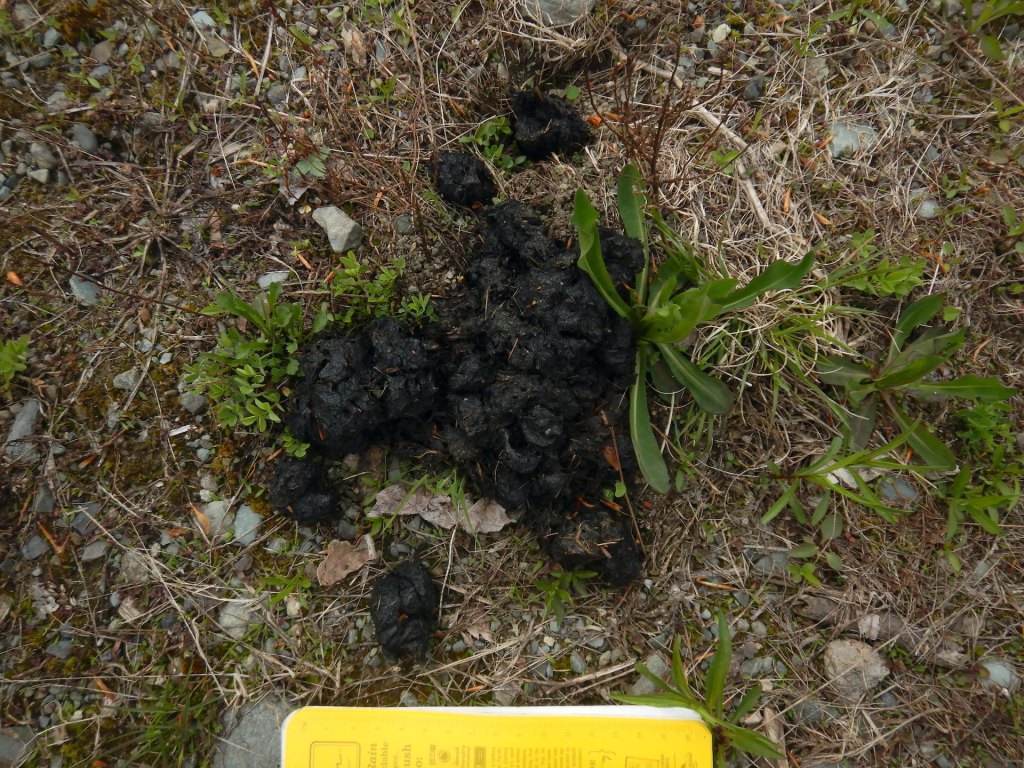
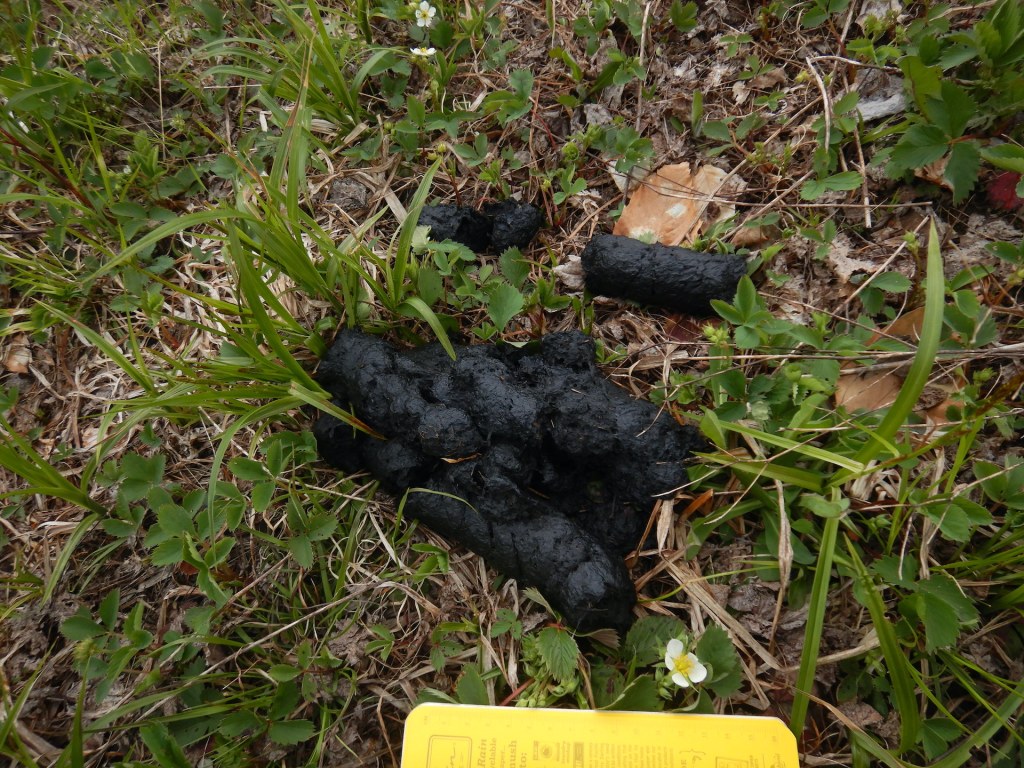
A large pile of dark colored, almost black, bear scat on gravel. The bear scat is framed by grass blades and wild strawberry leaves. The background is open forest.

In particular, scat can reveal how recently a bear was in the vicinity and what it was eating. Black bears are omnivores that are well adapted to survive on plants, and the vast majority of their annual calories come from plant foods. In north-central Maine, though, there are no calorie-rich berries to eat in the spring. Perhaps there are some leftover acorns, but oak trees are not common in the forests as this area is near the northern end of their range in the northeastern U.S. So other plant foods are a bear’s best springtime bet.

While a black bear’s digestive track remains essentially one of a carnivore, it utilizes adaptations such as an elongated gut and slightly flattened molars to extract nutrition from tough to digest plant foods. A bear also consumes plants when they are most nutritious and digestible. Newly emerged green vegetation like grass, sedge, and clover contains relatively high amounts of protein, for example. As those plants mature, protein content declines while indigestible fiber increases. Fiber helps keep the bear on a so-called regular schedule, but the bear is really after the protein. Even though hibernating bears maintain their muscle health without eating or exercise, if they’ve exhausted their fat reserves by springtime then their body is forced to tap into their lean tissue reserves. Young, tender veg helps bears stave off muscle loss and even build muscle before sugary, fat-building foods become available in mid to late summer.

All but one of the scat piles I found were filled with herbaceous plants. Although most looked older than a day–when bears eat green veg, the resulting scat quickly oxidizes when exposed to air to form a black surface crust–this was a promising sign. I knew that the lightly used roads are good travel corridors for bears and the sunlight reaching the road edges allows vegetation to green-up more quickly than the forest interior, which attracts bears to the roadsides. Perhaps I might see a bear if I pedaled slowly and remained observant.

The effort paid off near the crest of a hill when I spotted a dark mass of animal on the edge of the road. I stopped to watch.

The wind was at my back, which is a welcome push when cycling uphill but also carried my scent to the bear. Once it caught my scent, the bear only needed a couple of seconds to decide to run into the forest. Had the wind been blowing the other way, I probably could’ve watched it much longer with less chance of disturbing it unintentionally. Still, I was grateful for the moment and the small insights into its world.

Before widespread logging and, later, roadbuilding encroached on the area’s forests, grassy areas in northern Maine were likely much less common than today. Black bears always sought the first spring greens, but they had to look in other places—riverbanks, stream sides, and beaver meadows for example. They continue to go to those areas, of course, even as roadsides have opened another foraging opportunity. Roads are risky places that expose bears to people though. Bears weigh the risk along with the potential reward of a good meal.

I knew the bear I saw was eating well even as it still had a long way to go until it was fat enough to enter its winter den next fall. Its effort is a journey recorded in its scat—pages, if you will, in the Book of Turds.