Should Alaska be permitted to implement predator control measures on Alaska’s national wildlife refuges? The feds say no, but a bill in the U.S. House of Representatives, H.J.R. 69 and its equivalent in the Senate, S.J. 18, will rescind U.S. Fish and Wildlife Service regulations that prohibit predator control methods on national wildlife refuges in Alaska, specifically:
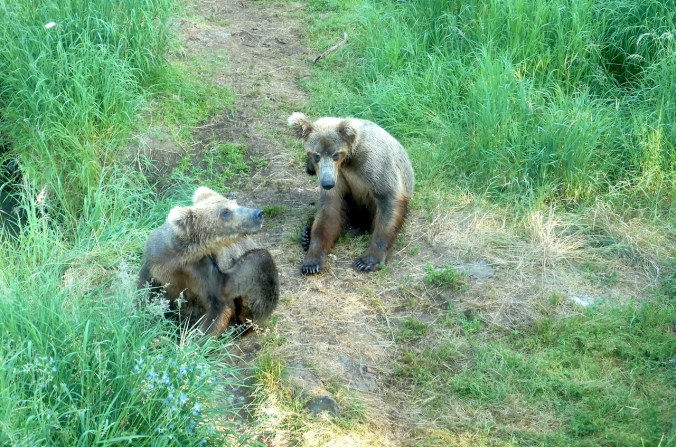
- Taking black or brown bear cubs or sows with cubs (exception allowed for resident hunters to take black bear cubs or sows with cubs under customary and traditional use activities at a den site October 15-April 30 in specific game management units in accordance with State law);
- Taking brown bears over bait;
- Taking of bears using traps or snares;
- Taking wolves and coyotes during the denning season (May 1-August 9); and
- Taking bears from an aircraft or on the same day as air travel has occurred. The take of wolves or wolverines from an aircraft or on the same day as air travel has occurred is already prohibited under current refuge regulations.
Alaska and the Alaska congressional delegation contend the state should continue to manage wildlife harvest on refuges. Rep. Don Young, H.J.R. 69’s sponsor, argues that the USFWS regs are an unacceptable federal overreach. He believes wildlife management should be left to the state of Alaska. (H.J.R. 69 already passed the House of Representatives by a 225 to 193 vote.)
However, national wildlife refuge managers in Alaska determined the “hunting” practices adopted by the state of Alaska are predator control, which is an unnecessary and prohibited manipulation of ecosystem processes on national wildlife refuges. The state has said the Feds can’t prove it’s predator control, but the hunting methods and the species they target are designed to reduce predator populations. By allowing those methods, the Alaska Board of Game forced the USFWS’s hand, as well as that of the National Park Service who manages national preserves in Alaska.
Compared to the USFWS regs, the NPS has very similar regulations on the books for hunting in national preserves. The NPS regs will not be affected by H.J.R. 69 or S.J. 18, although Alaska has sued the NPS over it. Here’s why the NPS justifies the prohibition:
“In the last several years, the State of Alaska has allowed an increasing number of liberalized methods of hunting and trapping wildlife and extended seasons to increase opportunities to harvest predator species.
“These practices are not consistent with the NPS’s implementation of ANILCA’s authorization of sport hunting and trapping in national preserves. To the extent such practices are intended or reasonably likely to manipulate wildlife populations for harvest purposes or alter natural wildlife behaviors, they are not consistent with NPS management policies implementing the NPS Organic Act or the sections of ANILCA that established the national preserves in Alaska. Additional liberalizations by the State that are inconsistent with NPS management directives, policies, and federal law are anticipated in the future.”
Here’s the U.S. Fish and Wildlife Service’s justification in a nutshell:
“The different purposes of State and Federal laws and the increased focus on predator control by the State have resulted in the need for FWS to deviate, in certain respects, from applying State regulations within refuges. This is because predator-prey interactions represent a dynamic and foundational ecological process in Alaska’s arctic and subarctic ecosystems, and are a major driver of ecosystem function. State regulations allowing activities on refuges in Alaska that are inconsistent with the conservation of fish and wildlife populations and their habitats in their natural diversity, or the maintenance of biological integrity, diversity, and environmental health, are in direct conflict with our legal mandates for administering refuges in Alaska under ANILCA, the Improvement Act, and the Wilderness Act, as well as with applicable agency policies (601 FW 3, 610 FW 2, and 605 FW 2).
“In managing for natural diversity, FWS conserves, protects, and manages all fish and wildlife populations within a particular wildlife refuge system unit in the natural `mix,’ not to emphasize management activities favoring one species to the detriment of another. FWS assures that habitat diversity is maintained through natural means on refuges in Alaska, avoiding artificial developments and habitat manipulation programs, whenever possible. FWS fully recognizes and considers that rural residents use, and are often dependent on, refuge resources for subsistence purposes, and FWS manages for this use consistent with the conservation of species and habitats in their natural diversity.”
As Don Young contends, this is a state versus federal rights issue. However, he doesn’t attempt to disprove the U.S. Fish and Wildlife Services justifications for the regulations (which, again, prohibit the state’s predator control practices on national wildlife refuges). The congressman’s efforts through H.J.R 69 is an attempt to limit the authority of U.S. Fish and Wildlife Service in Alaska. (Alaska’s senators, Sullivan and Murkowski, sponsor S.J. 18, the Senate equivalent of H.J.R. 69.)
This bill isn’t just about killing bear cubs and wolf pups, although that’s how a lot of click bait portrays the issue.
It’s really about whether predator control should occur in national wildlife refuges. Its about states’ rights versus federal authority. Personally, I believe the prohibited hunting methods are nothing more than thinly veiled predator control, which should not be allowed on land managed in the national interest.
If you’re concerned about predator control on wildlife refuges in Alaska, then you should oppose these bills. The House resolution has already passed, so any efforts should be focused on the Senate version, S.J. 18.
Edit: The Senate passed H.J.R 69 by a 52-47 vote. The President is expected to sign it into law.
 Wandering at Large