Fisher and Other Trails

Compared to summer, winter can seem like a dull companion, especially in my corner of the globe. The buzzing of insects ceased months ago. The forest floor rests under one to three feet of snow. Trees, shrubs, invertebrates, amphibians, and fungi lie dormant. Ice insulates wetlands that were vibrating with life not long ago. Migrating birds vanished months ago. Then, there’s the dangers posed by cold weather. Numbed toes and fingers aren’t pleasant, nor are the perpetual threats of frostbite and hypothermia. All-in-all, I could convince myself that winter is a season to be endured rather than embraced. This would be a mistake, though. 

While I miss the sheer volume of aliveness that accompanies summertime, winter has many endearing qualities. It helps me appreciate the abundance of summer. Off-trail travel is often easier when wetlands are frozen and snow smooths the terrain. And few experiences are as peaceful as the immense quiet that accompanies a snowstorm in an isolated grove of trees.

But this post isn’t about falling snow. Rather, it’s about a story written in the snow. Instead of looking at the wintertime forest as lonesome and empty, snow allows me to better understand how the landscape is a fully inhabited place. 

Last Monday, I highlighted the travels of a fisher during More to Explore, a bi-weekly highlight show on explore.org cohosted by Brian Byrd and me.

In the interest of brevity for the show, I skipped some details of the fisher’s trail. Tracking is an art that I’m still learning and I argue that I’m a slow study, but a few clues revealed I was looking at a fisher’s trail rather than a fox, coyote, marten, or lynx, all of whom inhabit the area.

  • Claw marks registered in most of the prints that I examined carefully, effectively ruling out felines since their claws are retractable and don’t register reliably in tracks.
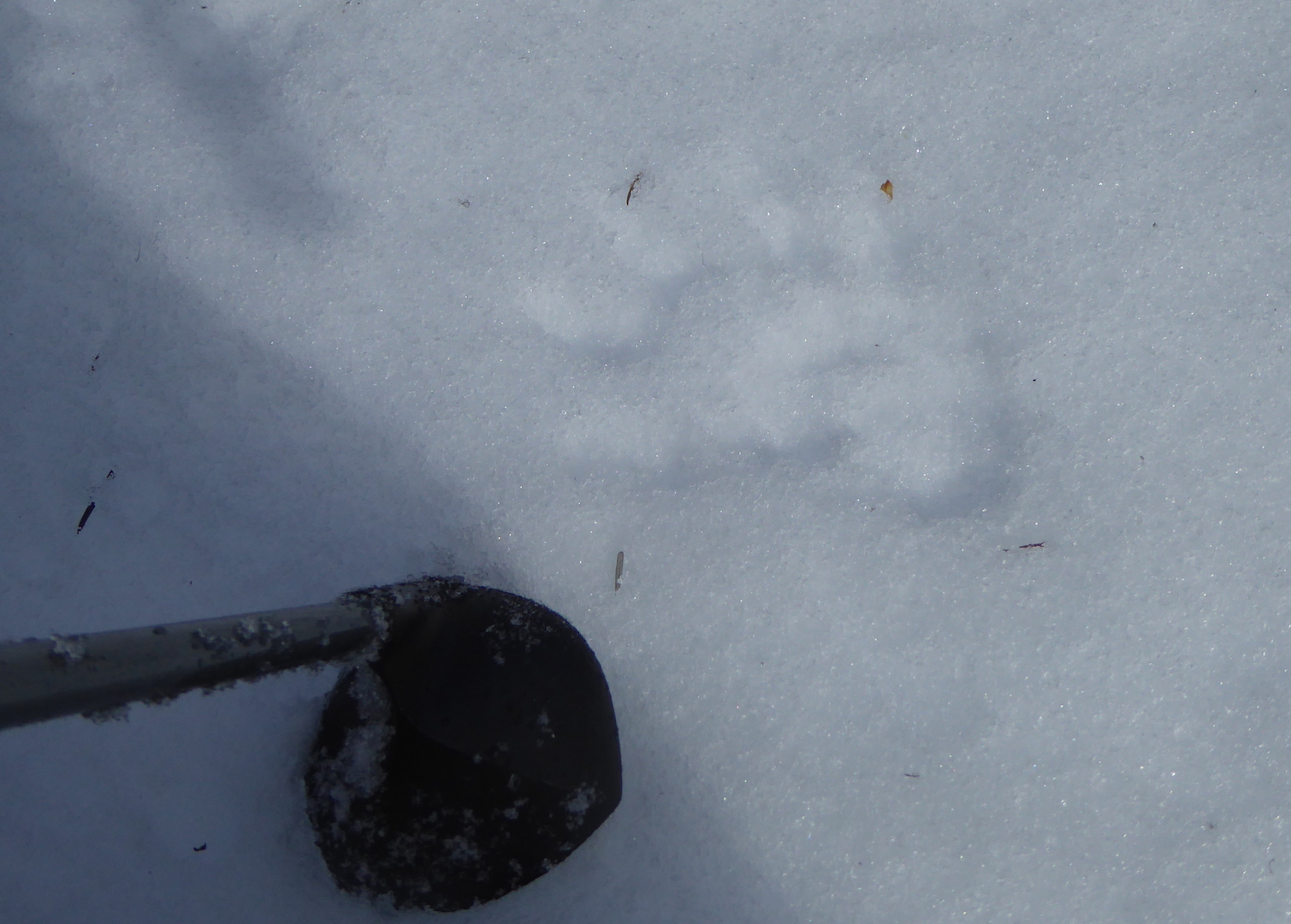
  • The clearest tracks had five toes—an important clue that rules out the canines such as foxes and coyotes. Porcupines, bears, skunks, hares, and rodents can make five-toed tracks too, but they have other features that make them distinctive.*
  • The tracks’ size were too large for other members of the weasel family who live here such as short- and long-tailed weasels, mink, and marten. I could rule out river otters too since there was no evidence that the animal slid across the snow (something otters routinely do) or sought liquid water. The trackway crossed a beaver-created swamp but the tracks did not lead to water as an otter would have.
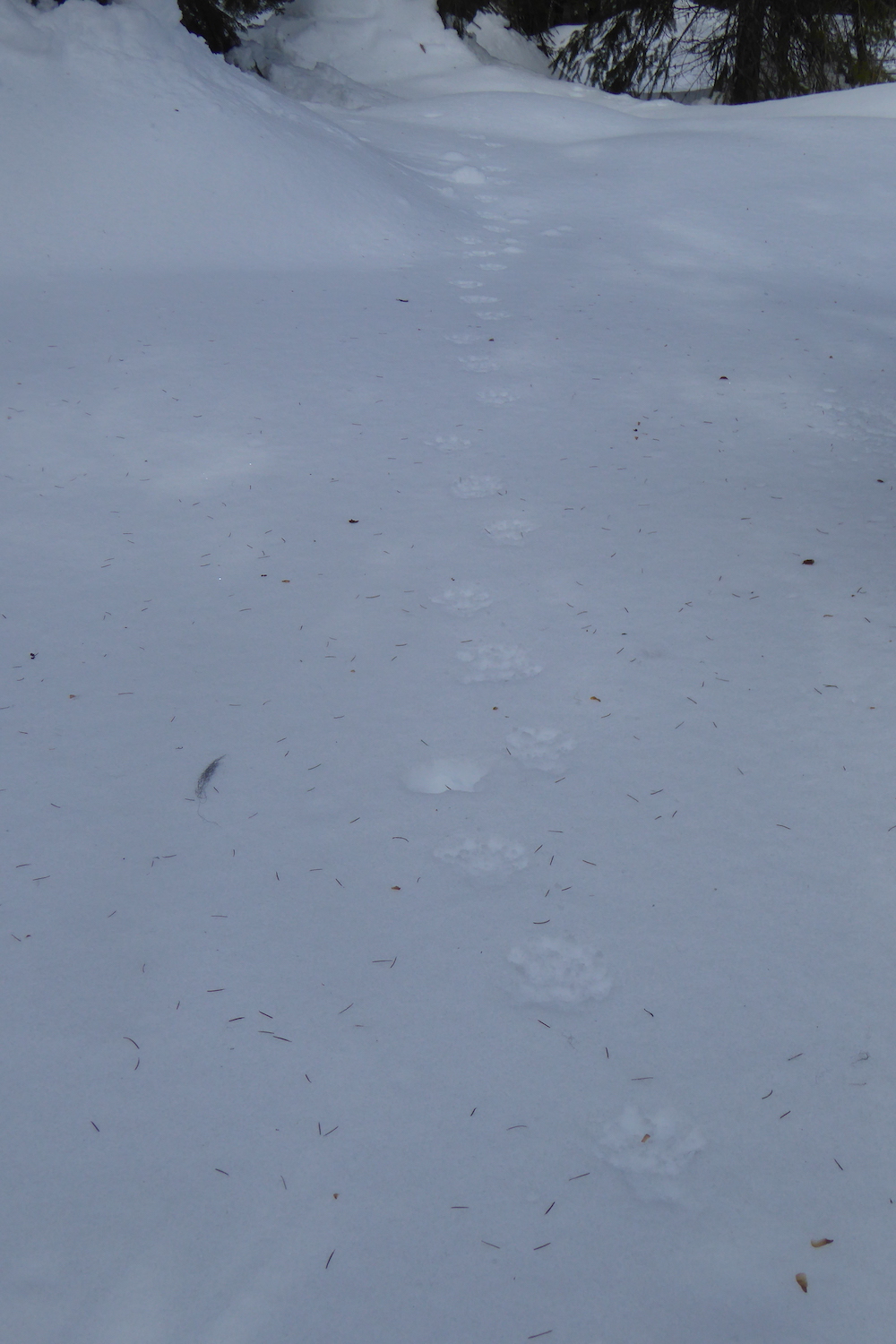
  • The animal’s gait was a mostly loping in a 3 x 4 pattern, which is a common way for fishers to travel. The 3 x 4 lope is a method of travel where a fisher places a front and rear foot from one side of the body in the same place, while the feet on the other side do not overlap. This gives the impression of only three tracks instead of four. Fishers walk, lope in a 2 x 2 pattern, and gallop too, but in my experience they’ll use a 3 x 4 pattern much more often in firm snow than American martens.
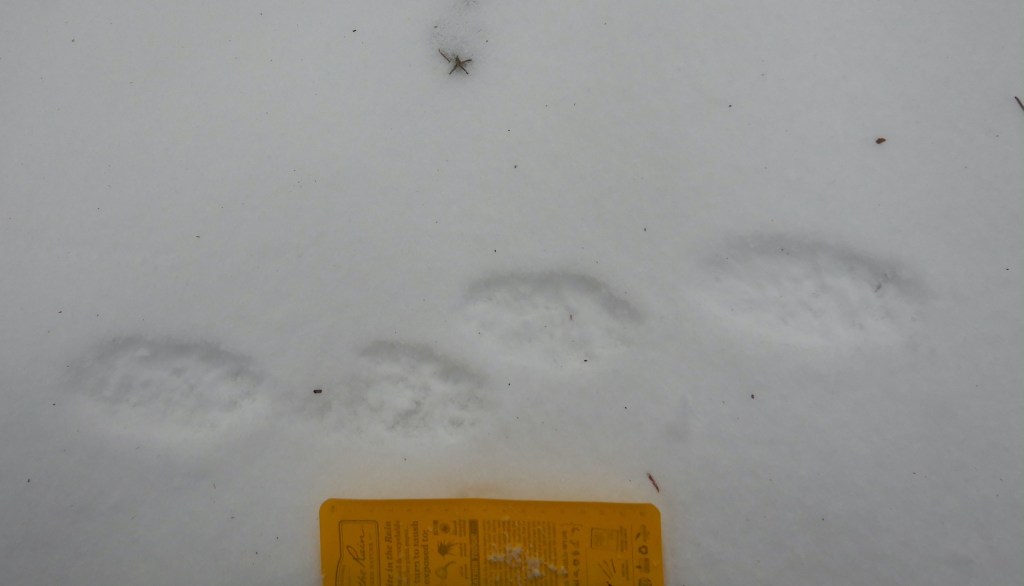
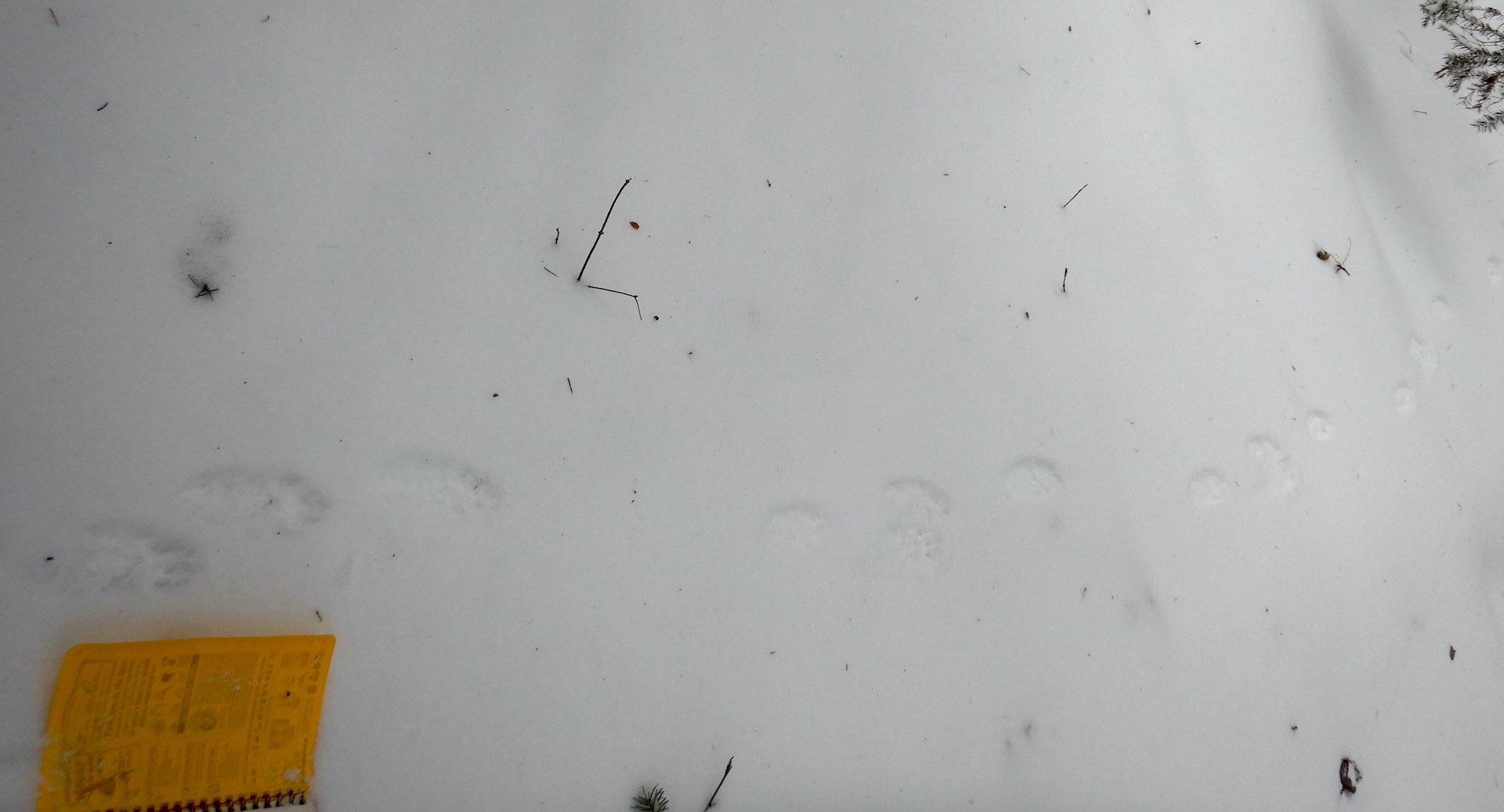
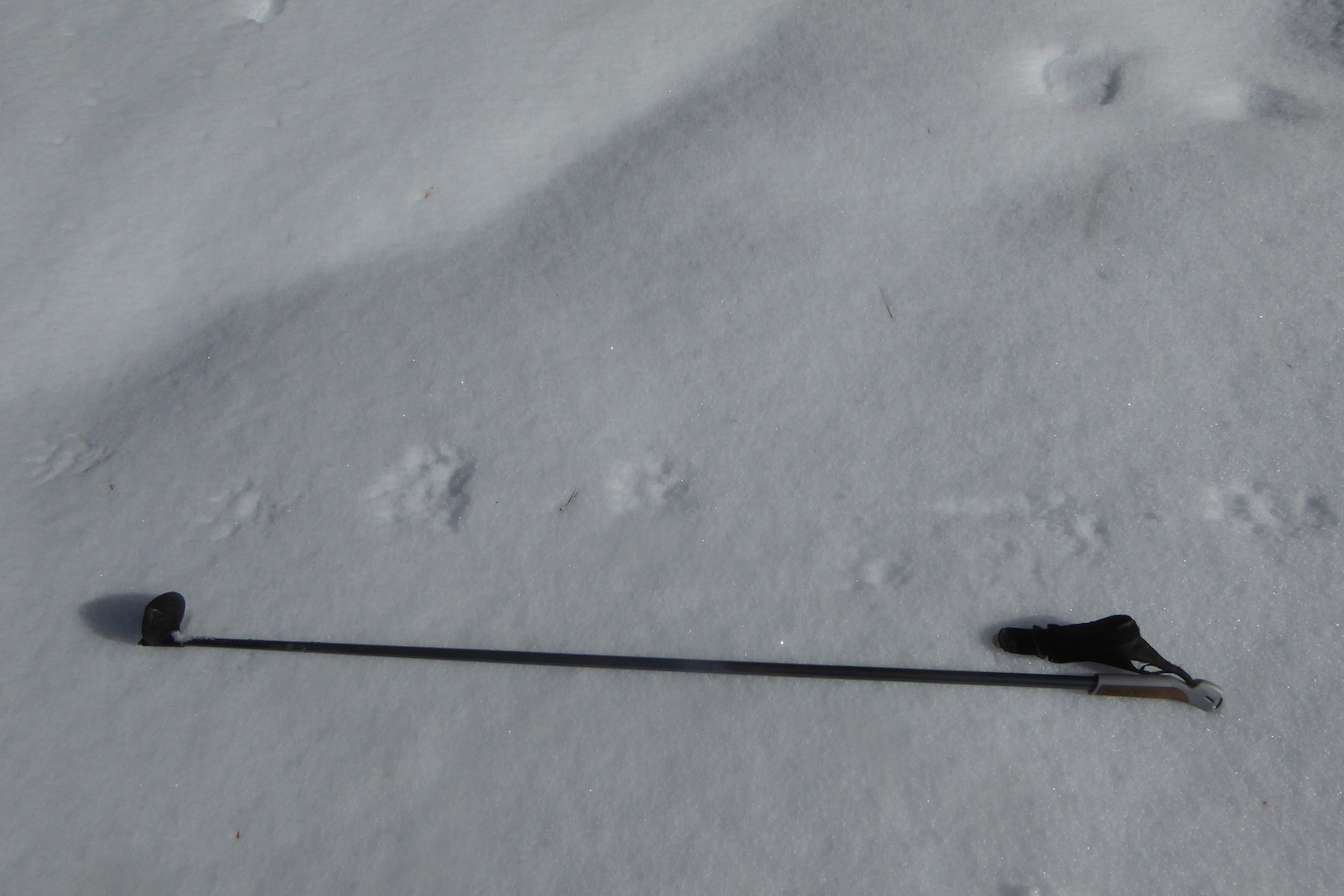
A set of fisher tracks in the snow. Four tracks are visible. The fisher moved from left to right. The yellow notebook at bottom center is ~17 cm wide.
A clear set of fisher prints. Her five toes are perhaps easiest to see in the second track from left. Also note that the fisher created four prints here so she slightly deviated from her typical 3 x 4 lope.

A fisher trackway in snow. The yellow notebook at bottom left is ~17 cm wide. The fisher moves mostly in a 3 x 4 lope. It was headed from left to right in the photo. The tracks are shallow, maybe only a centimeter deep.
A trackway from the fisher. She was moving with a 3 x 4 lope across firm snow. My notebook is about 17 cm wide for scale.

Several other mammals were active that day as well. Snowshoe hares, red fox, red squirrels, mice, and voles all left tracks or scat to reveal their presence. I was only lucky enough to be chastised by a couple of squirrels and didn’t see any other mammals for the majority of the day but walking slowly and quietly gives one the opportunity to be surprised. In a moment of quiet contemplation, the kind you experience while gazing through trees pondering your next move, a glimmer of movement appeared in the corner of my eye. I turned my head to find a weasel bounding through the snow. I didn’t dare reach for my camera knowing I’d spook it into hiding, although I remember clearly my confusion upon seeing it. 

A long-tailed weasel changes its fur color from summer brown to winter white and back again with the seasons. In winter, they are nearly pure white except for the tip of their tail, which is black—a feature that seems to misdirect attacking predators away from the head. This weasel, however, appeared to have a dark tail and head. 

My brain needed to register a few more bounds by the weasel to clear the confusion. it wasn’t oddly colored. The weasel was carrying a vole or mouse in his mouth. As he disappeared in a thicket, I was offered a special opportunity to examine its prints for clues about that may help me better understand how small weasels move in snow when they are burdened by the weight of their prey. 

Long-tailed weasels and the smaller short-tailed weasel (ermine) travel most often in snow by using a 2 x 2 lope. When you see them traveling in this way, it looks almost like a long hop, with the front feet hitting the ground first. The front feet quickly lift into the air while the hind feet land in the same place. The weasel I watched used this method and he seemed to carry his rodent cargo with ease—an impressive display of relative strength. His prey, though, left an important clue. Each of the weasel’s bounds were accompanied by a slash in the snow, which must have been created by part of the dead rodent (a foot? a tail?) dragging in the snow with each leap of the weasel.
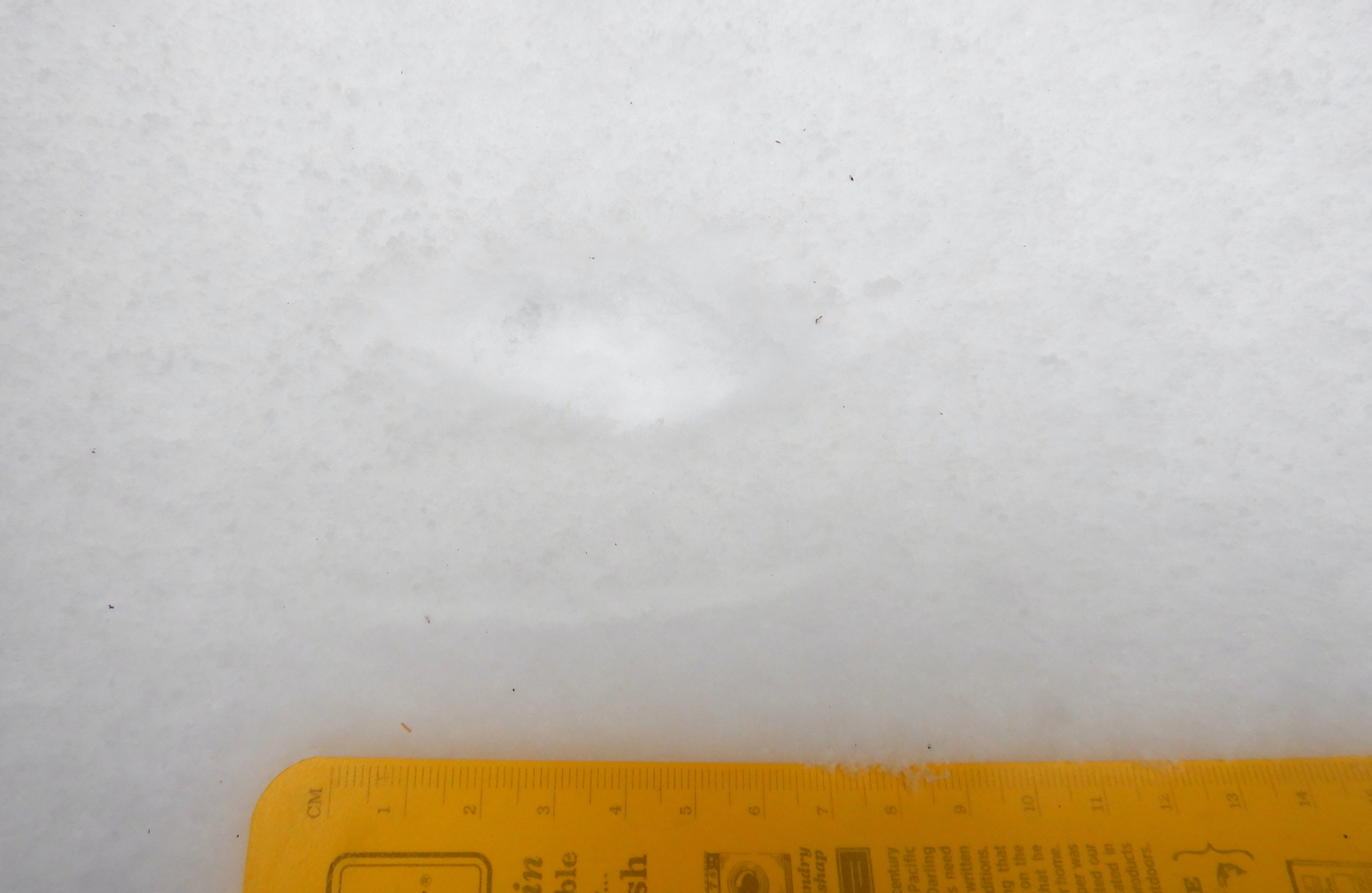
A single set of long-tailed weasel tracks. They make a single depression in snow in the center of the photo. A light slash is visible beneath the weasel prints. The width of the yellow notebook at bottom is about 15 cm.
A long-tailed weasel’s prints are underscored by a slash in the snow created by the rodent prey it carried.

Two sets of long-tailed weasel tracks. Each set makes a single depression in snow. A light slash is visible beneath the weasel prints. The width of the yellow notebook at bottom is about 17 cm.
Two sets of prints from a long-tailed weasel. Note the repeating slash next to each track. The weasel traveled from right to left.

As I discussed in the video segment above, the life of a fisher would be far more mysterious without the record it leaves in snow. I would have no real clue how much fishers leave scent marks or climb trees without reading their trackways. Likewise, if I’d not been in the right place at the right time or been looking in a different direction I would have missed the weasel and its meal completely. Had I stumbled upon its trail with the strange, repeating mark next to each print I’m not sure I’d reason it was from the weasel’s prey. But now, I’ll be looking for other examples like it.

I hope you have the opportunity to utilize snow to learn more about your neighbors. When the snow pack melts in spring, I welcome the change although I must admit that forest seems a bit lonelier when I don’t know who has been visiting. 

*Mammal Tracks and Sign: A Guide to North American Species by Mark Elbroch is an invaluable resource if you want to learn more.

A Mountain Lion Prowls the Neighborhood

There’s a place along the Skagit River where I like to wander. Upstream and downstream, the river is lined with rural home sites, but in between there’s a small pocket of undeveloped land where relatively few people go. Compared to the wild lands surrounding nearby Mount Baker and the North Cascades, it’s a small area and nothing close to what most people would consider wilderness. A regenerating clear cut sits on a terrace above the water. Below it, the river flows through a shallow S-curve and a swampy area occupies the annual floodplain. Filled with a willow thicket, it’s a good place to hide, for me as well as many other animals.

I’ve made it a habit to explore the animal trails leading in, out, and through the floodplain. In the spring, when the water table is higher, Pacific tree frogs spawn in ephemeral pools. In fall, a black bear visits the riverbank to scavenge spawned-out salmon. All year, elk use it to move between pasture. I frequently see sign left by coyotes, and if I look hard enough I might be able to find the tracks and scat of bobcats. While I rarely see the live animals, exploring their haunts helps keep me connected to the other creatures that I share this place with. I have a spot within this area where I like to sit and listen, but sometimes the most interesting observations happen upon my approach and exit into this little pocket of wilder land.

Following an elk-maintained path down to the riverbank, I exited the forest onto a muddy side-channel, now mostly dry after a long, arid summer. The exposed mud and sand of late summer offer some of the best tracking opportunities of the year. I slowed my pace, eager to see which animals had moved through the area recently. In the semi-firm mud, I stumbled upon a set of feline tracks. The tracks were large, as wide as the palm of my hand with four clear toe prints. There were no claw marks and the sizable metacarpal pads were distinctively three-lobed at the base. These belonged to a mountain lion.mountain lion tracks in mud. Notebook is approximately 7 inches wide.mountain lion track in mud. track point towards right. Notebook is approximately 7 inches wide.mountain lion tracks in sand. tracks point towards notebook at bottom of photo. Notebook is approximately 7 inches wide.Curious to know more about its travels here, I followed the tracks along the edge of the river. The cougar followed the same general path I would have to move upstream; it stuck to the mud and driftwood on the edge of the willows. From the additional tracks I was able to find, the cougar continued along the riverbank for another hundred yards before I lost the trail in the adjacent thicket.
Based on my completely unscientific survey of mammal sign in the surrounding few acres, elk seemed to be the most abundant large animal here. They left many sets of tracks that moved perpendicularly from the river and into the deep cover provided by the willows. Was the lion stalking potential prey, or was it simply wandering through? Could a kill site be nearby? My imagination ran with the possibilities, but the dense vegetation would effectively hide any further evidence of the lion’s travels—unless I was lucky enough to stumble upon more sign.

Discounting that possibility as too unlikely, I left the river by following a narrow elk trail lined with salmonberry. The trail led, in a convoluted manner, to my sit spot where I sat for while to jot a few written notes and listen to the forest.

forest scene with taller trees in background and many small shrubs in foreground

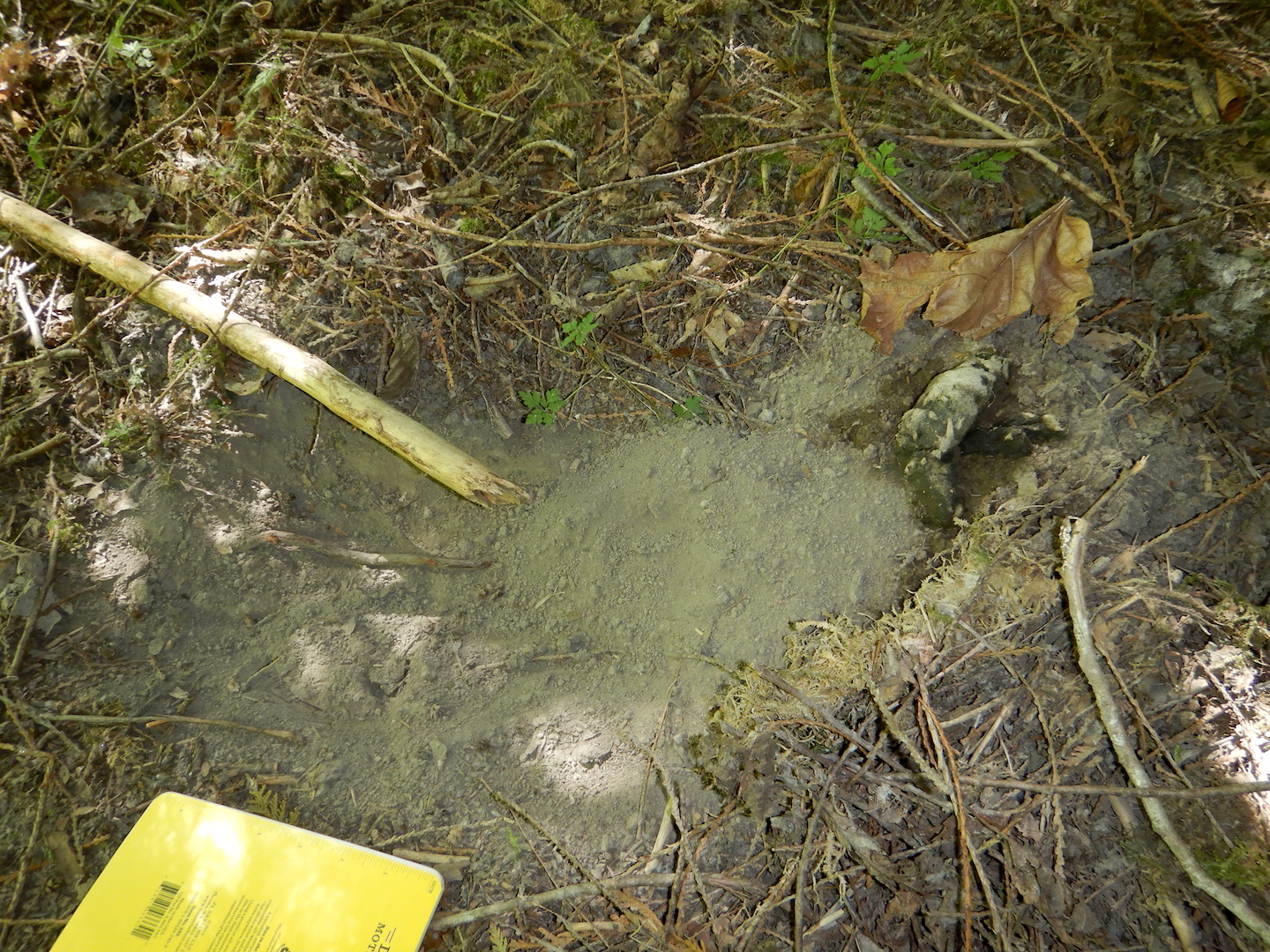
To head home, I took a different yet familiar route along more elk trails. By this time, I wasn’t expecting to find any more sign of cougars (the duff was too well compacted and dry to hold their paw prints), but when I reached a fork in the trail I found evidence that at least one cougar had visited the area several times. Under low hanging branches of western red-cedar were four large scrapes. Each scrape was oblong and about a foot in length. Each had a small pile of debris at the base and three were accompanied by scat.

photo of mountain lion scrape in forest litter. notebook at bottom left is about 7 inches wide.photo of mountain lion scrape in forest litter. notebook at bottom left is about 7 inches wide.

Mountain lions are reported to urinate when they make scrapes, but I couldn’t detect any strong urine odor despite kneeling down for a better waft. Evidently, the cougar had been here several times, but not that day and perhaps not even the past week. It looked to be eating well when it was here though. One pile of scat was sizable and reflective of a diet heavy with meat.

I found no other mountain lion sign that day, but the scrapes and tracks caused my mind to again race with the possibilities of its life here. Did it make a kill nearby? Or, was it merely using the heavy cover as a secure place to rest between meals? I left with more questions than answers. This mountain lion’s story might be missing some pages, but sometimes the finer details of a good tale are best left to the imagination.

The Other Wanderer

Most mammals aren’t keen to reveal themselves to people, which I understand. I don’t want to be around people much of the time either. Unless I’m very lucky or very observant (sometimes it’s both), I typically don’t see the more elusive animals that inhabit the North Cascades ecosystem. Winter, however, provides an opportunity to see the animals without actually seeing them.

In winter, animal tracks in snow reveal stories I could never read otherwise. Without tracks, I would be oblivious to the presence of most animals, so on every trip outside I look for them. On a recent ski journey, I found some tracks I did not expect to see.

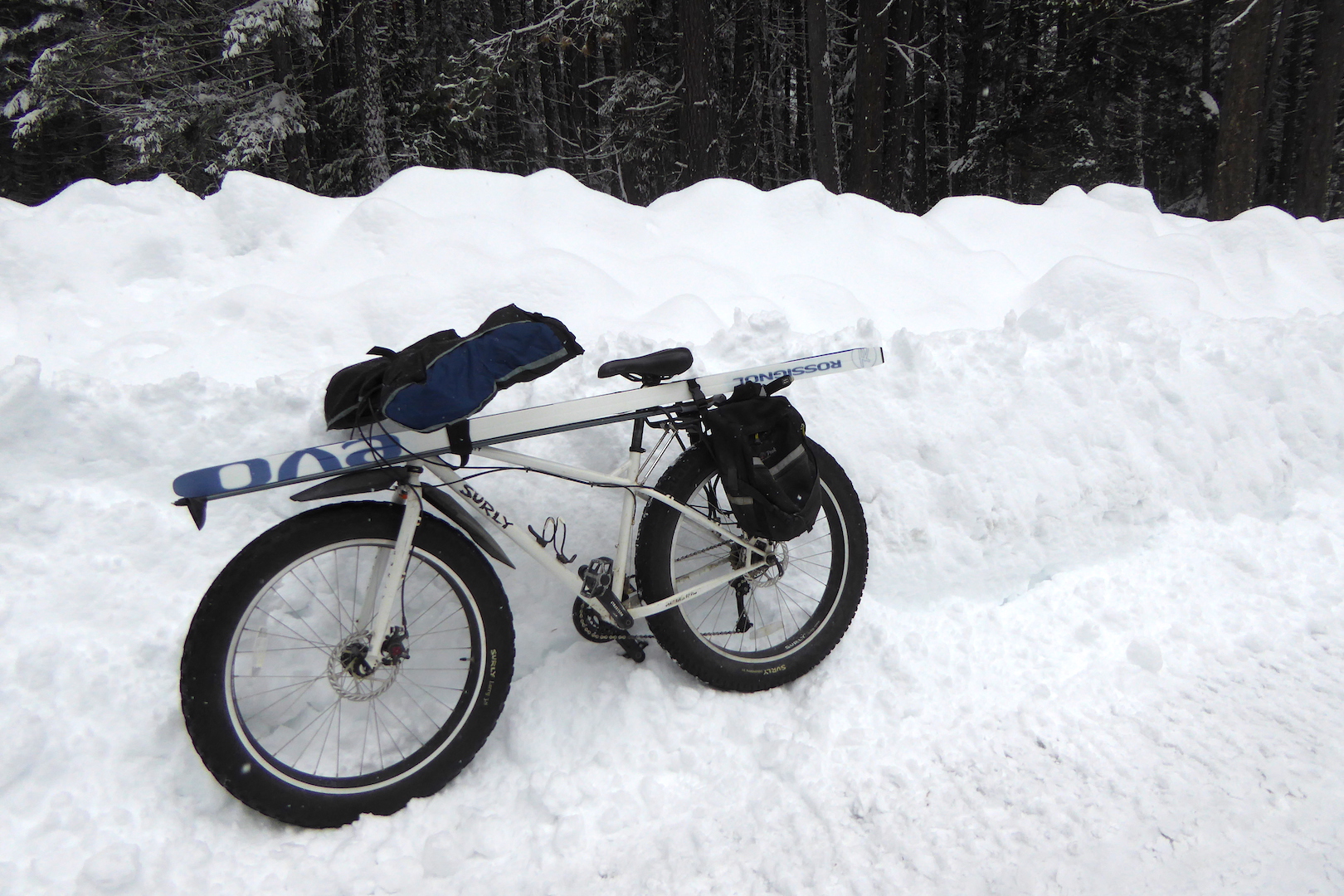
The day was comfortable (35˚F/2˚C) and sunny. The snow was reasonable firm. I parked Large Marge at the end of plowed section of road and skied up valley. Skiing wasn’t fast, but it wasn’t a slog either. With long sleeves, I felt overdressed in bright sun, so I paused frequently to cool down and enjoy the view.

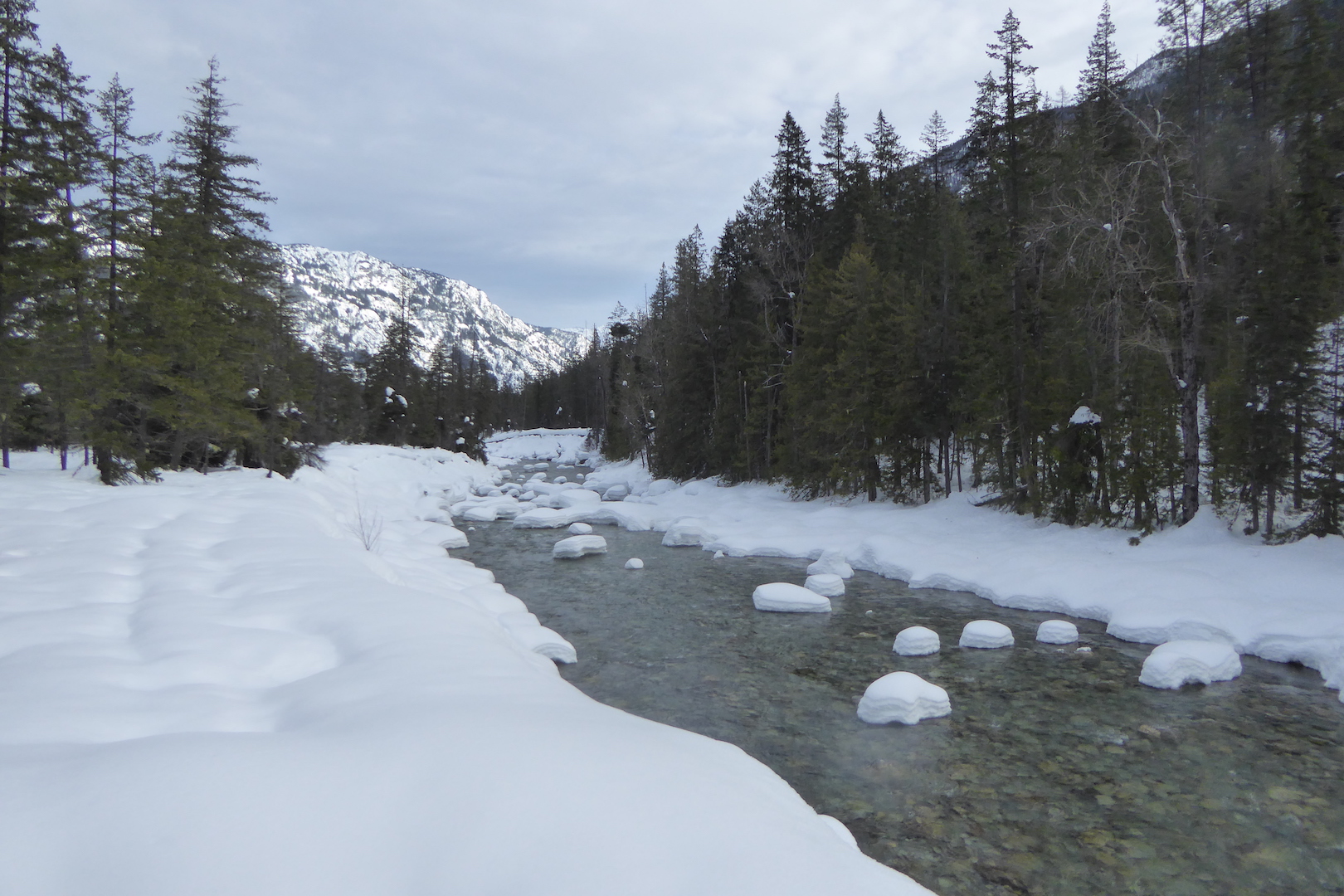
River running through snowy forest.

Pillows of snow sat on rocks in Stehekin River downstream of High Bridge in Lake Chelan National Recreation Area.

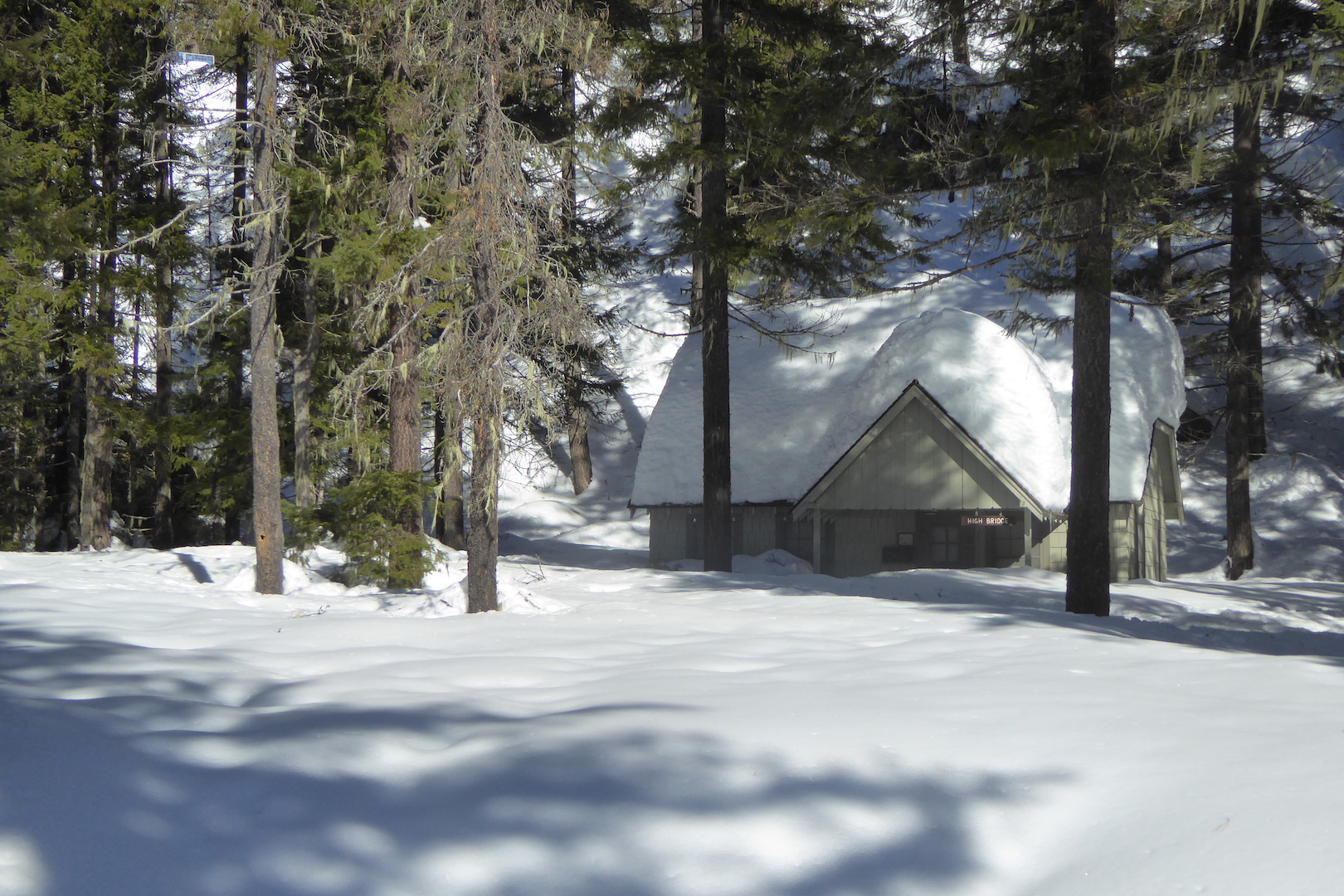
I found High Bridge, which is the boundary between the national recreation area and the national park, buried under several feet of snow.

cabin in deep snow

The NPS cabin at High Bridge was mostly buried by snow.

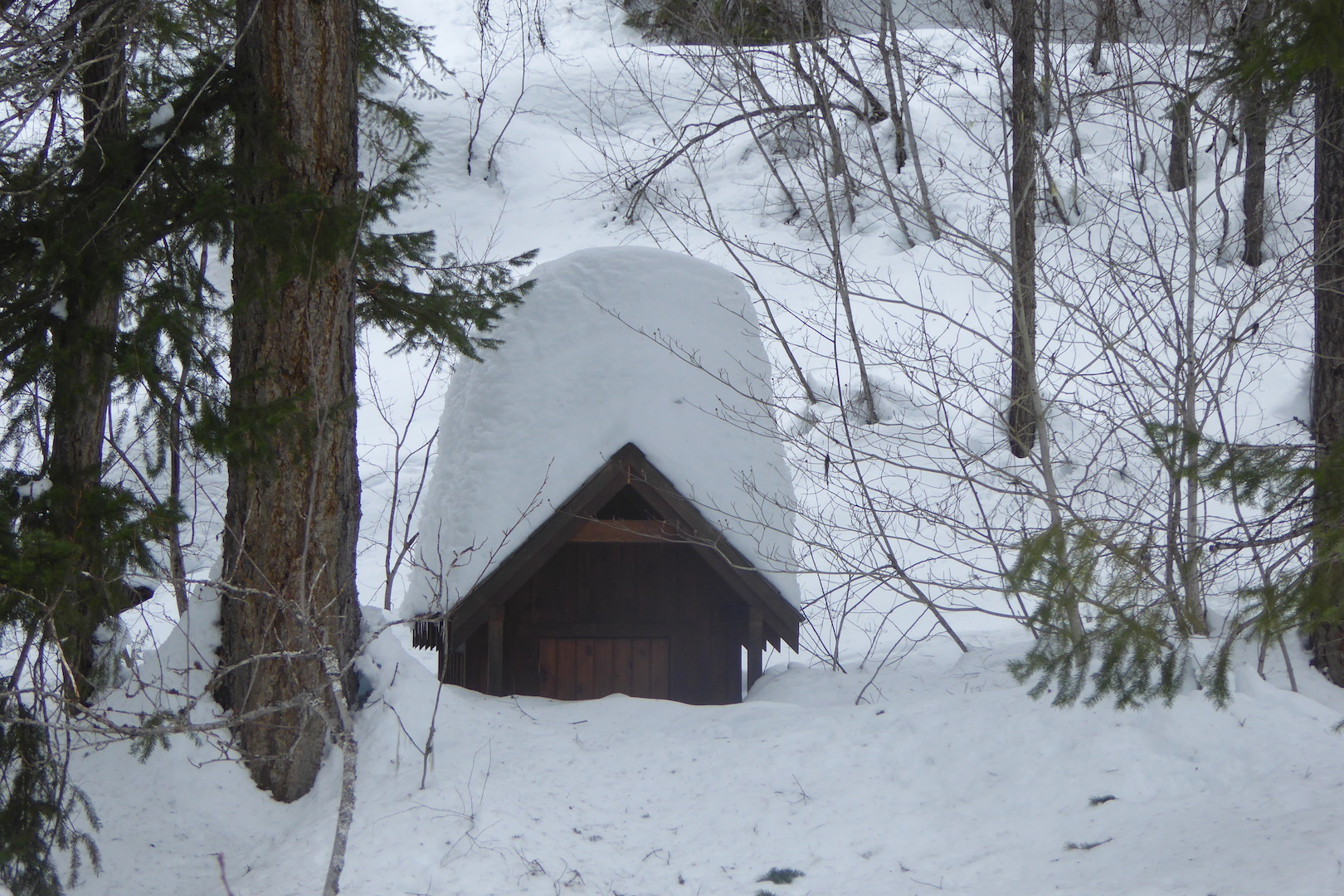
outhouse buried in snow

Good thing I didn’t have to use a toilet, because this outhouse at High Bridge wasn’t accessible.

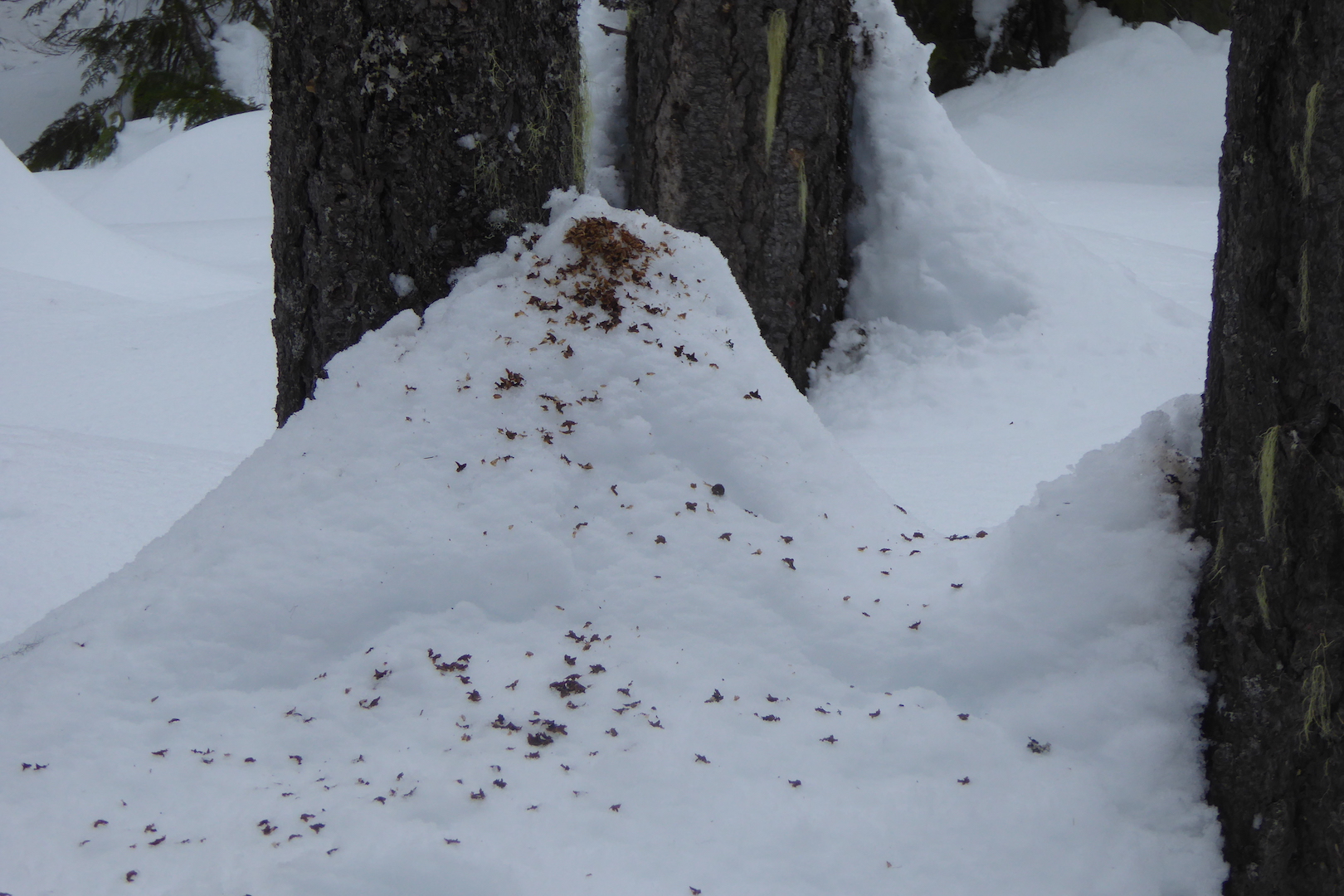
Up to this point, I had seen or heard little evidence of animals. Douglas squirrels were active because I found bracts from Douglas-fir cones scattered under a couple of trees. Red-breasted nuthatches occasionally called from the tree tops (this species is one of the most common in the Stehekin Valley in the winter; at least one of the most vocal.) There was no sign of large or even medium sized mammals.

The snowy road offered a convenient path so I followed it up valley, especially since the avalanche forecast was high and I didn’t want to risk getting caught in any slide. About a mile from High Bridge, I noticed a set of faint, but fairly large tracks in the snow.

wolverine tracks in snow next to ski pole

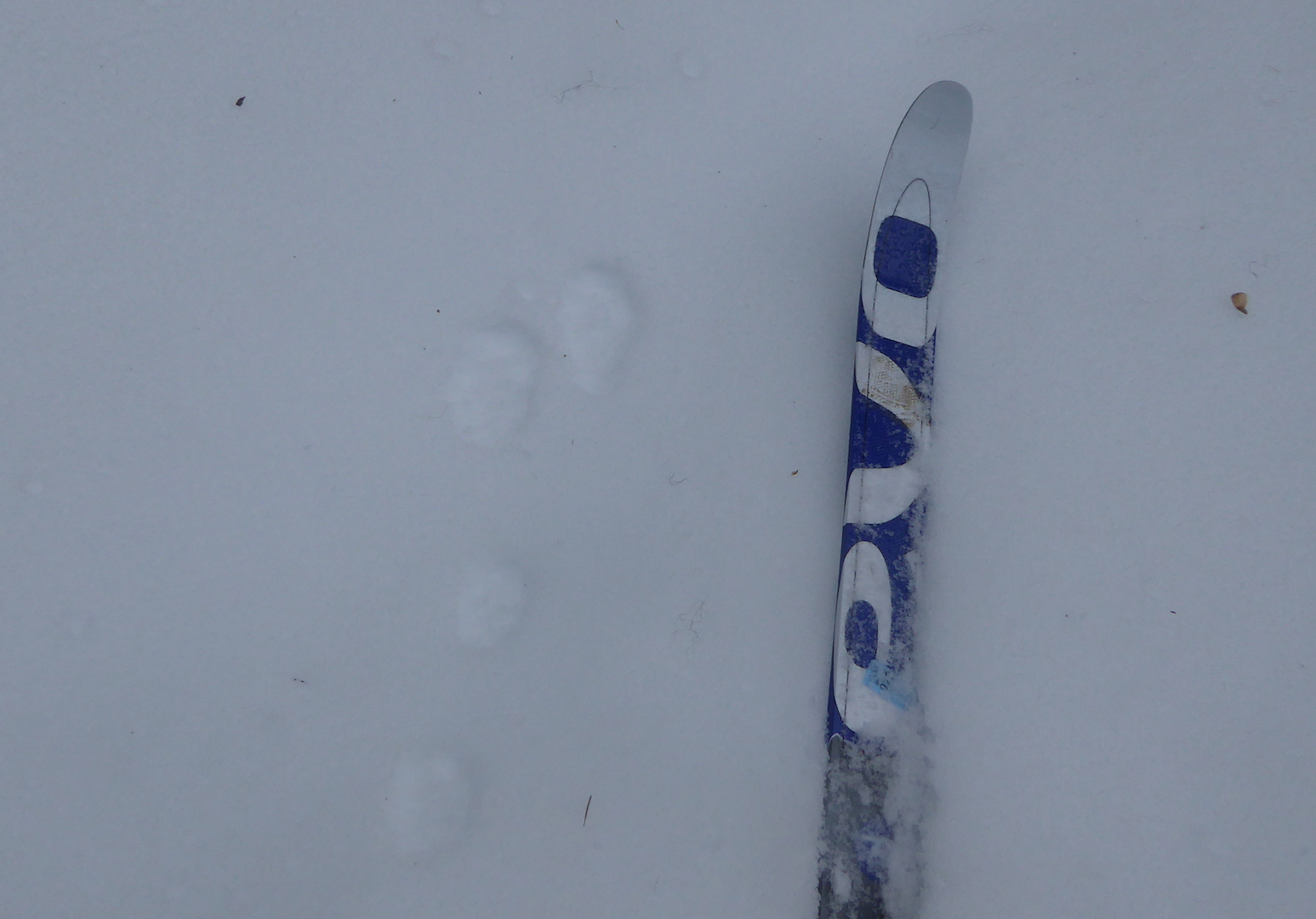
The set of tracks I found. What animal made them?

The tracks were fairly large, although I lacked measuring tape to get accurate measurements. My first thought was “mountain lion,” but then logic started to creep in (thanks Spock). Mountain lions eat many animals, but prey probably isn’t abundant enough in the mid to upper Stehekin River valley at this time of the year to sustain a mountain lion. I saw no deer tracks, even though deer are common in the lower valley now. Other characteristics of the tracks eliminated mountain lion as the source.

  • The tracks weren’t the right size or shape.
  • Their pattern, or gait, was a 3 x 4 lope.
  • Claws marks registered with almost every track.
  • The tracks rarely broke through the snow’s surface crust. This animal, despite its size, could float on the snow.
  • Fur marks often registered around the toes.
  • Most importantly, this animal had five toes.

This was a wolverine.

wolverine track in snow next to basket on bottom of ski pole.

This fairly distinct wolverine track clearly shows the animal’s five toes. The basket on the ski pole is 7.5 x 7 cm.

The track pattern indicated it was walking in some places, but loping most of the time.

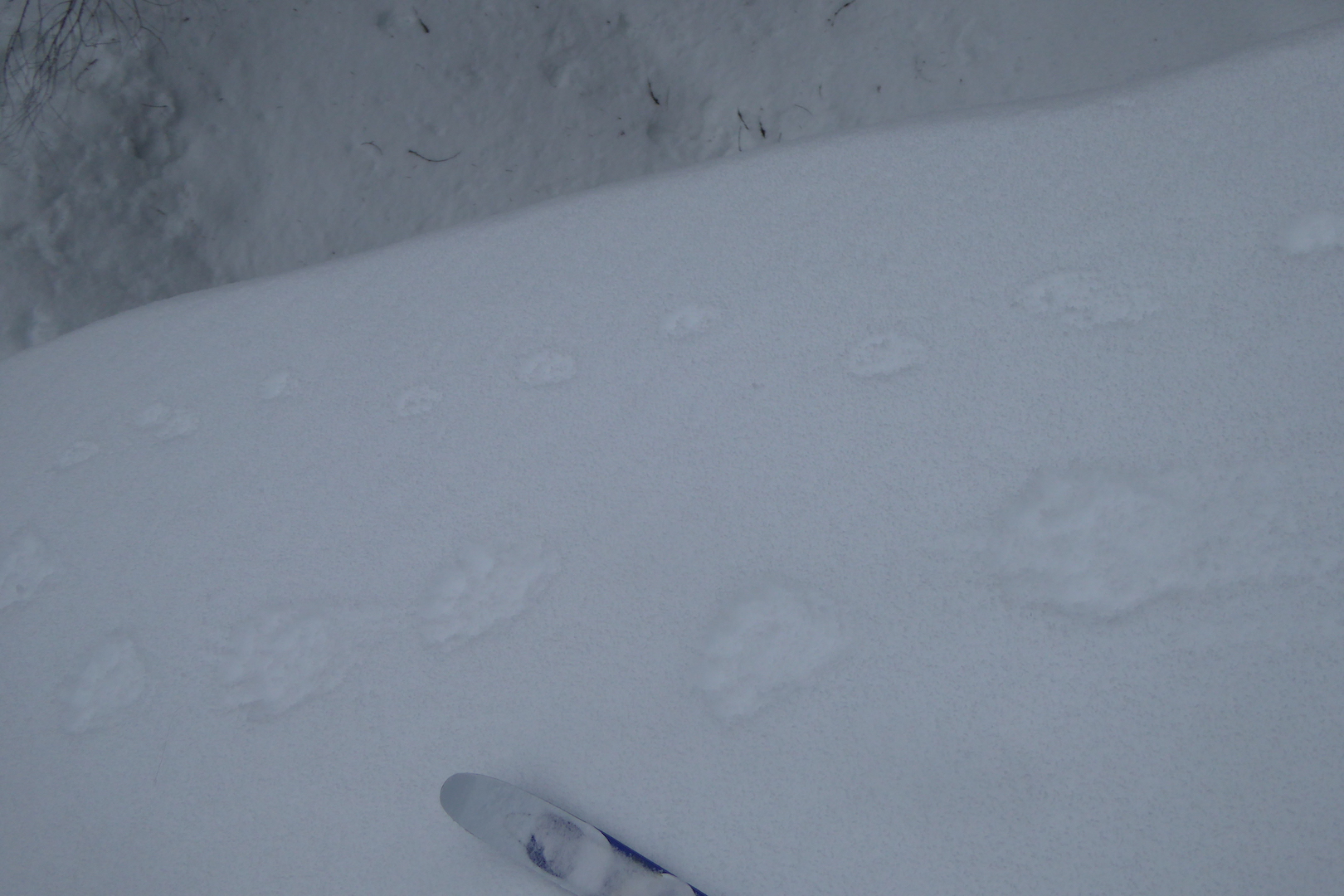
Wolverine tracks in snow.

Wolverine tracks in snow. Each set of three, starting from the bottom, represents a one lope made by the animal.

Wolverines are the largest members of the weasel family and occupy huge home ranges. The tracks were fresh, their crispness suggested they were made early in the morning or overnight. If they had been made the day before, the warm sun would’ve obscured some of their finer details.

What might it eat in this habitat? Perhaps one of the squirrels or hares out and about.

scales from Douglas-fir cone scattered on snow

A Douglas squirrel had recently torn apart a Douglas-fir cone on this pile of snow.

Snowshoe hare tracks in snow next to ski

Snowshoe hares were also moving about the forest.

At Tumwater Bridge, the wolverine continued across right next to tracks of a marten, a smaller more arboreal member of the weasel family.

wolverine tracks (bottom) next to smaller marten tracks. Tip of ski at bottom center.

Wolverine tracks (bottom) run parallel to marten tracks.

The day was waning at this point, so I turned around and left the wolverine and its tracks behind.

Last year, a large male was trapped and radio collared at Easy Pass by the U.S. Forest Service and Washington Department of Fish and Wildlife. This is almost 20 kilometers due north of the tracks I found. Could it have been the same one?

Maybe, maybe not. Wolverines occupy huge territories and are rare in this area. I was lucky to stumble upon this set of tracks before they disappeared in overnight rain. That day, I was probably the only human in the south unit of North Cascades National Park, but I certainly wasn’t the only mammal prone to wander.

Read more about on the wolverine’s status in Washington.