A Dammed Opportunity

In Maine, Atlantic salmon are highly endangered. Prior to European colonization and, later, industrialization of the landscape’s rivers, hundreds of thousands of salmon returned to spawn in Maine every spring. Now, however, a so-called good year includes the return of 1,500 fish to the Penobscot River, which is Maine’s most productive salmon river, and maybe 2,000 fish total statewide. Maine is also the only state with runs of wild Atlantic salmon.

Kennebec River used to be one of Maine’s great salmon rivers, but its Atlantic salmon are nearly extinct. The recent 10-year average (from 2014-2023) of annual returning adult salmon at the Lockwood fish lift in Waterville, Maine is a mere 51 fish. Salmon fare so poorly in the Kennebec because they encounter four impassible dams between Waterville and Skowhegan. Even so, there’s an opportunity to save the Kennebec’s salmon run if we act now. 

The Federal Energy Regulatory Commission (FERC) is considering relicensing operations on four hydropower dams on the Kennebec River. For decades, these dams have lacked any effective fish passage for salmon and have prevented salmon from reaching upstream spawning areas. If the dams are kept in place, even with improved fish passage efforts, we can expect the dams to continue to harm salmon and heighten their risk of extinction. 

Unfortunately, FERC’s draft environmental impact statement (DEIS) for the dams calls for relicensing the facilities at the expense of salmon. At the end of this post, you’ll find the comments that I submitted to FERC about its DEIS. I found reason for extraordinary concern in FERC’s conclusions.

We know that dam removal works to restore fish runs. One of the first and best examples was on the Kennebec in Augusta. The 1999 removal of the Edwards Dam led to a great resurgence of shad, sturgeon, striped bass, river herring, and alewives to the lower Kennebec. Elsewhere in Maine, many people and organizations have worked diligently over the last few decades to restore Atlantic salmon with the largest success occurring on the Penobscot River. (This short podcast explores current efforts to restore sea-run fish in the Penobscot.) On the West Coast, the removal of dams on Washington State’s Elwah River allowed salmon to return in numbers not seen there in 100 years. In California right now, efforts are underway to remove large dams on the Klamath River to open hundreds of miles of river to Chinook and other salmon. In Washington and Idaho there is a growing chorus of support to remove impassible dams on the Snake River for the benefit of salmon and the species (including people) who depend on them.

The upper Kennebec River, though, remains imperiled because four dams block passage of sea-run fish. The few salmon that attempt to return to the upper Kennebec must be captured and transported by truck around the dams to reach any spawning habitat. 

In its DEIS, FERC proposes to relicense the dams of the Shawmet Project on the Kennebec. This seems to be another example of conservation minimalism, which was defined in a 2023 paper as “Any minimal standard [that] inevitably excludes some worthwhile conservation targets—values, obligations, and principles that ought to be upheld, or specific ecosystems and species that ought to be protected—by factoring them out as irrelevant to the specified minimum.” That is, humans taking everything but the bare minimum. We allow a species to persist only in greatly restricted ranges or low overall numbers or both. Regarding salmon, the cost-benefit analysis of dams are too often viewed through a lens that obscures the ecological and cultural benefits of fully restored salmon runs. That viewpoint does not allow for the restoration and maintenance of salmon at their fully realized ecologic potential. 

Too often, “balancing” the wants of people and needs of wildlife, including fish such as salmon, has meant a cumulative degradation and loss of wildlife habitat. Therefore, the so-called balance is not a compromise with wildlife but harm forced on wildlife and their habitats. These decisions eat away at our natural heritage, piece by piece, leaving each successive human generation with a more impoverished environment than the last. FERC is on the cusp of repeating that mistake on the Kennebec unless the FERC requires stronger, more effective fish passage structures for the Shawmut Project beyond what is already proposed in the DEIS or the dams are removed. These dams are not worth more than salmon. Extinction cannot be an option.

Please comment on the DEIS (docket 2322) if you can (which is not a simple process so see these instructions). But I realize this is a last minute request since the comment period closes today (June 4), and most people don’t have time to wade into a 400-page environmental impact statement. So if you can’t comment this time, then I ask you to keep salmon and other sea-run fish in mind when you make your daily decisions. Vote for people who support wild, sustainable populations of fish and will work to improve protections for salmon, which includes tackling climate change ASAP. Don’t eat farmed salmon, as farmed salmon are one of the greatest threats to the viability of Atlantic salmon in North America, especially in Maritime Canada. Finally, please share the amazing journeys of salmon with people you know. The more people who appreciate the remarkable lives of salmon the better.

Thanks for reading and for your support of wild salmon. Below are my comments on the Shawmut Hydroelectric Project. (FERC restricts comments to 6000 characters, which is quite limiting considering that the documents about relicensing dams often run for hundreds of pages. Nevertheless, I tried my best with the character limit.)

I’m writing to urge FERC to recommend the decommissioning of the Shawmut Hydroelectric Project No. 2322 (Shawmut Project) on the Kennebec river. The fish passage measures outlined in the draft environmental impact statement (DEIS) are inadequate and will likely prevent the restoration of self-sustaining runs of sea-run fish, especially Atlantic salmon. FERC should recommend the Shawmut Project’s dams be removed on the Kennebec River. 

We lack the necessary skill and knowledge to engineer fish passage that allows all migratory fish species to overcome the challenges created by dams. On the Kennebec River, it is particularly difficult to provide adequate fish passage around dams because the river is home to at least ten diadromous species that migrate at different times of day, different times of the year, and under different hydrologic conditions. 

Of utmost concern is the Kennebec’s run of Atlantic salmon, a distinct population that is highly endangered. Their recovery is doubtful as long as dams exist on the Kennebec. The DEIS contains no substantive evidence that adding additional fish passage to the four dams on the lower Kennebec will favor Atlantic salmon and enhance their recovery to a point where the population is no longer endangered. 

I’m greatly concerned that Brookfield’s proposed fish passage measures will not provide salmon with the opportunity to migrate rapidly upstream or downstream. For example, page xx of the draft EIS states, 

“Brookfield also intends to achieve an adult salmon upstream passage effectiveness standard of 96% within 48 hours of a fish approaching each project, in order to achieve a cumulative upstream effectiveness standard of 84.9% through all four projects within 192 hours.” 

“Resident time” is double speak for substantial, harmful migration delays imposed on salmon. A 192-hour delay is an 8-day delay for a salmon to travel about 18 river miles between the lowermost and uppermost dam of the Shawmut Project. Since Atlantic salmon are reliant on stored body fat and protein to fuel upstream migration, this will cost adult salmon vital energy reserves as they attempt to find a way past the dams with negative consequences on their reproductive survival. 

Dams make river water warmer and slow its flow. Under future climate conditions, the Kennebec may become warmer during salmon migration periods. Warmer water holds less dissolved oxygen and increases the metabolism of salmon. Therefore, the effects of an 8-day delay will decrease salmon survival and reproduction upstream, regardless of the modeled 84.9% effectiveness. 
Pages 55-57 of the DEIS explore the risks of such a delay on salmon, yet somehow the significant, cumulative, and negative consequences of delays due to the dams are deemed acceptable by FERC. Pg 57 of the DEIS states, “Brookfield’s proposal to test the fishway effectiveness and implement additional adaptive management measures … is a reasonable approach.”

However, FERC’s conclusions on page 57 are not consistent with the science cited in the DEIS. For example, page 56 of the DEIS includes the remarkable statistic that under a four dam scenario on the Kennebec 37.4% of the run would die before spawning. As the Kennebec Atlantic salmon population is close to extinction–the recent 10-year average (from 2014-2023) of annual adults returns at the Lockwood fish lift is a mere 51 fish (DEIS page 44)–then a nearly 40% mortality due to dam-caused migration delays is completely unacceptable. 

Additionally, on page 52 of the DEIS notes that Brookfield “would modify or construct additional fishways only if needed after its proposed fishways are complete and have been tested for effectiveness.” This position also risks further harm to salmon. If new fish passage structures are ineffective, then the Kennebec’s salmon may already be faring worse than now. The most parsimonious and beneficial strategy for Atlantic salmon would be to require, beyond doubt, reasonable and effective fish passage as part of the relicensing process or decommission the dams. Based on the best scientific evidence, FERC’s position is neither reasonable or scientifically justifiable.

Additionally, the reasons why certain species of fish do not take to artificial fish passageways is sometimes unknown. Rivers are complex systems and artificial fish passageways only grossly approximate the conditions the fish would experience in the absence of dams. 

A free-flowing Kennebec River and naturally self sustaining runs of diadromous fish are worth more—economically, ecologically, and culturally—than anything the Shawmut Hydroelectric Project can provide.

Maine’s rivers likely never supported tens of millions of salmon, but they could and should support hundreds of thousands of salmon and tens of millions of sea-run fish collectively. Instead, status quo industrialization threatens to keep our watersheds impoverished. It is difficult to imagine the richness of a river full of salmon in Maine because that phenomenon hasn’t been experienced here in many generations. We suffer from a multi-generational amnesia that has us collectively accepting the near or complete absence of salmon and other sea-run in our rivers when their absence is not at all normal. The DEIS somehow tries, and fails, to justify that the current status quo is okay when it is not.

The electricity generated by the dams can be replaced easily by wind and solar installations. Energy conservation measures across the state could also be implemented to mitigate the loss of the hydropower. As long as these dams exist, the Kennebec’s Atlantic salmon are likely to remain endangered or, at best, exist only as a remnant population, while people and the ecosystem will never experience the full benefits of healthy runs of Atlantic salmon and other diadromous fish. Do not relicense the dams. It is the wrong decision and guarantees, with near certainty, that Atlantic salmon will remain endangered for the foreseeable future.

I was not prepared

I stood in awe as the Moon eclipsed the Sun on April 8. I thought I was prepared for the experience. I was not. 

View of Earth from ISS. Atmosphere is mostly clear. A dark shadow blocks the landscape in the center of the photo.
The Moon’s shadow covers portions of Canada and the U.S. on April 8, 2024 as seen from the International Space Station. When this photo was taken, I stood agape in the eclipse’s path of totality. The view looks east. Maine and New Brunswick are centered under the Moon’s shadow. The Saint Lawrence Seaway is the wedge of water at left and slightly below the Moon’s shadow. The Atlantic Ocean occupies the top section of Earth. Photo courtesy of NASA.

Viewing totality of the eclipse was one of the most amazing experiences of my life. Please read more in my most recent post on explore.org.

Fisher and Other Trails

Compared to summer, winter can seem like a dull companion, especially in my corner of the globe. The buzzing of insects ceased months ago. The forest floor rests under one to three feet of snow. Trees, shrubs, invertebrates, amphibians, and fungi lie dormant. Ice insulates wetlands that were vibrating with life not long ago. Migrating birds vanished months ago. Then, there’s the dangers posed by cold weather. Numbed toes and fingers aren’t pleasant, nor are the perpetual threats of frostbite and hypothermia. All-in-all, I could convince myself that winter is a season to be endured rather than embraced. This would be a mistake, though. 

While I miss the sheer volume of aliveness that accompanies summertime, winter has many endearing qualities. It helps me appreciate the abundance of summer. Off-trail travel is often easier when wetlands are frozen and snow smooths the terrain. And few experiences are as peaceful as the immense quiet that accompanies a snowstorm in an isolated grove of trees.

But this post isn’t about falling snow. Rather, it’s about a story written in the snow. Instead of looking at the wintertime forest as lonesome and empty, snow allows me to better understand how the landscape is a fully inhabited place. 

Last Monday, I highlighted the travels of a fisher during More to Explore, a bi-weekly highlight show on explore.org cohosted by Brian Byrd and me.

In the interest of brevity for the show, I skipped some details of the fisher’s trail. Tracking is an art that I’m still learning and I argue that I’m a slow study, but a few clues revealed I was looking at a fisher’s trail rather than a fox, coyote, marten, or lynx, all of whom inhabit the area.

  • Claw marks registered in most of the prints that I examined carefully, effectively ruling out felines since their claws are retractable and don’t register reliably in tracks.
  • The clearest tracks had five toes—an important clue that rules out the canines such as foxes and coyotes. Porcupines, bears, skunks, hares, and rodents can make five-toed tracks too, but they have other features that make them distinctive.*
  • The tracks’ size were too large for other members of the weasel family who live here such as short- and long-tailed weasels, mink, and marten. I could rule out river otters too since there was no evidence that the animal slid across the snow (something otters routinely do) or sought liquid water. The trackway crossed a beaver-created swamp but the tracks did not lead to water as an otter would have.
  • The animal’s gait was a mostly loping in a 3 x 4 pattern, which is a common way for fishers to travel. The 3 x 4 lope is a method of travel where a fisher places a front and rear foot from one side of the body in the same place, while the feet on the other side do not overlap. This gives the impression of only three tracks instead of four. Fishers walk, lope in a 2 x 2 pattern, and gallop too, but in my experience they’ll use a 3 x 4 pattern much more often in firm snow than American martens.
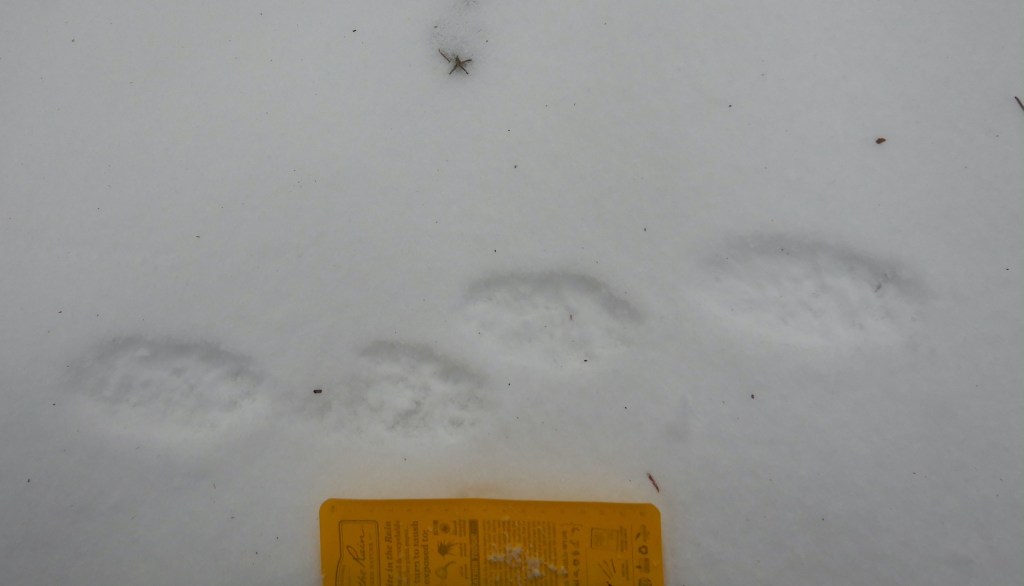
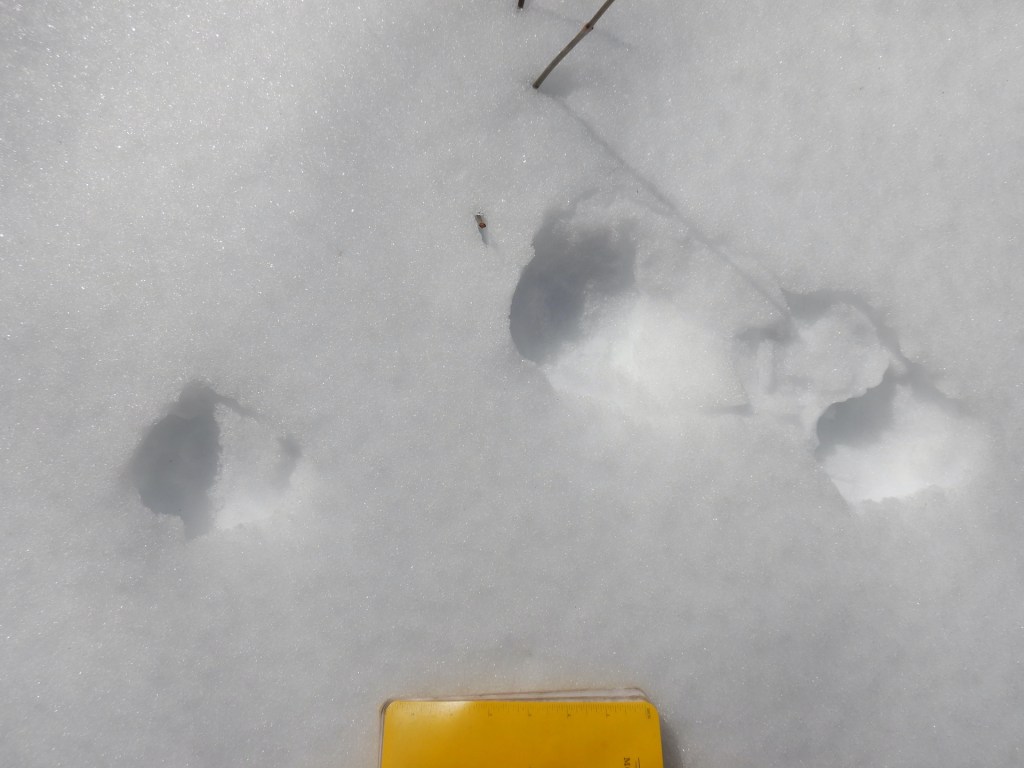
A set of fisher tracks in the snow. Four tracks are visible. The fisher moved from left to right. The yellow notebook at bottom center is ~17 cm wide.
A clear set of fisher prints. Her five toes are perhaps easiest to see in the second track from left. Also note that the fisher created four prints here so she slightly deviated from her typical 3 x 4 lope.

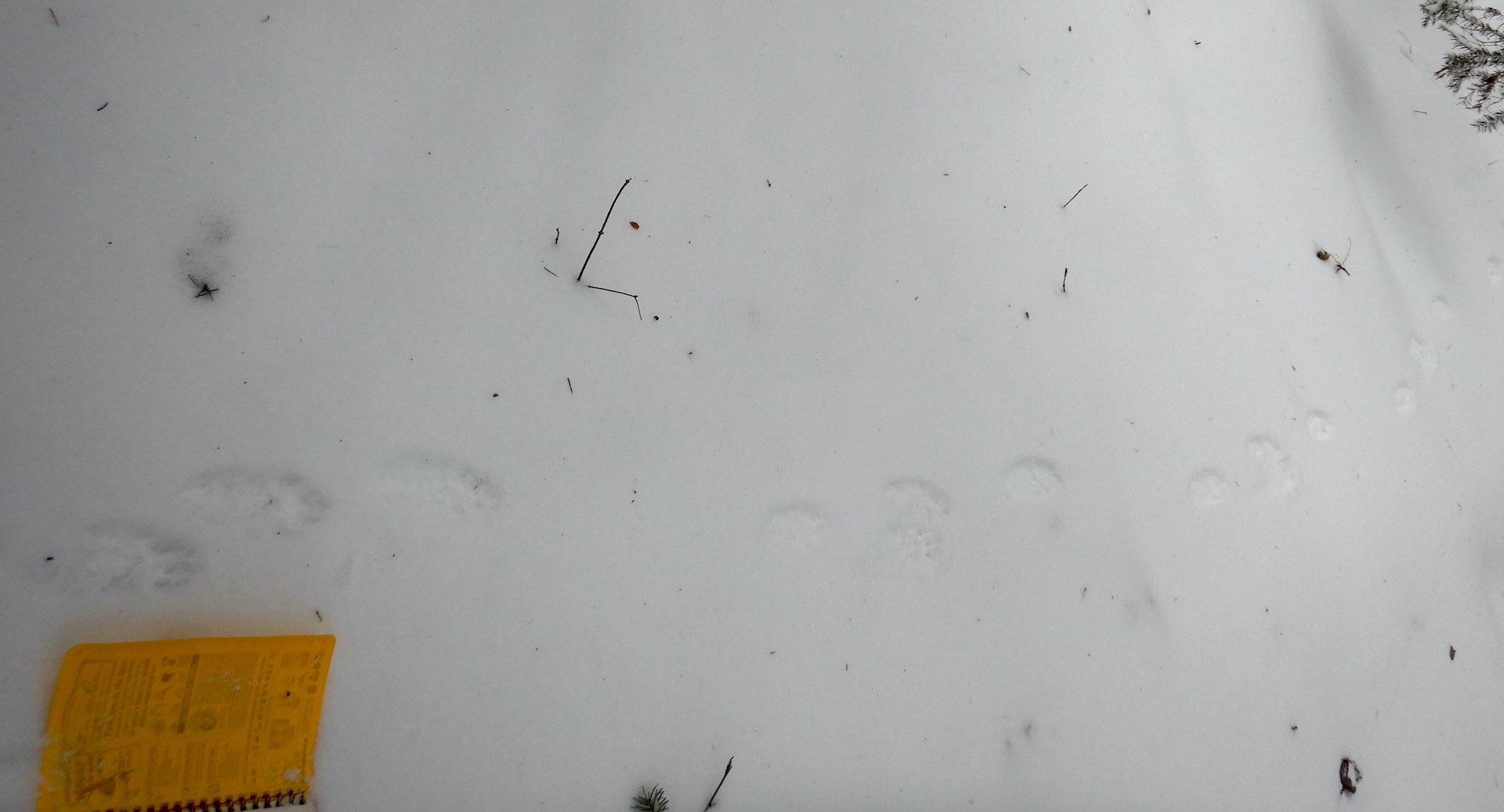
A fisher trackway in snow. The yellow notebook at bottom left is ~17 cm wide. The fisher moves mostly in a 3 x 4 lope. It was headed from left to right in the photo. The tracks are shallow, maybe only a centimeter deep.
A trackway from the fisher. She was moving with a 3 x 4 lope across firm snow. My notebook is about 17 cm wide for scale.

Several other mammals were active that day as well. Snowshoe hares, red fox, red squirrels, mice, and voles all left tracks or scat to reveal their presence. I was only lucky enough to be chastised by a couple of squirrels and didn’t see any other mammals for the majority of the day but walking slowly and quietly gives one the opportunity to be surprised. In a moment of quiet contemplation, the kind you experience while gazing through trees pondering your next move, a glimmer of movement appeared in the corner of my eye. I turned my head to find a weasel bounding through the snow. I didn’t dare reach for my camera knowing I’d spook it into hiding, although I remember clearly my confusion upon seeing it. 

A long-tailed weasel changes its fur color from summer brown to winter white and back again with the seasons. In winter, they are nearly pure white except for the tip of their tail, which is black—a feature that seems to misdirect attacking predators away from the head. This weasel, however, appeared to have a dark tail and head. 

My brain needed to register a few more bounds by the weasel to clear the confusion. it wasn’t oddly colored. The weasel was carrying a vole or mouse in his mouth. As he disappeared in a thicket, I was offered a special opportunity to examine its prints for clues about that may help me better understand how small weasels move in snow when they are burdened by the weight of their prey. 

Long-tailed weasels and the smaller short-tailed weasel (ermine) travel most often in snow by using a 2 x 2 lope. When you see them traveling in this way, it looks almost like a long hop, with the front feet hitting the ground first. The front feet quickly lift into the air while the hind feet land in the same place. The weasel I watched used this method and he seemed to carry his rodent cargo with ease—an impressive display of relative strength. His prey, though, left an important clue. Each of the weasel’s bounds were accompanied by a slash in the snow, which must have been created by part of the dead rodent (a foot? a tail?) dragging in the snow with each leap of the weasel.

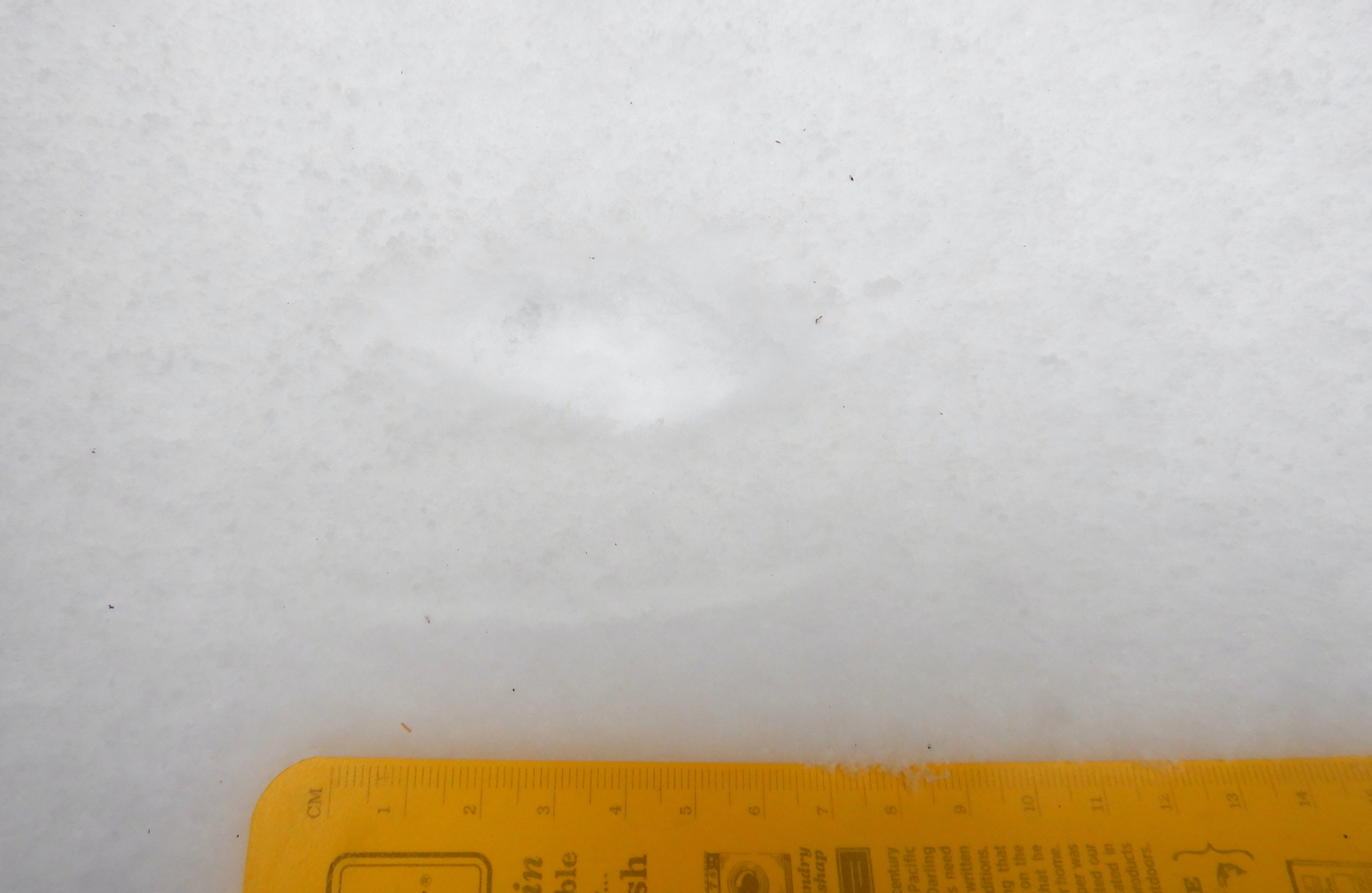
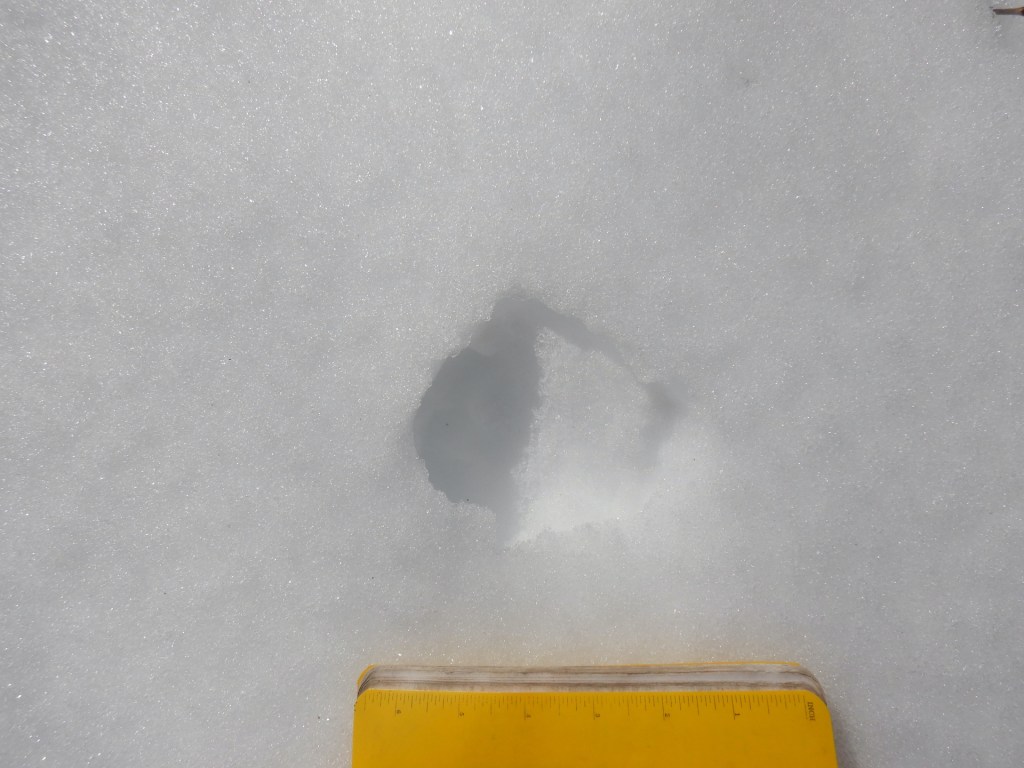
A single set of long-tailed weasel tracks. They make a single depression in snow in the center of the photo. A light slash is visible beneath the weasel prints. The width of the yellow notebook at bottom is about 15 cm.
A long-tailed weasel’s prints are underscored by a slash in the snow created by the rodent prey it carried.

Two sets of long-tailed weasel tracks. Each set makes a single depression in snow. A light slash is visible beneath the weasel prints. The width of the yellow notebook at bottom is about 17 cm.
Two sets of prints from a long-tailed weasel. Note the repeating slash next to each track. The weasel traveled from right to left.

As I discussed in the video segment above, the life of a fisher would be far more mysterious without the record it leaves in snow. I would have no real clue how much fishers leave scent marks or climb trees without reading their trackways. Likewise, if I’d not been in the right place at the right time or been looking in a different direction I would have missed the weasel and its meal completely. Had I stumbled upon its trail with the strange, repeating mark next to each print I’m not sure I’d reason it was from the weasel’s prey. But now, I’ll be looking for other examples like it.

I hope you have the opportunity to utilize snow to learn more about your neighbors. When the snow pack melts in spring, I welcome the change although I must admit that forest seems a bit lonelier when I don’t know who has been visiting. 

*Mammal Tracks and Sign: A Guide to North American Species by Mark Elbroch is an invaluable resource if you want to learn more.

Thirteen Mountain Months

Truly knowing a place might be a capacity only of the omniscient or for earthly beings, perhaps, something gained through multi-generational experience. Lacking omniscience, living in an area far from where I was raised, and having lived in my home only for a few years, I’m forced to make do as best I can. I’ll never know a place in its totality, but I’ve come to realize that I can get closer if I experience it in every season, which is how I found myself trekking to the top of Mount Chase, Maine during every month of the year. 

December 11, 2022 
The first trip in the journey and the most treacherous. Snow has yet to establish itself for the winter and ice covers many sections of trail. The summit is frosty. The hike down is much slower than the hike up.

A trail ascends through a thick forest. The trees are generally less than 6 inches in diameter and grow closely together. The trail is covered in ice like a steep stream that has frozen. About 30-40 feet of the trail is visible before it disappears at center.
Ice covers the Mount Chase Trail on Dec. 11, 2022.

View of forested landscape. Lightly frosted spruce and fir fill the foreground. A lake is visible at center in the lower elevation forest. A ridge of mountains forms the horizon at left center.
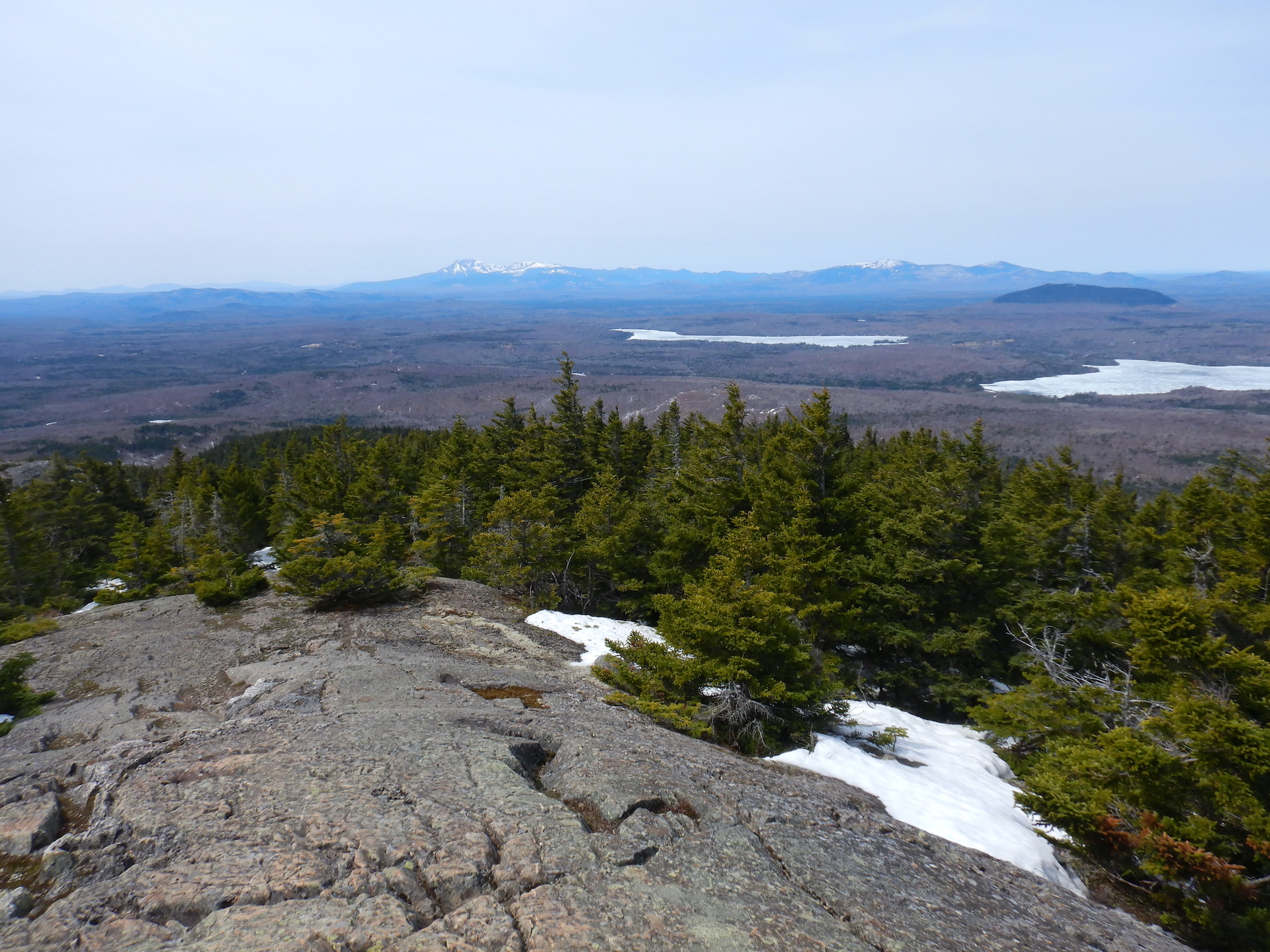
Looking west from the Mount Chase summit toward Upper Shin Pond, Sugarloaf Mountain, and Traveler Mountain.

January 8, 2023
With snow now covering the ice, the trip is far easier than last month and the snow is not yet thick enough that I have to ski to the trailhead. My trusty fat tire bike, Large Marge, gets me there. At the summit, visibility is exceptional and perhaps only limited on this day by the curvature of the Earth. On the way down, I hear a raspy-sounding chickadee. A boreal? Yes. I see it fluttering from branch to branch in the spruce-fir forest maybe 200 – 300 feet in elevation below the summit.

View from a mountain of a forested landscape. A ridge of large mountains form the horizon, although they appear small in the photo. Snow covered trees form the foreground just above windswept rock. Frozen ponds and forest sit in between the
The view to the west-southwest from the Mount Chase summit on Jan. 8, 2023. The mountains of Baxter State Park including Katahdin form the horizon.

A boreal chickadee perches in a frost covered dead spruce tree. The bird is at left center. It has a brown cap with is diagnostic of boreal chickadees.
A boreal chickadee perches in a dead spruce.

February 12
Peak winter. Minus 60˚ F wind chills during the week prior and low air temps approaching -30˚ F at home. I know arctic peoples cope with those temperatures routinely, but I’m too poorly prepared to survive those conditions. Thankfully, this day is warmer, so much so that snow fleas are active on the snow surface. I ski as far as I can up the trail. Eventually, I abandon my skis and walk the rest of the way when the trail steepness beyond my comfort level. The trail is also too narrow to ski down safely and I don’t own the the right style of skis or the skills to do that anyway. On the way up, though, I miss their floatation. The snow pack on the upper mountain must be at least 36 inches. I post-hole to my waist on two occasions.

View of mountain from a low elevation. The mountain is covered in trees that transition from deciduous to coniferous from low to high. The foreground is snow covered.
The destination: Mount Chase on Feb. 12, 2023.

View from a mountain of a forested landscape. Only a sliver of the lowlands are visible. Snow and trees fill the fore and middle ground. The trees are snow covered, especially on their left side.
The view looking south from the Mount Chase summit on Feb. 12, 2023.

March 11
The snow seems deeper than February, but maybe this will be the last deep snow trip of the year? Along an alternative route I like to take to the main trail, I find a set of lynx prints in the snow. Farther up the mountain I ditch my skis again at a point above the abandoned fire warden’s cabin where the slope gets too steep. A few snowmobiles have made the trip, though, and I continue with relative ease in their trackways.

A single lynx track. Photo is taken from directly above it. The notebook at bottom is about 7 inches long.
A single lynx track. The feline was traveling from right to left.
The 3x4 gait of a lynx in snow. Photo is taken from directly above tracks looking down. The tracks are several inches in width and length.
Although these lynx tracks aren’t well defined, the size and shape are distinctive. I find one set of these tracks per winter on average. Lynx are rare in Maine and have large territories.
Portrait view of forest. Spruce and fir trees fill the scene with spruce growing the tallest. A narrow trail is visible at bottom center.
The coniferous forest on the upper slopes of Mount Chase.

April 22
A difficult trip to the top and back (the hardest of them all, in hindsight). Mud season has fully enveloped the region. The dirt roads that approach the trailhead are slop. Large Marge gets me to the trailhead but not without extra effort from my legs. The trail remains almost wholly snow-covered above the abandoned fire warden’s cabin and the remaining snow is soft. Still, I’m thankful winter’s dormancy is broken. Near the trailhead, I hear wood frogs looking for love in a nearby a vernal pool. The calls of juncos, robins, and sapsuckers—birds that do not overwinter here—fill the deciduous forest nearby.

Two trails intersect at lower right. Both have water flowing on them. A sign at left points to the center of the photo. The sign is mounted on a post has a homemade look. It says "trail." An arrow points to the right toward the trail. Both "trail" and the arrow are outlined in permanent marker.
The official Mount Chase trailhead.

A derelict cabin in a forest. Wet, late season snow covered the bare area in front of the cabin. A mixed forest surround the cabin. The windows and door of the cabin is missing and the brick red lead paint is peeling from the outside.
The abandoned fire warden’s cabin on Mount Chase.
View from a mountain of a forested landscape. A ridge of large snow capped mountains form the horizon, although they appear small in the photo. Snow covered trees form the foreground just above windswept rock. Frozen ponds and forest fill the middle ground.
Looking west-southwest toward Katahdin and Baxter State Park from the Mount Chase summit on April 22, 2023.

May 17
I thought I’d be done with snow on the mountain by now. I was wrong. It falls on the way up and on the summit. Some small patches linger in the shadiest areas among the spruce and fir. Bud break might be advancing fast at lower elevations, but the plant phenology seems at least a week delayed on the mountain’s mid elevations and maybe two weeks behind in the summit area.

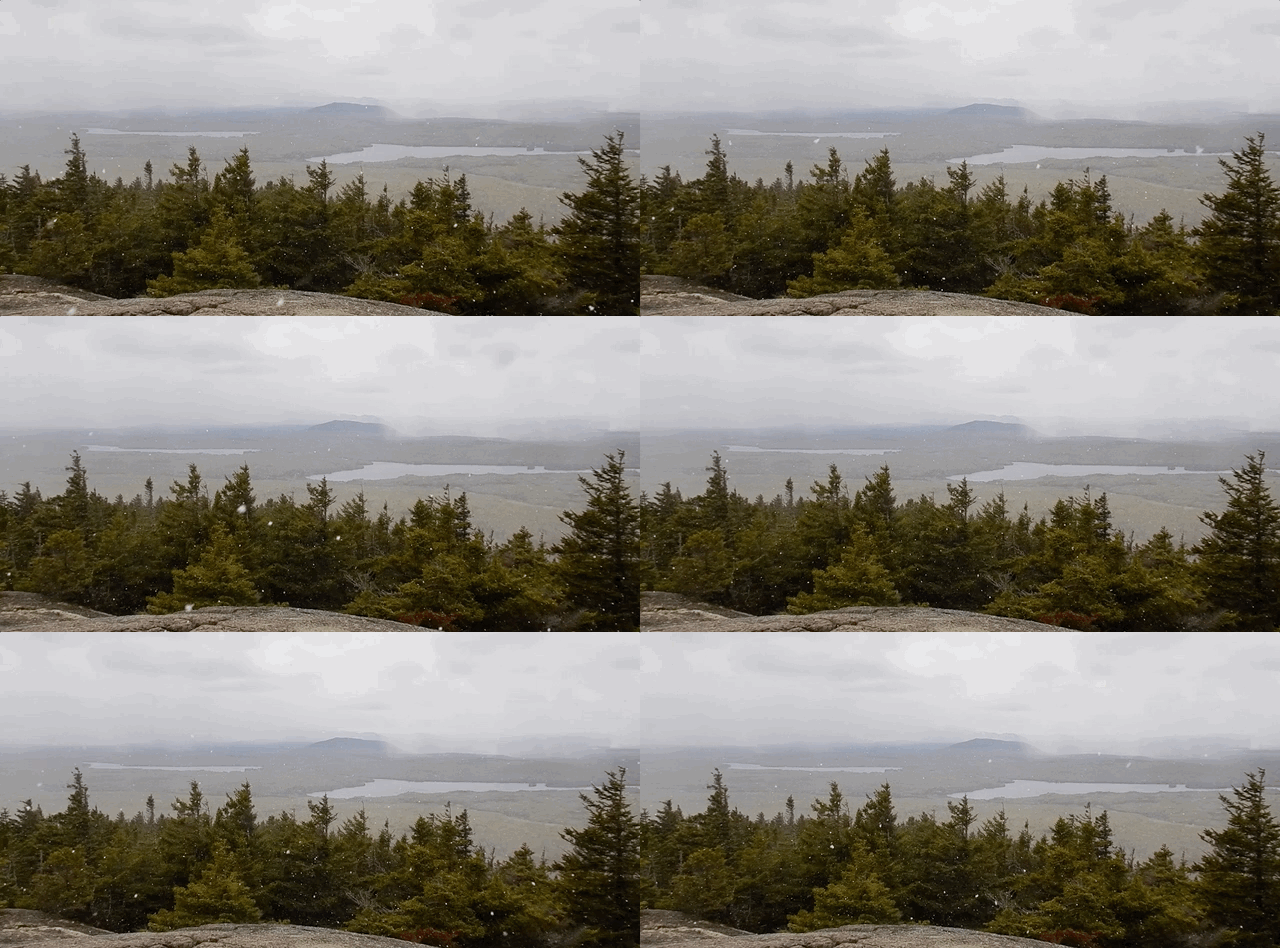
GIF of landscape view from a mountain top. Stunted spruce and fir fill the foreground. Forested lowlands fill the middle ground to the cloud obscured horizon. Snow flakes fall in the air.

Close up photo of flower in deciduous forest. The flower petals face the camera. The three petals are maroon.
Trillium erectum on the lower slopes of Mount Chase.

June 19 
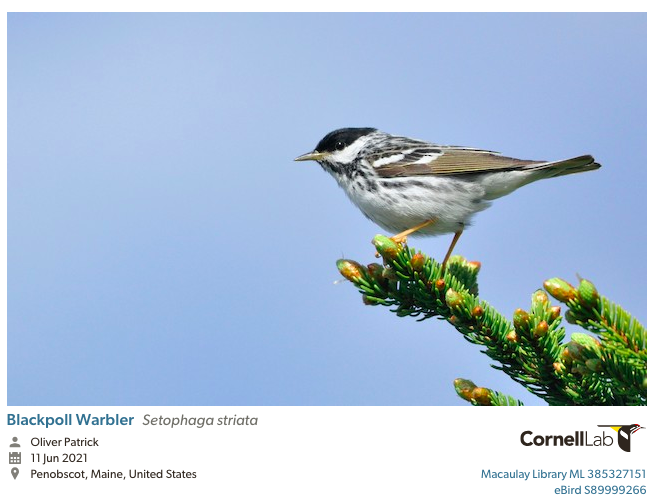
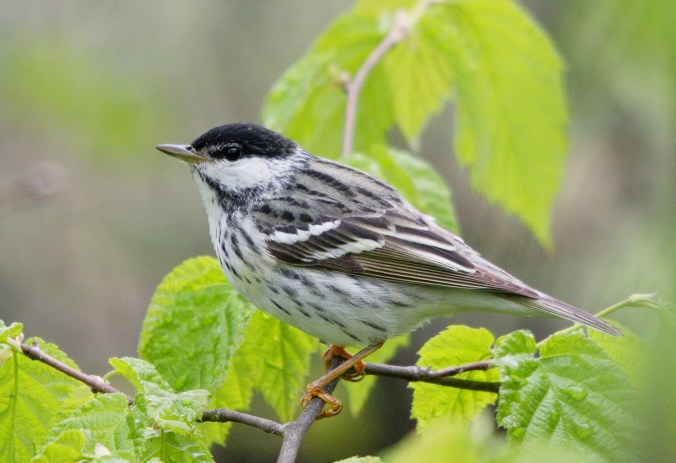
A busy day on the trail with a whopping three cars at the trailhead! Large Marge, as usual, doesn’t have any other bicycles to keep her company. The forest has come to life. I note more than 20 plant species blooming. Biting insects are surprisingly few in contrast to home where the abundance of mosquitoes and black flies force me to don long sleeves, long pants, and a headnet almost anytime I intend to spend more than a few minutes outside. In the spruce-fir forest, I enjoy listening to the songs of blackpoll warbler. Sadly, they are categorized as a threatened species in the state.

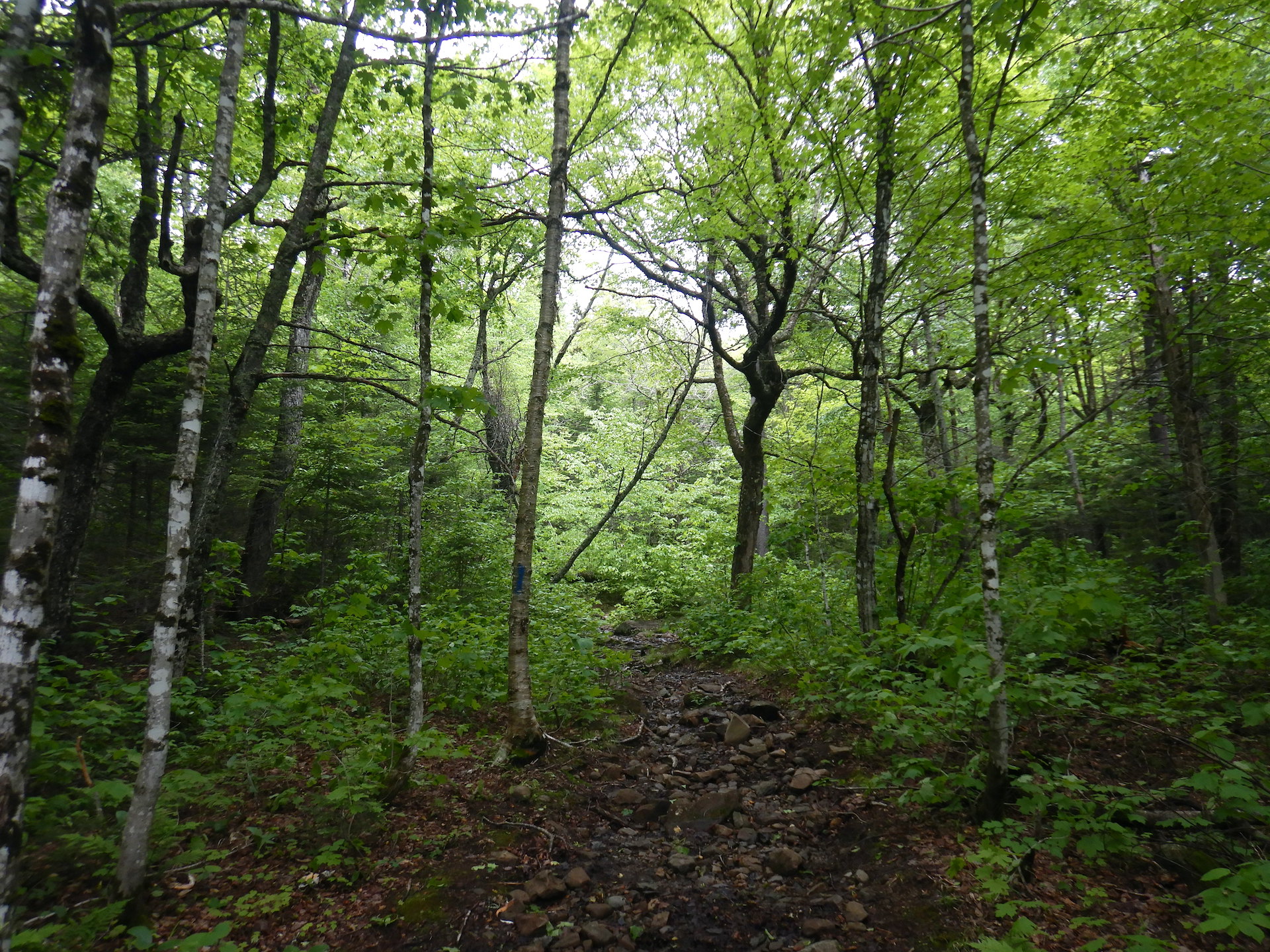
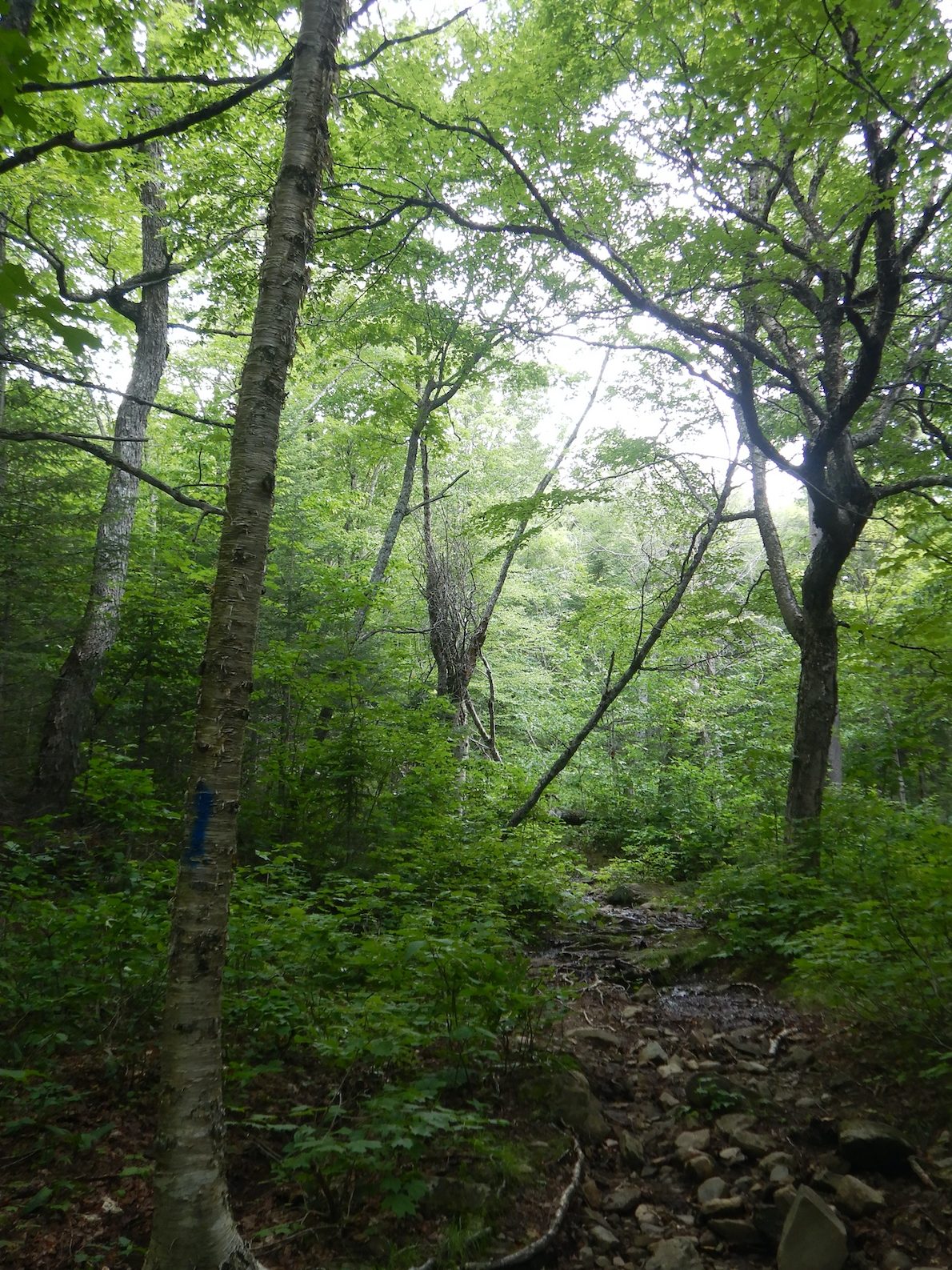
A rocky trail disappears into a green forest. Trees with bright green leaves obscure the sky. The understory is also thick with green plants.
Late spring on the Mount Chase Trail.

This is the song of a blackpoll warbler recorded in the spruce-fir forest of Mount Chase. The song is a rapid series of high-pitched notes near the beginning of the track. The audio also captures part of the songs of Swainson’s thrush and winter wren.

July 21
The air feels and looks heavy due to high humidity and hazy, smoke-filled skies. This isn’t the first day of the summer with these conditions, and the past two summers had days like this too. Is the presence of smoke becoming the new normal for summertime Maine? I concentrate on observing the trees, which are in “peak green,” a phase in summer when the foliage has reached its max yet still retains some of the freshness of spring. Fledgling birds are the latest addition to the animal community. Golden-crowned kinglets and red-eyed vireos feed noisy babies. On the summit, hundreds of dragonflies zip between the stunted trees.

Portrait view of rocky trail through a green forest. The trail starts at lower right and disappears at center.Trees with bright green leaves obscure the sky. The understory is also thick with green plants.
Peak green on Mount Chase trail. July 21, 2023.

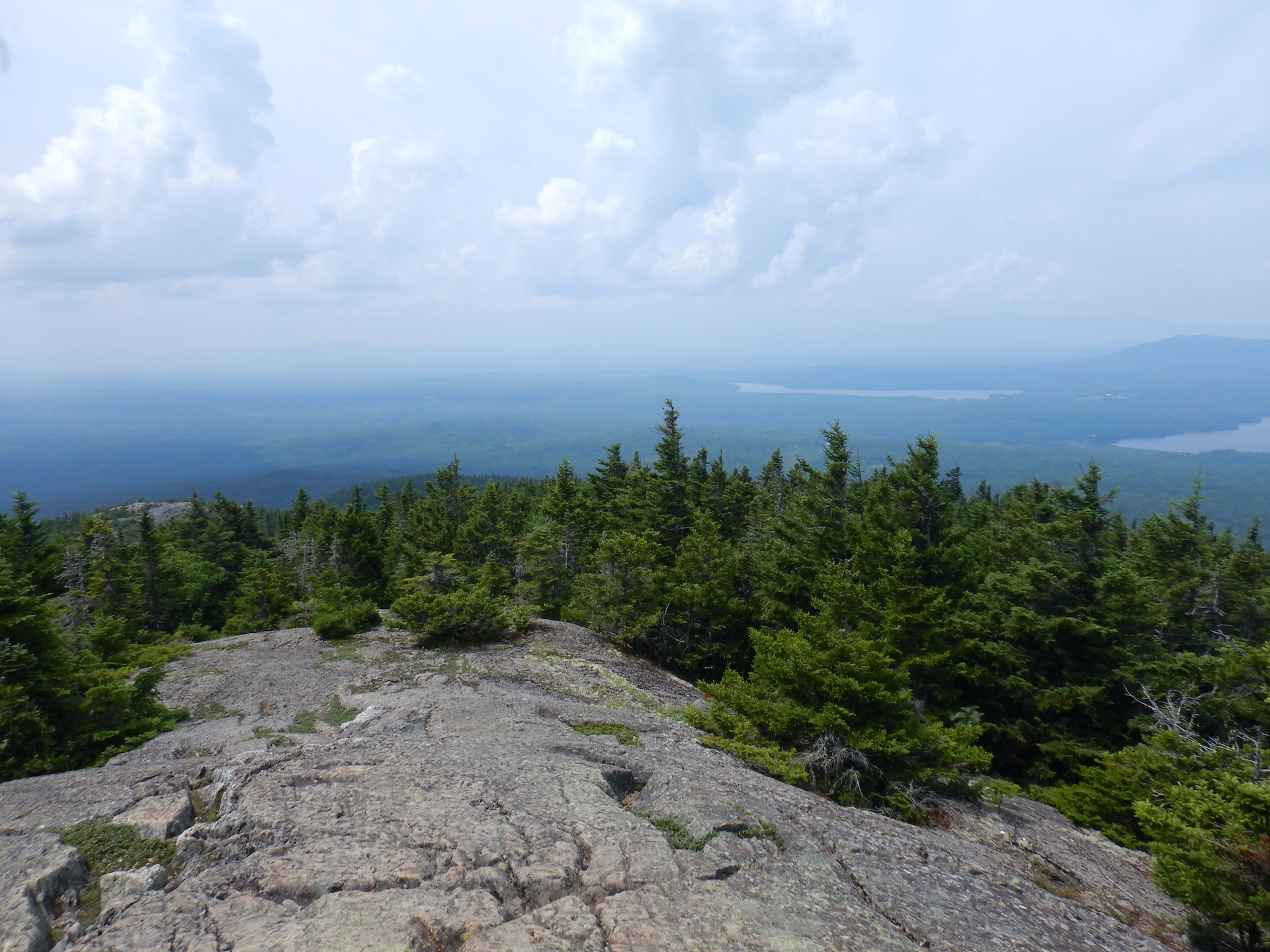
View of forested landscape from mountain summit. Bare rock covers the ground at bottom while spruce and fir trees slope off the mountain. The lowlands and horizon are obscured by haze in the air.
Looking west-southwest through smoky haze toward Katahdin and Baxter State Park from the Mount Chase summit on July 21, 2023.

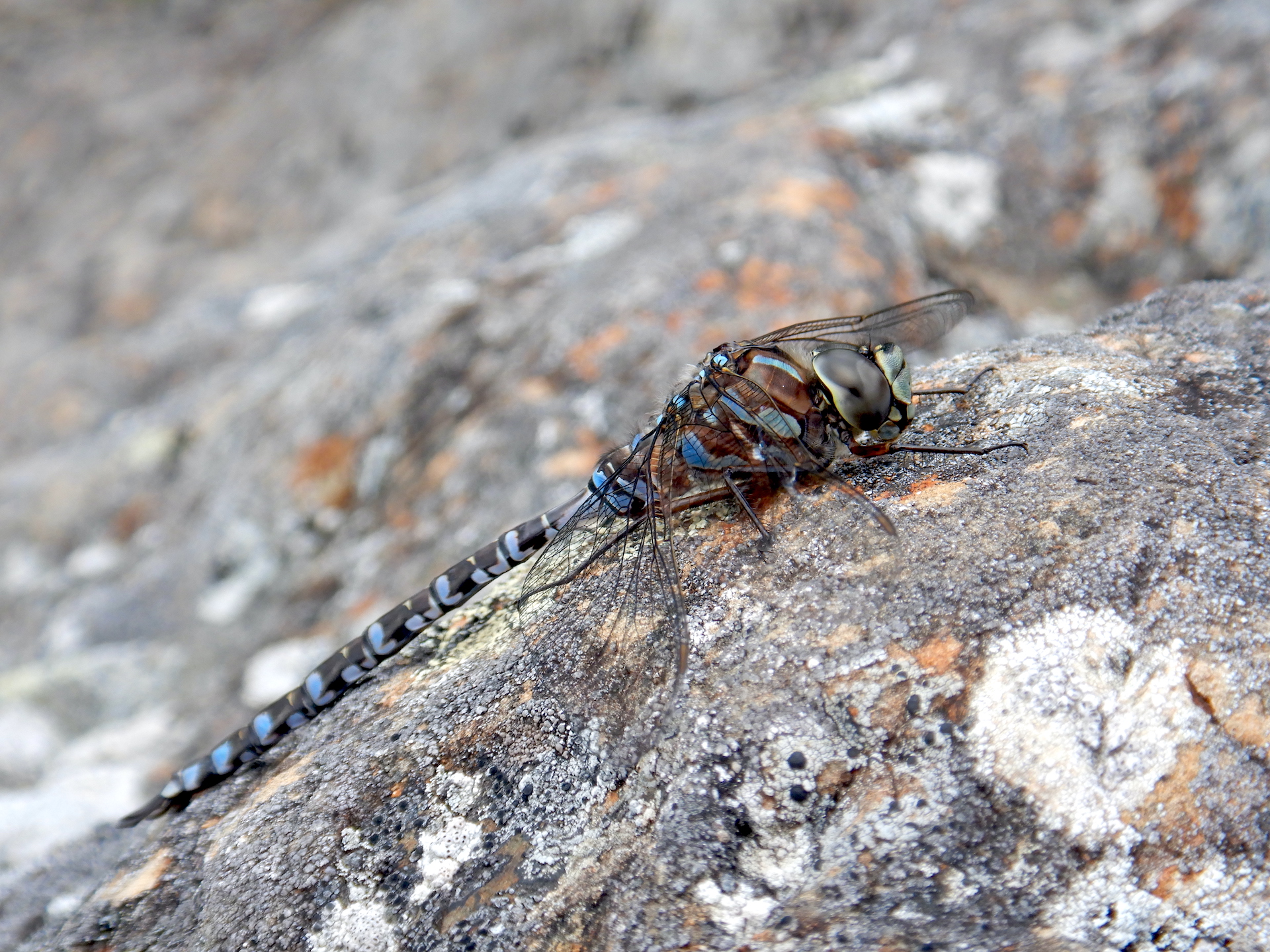
Close up view of a dragonfly. The insect rests on rock speckled with small crusty lichens. It has a blue-spotted abdomen and holds its wings flat parallel with the rock.
A darner dragonfly of genus Aeshna rests on at the summit of Mount Chase. If you know what species it is, please identify it on iNaturalist.

August 20 
A quiet hike now that songbird nesting season is done. Only white-crowned sparrows sing in the summit area. The summer foliage has reached “tired green.” The work of photosynthesis as well as insect attacks have rendered the previously vibrant leaves a darker, less vibrant hue. I experienced a stressful week. Yet, I’m fortunate to have an escape for some brief solace.

View of forest that is a mix of young and old spruce and fir trees. Dead standing trees are among them. A large trunk is at left.
A section of old growth forest on upper Mount Chase.

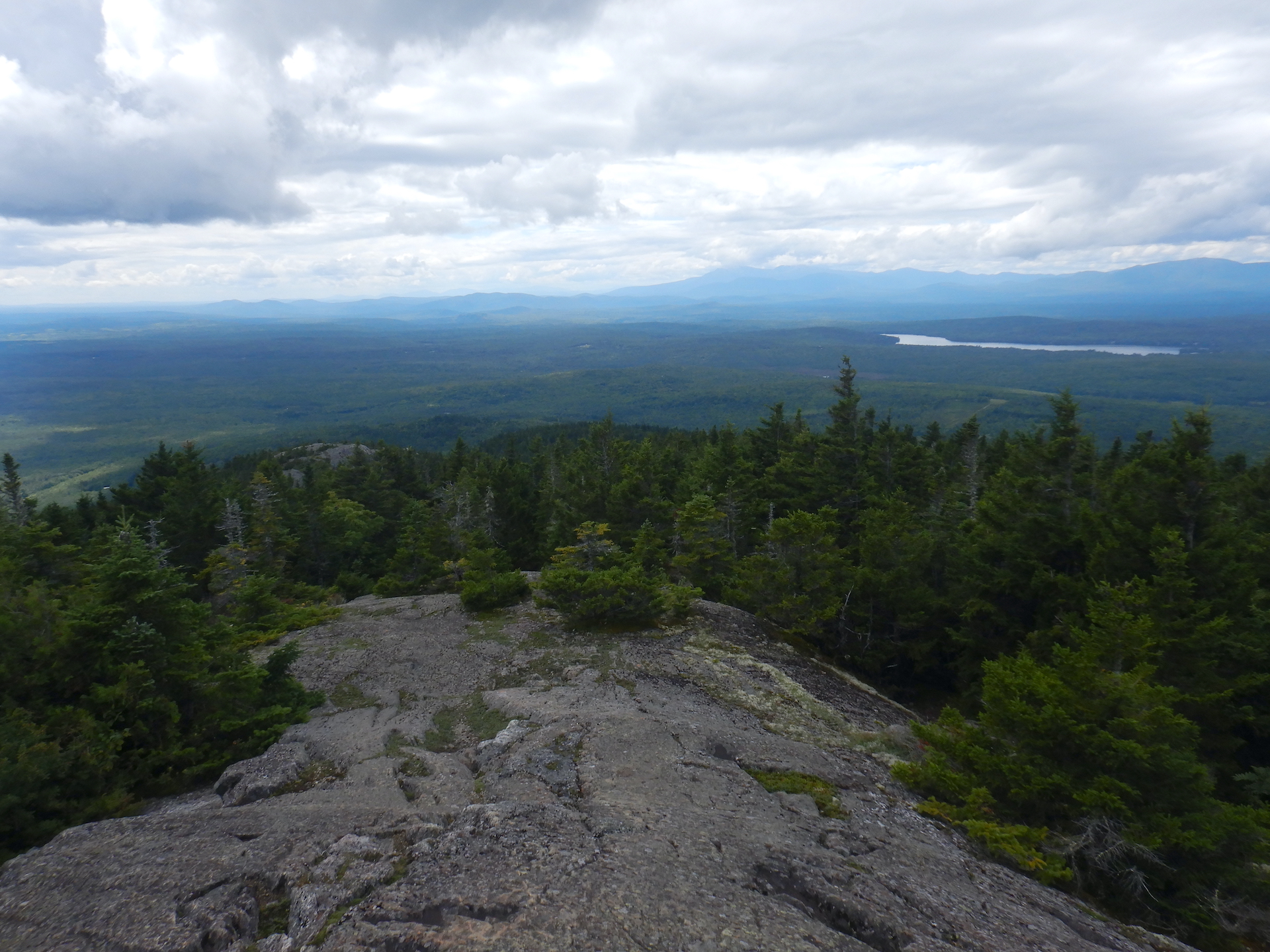
View of forested landscape from mountain summit. Bare rock covers the ground at bottom while spruce and fir trees cover the near slopes. The skies are mostly cloudy. Forest fills the lowlands. A pond and mountains can be seen near the horizon at center left.
Looking west-southwest toward Katahdin and Baxter State Park from the Mount Chase summit on August 20, 2023.

September 24 
I discover (for myself) the remnants of a long abandoned cabin maybe 20 yards off the trail. It’s collapsed to its foundation. Still, I’m surprised by its presence. I walked by it many times previously without seeing it. The forest tends to make things disappear. Hazy conditions have returned to the area. A thick band of wildfire smoke clouds the north horizon and the mountains of Baxter State Park are mostly obscured. A few red-tailed hawks ride the thermals on the mountainside on their migration south. A raven family doesn’t tolerate their presence. They move to chase one of the soaring hawks. We’re approaching peak fall colors, although the colors are quite muted compared to normal.

A collapsed cabin rests in the forest. Vegetation has yet to grow over the structure but the wood at the base in the foreground is rotted and moss covered. The rest of the structure forms a pyramid shape.
The forest and weather will soon consume this collapsed cabin.

The Mount Chase Trail on Sept. 24, 2023.

View of forested landscape from mountain summit. Bare rock covers the ground at bottom while spruce and fir trees cover the slopes. A pond is visible at center left. Haze obscures the horizon. The low elevation forest is speckled with yellow foliage.
Looking west-northwest from the Mount Chase summit on Sept. 24, 2023.

October 18
The forest trends brown. A solid layer of newly fallen leaves cloaks the forest floor. I somehow sleepwalk most of the way to the summit, a habit I’ve been trying to break for years with greater mindfulness. I find myself stopping to focus on my breath and immediate surroundings. Something distracted me, probably precipitated by a media culture that profits from distraction and rage-inducing social networks. It is possible to walk through a forest and not see it at all.
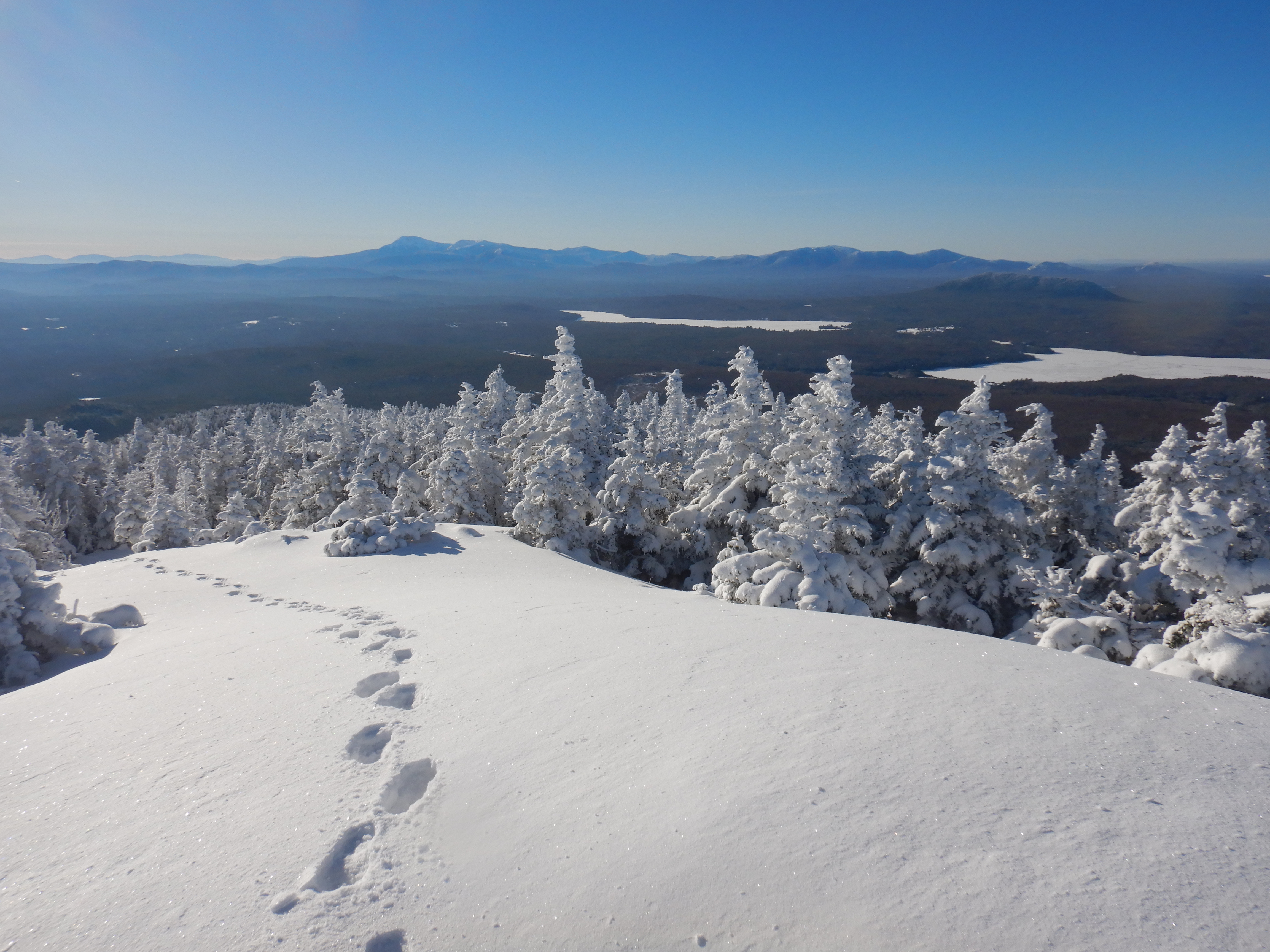
Landscape view of rocky trail through a forest. The trail starts at bottom center and disappears at left of center. The canopy is mostly bare of leaves. The leaves that remain are mostly yellow. A larger tree bisects the image from top to bottom.
The Mount Chase Trail on October 18, 2023.

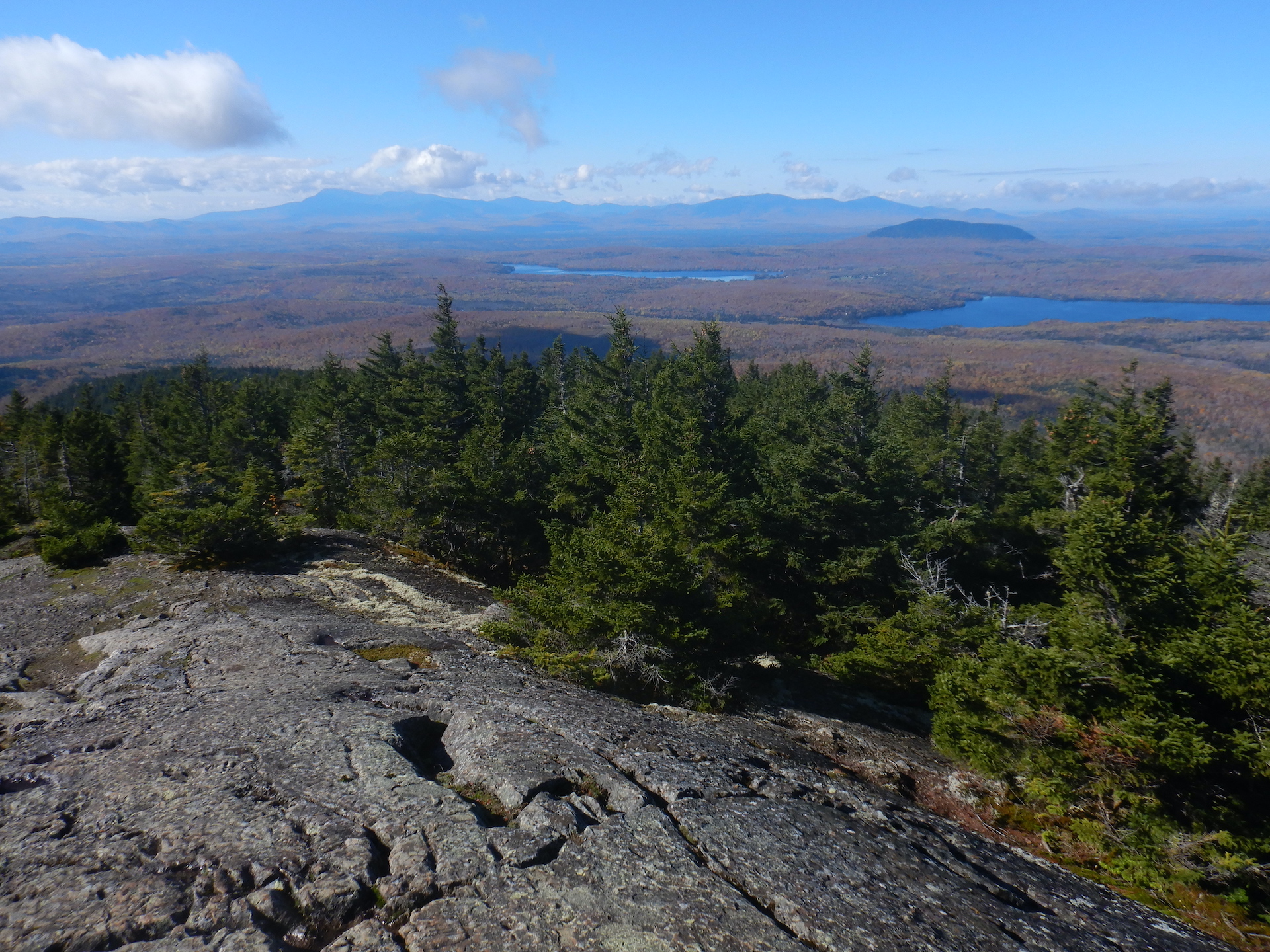
View of forested landscape from mountain summit. Bare rock covers the ground at bottom while spruce and fir trees cover the upper slopes. The lowland forest is mostly brown and bare of leaves. Tall mountains form the horizon although they look small due to the perspective. A pond is visible in the forest at center right.
Looking west-southwest toward Katahdin and Baxter State Park from the Mount Chase summit on October 18, 2023.

November 16
I begin at an alternative trailhead that I’ve used a few times this year. The route isn’t maintained. It’s nothing more than a decades-old skidder trail, but it is a quicker and more secluded course than the main trailhead. The year has been wetter than average, so water has consistently flowed over parts of the trail. Mid fall brought a prolonged stretch of dry weather though, and the trail is drier than it has been over the entire year. Winter will soon be here. The canopy is bare. Patchy snow sits in the shady areas of the mountain’s spruce-fir forest.

View of forest that is a mix of young and old spruce and fir trees. Dead standing trees are among them. A large trunk is at left. Tiny patches of snow sit on fallen tree trunks.
The old growth forest on upper Mount Chase on November 16, 2023.

View of forested landscape from mountain summit. Bare rock with some patchy snow covers the ground at bottom while spruce and fir trees cover the upper slopes. The lowland forest is bare of leaves. Tall mountains form the horizon although they look small due to the perspective. A pond is visible in the forest at center right.
Looking west-southwest toward Katahdin and Baxter State Park from the Mount Chase summit on November 16, 2023.

December 8, 2023
Winter is a time of dormancy for many life forms, although it brings vibrancy in other ways. None of the previous trips were as beautiful or as quiet. Several inches of snow coat the ground at low elevations and about 12 inches linger higher on the mountain. No human footprints are discernible on the trail. Snow and hoarfrost cover the conifers like cake icing. The landscape appears clean in a way that I don’t find in spring, summer, and fall.

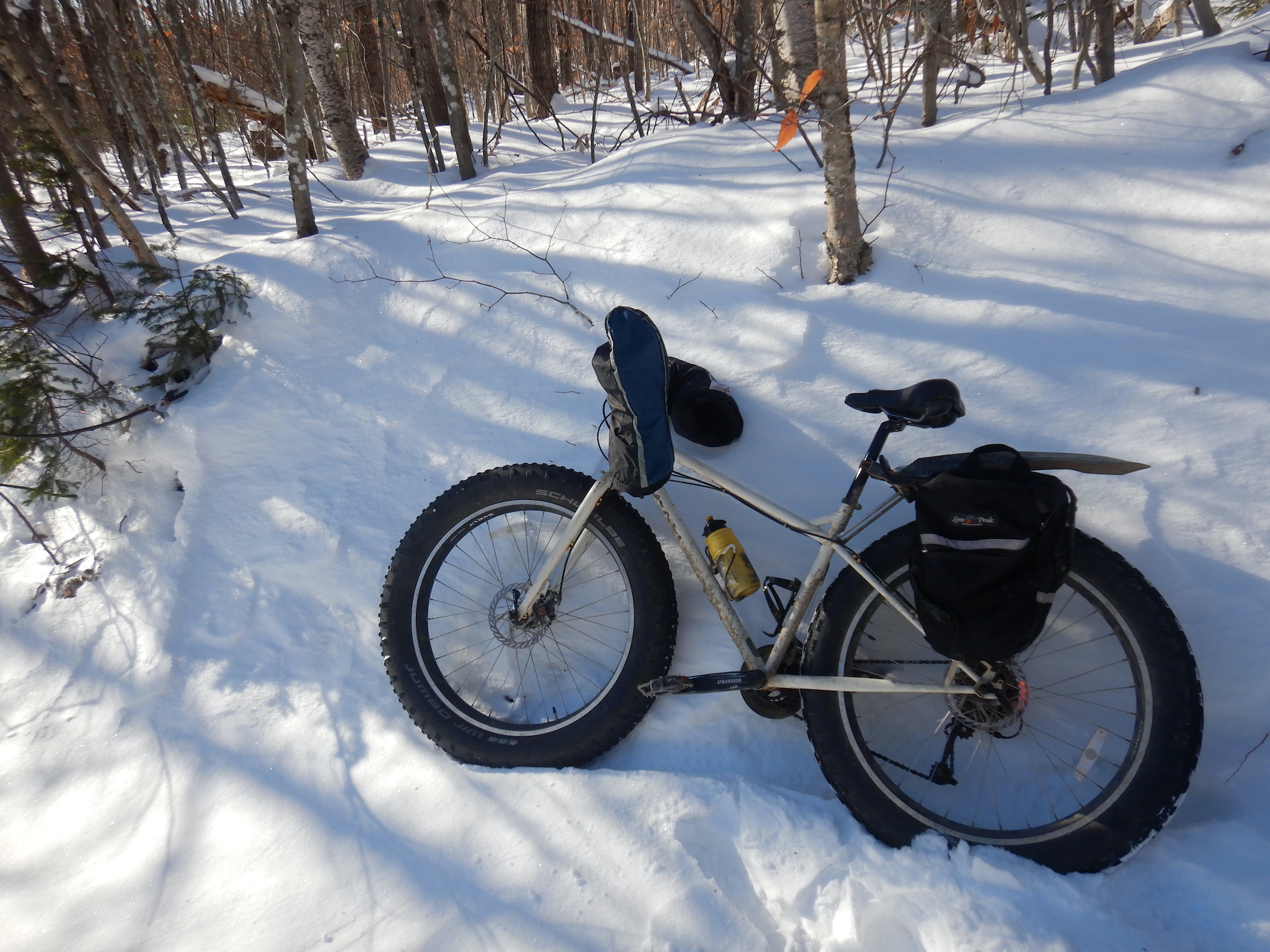
A fat tire bicycle rests against a snow covered bank. Trees fill the background at top. The bike has a rear pannier and bar mitts.
Large Marge

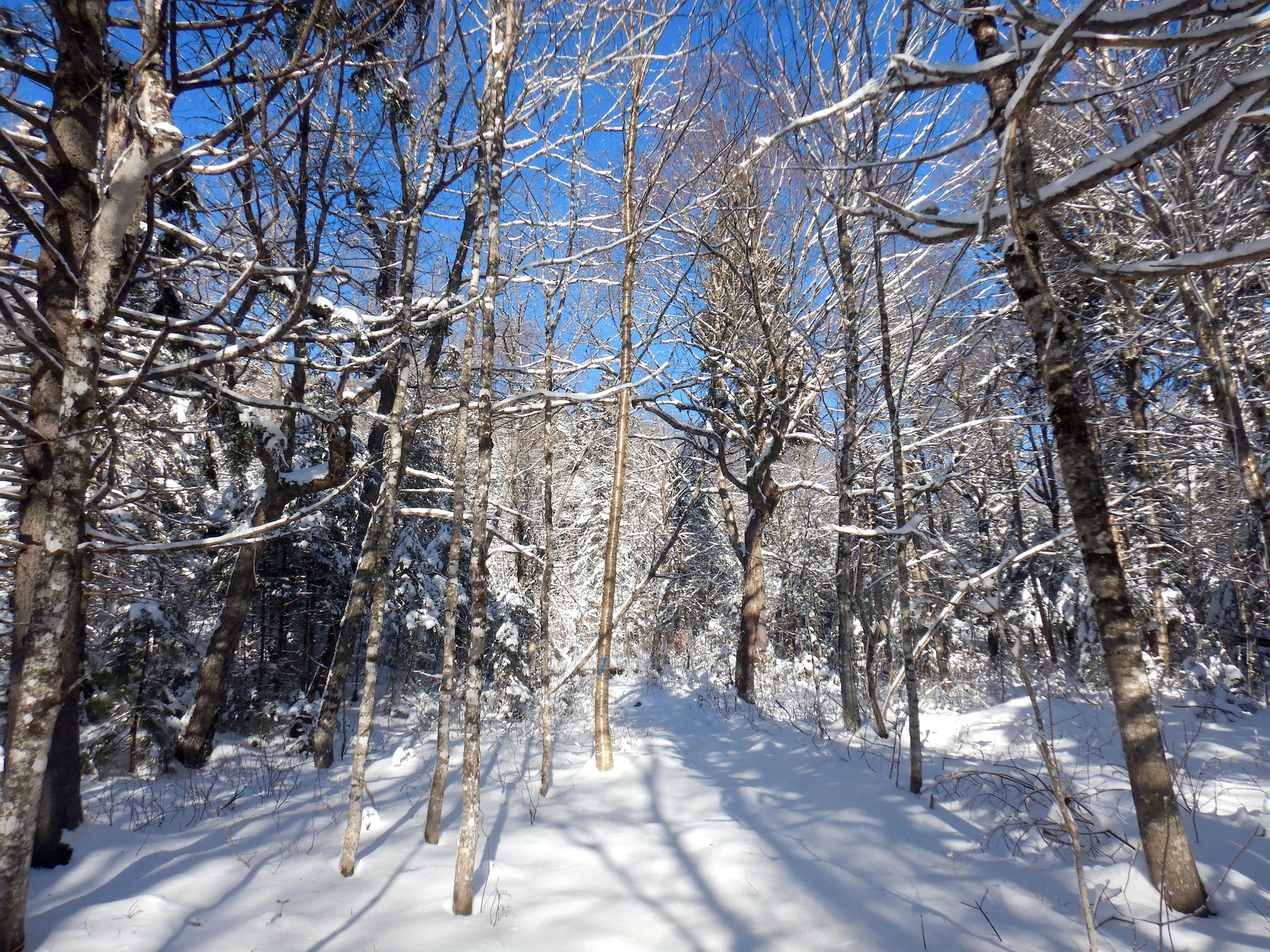
view of snowy forest. The trees are mostly deciduous and bare of leaves. Snow covered the ground.
The Mount Chase Trail on December 8, 2023.
The final approach to the Mount Chase summit on December 8, 2023.

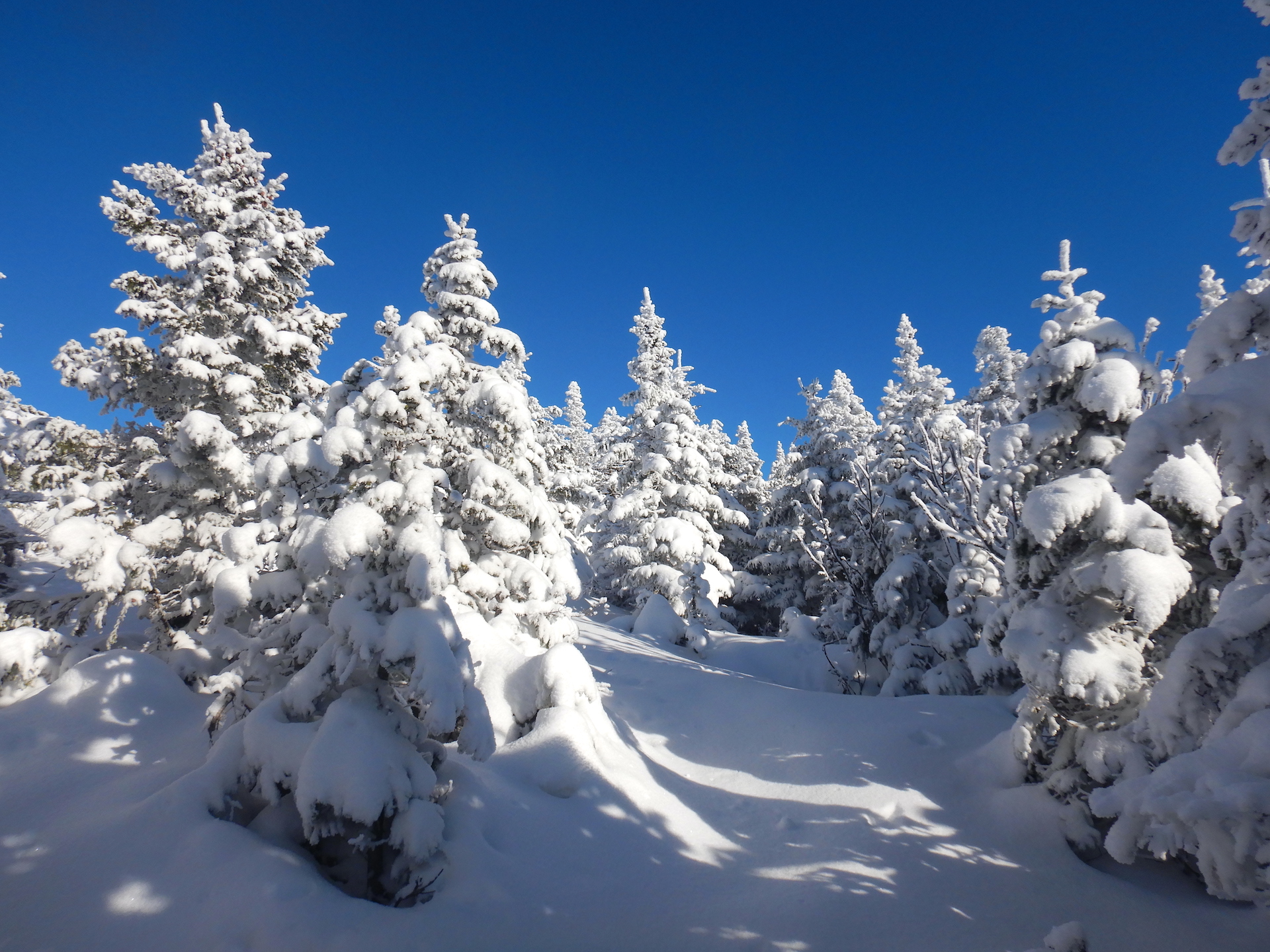
View of snowy conifer trees looking toward mountains on a far horizon. The trees are pyramidal in shape and their branches are covered in thick snow. The ground is fully snow covered. A blue sky fills the upper half of the photo.
Looking down the Mount Chase Trail near the summit on December 8, 2023.

View of forested landscape from mountain summit. Snow covers ground at bottom. A single set of human footprints cross them toward the perspective of the camera. Snow-covered spruce and fir trees cover the near slopes. Ice covered ponds and forest fill the lowlands. A line of mountains forms the horizon.
Looking west-southwest toward Katahdin and Baxter State Park from the Mount Chase summit on December 8, 2023.

Time spent in the forest is never wasted and every moment offers the potential to discover new perspectives. I’m no closer to profound insights after thirteen trips to the summit of Mount Chase, although I’ve walked away with a greater appreciation for the mountain’s rhythms. The experience is both the same and vastly different every time. 

Time and Change Along the South Branch

There’s a walk I’ve been eager to follow since reading about it in A Guide to the Geology of Baxter State Park and Katahdin. So on a warm day in early September, I found myself meandering downstream along the South Branch of Trout Brook. 

I was fortunate to be there at that time of year. Water levels were low, which made for easy walking. Water temperatures were cool, which allowed my wet feet to buffer the heat of the day. Importantly, biting insects were few, which permitted me to enjoy the scenery without taking extraordinary measures to protect exposed skin.

A hike down the South Branch is intriguing because stream erosion exposes a series of rock formations that reveal a 400 million year-old story. In it we find the violence of long extinct volcanoes as well as the marvel of the first plants to colonize land on Earth. It is a story of immense time and change.

A calm portion of a stream surrounded by deciduous trees. The stream flows from lower left to center before disappearing around a bend.
South Branch Trout Brook in Baxter State Park.

Maine in the early Devonian Period, about 400 million years ago, would be wholly unrecognizable. The landmasses that would become Maine were located south of the equator. Extensive volcanism scalded the Katahdin region. Terrestrial vertebrates weren’t yet a thing. Dinosaurs were still about 150 million years into the future. Perhaps the oceans would be the only similarity we could recognize.

To explore this age of Earth’s past, I began at South Branch Falls which was empty of people when I arrived in mid-morning. It is an appealing swim spot with shoots and pools carved into Traveler Rhyolite, a rock formation created by ash fall and pyroclastic flows that may have filled a volcanic caldera about 407 million years ago.

A stream flows through a narrow chute carved into bedrock. The stream flows from center to bottom right. Deciduous trees and some white pines overtop the stream and trees.
South Branch Falls. The rock is composed of a type of rhyolite known as welded tuff.
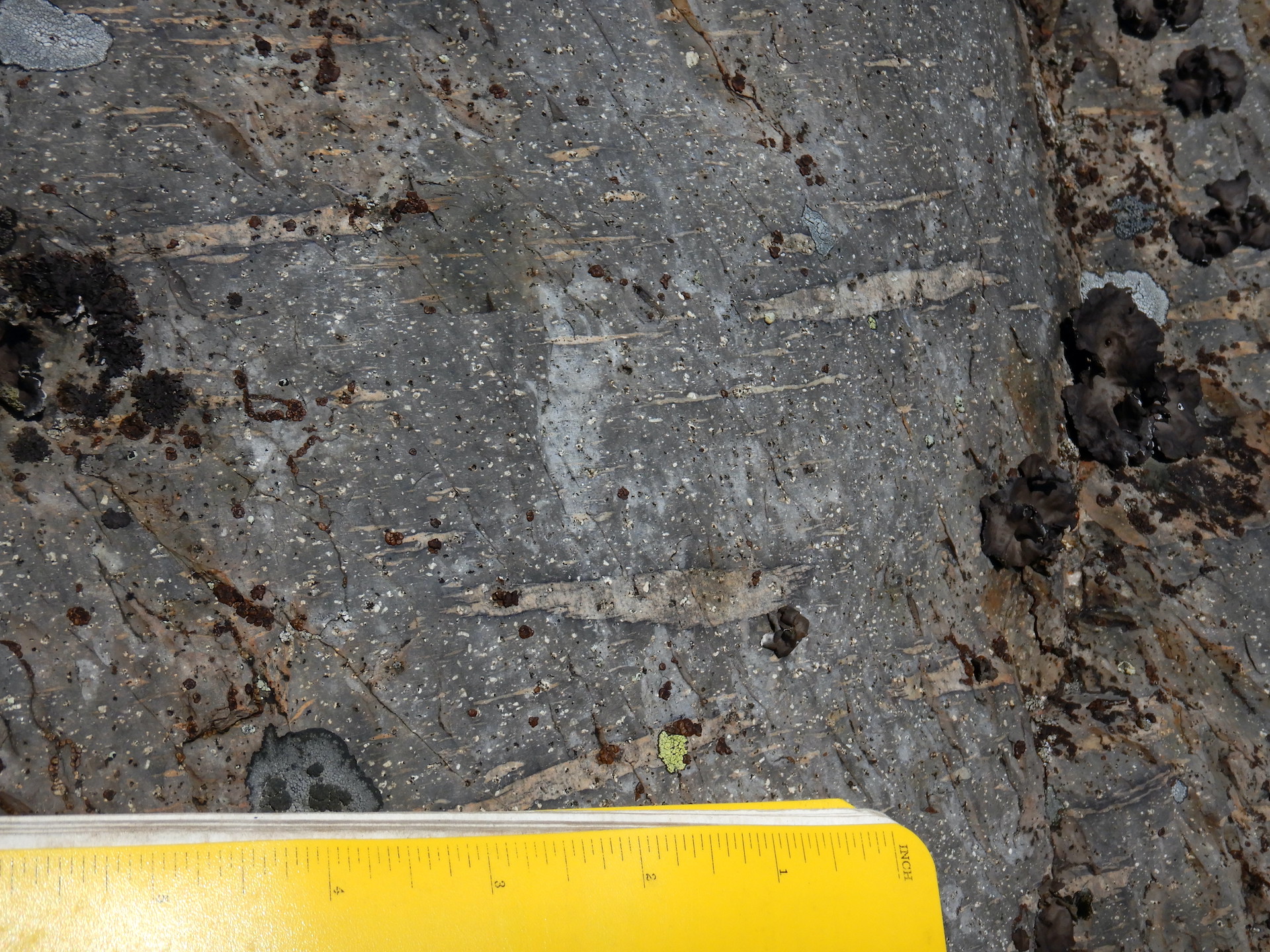
Close up photo of rock. The rock is gray and includes light gray inclusions of flattened pumice. The scale at bottom measures about 6 inches.
An example of welded tuff from Peak of the Ridges to the south of the South Branch. While this photo was taken a few miles from South Branch Falls, the rocks formed in the same manner. Ash and pumice from volcanic eruptions were heated and compressed, which deformed and stretched clasts of pumice within it. Instead of loose ash and pumice, it was welded together by heat and pressure.

In contrast, nearby Katahdin, Maine’s tallest peak, in the southern portion of Baxter State Park is composed of granites. 

View of boulder field and alpine vegetation (mostly small sedges tucked between the rocks) looking toward a taller mountain peak in the background.
Mount Katahdin as seen from the North Peaks Trail in Baxter State Park.

Despite their differences in appearance and texture, rhyolite and granite are chemical equivalents. Both are formed from silica-rich magma. The difference is a product of time and location. Rhyolite is a volcanic rock formed from viscous lava. Because of its high viscosity it tends to erupt explosively—think Plinian type eruptions such as Krakatoa in 1883. Granite, though, forms underground when silica-rich magma is given the opportunity to crystalize over millions of years. According to the aforementioned Guide to the Geology of Baxter State Park and Katahdin, mineralogical analysis confirms the relatedness of the Katahdin Granite and the Traveler Rhyolite. They both date to about the same age too, although the rhyolite must be younger since it rests on top of the granite and there’s no evidence that the granite intruded into the rhyolite. Katahdin’s granite, therefore, is the solidified core of a magma chamber that fed the eruptions resulting in the Traveler Rhyolite.

The nearest modern analog to the Traveler Rhyolite that I have seen is the pyroclastic flows of the Valley of Ten Thousand Smokes in Katmai National Park, but that was result of a single, 60-hour eruption. While Traveler Rhyolite is not a widespread rock formation currently it may have once covered a much more extensive area. It is also voluminous where it remains, perhaps accumulating to a total depth of 10,000 feet (3,000 meters) from the successive accumulations of an unknown number of eruptions. The enormity of the eruptions that created the Traveler Rhyolite is difficult to imagine. The serenity of a quiet morning at South Branch Falls fails to capture the violence of the events that created the bedrock here.

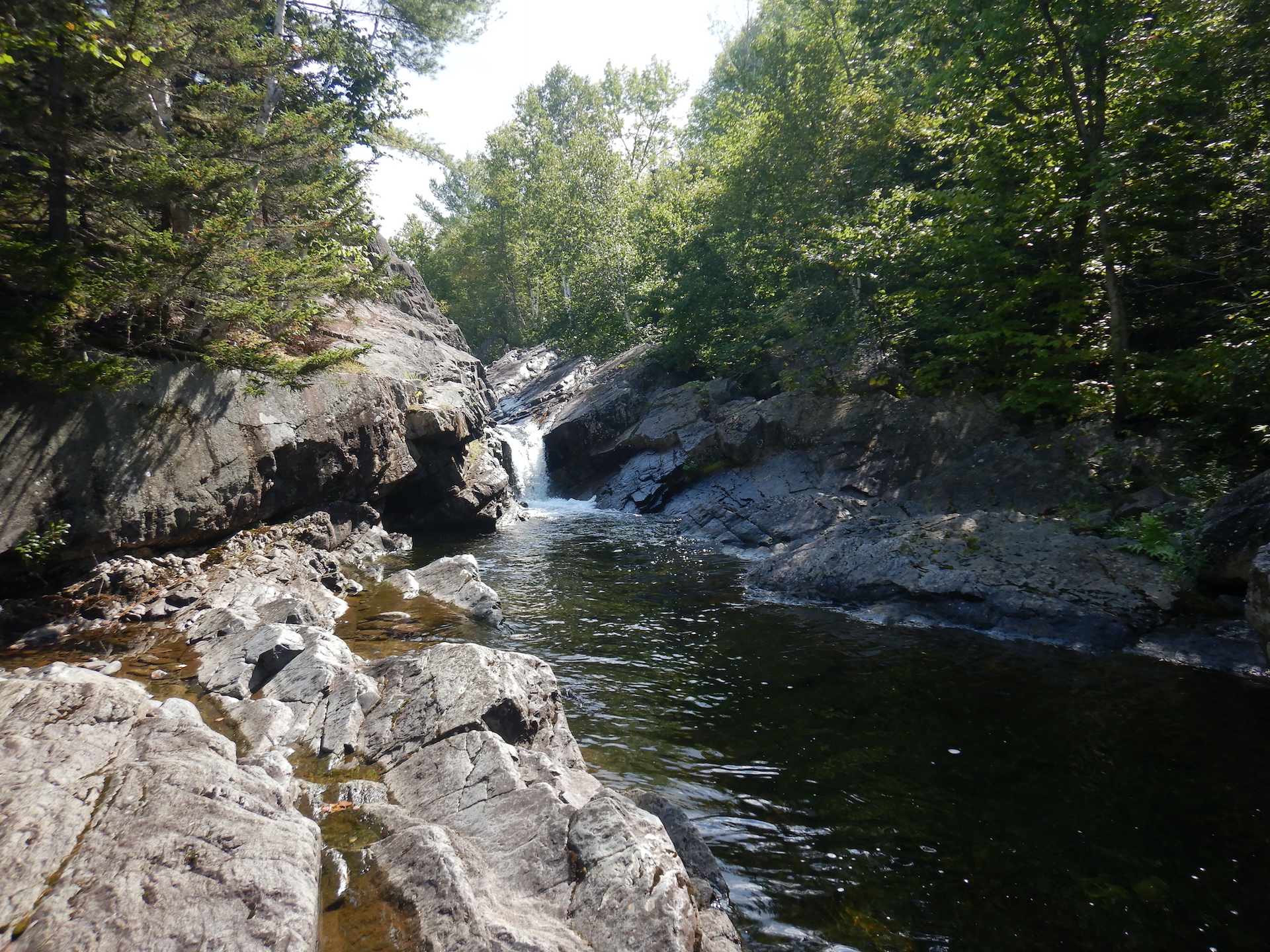
Stream flowing over a small waterfall then through a wider pool. Water flows from center at the waterfall to lower right. Bedrock surrounds the lower portion of the stream, while forest frames it from above.
South Branch Falls.

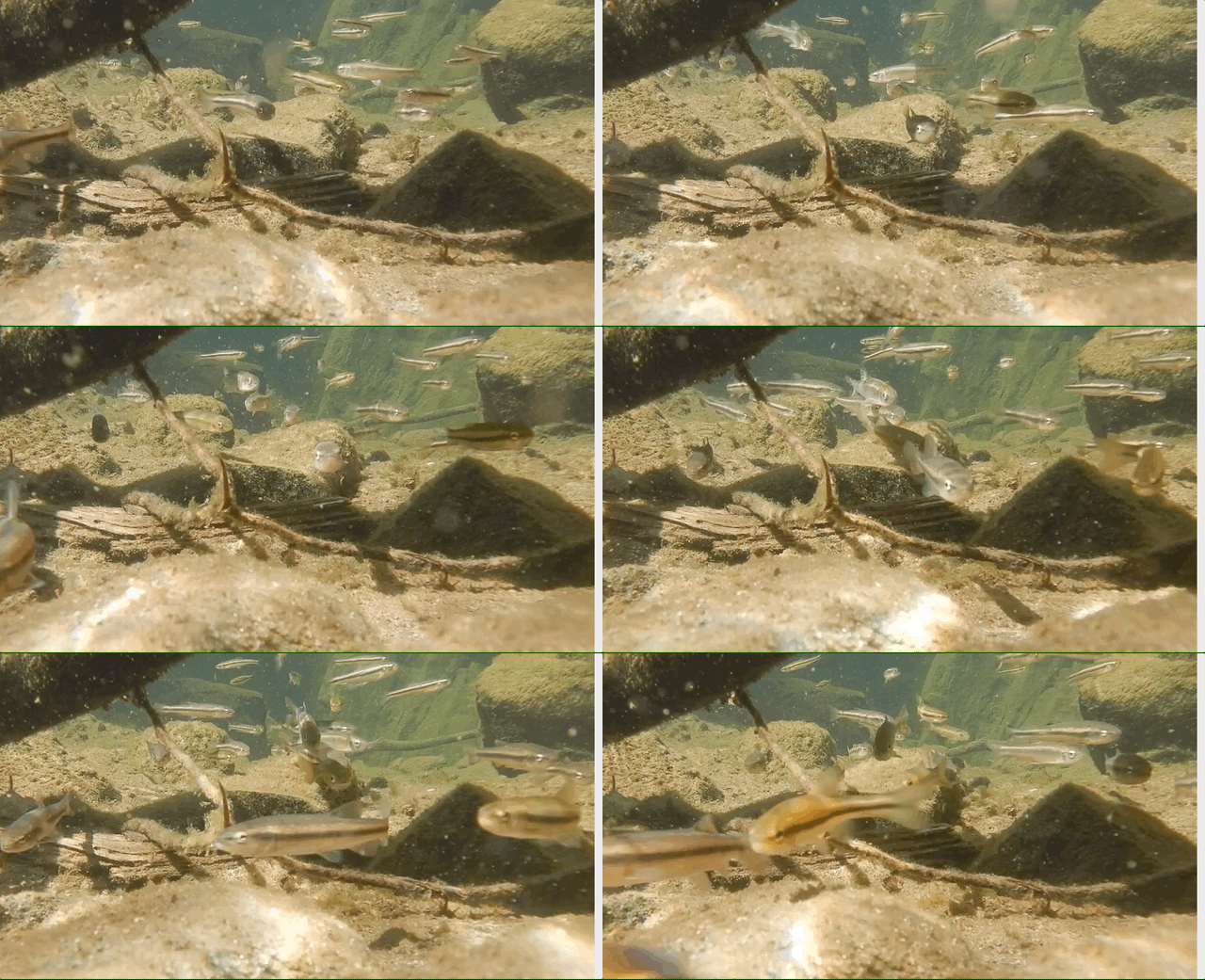
I left the falls to walk downstream before anyone arrived to wonder why I was putting my face so close to the bedrock (I’m not much of a conversationalist when out in public) but not before stopping slightly downstream to watch fish…

GIF of small fish in a stream. Most of the fish are a few centimeters long and have a dark stripe from head to tail on their side.

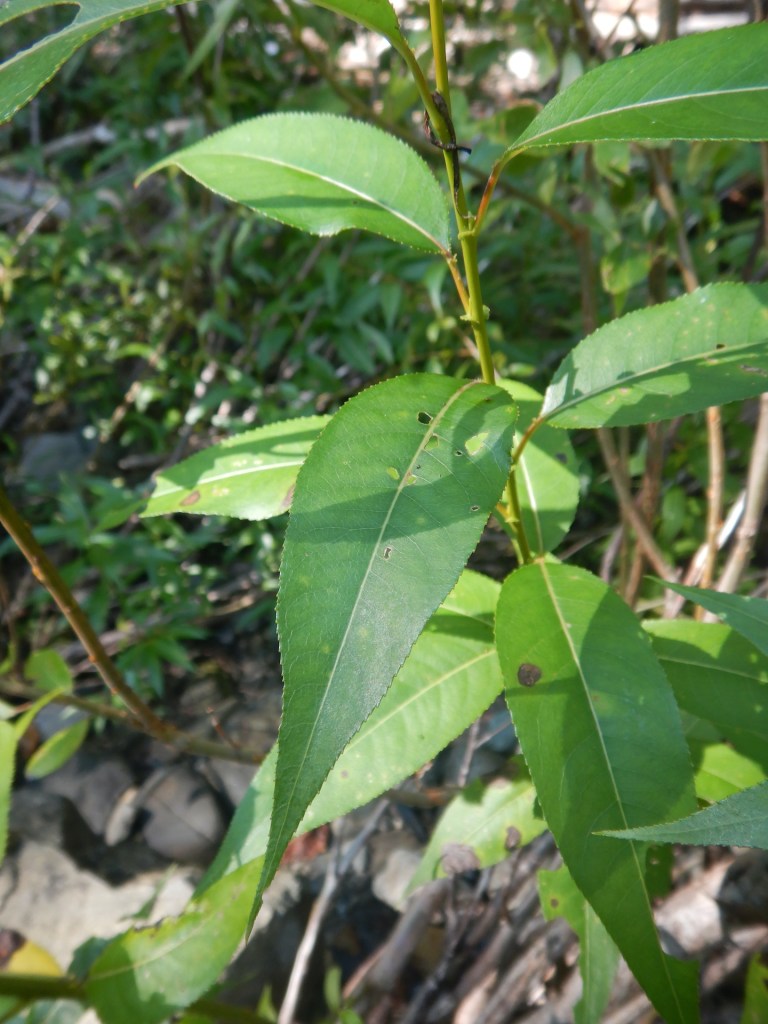
…and to identify a species of willow I had not seen before.

Close up photo of willow leaves. The leaves are arranged alternately on the stem and taper to a long, sharp point.
Summer foliage of shining willow, Salix lucida.

Much of the rock in Maine has been subject to deformation by plate tectonics and mountain building processes. Occurring between the Late Silurian and Devonian, the Acadian Orogeny saw the convergence of crustal terranes (essentially fragments of crustal plates with different geologic histories) as well as the creation of volcanic arcs and the folding metamorphism that accompanies tectonic collisions. Part of modern Maine and Atlantic Canada belongs to Avalonia, a crustal terrane that is also found in Europe from Ireland to Poland. Still more bedrock was formed under the Iapetus Ocean, an ancestral Atlantic that closed in the Paleozoic. Imagine the mess of geology which would be created by the collision of Sumatra, New Guinea, and Borneo into mainland southeast Asia by future tectonic movement. Something like that happened in the area we now call the Northeast U.S. and Atlantic Canada about 400 million years ago. The geology, as you can infer, gets complicated quickly. 

So owing to the forces formerly at work here, it is uncommon to find unaltered sedimentary rocks in this neighborhood. They are usually tilted, folded, and baked. Yet, only few hundred meters downstream of the South Branch falls the bedrock changed and we’re provided with a rare example to the contrary.

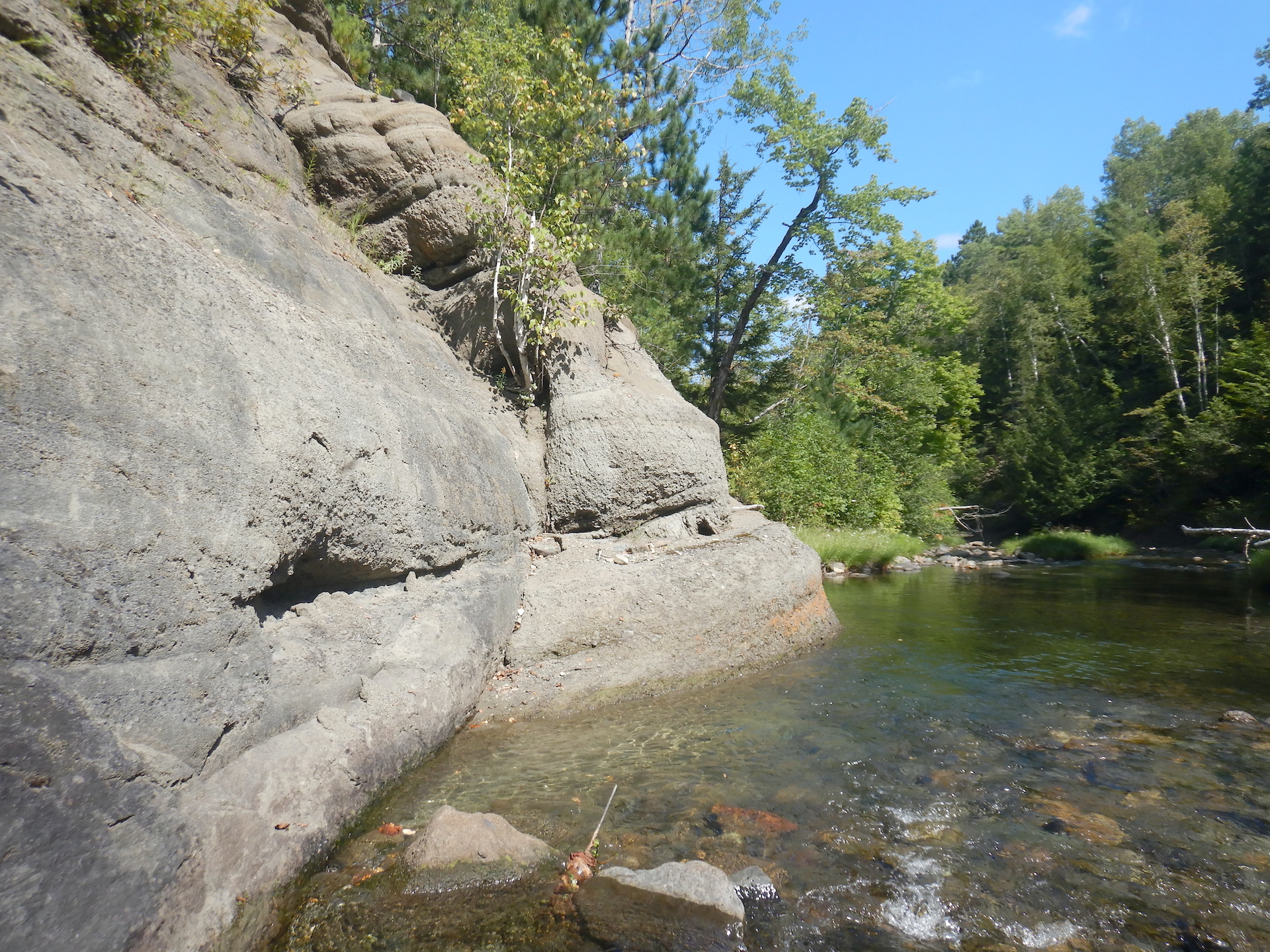
The Gifford Conglomerate is a section of the larger Trout Valley Formation, a collection of younger, Devonian-aged sedimentary rocks overtopping the Traveler Rhyolite. This is reportedly one of the few places in Maine where sedimentary rocks formed post Acadian Orogeny and haven’t been extensively altered even though they did experience some metamorphic change. With its rusty cliffs and shallow grottos, this section of stream was also particularly beautiful. 

Stream flows past a wall of rock. The rock is rusty in color and composed of cobbles that are cemented together. A series of grottos are enclosed in the rock at stream level. The water flows from bottom left to
This wall of cobbles are eroded pieces of Traveler Rhyolite in a deposit known as the Gifford Conglomerate. It was emplaced during the waning epochs of the Acadian Orogeny. It’s also not found anywhere else, which suggests this spot could have once been an alluvial fan at the base of a canyon or valley on the side of a volcano.

As I continued downstream, the conglomerate disappeared under rocks with a finer consistency. As these sediments accumulated the plants growing among them seized a revolutionary opportunity.

Steam flowing past a wall of gray rock. The rock wall is at left. The stream flows from lower right to center right.
An exposure of the Trout Valley Formation along the South Branch. Younger portions of the Trout Valley Formation do not include cobbles of rhyolite like the Gifford Conglomerate. In fact, the rock is composed of progressively finer sediments the higher one looks in the formation. Sandstones, shales, siltstones are common.

The Trout Valley Formation contains some of Earth’s oldest terrestrial plant fossils. At first, finding the fossils was a challenge. I wasn’t sure exactly where to look, but once I developed an eye for them then they popped into view.

A rock containing a branched fossil stem of a plant. The rock with the fossil is wet and sits on a rusty colored dry rock. The scale at bottom measures about 10

Forests of the late Devonian included tree-sized plants, but that was still several million years into the future. The plants found in the Trout Valley Formation had only just begun the colonization of dry land and they remained small in stature. One Psilophyton species reached a foot or two (a few decimeters) in height. Another Psilophyton had dainty 3 millimeter-wide stems. Kaulangiophyton akantha (don’t ask me how to pronounce that) had almost centimeter-wide stems with irregularly spaced spines. Pertica quadrifaria is the tallest known plant of its time. It grew to be about 10 feet (~3 meters) tall with stems about 0.6 inches (1.5 cm) in diameter. They were perhaps fragile as well. Their fossils are often highly fragmented.

An in situ rock with a plant fossil. The rock is dark gray. The fossil is branched and rusty in color. The scale at left measures about 10 centimeters.

Sidenote: I hesitated to include any mention of fossils because certain people are dicks and steal them. But I chose to include them anyway because they are frequently mentioned in the published book I used to guide me. The state park also has a publication noting some fossil locations online. Athough collecting is prohibited in Baxter State Park, there is still a risk someone will read this and steal fossils. Please don’t be that guy. Leave the fossils where they are for others to enjoy and study.

So here are 400 million year-old plant fossils comprising few to several species found in finely grained sediments. What might this tell us about the habitat they lived in? The authors of one of the first papers to formally describe the fossils, published in 1977, stated, “The number of plants found at a single site is very small, usually only one species, occasionally two or three at most. There seems to be a valid comparison with present-day marshland vegetation along the New England coast where the number of species is relatively small over much of the area with scattered peripheral patches of other species that occupy smaller niches in the landscape.” When I read that I immediately thought, “Hmm…sounds like a salt marsh.”

Salt marsh grass with dry, browning stems are bordered by channels of mud on left and right. A line of trees
A salt marsh near Charleston, South Carolina.

Salt marshes are harsh environments for plants. For most species, it is an uninhabitable space. Vegetation must be able to survive flooding by tides, oxygen-poor soils, and high salinity. But for the plants that possess the physiological adaptations to cope with the challenges, the salt marsh becomes a richly productive environment. 

On the east coast of the United States, salt marshes exist in the wetland transition zone between the sea and land. Salt marsh or smooth cordgrass (Spartina alterniflora) dominates the low marsh, the area flooded by tides each day. It grows in sand, clays, and mud. It can tolerate salinities that are double that of sea water by excluding salts from entering its roots, sequestering of sodium in its tissues, and secreting excess salt through its leaves. It counters a lack of oxygen in the soil with stems and roots connected through air pockets. No other plant in its native range copes as well with the salt, flooding, and disturbances that cordgrass experiences.

While smooth cordgrass dominates the low marsh, salt meadow hay (Spartina patens) outcompetes it in places above the average high tide line. Salicornia, a tasty edible, finds space in salt pans where conditions can be too harsh for even the Spartina grasses. When I learned to recognize the dominant plants of salt marshes while working at Assateague Island, I could use that information to note at a glance the approximate average high tide and the driest, saltiest places in the marshes. In east coast salt marshes, the few thriving species grow in habitats that differ in salinity and tide exposure. 

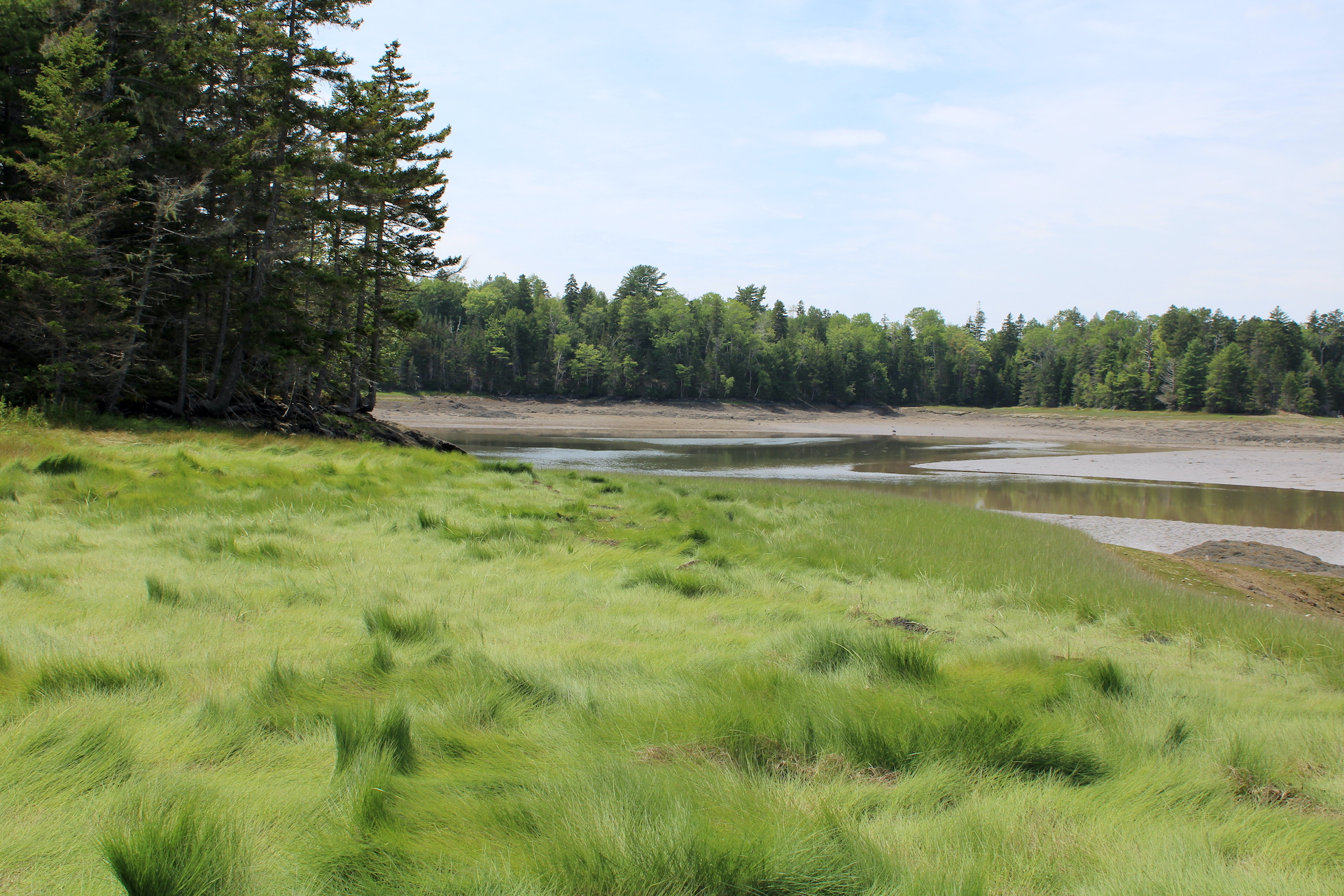
A grassy meadow in front of a mud flat. Trees form the horizon at center.
A meadow of Spartina grasses in Pembroke, Maine. The cow-licked grasses are Spartina patens (i.e. salt meadow hay) that live in the high marsh. Just to the left of the S. patens is a border of S. alterniflora (i.e. smooth cordgrass) that marks the low marsh.

Might the first plants that took to the land in the Devonian have created habitats that resembled salt marshes? I do not possess the ability, imagination, or knowledge to adequately envision those environments. But that won’t stop me from trying. There were no grasses or flowering plants or even seed-bearing plants in the Devonian so the scene was different. Even so, perhaps a series of extensive mudflats and braided streams flowed into the sea on the edge of an eroding volcano. Maybe some of the now fossilized species were best adapted for habitats closer to fresh water. Others could have preferred spaces inundated by tides. Disturbance and competition may have partitioned them into habitats perfect for some and harsh for others.

Rock containing plant fossils. The fossils are roughly parallel in the rock and trend horizontally in the photo. The rock with the fossils rests on other rocks. The scale at bottom is about 9 centimeters.

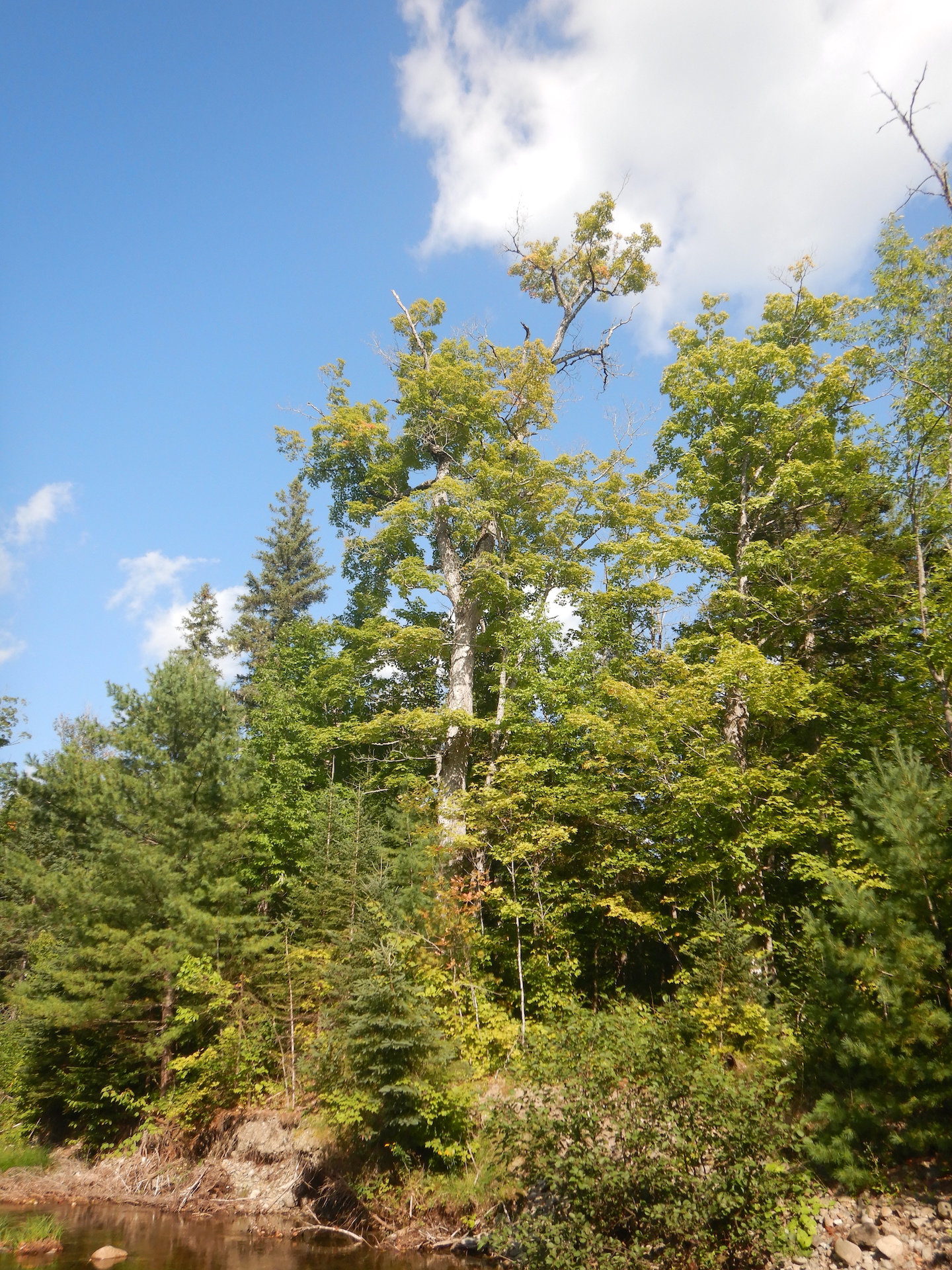
After continuing downstream where most of the Trout Valley Formation became hidden under a veneer of glacial till and not far from the South Branch’s confluence with the main stem of Trout Brook, I paused to admire a large sugar maple. 

A large sugar maple stands at center of the photo. It is surrounded by other smaller statured trees in a dense forest.
A beauty of a sugar maple along the lower reaches of the South Branch.

Perhaps 75 feet tall, its broad crown of leaves included the first hints of fall color. The tree was a fine representative of its species. A world without sugar maples would be a poor one, I think, and the humble fossils I examined upstream represent a beachhead for land plants to eventually become beings as magnificent as maples. In the Devonian, terrestrial plants began to stabilize landscapes from erosion, create soils rich in nutrients, and provide food for arthropods and vertebrates. It might’ve been the first time in Earth’s history when an organism with my oxygen needs could have breathed the air and survived.

Each fossil I found was a plant that grew for months or years. It died during a specific point in time at specific place. In contrast to the collective millions of years preserved in the rocks and the hundreds of millions of years of evolution represented by the maple tree and me, each fossil represents single moments of life and death. They are, paradoxically, the past and the present and the future. 

Although this is an ancient story, I’m not sure “ancient” is an appropriate adjective for it. In my mind, the word implies a connection to human antiquity, while this story of change is a chapter of Deep Time. It is part of the arc of Earth history before humanity’s evolved ability to conceive of it. We can, though, draw a metaphoric line between the volcanoes that once blanketed the area under thousands of feet of ash to the plants which grew in tidal marshes to the forests that now bath my lunges in oxygen. I might live in a different world, but my existence remains rooted in the events preserved in these rocks.