Spring is a season of renewal and change. For brown bears especially, it is a time of metabolic, physiologic, and familial transitions. I explain why in my latest blog post on explore.org. Check it out at https://blog.explore.org/brown-bears-spring-emergence/.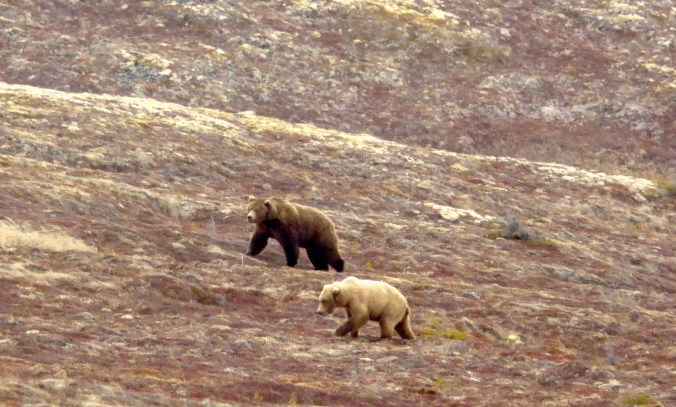
Katmai
Of Bears and Bicycles
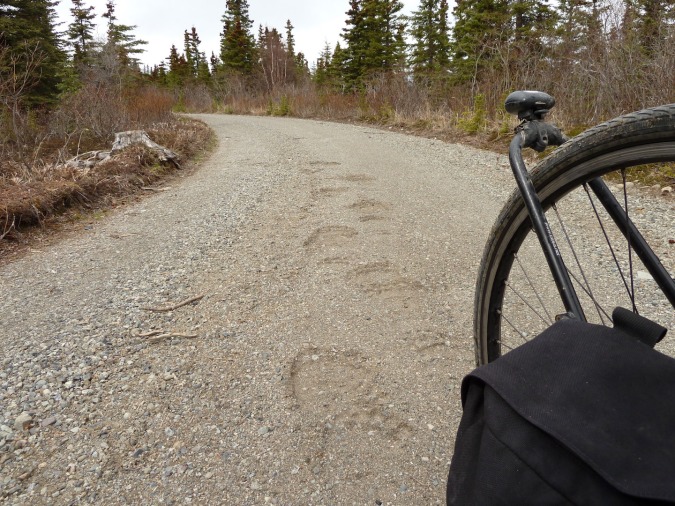
Sometimes bears like to use roads as much as people, giving new meaning to the “share the road” concept.
While enjoying a quiet bicycle ride on a remote road you surprise a large animal in the brush. A split second later, you realize the seriousness of the situation, because you didn’t surprise just any animal. You surprised a bear. Would you be prepared to respond appropriately? What can cyclists do to reduce risky bear encounters?
Some of North America’s most amazing cycling destinations are located in bear country—Alaska, the Rocky Mountains, the Appalachians, Cascades, and Sierra Nevada, and the Great Lakes region. I’ve lived, worked, and cycled extensively in bear country and I love it. I’ve commuted by bicycle at Yellowstone National Park. I’ve toured in the Appalachians, Rockies, and Cascades where bears are frequently seen. When I worked at Katmai National Park, Alaska, I had hundreds of encounters with brown bears, and I frequently saw them while riding the park’s Valley of Ten Thousand Smokes road. Each experience taught me to fear bears less and respect them more. Cyclists can safely enjoy riding in bear country, but there is risk involved. However, the risk is manageable with the right knowledge, prevention, and preparation.
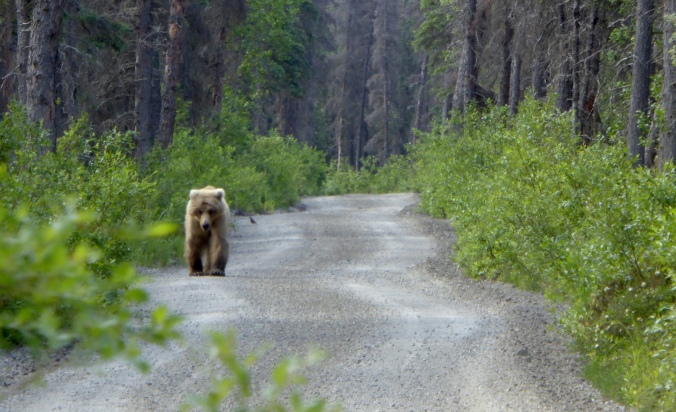
Cyclists need to be prepared for bear encounters. I found this bear walking toward me while I pedaled the Valley of Ten Thousand Smokes road.
Cycling in bear country creates two main issues. First, bicycles are usually quiet and often travel at high speed increasing the possibility of surprising bears. Secondly, many touring cyclists prefer to camp, and while camping isn’t the problem, if you’re camping in bear country then the good campsite you found is often located in good bear habitat.
Warning noise is one of the easiest precautions to take in bear country. Given enough notice, many bears will avoid people. Noise is not a safety net though, just a preventative measure so you don’t surprise a bear. It must be made appropriately and for the right reasons. It’s especially useful in areas where visibility is limited, and it’s easy too. Use your voice or a loud bike bell. Those cheap bear bells may save your vocal chords for campfire songs later in the evening, but they aren’t nearly loud enough in most situations to adequately warn bears. More importantly, bears may not identify any bell’s sound with people. You need to make noise to warn bears of your approach and identify yourself as human. No bell is as effective as the human voice. It’s no fun to shout all day, nor is it an action that fits well in all settings, so vary the amount of warning noise as necessary.
If you need an excuse to slow down during a ride, bears can be it. Excessive speed was one of the main factors that led to a fatal mauling of a mountain biker in Montana. Ride cautiously where bears are frequently seen, avoid biking during hours when bears are less likely to expect encounters with people, and pay attention to your surroundings. On the Valley of Ten Thousand Smokes road, a road that averages less than five vehicle trips a day in summer, I’m forced to ride slowly because too many bears use it to allow for a purely fitness ride. This is torturous for certain cyclists, myself included on occasion, but bears necessitate it. If I want to ride responsibly here, I must slow down.
Take the time to assess the terrain. Are you approaching the crest of a hill, a sharp bend, or is the road carved through thick brush? Will you be traveling through areas with food sources, like berries or salmon, that attract bears? This may seem like a mental burden that will cause a headache by the end of the day, but cyclists practice this risk assessment all of the time. While riding in traffic we identify and respond to unsafe situations routinely. Bears pose different challenges than cars, I realize, but trust your instincts. Slow down and give yourself time to use them.
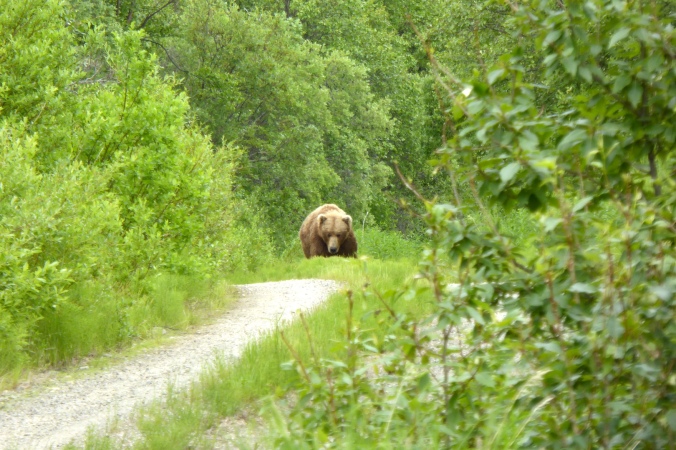
This bear in Katmai was intent on using the road. To safely avoid a stressful encounter with him I stopped, picked my bike up, carried it off of the road and well into the forest to let the bear pass. Had I been traveling too fast, I would have risked surprising the bear at a very close range.
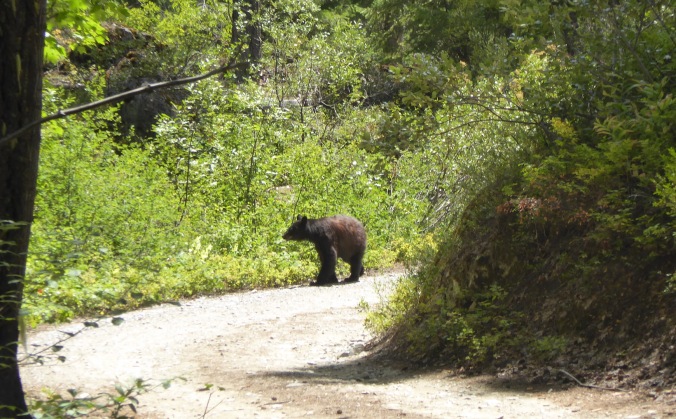
I let this black bear in North Cascades National Park know I was human by talking in a normal tone of voice. Once the bear realized I was human, he walked calmly into the forest.
Statistically speaking, groups of four or more people are very safe in bear country. So if the thought of encountering a bear alone is too intimidating, then join a group ride and stay close together. Group size is not effective if the group is spread so far apart that a bear only recognizes individual persons. Groups tend to be noisier and have lots of eyes to spot wildlife. Plus, during a bear encounter, a mass of humanity is intimidating to even the biggest bear.
With that being said, what should you do during a close encounter? Things can get complicated quickly and adrenaline will certainly rush, so prepare yourself mentally before you leave home. The key, according to Tammy Olson, a former wildlife biologist for Katmai National Park, “is to not behave in ways that are likely to be perceived as threatening when responding to a [defensive] bear at close range.”
How close is too close? The answer depends on a variety of factors (the presence of cubs, the vicinity of food like animal carcasses, the bear’s human-habituation level and disposition, surprise, and more). There are general recommendations to follow, but each bear is an individual and each situation is unique. A Yellowstone grizzly shouldn’t be treated like a Pennsylvania black bear. Talk with local officials about the general patterns of bear use and behavior in the area you plan on traveling through. Some areas, especially national parks, have regulations that define the minimum, legal distance to keep between yourself and a bear (50 yards at Katmai, 100 yards at Yellowstone, and 300 yards at Denali). These can be a useful, but not absolute, starting point to determine if you are too close. As a general rule, if you are altering the bear’s behavior, then you are too close.
Any time you find yourself in close quarters with a bear, stop riding and take a few seconds to assess the situation. Position your bicycle between you and the bear. As well as possibly adding a modicum of physical protection, the bike makes you look larger in a non-threatening way. Size matters in the bear world. This is why groups of people are generally safer in bear encounters than a lone person.
If you surprise a bear while bicycling, quickly assess the situation. What is the bear doing? Is it resting, feeding, approaching you, or showing signs of stress? Do you see or hear cubs? Is the bear vocalizing? Were you charged? Your behavior in these situations goes beyond the scope of this post, but what you see, hear, or think the bear is doing will influence your decision on how to react. (Please see the references at the end of the post for more information on bear behavior, identification, how to differentiate between defensive and predatory encounters, and the recommended responses.)
When you’re on a bike, you’re moving swiftly and you have less time to react than someone who is walking. This is more likely to provoke a charge from defensive bears, especially grizzly bears. If a bear charges you in a defensive, non-predatory situation, it is usually a bluff. Even so, this is a frightening experience. Hold your ground. Running or pedaling away may trigger the bear to chase you, and you can’t outrun a bear. Keep your bicycle with you if possible. Abandoning the bike, especially if there’s food in your panniers, can teach bears to approach people for another food reward.
Yelling at a defensive bear may provoke it further. Instead, talk to the bear calmly and back away slowly until the bear resumes its normal behavior (resting, feeding, traveling). Contact is rare, so only play dead if a bear makes physical contact with you. If it does, lie face down and cover your head and neck with your hands and arms. Remain still and quiet until the bear leaves the area. (Black bears attacks are very rare, but are much more likely to be predatory, so most bear behavior experts recommend you fight back if a black bear attacks.)
Sometimes you may see a bear before it is aware of you. If this happens, move away quietly the way you came and give the animal the room it needs. Find an appropriate place to observe it, where possible, and enjoy the moment. It’ll certainly be one you won’t forget.
Your goal should be to prevent close encounters. This is just as important when camping as it is when riding. At the end of a long day of bicycle touring, is there anything more satisfying than a beautiful campsite with a hot meal? Maybe not, but before you commit yourself to that wonderful campsite, take a few moments and search for signs of previous bear activity. Is there garbage scattered about from previous campers? Is the campsite near natural food sources that attract bears? Do you see fresh bear scat with human food or garbage in it? If so, consider moving on. You don’t want to risk a food conditioned bear coming into your camp at night.
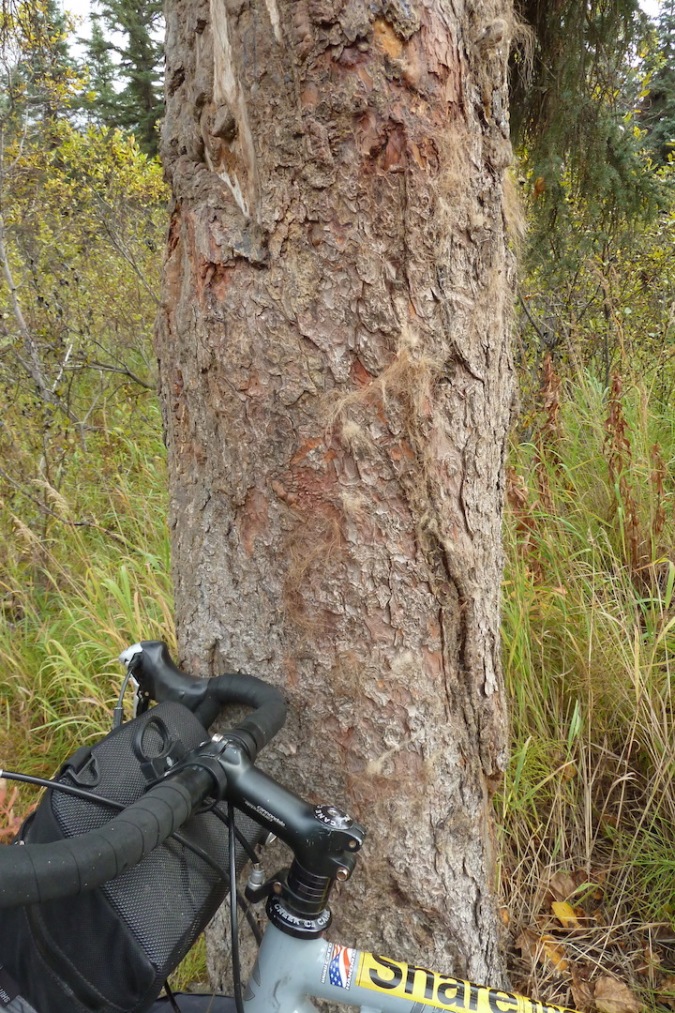
Look for signs of bears like scat, tracks, and marking trees when you choose a campsite. Move on if the area seems to be frequently used by bears. The bear fur on this marking tree indicates plenty of bruins use the Valley of Ten Thousand Smokes road.
Most problems with bears while camping can be avoided if bears aren’t attracted to your campsite in the first place. Outside of developed campgrounds, cook and eat well away from your sleeping area (at least 100 yards). This is a Leave No Trace principle everyone should follow, but it also disperses food odors away from your sleeping area.
Consider where and how you plan on preparing your food in the backcountry. Are hot meals important, or would cold dinners and snacks suffice? Eating cold meals and eliminating the need to cook is one easy way to substantially reduce food odors around your camp. There is less to clean and less garbage at the end of the day. If you choose to cook then consider meals that require little field preparation. Touring cyclists don’t normally carry and cook perishable, odorous items like bacon, but anything strongly scented or should be avoided.
Before you leave home, decide how you will store your food and other odorous items like soap and toothpaste. Bear resistant containers (BRCs) are the best and most portable way to keep bears from your food, and in some areas they are required. BRCs lack creases or hinges that allow bears to open them. Yes, they are heavy and bulky, but their effectiveness has been proven repeatedly and backpacking-style BRCs normally fit into a large, rear pannier. The most common alternative, hanging food in a tree, is time consuming and risky. Some bears, especially in the Sierra Nevada, have learned to ignore BRCs but specialize in stealing food hung in trees. Occasionally, developed campgrounds in high bear use areas provide food storage facilities as an alternative to BRCs, but many do not.
Lastly, some people prefer to carry a bear deterrent like bear spray (not self defense spray) or firearms. Neither firearms nor bear spray are 100% effective against bears. I carry bear spray since it is non-lethal, non-toxic, and easy to use. It is intended only for close encounters (generally 30 feet or less) on aggressive or attacking bears. This stuff is potent too, so be careful. I know enough people who have accidentally discharged their bear spray to know you don’t want it in your face or in your pants, as one unfortunate individual at Brooks Camp discovered. Wherever you choose to keep it, bear spray needs to be quickly accessible. When necessary, I carry bear spray in my bike’s handlebar bag. (Thankfully, I’ve never had to use mine.)
There are many bear deterrents, but the greatest of all is your brain. No matter what you do in bear country, where you ride, or what you see, there is no substitute for common sense. We empower ourselves with safe cycling practices in traffic, and we can do the same around bears. The scenario at the beginning of the article isn’t fiction. It happened to me, and it’ll probably happen again. Traveling in bear habitat requires responsibility. Sloppy habits and dirty campsites can endanger future visitors and the lives of bears.
I always look forward to bicycling in bear country, which is some of the most scenic and inspiring land imaginable. Knowledge of and respect for these animals can turn what would be a dangerous and fearful encounter into the highlight of the trip. Given the opportunity, humans, bears, and even bicycles can coexist.
More Bear Safety Information
You can never know too much about bears, but an action appropriate in one region may not be appropriate in another. Talk to local officials about what works and is expected in their area. There is also plenty of contradictory information available about bear safety available online. The information provided in the resources below generally follows the consensus of leading bear biologists and public land managers. Besides learning behavioral techniques that may keep you safe and give you peace of mind, learning about bears and their ecology is fascinating and can open up a world of wonder into their complex lives.
Websites:
Interagency Grizzly Bear Committee: The IGBC was established in 1983 to help ensure recovery of viable grizzly bear populations and their habitat in the Lower 48 states.
Leave No Trace: The seven guiding principles of LNT ethics not only reduce our impact on the outdoors, but also correlate to the best camping practices in bear country.
Yellowstone National Park Bear Safety Pages: These may be the most comprehensive bear safety pages on the web.
Get Bear Smart Society: This organization is dedicated to reducing conflicts between bears and people.
Literature:
Bear Attacks: Their Cause and Avoidance by Stephen Herrero: This is not your typical bear attack book. It written by a wildlife biologist who has statistically analyzed bear attacks across North America. It offers scientifically supported advice for travelers in bear country.
Backcountry Bear Basics: The Definitive Guide to Avoiding Unpleasant Encounters by Dave Smith: Although less academic than Bear Attacks, this is another readable, common sense look at bear identification, behavior, avoidance, safety, and it includes a brief section on mountain biking.
DVD:
Staying Safe in Bear Country: If there was just one resource you could choose to educate yourself on how to behave around grizzly and black bears, this video is near the top of the list. In a no-nonsense fashion, it clearly and accurately explains bear behavior and how people can minimize the chance of bear encounters and attacks. It also provides insightful footage of bear behavior that may be hard to visualize. A transcript is available too.
Brooks River Bears Need Your Help

402’s spring cubs rest near the Lower River Platform at Brooks River on October 24, 2013.
Addendum: Please read the response to this issue by Katmai’s Superintendent, Mark Sturm.
In 2017, an elevated bridge and boardwalk will be constructed at Brooks River. In this post, you’ll find a letter that asks Katmai National Park to further restrict the timing of staging and construction for the bridge. My reasoning is outlined in the letter. I wrote it because I believe no staging or work on the project should happen from late June to late July or September and October. Brooks River’s bears, especially those who are not habituated to people, need complete access to the lower river area in the fall. That is their last chance to gain weight before hibernation. The current work schedule allows staging and work to begin when bears need Brooks River most. This is not acceptable.
You are welcome to use the letter to contact the park. You can use it as is, or personalize it as you see fit. You can copy the letter’s text below or download the rich text file which can be used with almost all word processing software.
Before you contact Katmai with your thoughts, please consider the following…
- The construction dates for the bridge project are in a federal contract which has already been awarded. If the dates can be modified it won’t be a simple process since it’s currently a contractual obligation. Don’t expect any change, if it comes, to be quick.
- Form letters are easy to respond to, because the recipient only needs to write one response. Personalized messages often require more in-depth responses.
- Phone calls can be more effective than written correspondence.
- Be polite and respectful when you contact the park. The people who manage Katmai are intelligent and well-meaning. They do not deserve insults or personal attacks.
You can contact the park in several ways.
- Snail Mail: Katmai National Park and Preserve, Attn: Superintendent, PO Box 7, King Salmon, AK, 99613
- Email: Write the park through its website.
- Phone: (907)246-3305
And now the letter:
Superintendent Sturm,
As you know, an elevated bridge and boardwalk will be constructed at Brooks River in 2017. The summary of work outlined in the project’s construction specifications generally restricts work and staging of equipment and supplies outside of July. Yet, it places minimal restrictions on staging and construction in late summer and fall. This will have serious impacts on bears who need full access to the river in September and October. I urge you to reconsider the construction schedule and modify the current contract to minimize the project’s impact on bears.
The construction schedule allows work in the river corridor to commence as soon as October 1. Work hours outlined in the construction specifications also permits staging on the spit at the mouth of Brooks River anytime after August 1. These activities can potentially displace many bears from the lower river, especially those who are not human-habituated.
Dozens of brown bears gather at Brooks River throughout September and October. The fall feeding period is especially critical, since bears are hyperphagic and need access to Brooks River’s abundant salmon. The river mouth provides salmon catch rates far higher than other areas of the river. Additionally, many bears who use the river in the fall are not habituated to people or vehicles. Habitat use by these bears is already restricted by the presence of people. Staging and construction in the fall will further displace these animals. Impacts to wildlife and the visitor experience from staging and construction of the bridge is of short duration, but can potentially be serious for individual bears who need to utilize the river. Bears that feed at Brooks River may do so because they know of no other or better place. For them, salmon in Brooks River ensures their yearly survival.
I understand that water levels in Naknek Lake provide a narrow window to transport materials and supplies to Brooks River, and often this can only occur in mid to late summer. However, this does not justify displacing bears from the food resources they need to survive, even for one season. Brooks River is a world famous bear viewing area. In FY16, the bearcams received 40 million hits. Brooks River’s wildlife deserves the highest level of protection possible. To do this, I urge you to place further restrictions on the construction schedule for the elevated bridge at Brooks River. Staging should only occur outside of July and September-October. Construction and clearing work in the river corridor should begin no sooner than November 1.
I look forward to your response and thank you for your time.
Addendum: Please read the response to this issue by Katmai’s Superintendent, Mark Sturm.
Bears Have Long Memories
 Bear cubs are apt to reflect mom’s mood. When she’s relaxed, they are relaxed. When mom is alert and stressed, her cubs are on edge. Cubs also take a keen interest in anything that their mother investigates. In this way, they learn much about what to eat, where to find food, and many other survival skills. In this way, mother bears are teachers. However, mother bears may teach their cubs behaviors that lead to conflict with humans.
In a study recently published in the journal PLOS One, researchers from the University of Alberta found that behavior that leads to conflict with humans is not genetic. It is learned. Bears who were raised by mothers with a documented pattern of conflict with humans were more likely to be involved in conflict with humans as adult bears. The study identified 213 bears (118 males and 95 females) through DNA extracted from hair samples, then examined behavioral patterns in both father-offspring and mother-offspring relationships. The researchers concluded over 60% of offspring from “problem mothers” were likely to be “problem bears.”* In contrast, only 29% of bears from “problem fathers” were identified in bear-human conflicts. This was very similar to the percent of bears (30%) involved in bear-human conflict raised by mothers with no history of conflict with people. Since male bears have no role in raising cubs, the evidence in the study suggests that behavior leading to conflict with people is learned, not inherited through genes.

Behavior of offspring was not related to the behavior of the father bear. http://dx.doi.org/10.1371/journal.pone.0165425.g002

Bears raised by mothers with a history of bear-human conflict have a higher likelihood of conflict with people. http://dx.doi.org/10.1371/journal.pone.0165425.g002
If you watch Katmai’s bearcams, you may be familiar with the escapades of 273 and her cub. These bears are famous for their curious and playful nature. Over the past two summers, they were prone to investigate almost anything that caught their attention. In 2015, they damaged buildings at Brooks Camp which prompted rangers to escalate their hazing techniques to deter them.

This building was damaged by 273 and cub in August 2015. I helped to erect the electric fence as a temporary deterrent to further damage.
They repeatedly damaged a sign near the bridge over Brooks River.
They caused wildlife technicians to photo-bomb a live chat on archeology.
They even played with unattended construction equipment.
I took the video of 273 and her cub with the construction equipment from inside a cabin last summer. Clearly, this family has demonstrated an interest in human objects and equipment. They are also relatively habituated to the presence of people. Since 273 has exposed her cub to people and buildings, does this increase the likelihood that the cub will repeat those behaviors when he becomes an independent bear? All signs point to yes.
I’ve long suspected that bears raised by highly human-habituated mothers are more likely to demonstrate high levels of habituation toward humans when they are adults. I’ve also suspected the same with bear-human conflict. If mom teaches her cubs to investigate human equipment or seek out human food, then the cubs are going to remember those experiences when they become independent bears. The study from Alberta provides some evidence to support my suspicions.
Does this mean that 273’s cub is destined to damage property at Brooks Camp? Not necessarily as long as rangers, lodge staff, and visitors at Brooks Camp are vigilant and actively work to eliminate conflict between bears and people. (Access to lots of natural food is extremely important too.)
Mother bears are teachers and cubs are students, but not everything cubs learn from mothers is advantageous in a world where habitat is increasingly crowded with people. Mother bears teach their cubs many survival skills, some of which can lead to conflict with humans. We can’t change the way bears live, nor should we. The onus is on us to act in ways that allow bears space to live and survive without learning behaviors that lead to conflict.
——-
*I discourage the use of “problem bears” as a term to describe bears involved in bear-human conflict. The term was used in the study, but this label stigmatizes bears in negative, anthropomorphic ways. These bears are only exploiting opportunities presented to them. The problem isn’t the bear. The problem is the temptations for conflict provided or caused by people.
 Wandering at Large