One thing I find fascinating about bears is the complexity of their behaviors. Bears are intelligent and mentally flexible. They understand who can be friendly and who is not. They recognize each other as individuals and, despite their asocial reputation, bears can also be quite social when the right mood and circumstances strike.
In 2022, I, along with millions of bearcam viewers, watched two sister bears, each with their own cub, form their own version of a bonded, extended family.
Although this was not unprecedented among brown bears, the bonding between bears 909, 910, and their cubs was something that I had never seen before. I was fascinated by the story—so much so that I wrote a paper for the peer-review journal Ursus. Please head over to explore.org’s blog to read more and check out the paper in Ursus.
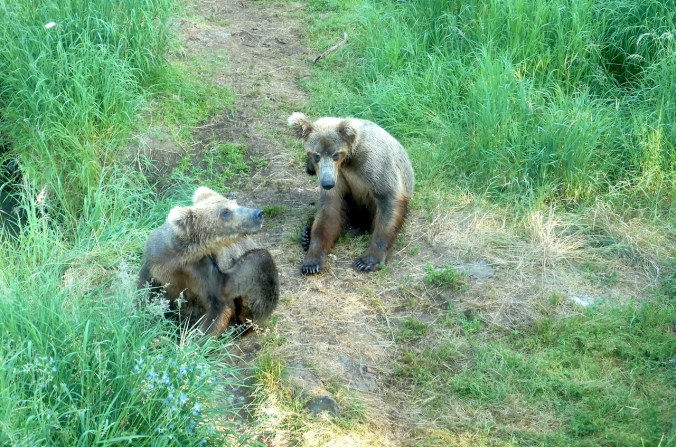
Bears 909 and 910 sit next to Brooks River in 2019, which was their second year of independence.
One of the difficulties that the NPS, among many federal agencies, is facing is the presidential administration’s freezing of funding that Congress has already appropriated. This is on top of the loss of thousands of employees already this year due to (often coerced) resignations and unjust firings. None of those actions were approved by Congress. Congressman Jared Golden, who represents my congressional district, has recently introduced the Protect our Parks Act of 2025 which would require the Secretary of the Interior to use funds that were already appropriated to complete NPS projects and fully staff national parks and reinstate employees that were unjustifiably fired. It is good legislation. A stop gap, for sure, but worth urging your member of Congress to vote for.
Think of a mama bear. What does that idea conjure in your mind? Perhaps it is fierceness, since mother bears are ornery and defensive when necessary. Maybe it is commitment, because mother bears dedicate years to raise a single litter. Perhaps it is sacrifice, since mother bears provide cubs with time and energy that could otherwise serve to promote her own physical health.
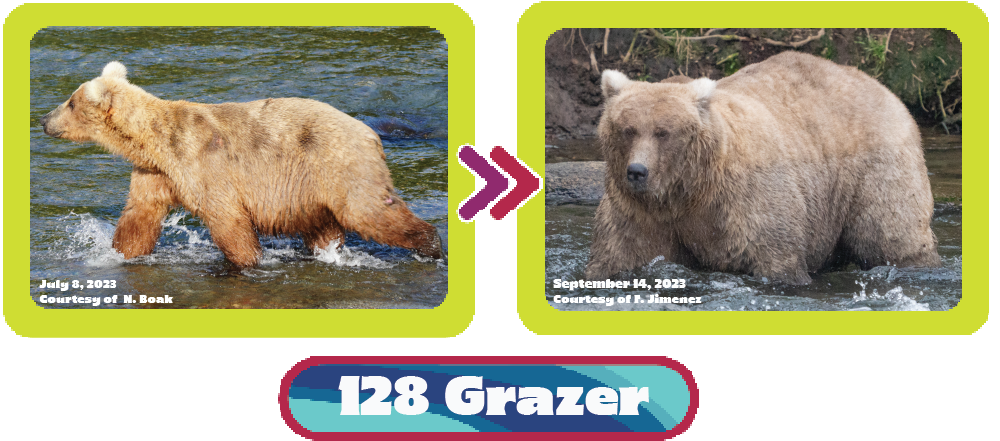
We’re fortunate to watch many different female bears at Brooks River in Katmai National Park. Yet there is one whose maternal efforts are legend. One who can fish successfully almost anywhere. One whose fearsome reputation is long-lived among other brown bears, including large adult males. Don’t get in her way. Don’t lurk near her fishing spot. Don’t look at her cubs. Do give 128 Grazer your 2023 Fat Bear Week vote.
Grazer | ɡrāzər |
(2005 – Present) A female brown bear documented to use Brooks River in Katmai National Park, Alaska. Also known as bear 128.
verb. [with object] The effort of a mother bear to maul or attack another bear with little provocation, especially in defense of her cubs: She grazered him.
Origin: Bear cam slang. Circa late 2010s and early 2020s.
Grazer is famous among people and (maybe) infamous among brown bears for her extraordinary defensiveness. When she arrived at Brooks River in 2016 with three cubs representing her first known litter, she would confront and attack other bears with little or no provocation. Sometimes it appeared that another bear only had to look in her family’s direction to draw her ire, as bear 83 knows well.
Her behavior didn’t mellow when those first cubs grew into yearlings the following summer. Nor did she rethink her aggressiveness toward other bears when raising her second litter. While mother bears can change their parenting strategy as they gain skill and experience, Grazer continued on the path forged with her first litter—the best defense is a good offense.
Grazer separated from her most recent litter at the beginning of summer 2023. Since then, she’s lived a brown bear bachelorette’s life. Her pheromones attracted the attention of male bears during the mating season. They chased her tail, with varying degrees of success, right bear 164? After the mating season, and also during it, she focused on eating. A lot. Her waistline carries the weight of her success.
Grazer’s formidable reputation carried into this summer. She ranked high in the hierarchy among bears and was perhaps the river’s most dominant female. Notably, 151 Walker deferred to her frequently in early summer. Walker is a big dude and he’s not shy about displacing bears from preferred fishing spots. Bears have good memories, though. Maybe he had too many bad experiences with her in the past and didn’t want to risk more dangerous confrontations.
In this video, Walker is in full dominance mode as he works to displace another adult male at Brooks Falls. But watch his behavior when Grazer shows up on the boulders above.
And in case you need more examples of Grazer bulldozing bears, here you go. (Watch with sound on for the full effect.)
During my brief time at Brooks River early last summer, I watched bears fish largely without success because the expected salmon run was slow to arrive. Some of the big guys caught some fish. 747, for example, sat at Brooks Falls like he always does and let the fish come to him, but even he wasn’t catching many. Most other bears fared worse. They roamed from one place at the river to another, searching for the few early arriving salmon.
Grazer, though, has practiced—no, perfected—her fishing tactics in many different places. If fish are jumping Brooks Falls, she’ll catch them there. If there’s space in the waterfall’s far pool, she’ll catch them there. She’ll work the jacuzzi below the falls. She’ll fish in the middle of the night. She’ll use her strength and agility to chase down salmon.
One evening last summer, I stood on the riffles platform watching her work the river in front of me. While the riffles provides brown bears with fishing opportunities, it is often a more challenging place for bears to catch salmon than the falls. The riffles doesn’t provide the same pinch points in topography as the falls and salmon have many escape routes. There aren’t many bears who can make the best of that situation consistently, especially when few salmon are in the water and bears are forced to run through the water to get them.
Grazer parks herself on the near bank upstream of me. She moves into the water after several minutes and spots a lone salmon. She lunges and misses. She chases. Another lunge, another miss. She continues running at full speed through the water while somehow keeping an eye on the salmon. With a final lunge, she fully submerges into a two to three-foot-deep pool and surfaces with the salmon in her jaws. I can see the fish gasping in the air as blood runs from deep puncture wounds in its body. Grazer eats all of it—tail to head—even the gill plates and mandibles.
In early summer when few bears were catching salmon, Grazer found success. She is perhaps the best angler at Brooks River.
Bear 128 Grazer with a catch in the riffles on July 6, 2023.
Let’s not lose sight of Grazer’s goals either. She’s working to build the fat reserves necessary to sustain her survival during winter hibernation. She’s also building fat in case she gives birth in the den. Bear cubs are born mid winter while mother hibernates. Abundant fat reserves are necessary for mother bears to reproduce, so getting fat is vital to a bear’s reproductive success.
In a way, my 2023 Fat Bear Week endorsement is a recognition of Grazer’s full-bodied and fat-addled collection of work since 2016. When she is raising cubs Grazer is the archetypal mama bear. She’s formidable, strong, brave, skilled, and successful. She deserves your vote in Fat Bear Week 2023.
My Fat Bear Week bracket predictions for 2023. Yes, yes, I know. I don’t predict that Grazer will win. There’s a difference between who I think should win and who I think will actually win, after all. Which bear’s corner are you in? Download your bracket from FatBearWeek.org.
While every season has much to admire, I find springtime especially enthralling. Something new appears nearly every day. At first, maple sap runs heavy during March’s warm days and sub-freezing nights. Around then, a trickle of meltwater in a ditch and a bare patch of matted leaves on the edge of a snow bank promise room for other plants to break dormancy. Soon after, the first golden catkins appear on the hazelnut and gray alder. Rainy evenings bring amphibians out of hibernation. In a short time, the soon-to-flower ephemeral herbs emerge from the crust of leaves. By late April and early May, the forest canopy bursts to life again with bird song, the blossoms of red maple and quaking aspen, and finally the unfurling of leaves that will soon thoroughly shade the ground where I trod.
Each of these are little events that promise a lot more. I’m unsure if non-human animals contemplate these changes like I do. Yet, I’m certain they pay attention to them. Black bears, recently emerged from their dens, know the pattern and are eager to exploit the change of the season to their advantage. If I’m lucky, their efforts to find their first substantial meals of the year might allow me to investigate what they are up to.
A section of Katahdin Woods and Waters National Monument sits to the east of Sebois River. It’s a quiet area of the park since there are no campsites, less than a mile of developed hiking trails, and only a few maintained roads. Bicycling through it is fun and is made even more enjoyable when I afford myself the time to go slow and pay attention. It’s one of the best places in park that I’ve yet found to look for bear sign in the spring.
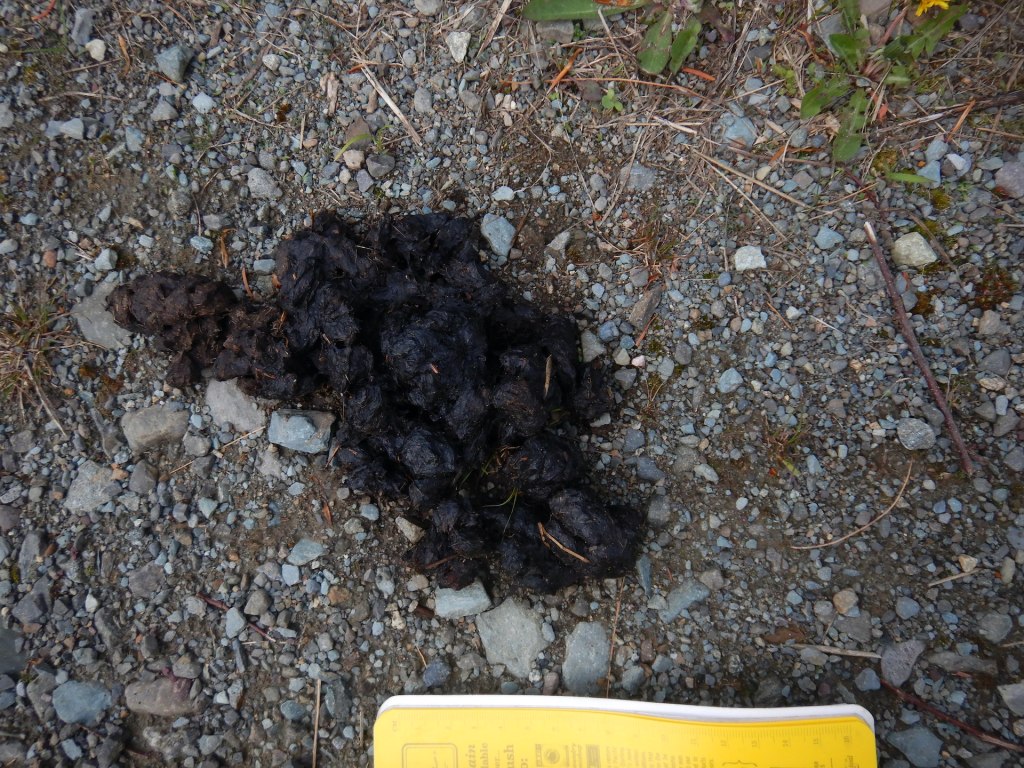
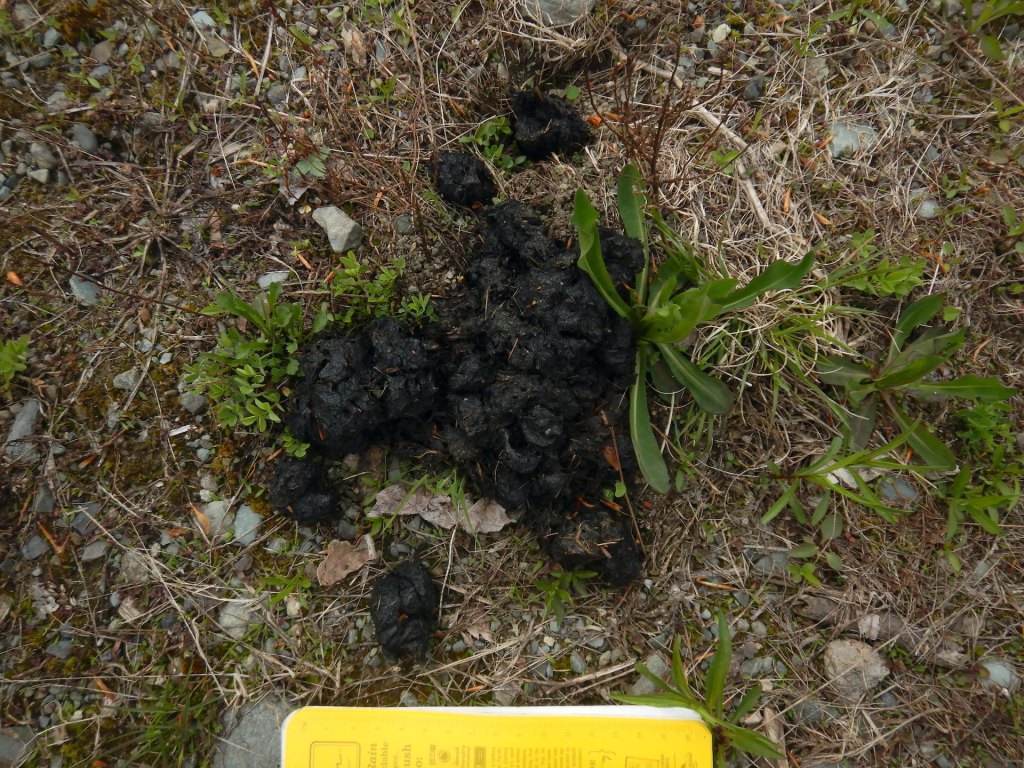
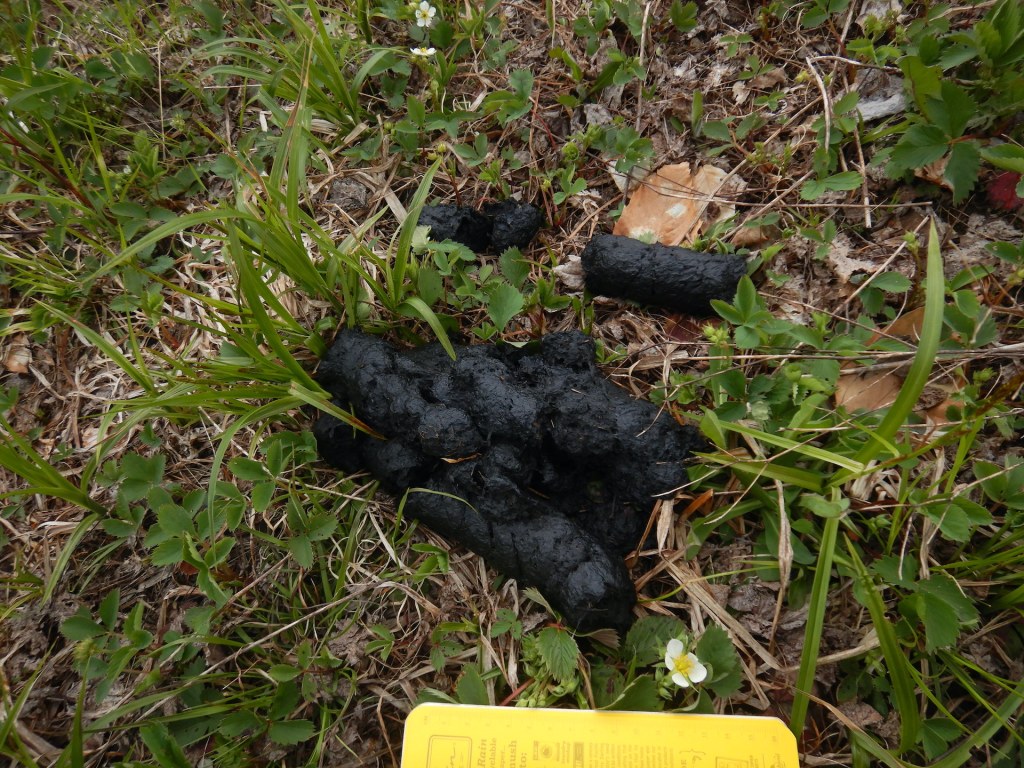
Riding the single lane spur that loops off and back to American Thread Road last weekend I came across many piles of bear scat, which I was hoping to see. Not because I particularly admire turds, but because bears are cryptic here. They are frequently hunted throughout northern Maine and consequently have a substantial fear of people. The thick forest also limits my ability to watch a bear if I happen to see one. The signs that bears leave behind—such as marking trees and scat—are like pages in a book. A single page may not reveal much but look at enough pages and you’ll get a good story.
In particular, scat can reveal how recently a bear was in the vicinity and what it was eating. Black bears are omnivores that are well adapted to survive on plants, and the vast majority of their annual calories come from plant foods. In north-central Maine, though, there are no calorie-rich berries to eat in the spring. Perhaps there are some leftover acorns, but oak trees are not common in the forests as this area is near the northern end of their range in the northeastern U.S. So other plant foods are a bear’s best springtime bet.
While a black bear’s digestive track remains essentially one of a carnivore, it utilizes adaptations such as an elongated gut and slightly flattened molars to extract nutrition from tough to digest plant foods. A bear also consumes plants when they are most nutritious and digestible. Newly emerged green vegetation like grass, sedge, and clover contains relatively high amounts of protein, for example. As those plants mature, protein content declines while indigestible fiber increases. Fiber helps keep the bear on a so-called regular schedule, but the bear is really after the protein. Even though hibernating bears maintain their muscle health without eating or exercise, if they’ve exhausted their fat reserves by springtime then their body is forced to tap into their lean tissue reserves. Young, tender veg helps bears stave off muscle loss and even build muscle before sugary, fat-building foods become available in mid to late summer.
All but one of the scat piles I found were filled with herbaceous plants. Although most looked older than a day–when bears eat green veg, the resulting scat quickly oxidizes when exposed to air to form a black surface crust–this was a promising sign. I knew that the lightly used roads are good travel corridors for bears and the sunlight reaching the road edges allows vegetation to green-up more quickly than the forest interior, which attracts bears to the roadsides. Perhaps I might see a bear if I pedaled slowly and remained observant.
The effort paid off near the crest of a hill when I spotted a dark mass of animal on the edge of the road. I stopped to watch.
The wind was at my back, which is a welcome push when cycling uphill but also carried my scent to the bear. Once it caught my scent, the bear only needed a couple of seconds to decide to run into the forest. Had the wind been blowing the other way, I probably could’ve watched it much longer with less chance of disturbing it unintentionally. Still, I was grateful for the moment and the small insights into its world.
Before widespread logging and, later, roadbuilding encroached on the area’s forests, grassy areas in northern Maine were likely much less common than today. Black bears always sought the first spring greens, but they had to look in other places—riverbanks, stream sides, and beaver meadows for example. They continue to go to those areas, of course, even as roadsides have opened another foraging opportunity. Roads are risky places that expose bears to people though. Bears weigh the risk along with the potential reward of a good meal.
I knew the bear I saw was eating well even as it still had a long way to go until it was fat enough to enter its winter den next fall. Its effort is a journey recorded in its scat—pages, if you will, in the Book of Turds.
Brooks River in Katmai National Park, Alaska is historically, culturally, and ecologically unique. The river corridor has harbored Alaska Native peoples for thousands of years, is one of the densest archeological sites in Alaska, and remains a place of profound significance for Alutiiq descendants of former Katmai residents. The underlying geology records stories of great volcanic and glacial change. Hundreds of thousands of sockeye salmon annually use the river for migration and spawning. And, during the last 40 years it has become especially famous for its brown bears and wildlife viewing opportunities. There’s no other place like it.
Bear 482 Brett searches for salmon in Brooks River while her two cubs hang on for the ride. July 14, 2021.
Brooks Camp is also experiencing more people than ever before.
In the midst of skyrocketing visitation last year, Katmai National Park implemented a pilot permit program for Brooks River. The permit system didn’t change wildlife distance regulations at Brooks River or limit the overall number of people who could visit. Instead, it applied only to those who wish to physically enter the river or its banks outside of the designated trails, roadways, bridge, and platforms. No one needed to reserve a permit unless they planned to enter the river or walk off trail along the riverbanks (two activities that I suggest should be avoided to give bears the space they need).
The pilot program appeared to be successful. It provided National Park Service (NPS) staff with an additional opportunity to communicate the special circumstances, rules, and responsibilities that apply to Brooks River. The NPS could revoke the permit in instances where permit holders did not adhere to wildlife distance or fishing regulations, which effectively prohibited the person(s) from reentering the river. It allowed approved Brooks River Guides to continue to give their clients the mandatory bear-safety orientations. And finally, it did not restrict or interfere with subsistence fishing associated with the traditional redfish harvest.
Now, the NPS is looking for public comments about the permit system. If you have the time and care about the bears who make the river their summer home, then please support the plan with a comment on or before April 28. As the Katmai Conservancy suggests, say yes to the permit and ask the NPS to limit the number of permits on a daily or weekly basis.
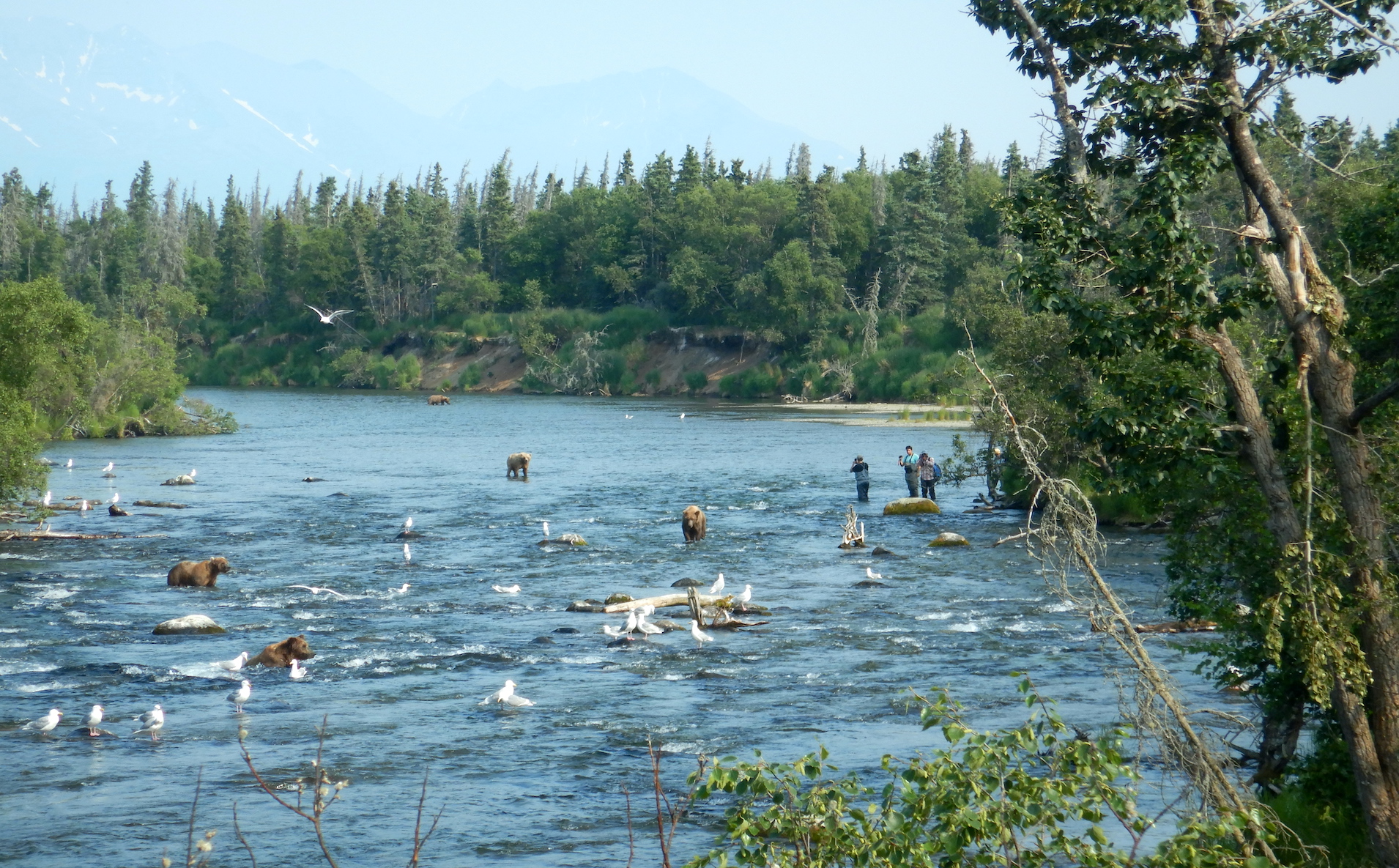
Why are permits necessary? The relative ease and accessibility of the bear-viewing experience at Brooks Camp has attracted increasing numbers of people. More than 16,000 people visited in 2022—an all time record high—and almost double the visitation of 2008. Brooks River is a mere 1.5 miles (2.6 km) long, yet dozens of brown bears use it during the salmon migration and spawning seasons of summer and early fall.
People who enter in the river directly occupy the habitat that bears need to fish for salmon. Numerous scientific studies (reviewed here) have documented that human recreation can displace bears in time and space. The presence of people can cause bears to switch from diurnal to crepuscular activities in response to bear-viewing, angling, hiking, and camping. Bears decrease in number and are present for shorter time spans when exposed to people, angling, and bear-viewing. Bears also spend less time fishing and have less fishing success when anglers and bear-viewers are present.
Bears gather at Brooks River to fish for salmon. People in Brooks River risk displacing bears from important foraging areas in the river. This is especially true for bears who do not habituate to our presence. In these situations, we unwittingly become a competitor in the bear’s mind for space, and most of the time that bear won’t challenge us for it.
Studies specific to Katmai National Park have found that the presence of people can affect when bears fish (Olson et al. 1998) and cause bears to avoid or alter their use of foraging areas (Rode et al. 2007; Smith 2002; Turner and Hamon 2016). Therefore, even a small number of well-behaved and well-intentioned people in the wrong place (like in the river) can have a disproportionately negative effect on brown bears. Disturbance of wildlife can also result in decreased visitor satisfaction (Skibins et al. 2012) and create user conflicts between visitors who are recreating in different ways (bear watching from the platforms or online via webcams vs fishing or photographing bears in the river).
Importantly, and tucked away in the park’s newsletter about the permits, is this: “There is no limit established to the number of permits issued during the permit-required time frame currently, but this will be considered if public feedback to the plan supports a limitation or if conditions change within the Brooks River Corridor to warrant a limitation.” Therefore, I recommend that comments ask the NPS to go beyond merely requiring permits. Comments about the permits should encourage the NPS to establish limits to permits on a daily or weekly basis and perhaps even greater seasonal closures to Brooks River to adequately protect habitat for bears.
I didn’t visit Brooks River in person last year, but rangers and some people I know who had traveled there reported to me that the pilot permit system worked well. While it does not address over-crowding and congestion issues at Brooks Camp caused by record-high levels of visitation, it is certainly a big step in the right direction to ensure the river’s bears have access to the habitat they need to survive. None of the existing regulations would change at Brooks Camp. The permits only make it easier for the NPS to enforce them. But permits alone are not enough. Existing protections for bears can be made more effective if permits were limited in availability. Our national parks, and indeed Brooks Camp, cannot support unlimited numbers of people. The Brooks River corridor is a small area overall. It has limited space for bears and a limited carrying capacity for a high-quality bear-viewing or fishing experiences. Please let the NPS know you support their efforts to protect habitat for bears in the river through the permit system and that the number of permits should be limited on a daily or weekly basis when bears are actively fishing in the river.
This may seem non-controversial. After all, wild animal populations are made of individuals just like human families and communities are composed of individual people. But this idea hasn’t been accepted widely among scientists and managers of national parks.
Thankfully that tide seems to be turning, and I’m pleased to be able to contribute to this scientific effort. Results from a survey of bear cam viewers on explore.org show that people who care about Otis and other individual bears are more likely support conservation efforts for brown bears compared to viewers who do said they could not identify individual bears. Please head over to my post on explore.org to learn more.
Bear 480 Otis sits in his office at Brooks Falls in Katmai National Park, Alaska.
I’d like to thank the researchers who made this study possible—Jeff Skibins (who drafted this paper and did the data analysis) and Lynne Lewis and Leslie Richardson (who were instrumental in the survey design and implementation). I’d also like to thank the Katmai Conservancy for covering the expense to make the paper available to everyone through open access.
Last summer, explore.org celebrated the 10th anniversary of the bear cams at Brooks River in Katmai National Park. These webcams offer an in-depth look at the behavior and ecology of a population of brown bears, allow us to observe the same individual bears over many years–giving us the chance to learn about their personalities and habits–and provide a platform for rangers and other experts to host live programs and commentary about the bears and their stories. It’s a wildlife watching experience like no other.
As part of the celebration, I chose to highlight some the moments that I thought were most memorable from the last ten years of bear cam. Some explore point-in-time events. Others celebrate the behavior of individual bears who have left their mark on Brooks River in ways we can’t forget or ignore. Each was unforgettable from my perspective. I hope you enjoy them.
Most Defensive Mother: 128 Grazer
Grazer is an archetypal mother bear. Don’t get in her way and don’t approach her cubs.
Lefty Learns to Fish at Brooks Falls
Old bears can definitely learn new tricks. In July 2015, we watched a fully mature adult male brown bear figure out how to fish where he’d never fished before.
Otis Eats 42 Salmon in a Sitting
Be awed by the capacity of his stomach.
Death of 451’s Spring Cub
When a bear cub falls ill the world will watch.
503’s Saga
A lone yearling finds a new family.
Reign of 856
Few bears will ever experience the prolonged dominance and advantage earned by 856.
2020 Salmon Smorgasbord
What happens when bears have access to unlimited salmon? The 2020 salmon run gave us the answer.
History of Fat Bear Week
A goofy idea becomes a world famous internet sensation.
We are Family: 909, 910, and Cubs
Sister bears reunite while raising cubs to create an extended family.
If that’s not enough, the bear cam community complied links to all of our bear cam live events from 2022. Two stand out in my mind: 1. The impromptu Q&A about a fight between and mother bear and a dominant male, and 2. The bear cam 10th anniversary live chat.
We’ve seen a lot of special moments on the cams during the last ten summers–perhaps too many to recall–so these are only a small snippet of the larger story. What are your most memorable moments from the bear cams?
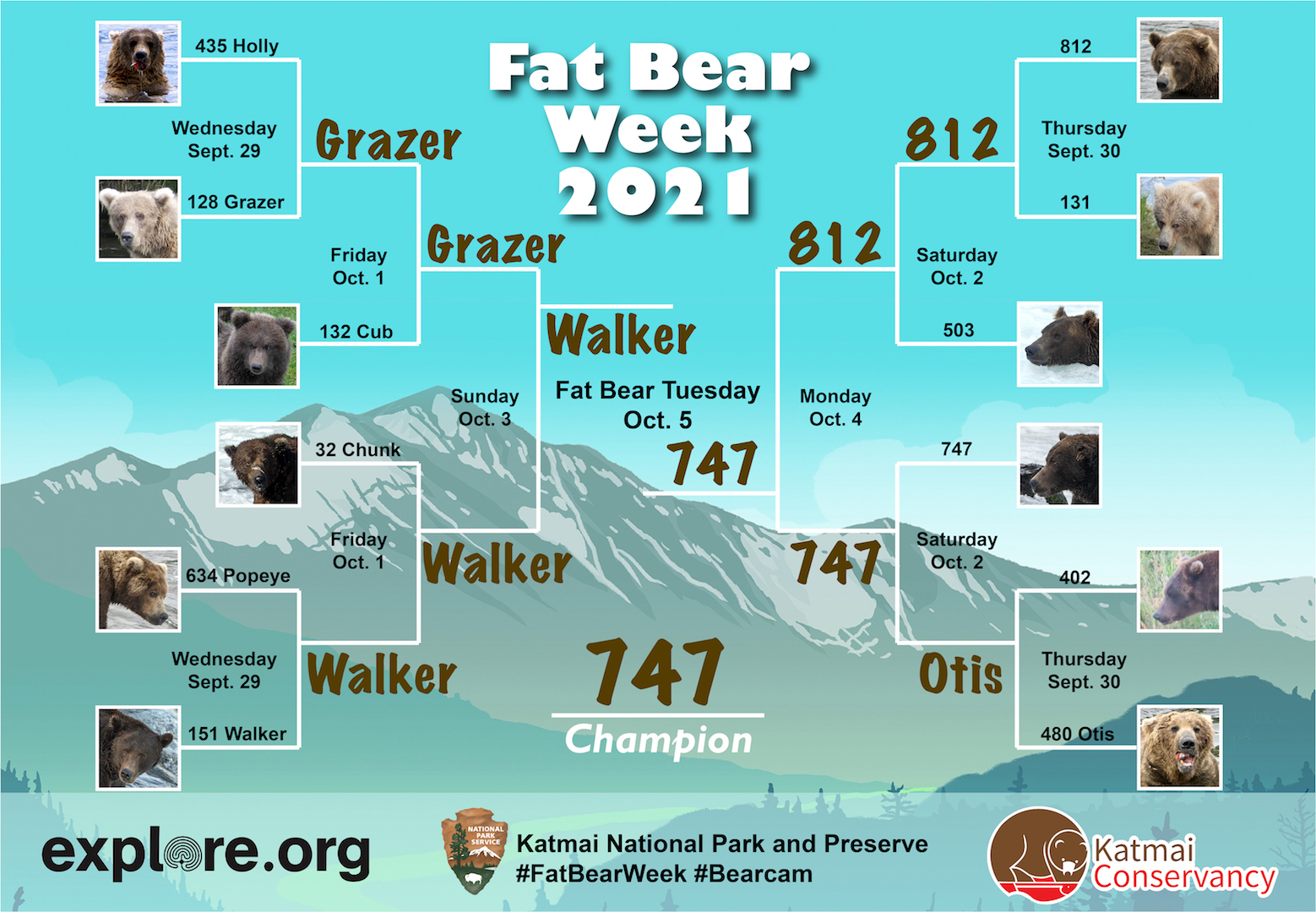
As is tradition—going way back to the before times (2017)—I’ve endorsed a bear for Fat Bear Week. This year’s bracket might be difficult to predict, but with voting commencing today at 12 p.m. Eastern and continuing through October 11, it’s time to throw my weight behind a Fat Bear Week contender.
I’d let him speak for himself but his mouth is usually too full of salmon.
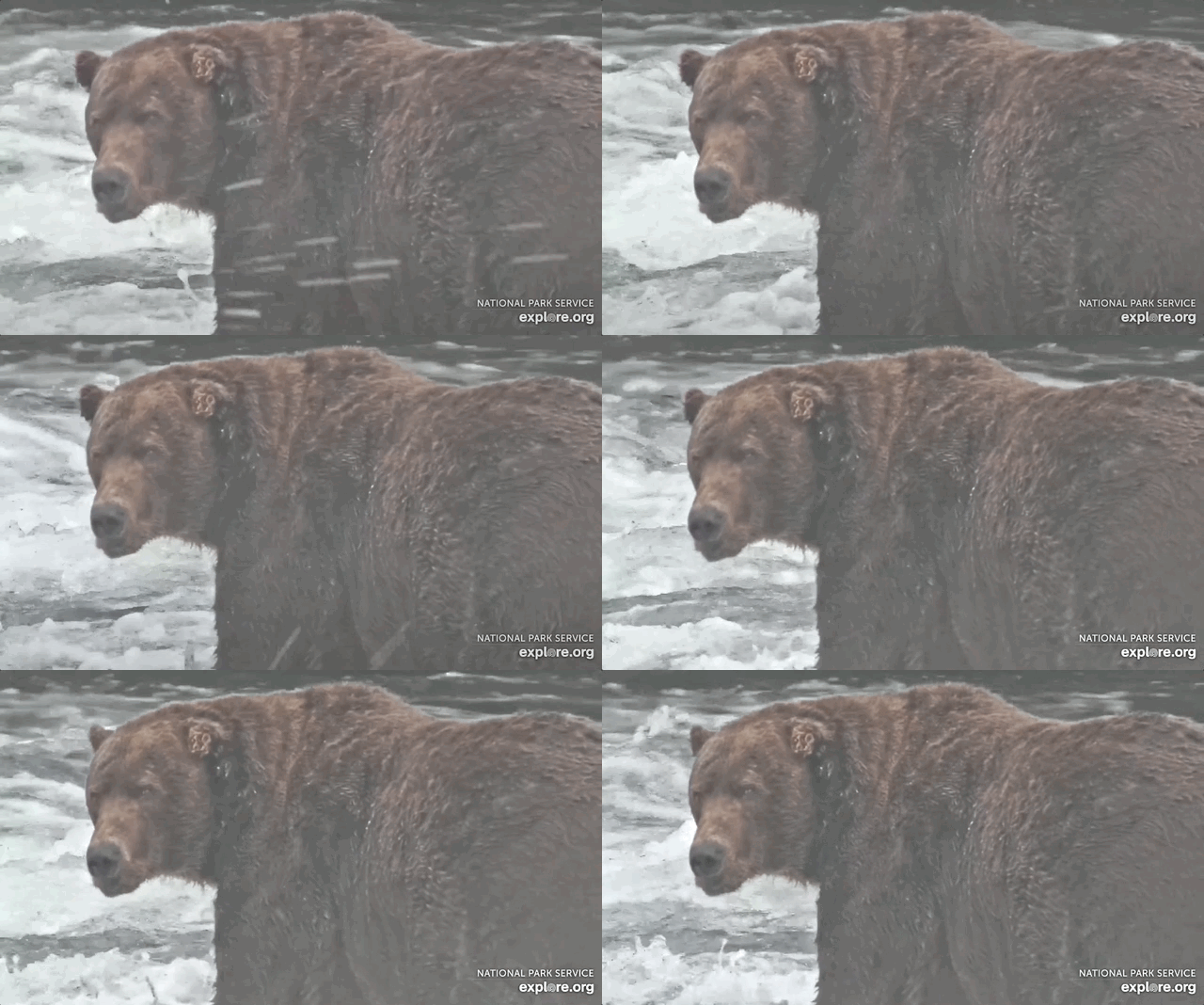
Friends, humans, and ursids, let us stand in awe of a true competitor. A candidate with conviction. A candidate with strength. A candidate that stands up for what he believes. A candidate the size of a double-wide refrigerator. This Fat Bear Week vote for the mighty 747.
747 returns to Brooks River every summer as a giant and just keeps getting bigger.
Perhaps you don’t want to listen to me. After all, I’ve endorsed 747 before and it hasn’t usually led to his victory. Our culture is celebrity obsessed, though, so maybe you’ll listen the expert opinions of these randos.
Homer remarked that 747 is the only other individual whose blubber flies like his.
Dr. Evil threatened world destruction if 747 fails to win.
I spoke with the President too, believe it or not. (He seems to clear his schedule when you have something to say about Fat Bear Week.) Joe Biden noted that 747 grew proportionally faster than this year’s inflation rate.
747’s summer was one of competition and success. In June and July, he yielded space to bear 856. By August, however, 747 turned the tables. He frequently challenged and displaced his long-time rival.
It’s hard work staying dominant and getting fat too. Bears as large as 747 tend to overheat easily, and while their limb bones are built to support their great mass sometimes climbing those hills is a struggle.
Name another bear who struggles uphill with such finesse. Here's a full minute of 747 riding a leisurely struggle bus. pic.twitter.com/mUoM4JxbbK
You also can’t get that fat without eating a lot of food, and 747 excels in this life goal. Although we don’t know exactly how many fish 747 ate this year, a study about brown bears on Kodiak Island may provide some insight.
Brown bears shed their fur once per year in early to mid summer. Since new fur grows during a bear’s active season, it contains a record of what the bear ate during that time. Studies of captive bears had previously determined the relationship between the mercury content in food and the mercury content in hair. To apply this to bears on Kodiak, researchers first determined how much mercury is found in the Pacific salmon that spawn on Kodiak. They then analyzed the mercury content found in the bears’ hair to gain an estimate of salmon consumption. Large adult males, on average, ate 6,146 pounds (2,788 kg) per bear per year! Some adult males ate a lot more, though, as much as 10,000 pounds of salmon. Since 747 fished at Brooks Falls almost every day between late June and mid September this summer, then his total salmon consumption may likely have been near the upper end of that spectrum.
For fisheries managers and biologists, these statistics are more than pieces of trivia. They are necessary to help inform decisions about salmon escapement goals, so that salmon runs are sustainable for people and the wildlife who depend on them. The aforementioned Kodiak study found that “the estimated population of 2,300 subadult and adult bears [on Kodiak] consumed 3.77 million kg of salmon annually, a mass equal to ~6 percent of the combined escapement and commercial [salmon] harvest (57.6 million kg).” Katmai National Park’s bear population is about as large as Kodiak’s, and when we work to sustain salmon runs we’re also celebrating the life they provide to many other species and individuals, such as bear 747.
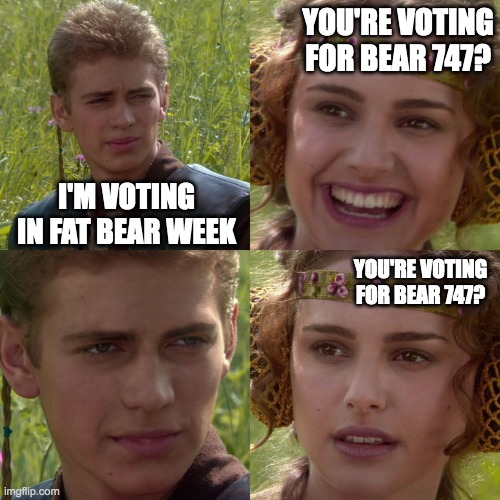
Bears get fat to survive winter hibernation, and Katmai National Park’s Fat Bear Week bears are well positioned to weather the oncoming famine. But there’s candidate who eclipses the rest. Your bear might be a 10 but 747 is 1,400 pounds. I’m voting for 747, are you?
Download your bracket from FatBearWeek.org and go there to vote in each Fat Bear Week match from October 5 to 11.
THE THING ABOUT BEARS IS THAT A LOT OF THEM ARE BIG. BUT LIKE HAVE YOU SEEN 747?? HE’S SO BIG. A GIANT, REALLY. HE JUST SITS THERE AND FISHES LIKE THERE’S NO TOMORROW. I MEAN HE HARDLY LEFT THE FALLS ALL SUMMER. DOESN’T MATTER HOW COLD THE WATER IS OR WHICH OTHER BEARS ARE THERE….
Life as a champ is rough. Rivals look to take advantage of any weakness you might show. Arm chair critics analyze your every move. Fans expect perfection. When the next championship tournament rolls into town your body has aged another year and your preferred food has worked its hardest to evade and escape you. Meanwhile, you’re trying to live your best life, because you are a bear and the concerns of humans matter not to you.
Yet, for those of us who recognize greatness and celebrate success when we see it, there is one clear choice for Fat Bear Week 2021—the mighty 747.
Long-time readers of this blog may be thinking, “This again?”
…Let me tell you dear friends: 747 is as fat as ever. He deserves your Fat Bear Week vote.
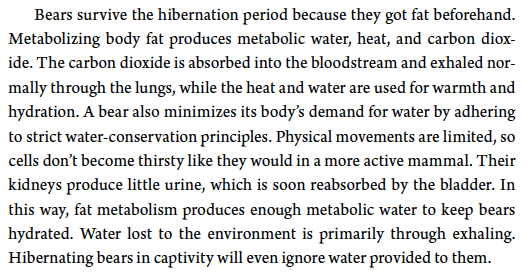
Brown bears get fat to survive. Their obesity (and it is that since a bear’s body fat percentage is routinely 20-30 percent or more when they begin hibernation) is a savings account. In the den, bears do not eat or drink. They stay warm and hydrated by burning body fat. Unlike utilizing muscle for energy—a process that produces metabolic wastes that must be recycled, sequestered, or purged from the body—burning fat is a relatively clean fuel as I write in chapter 4 of my book, The Bears of Brooks Falls.
It’s akin to cultivating mass only to carefully harvest it later. Just not for vanity’s sake, bro.
747 cultivates mass at an exceptional rate. This summer, he reigned as Brooks River’s most dominant adult male. Even the river’s long-time dominant bear, 856, would not challenge him, and as a result 747 had nearly free access to any fishing spot of his desire.
A single brown bear can eat thousands of pounds of salmon per year. The largest can eat 6,000 to 10,000 pounds. Given his size, appetite, high rank in the bear hierarchy, and his keen fishing skills, 747 is more than capable of eating many thousands of pounds of salmon each summer. At Brooks Falls, he intercepts a great deal of fish by being at the right place at the right time and waiting for his food to come to him. When Brooks River’s sockeye migrated upstream, 747 was primed to harvest them.
He’s so successful that in September 2019 and again in September 2020, he was estimated to weigh more than 1,400 pounds. This places him, as I estimate, among the top one percent of brown bears based on body mass.
Even with his size, he remains agile.
747 reminds Grazer and cubs that he's still a dominant big boy at Brooks Falls. pic.twitter.com/mNNNF3OD66
And yes, that is a tapeworm hanging on for a ride.
Fat Bear Week celebrates the success of Brooks River’s bears, the ecosystem and salmon that sustain them, and the bears’ abilities to get fat and survive. 747 exemplifies success among adult male brown bears. He deserves your vote and a repeat Fat Bear Week victory.
Brooks River in Katmai National Park is unique among bear watching sites, because its bears are known individuals with life histories so well documented that several are veritable internet celebrities. Many return to Brooks River year after year, some for their entire lives, a phenomenon we can watch on the bearcams. At Brooks River, bears are not anonymous wildlife, but unique individuals that we can know. Perhaps no other place offers the public the same wildlife watching opportunity.
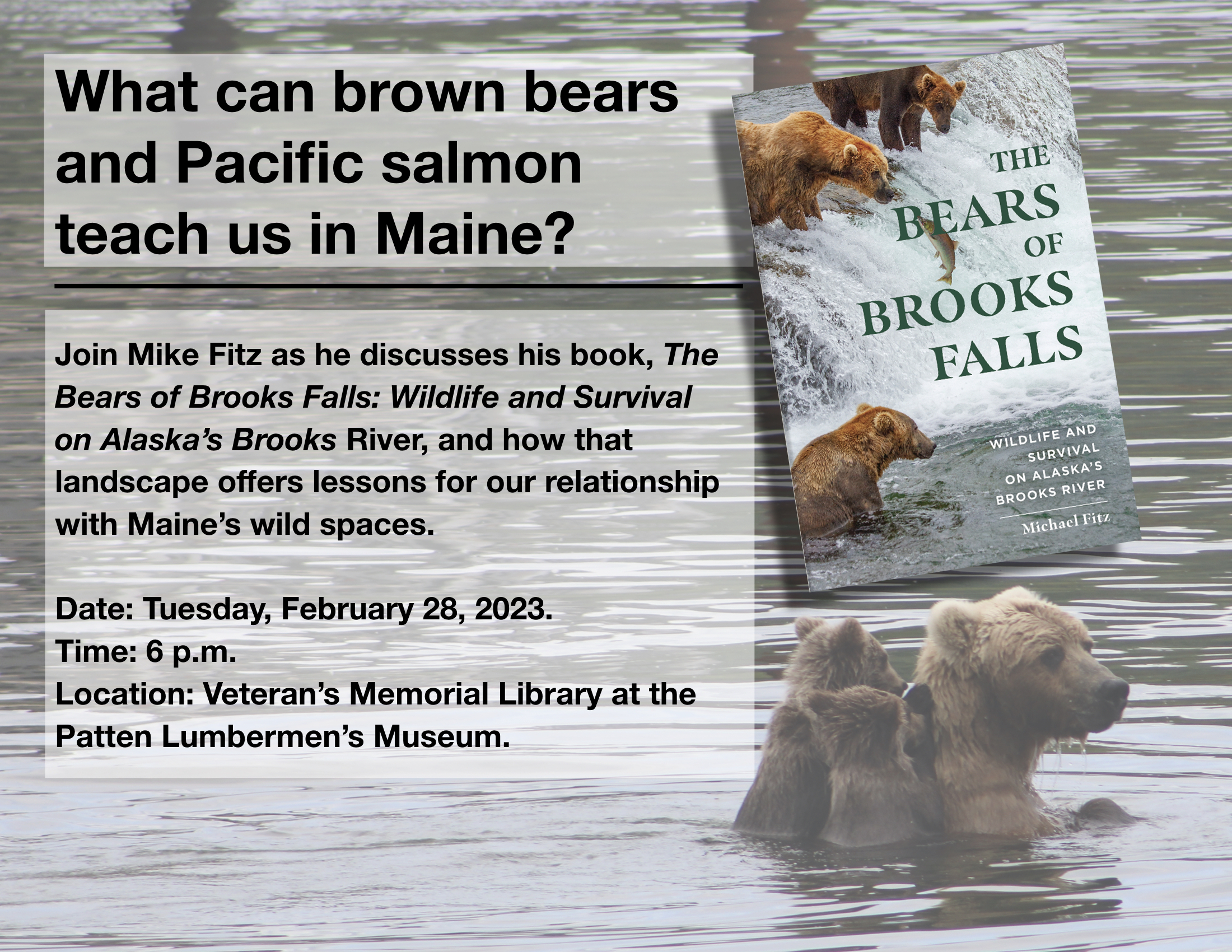
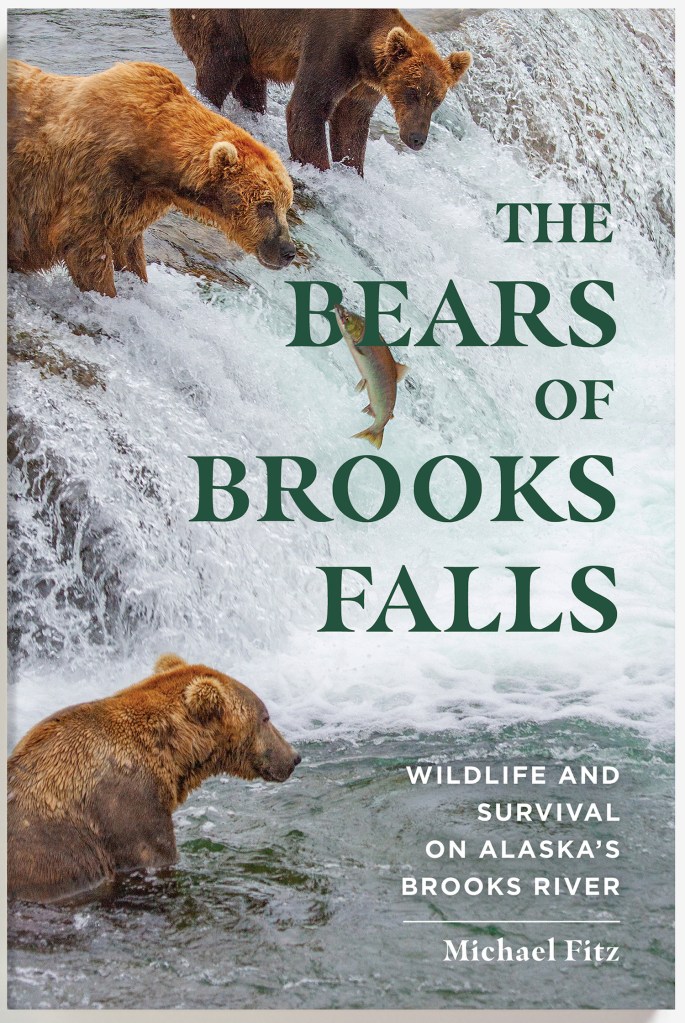
Many of these same bears feature prominently in my book, The Bears of Brooks Falls. I explore how Otis and 747 satisfy their profound hunger, how 856 establishes and maintains his dominance, how 402 and other female bears navigate the mating season, and how mother bears like 273 nurture their vulnerable cubs.
Since watching the lives of individual bears is a focus of many bearcam fans, I’m frequently asked, “Mike, which bears are on the cover of your book?”
I’ve steadfastly refused to answer, until now that is. I’ll answer, I promise, but you’ll have to do a bit of work first, and perhaps win a copy of my book in the process. Here’s how.
Guess the identity of the bears on the print and audiobook covers.
Correct answers to the identities of bears on the print book cover will be entered into a drawing to receive a personalized signed copy by the author of The Bears of Brooks Falls.
Correct answers to the identities of bears on the audiobook cover will be entered into a drawing to win a free copy of the audiobook of The Bears of Brooks Falls.
Everyone who submits answers, whether correct or not, will be entered into a drawing to win a free copy of the print book.
If you feel a bit unsure about which bears are on the book covers, here are some hints to consider.
On the print book cover, one of the bears hasn’t been seen at Brooks River in many years and is presumed deceased. The other two continue to use Brooks River, now as older individuals.
On the audiobook cover, only one of the bears was identified at the river in 2020. The other has not been seen since 2013.
Neither the print or audiobook cover photos were taken within the last seven years, but they were taken after 2005.