Sometimes Individuals Lose While Species Win

pine cones on the ground

Many seeds in these cones wait to be released.

Fire is a boon to some species and a detriment to others. When fire sweeps across the landscape there are winners and losers.The cones of lodgepole pine (Pinus contorta) demonstrate adaptations that allow the species to survive potentially catastrophic changes.

Serotiny is an adaptation of some plants to release seeds in response to an environmental trigger. Serotiny is expressed in lodgepole pine through its cones. In fire prone habitats, lodgepole pine cones are glued shut by resin. Heat from fires melts the resin allowing the cone scales to separate and release seeds. Since it’s not safe to watch a wildfire burn through lodgepole pines, I placed a tightly sealed serotinous cone from a lodgepole pine in a toaster oven to watch how it responded to temperature changes.

The cone scales began to expand noticeably when the temperature reached about 50˚C (122˚F).  According to the U.S. Forest Service, more precise lab experiments have found the resinous bonds between the cone scales begin to break between 45˚C and 60˚C, so serotinous cones lying at or near the soil surface can also open with these ground temperatures. If this cone was kissed by fire its scales would have expanded and allowed the seed to be slowly released. (I let the temperature in the oven rise to over 200˚C (400˚F) just because I felt like watching the scales fully expand.) Serotinous cones collect on the ground or on tree branches for many years. The seeds under the scales lie in a state of dormancy, waiting for the opportunity to sprout.

Not all stands of lodgepole pines have serotinous cones. Serotinous cones are not common in eastern Oregon, rare in coastal populations, absent in some fire prone habitats like the Sierra Nevada, and “many stands in the Rockies have less than 50 percent serotinous-cone trees.” Wherever it grows through, lodgepole pine thrives in full sun. Its seeds sprout best in or on bare mineral soil and disturbed duff free of competing vegetation—the exact conditions many fires create.

small pine trees under taller, dead-standing trees

After huge wildfires burned large swaths of Yellowstone National Park in 1988, lodgepole pine sprouted back in earnest. This NPS photo was taken ten years after the ’88 fires. The lodgepole trees are much larger now.

Serotiny in lodgepole pine makes large quantities of seeds available to germinate following a fire. In many cases, especially regarding lodgepole pines, fire may be an enemy to the individual, but not to the species.

Bears Have Long Memories

Mother bear standing on rock. Her cub sits on the rock between her legs.Bear cubs are apt to reflect mom’s mood. When she’s relaxed, they are relaxed. When mom is alert and stressed, her cubs are on edge. Cubs also take a keen interest in anything that their mother investigates. In this way, they learn much about what to eat, where to find food, and many other survival skills. In this way, mother bears are teachers. However, mother bears may teach their cubs behaviors that lead to conflict with humans.

In a study recently published in the journal PLOS One, researchers from the University of Alberta found that behavior that leads to conflict with humans is not genetic. It is learned. Bears who were raised by mothers with a documented pattern of conflict with humans were more likely to be involved in conflict with humans as adult bears. The study identified 213 bears (118 males and 95 females) through DNA extracted from hair samples, then examined behavioral patterns in both father-offspring and mother-offspring relationships. The researchers concluded over 60% of offspring from “problem mothers” were likely to be “problem bears.”* In contrast, only 29% of bears from “problem fathers” were identified in bear-human conflicts. This was very similar to the percent of bears (30%) involved in bear-human conflict raised by mothers with no history of conflict with people. Since male bears have no role in raising cubs, the evidence in the study suggests that behavior leading to conflict with people is learned, not inherited through genes.

If you watch Katmai’s bearcams, you may be familiar with the escapades of 273 and her cub. These bears are famous for their curious and playful nature. Over the past two summers, they were prone to investigate almost anything that caught their attention. In 2015, they damaged buildings at Brooks Camp which prompted rangers to escalate their hazing techniques to deter them.

Tar paper shack surrounded by portable electric fence.

This building was damaged by 273 and cub in August 2015. I helped to erect the electric fence as a temporary deterrent to further damage.

They repeatedly damaged a sign near the bridge over Brooks River.

They caused wildlife technicians to photo-bomb a live chat on archeology.

They even played with unattended construction equipment.

I took the video of 273 and her cub with the construction equipment from inside a cabin last summer. Clearly, this family has demonstrated an interest in human objects and equipment. They are also relatively habituated to the presence of people. Since 273 has exposed her cub to people and buildings, does this increase the likelihood that the cub will repeat those behaviors when he becomes an independent bear? All signs point to yes.

I’ve long suspected that bears raised by highly human-habituated mothers are more likely to demonstrate high levels of habituation toward humans when they are adults. I’ve also suspected the same with bear-human conflict. If mom teaches her cubs to investigate human equipment or seek out human food, then the cubs are going to remember those experiences when they become independent bears. The study from Alberta provides some evidence to support my suspicions.

Does this mean that 273’s cub is destined to damage property at Brooks Camp? Not necessarily as long as rangers, lodge staff, and visitors at Brooks Camp are vigilant and actively work to eliminate conflict between bears and people. (Access to lots of natural food is extremely important too.)

Mother bears are teachers and cubs are students, but not everything cubs learn from mothers is advantageous in a world where habitat is increasingly crowded with people. Mother bears teach their cubs many survival skills, some of which can lead to conflict with humans. We can’t change the way bears live, nor should we. The onus is on us to act in ways that allow bears space to live and survive without learning behaviors that lead to conflict.

——-

*I discourage the use of “problem bears” as a term to describe bears involved in bear-human conflict. The term was used in the study, but this label stigmatizes bears in negative, anthropomorphic ways. These bears are only exploiting opportunities presented to them. The problem isn’t the bear. The problem is the temptations for conflict provided or caused by people.

Squirrels and Truffles

The forest is blooming with fungus in Lake Chelan National Recreation Area. Mushrooms are easy to find on the forest floor, but the mere presence of a few mushrooms does not reflect the abundance of fungus working under the soil, nor their importance.

On most of my recent hikes I’ve stumbled upon small excavations in the soil. Typically, the depressions are a few inches across and deep. Even though I haven’t witnessed the excavation in progress, just the end result, I suspect these are made by rodents searching for fungus in the soil. On the Lake Shore Trail, south of Stehekin, I found clue to support my hypothesis.

small hole in soil with fungus at bottom

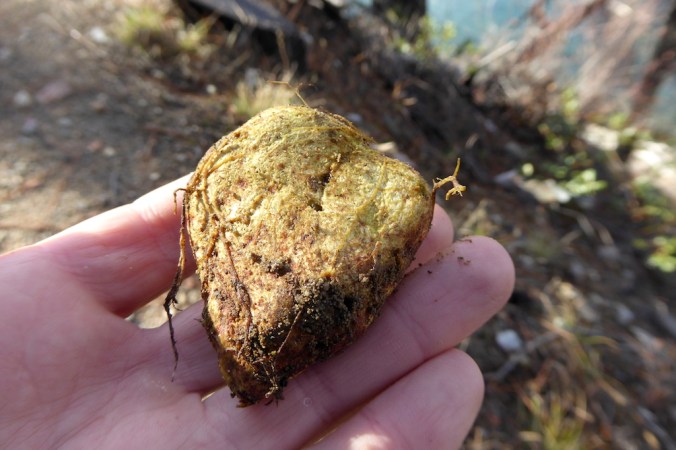
The small depression next to the tip of my shoe contains a truffle.

Inside the hole was a truffle. Truffles are mychhorizal fungi. They do not photosynthesize, but these fungi are not parasites. They live in a symbiotic relationship with tree roots. Trees provide the fungi with sugar and the fungi provide trees with water and nutrients like phosphorus and nitrogen.

truffle in hand

This is the truffle at the end of the excavation. Over 350 truffle species in 50 genera inhabit the Pacific Northwest.

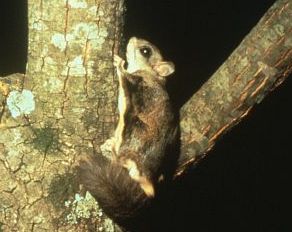
Truffles are highly sought after by fungal connoisseurs, human and rodent alike. They are especially important to flying squirrels, but rodents like flying squirrels are equally important to truffles. Unlike your typical toadstool, these underground fungus have no spore dispersal mechanism. They need animals to dig them up to spread their spores.

squirrel on tree

Northern Flying Squirrel (Glaucomys sabrinus), USFWS photo.

Flying squirrels, in particular, love truffles. Under the cover of darkness, flying squirrels find truffles by their odor, unearth them, and greedily devour them. Truffle spores are then distributed randomly and effectively in squirrel scat. For reasons unknown, my truffle was not harvested. Small rodents that eat truffles are preferred prey of owls and weasels. Was the excavator of this truffle snatched up by a unseen predator?

I don’t know the end to this particular story, but this is evidence of more than a rodent and hole. It symbolizes how predators need rodents; how rodents need fungi for food and trees for shelter; how trees need fungi for nutrients; how fungi need trees for sugars and rodents for dispersal. The tiny hole I found is more than superficial. It leads to a world of interdependence.

——

For more info on flying squirrels and truffles, check out Squirrels Cannot Live by Truffles Alone and Ties that Bind: Pacific Northwest Truffles, Trees, and Animals in Symbiosis.

On Election Day, Vote to #ActOnClimate

When I think about how climate change may impact my home and the people and places I care about one example resonates strongly with me.

sockeye-salmon-jumping-brooks-falls_03_06272015

Sockeye salmon jump at Brooks Falls.

When I lived in southwest Alaska, I marveled at the return of sockeye salmon each summer. These extraordinary fish endure weeks, even months without food after they reenter freshwater. Instincts and memory drive them upstream to conditions they cannot know until they get there. Finally, they sacrifice their lives to reproduce. Salmon are Katmai’s keystone, yet climate change may threaten these fish that sustain so much of the region’s ecology and economy.

Ocean acidification is a by-product of climate change. Not all the CO2 we pump into the atmosphere stays there. Plants use it during photosynthesis and the oceans absorb it. At first glance, the ocean’s capacity to absorb CO2 seems like a good thing, because less CO2 will be in the atmosphere to trap heat.

In the ocean however, high concentrations of CO2 impact the base of the food web through a process of ocean acidification. H2O plus CO2 forms a weak acid, H2CO3, also known as carbonic acid. In ocean water, carbonic acid makes the water more acidic by releasing a hydrogen ion, which combines with carbonate ions, CO32 to form bicarbonate molecules (read more about the chemistry involved).

Ocean water is normally supersaturated in carbonate, which many species of plankton need to build and maintain their shells. When ocean water becomes more acidic, less carbonate is available for certain algae and animals grow and maintain calcified shells. Calcium minerals used in shell building dissolve in acid, even weak acids like carbonic acid (that’s how most limestone caves are formed), so if you’re a tiny bit of plankton then a small dip in pH can have dramatic affects on your shell.

Plankton are the foundation of marine food webs in many parts of the worlds, including the North Pacific. In one experiment pteropod shells dissolved when placed in sea water with pH and carbonate levels projected for year 2100.  Pteropods are eaten by everything from krill to salmon to whales. If we continue to pump CO2 into the atmosphere at current rates, not only will the climate warm, but the oceans will acidify further. (More info on ocean acidification including a great series of photos demonstrating the effects of carbonic acid on pteropods can be found on NOAA’s ocean acidification page.)

How would a decline in marine plankton affect Katmai’s terrestrial world? Follow the food chain. Ocean acidification impacts the base of the food chain. More acidic oceans can mean less food for salmon. Sockeye salmon primarily eat aquatic invertebrates while they travel the open ocean. When they return to fresh water, salmon feed Katmai’s wolves, bears, trout, char, even plants. Katmai’s world famous bears are adaptable enough to survive dramatic climate shifts, but only if they have adequate habitat to adjust. Adequate habitat means food. Without large runs of salmon, bear densities in Katmai would plummet. The gathering of bears at Brooks Falls will become a memory and Bristol Bay’s economy, based on the salmon fishery and salmon based tourism (sport fishing and wildlife viewing) would collapse.

505-with-fish-07072016

Salmon are the most important food source for Katmai’s bears.

In a few more years, maybe it’ll be easier to grow tomatoes in Anchorage, but climate change’s worldwide consequences outweigh any potential benefits. Climate change is one of the greatest issues humanity faces, and if left unmitigated it may exacerbate every other environmental issue. Climate change is real and humans are forcing Earth’s climate to warm. That’s not political, it’s scientific fact.

Politics though drives efforts to mitigate climate change. Voters can make an impact this fall. For example, I got Washington’s Voter’s Pamphlet in the mail recently, and discovered Initiative 732 on the ballot.

P1230484.JPG

“This measure would impose a carbon emission tax on certain fossil fuels and fossil-fuel-generated electricity, reduce the sales tax one percentage point and increase a low-income exemption, and reduce certain manufacturing taxes.”

This initiative is modeled after British Columbia’s similar carbon tax. Turns out, that the tax was effective without slowing economic growth. However, some environmental groups oppose the initiative. While they may have legitimate concerns, we no longer have time to wait for something better. We’ve waited far too long to address climate change. This situation reminds me of the debate over the 1980 Alaska National Interest Lands Conservation Act (ANILCA), which permanently protect millions of acres of land in Alaska. The final version of ANILCA didn’t give environmental groups everything they wanted, but it gave Americans a whole hell of a lot.

We didn’t have time to waste with ANILCA and we don’t have time to waste on climate change. It’s time for all of us to step up and sacrifice a bit for the future. I’m glad to see to that Washington voters are considering taking action to help mitigate climate change. I voted early and I voted yes on Initiative 732. If you live in Washington, I think you should as well. Wherever you live, vote for candidates who will take action on climate. I vote #ActOnClimate. I do it for salmon, bears, and people everywhere.

For more information on climate change science: You can read the climate change chapter I wrote for Katmai’s Interpretation Training Manual, available for free from Earth To Sky’s website. Also check out Skeptical Science, one of the best climate science website I’ve found.